Why Do Some Hotels Have Windows Facing Interior Atriums Instead of Outside?
Some hotels have guest rooms with windows that face an interior atrium rather than the street, garden, or surrounding landscape. This arrangement is usually a deliberate architectural choice. It can help a hotel organize rooms around a central public space, bring natural light into the building, make use of a particular floor plan, or adapt an existing structure for hotel use.
An atrium-facing window is not automatically a disadvantage. Some overlook impressive interior spaces filled with greenery, architectural details, or natural light from a glass roof. Others face relatively enclosed areas where privacy, noise, and limited daylight become important considerations. Understanding the difference can help travelers choose a room that suits their expectations.
Quick Answer: Why Hotels Use Atrium-Facing Windows
- Building design: Rooms can be arranged around an open central space rather than exclusively along exterior walls.
- Efficient floor plans: An atrium can help organize circulation, guest rooms, and shared facilities within a large building.
- Architectural character: Interior windows may overlook a dramatic lobby, landscaped courtyard, or distinctive communal space.
- Adaptive reuse: Converted historic or commercial buildings sometimes have layouts that make conventional exterior-facing rooms impractical.
- Different guest experiences: Atrium-facing rooms may offer sheltered interior views, although daylight, privacy, and sound conditions vary considerably.
How Interior Atriums Shape Hotel Architecture
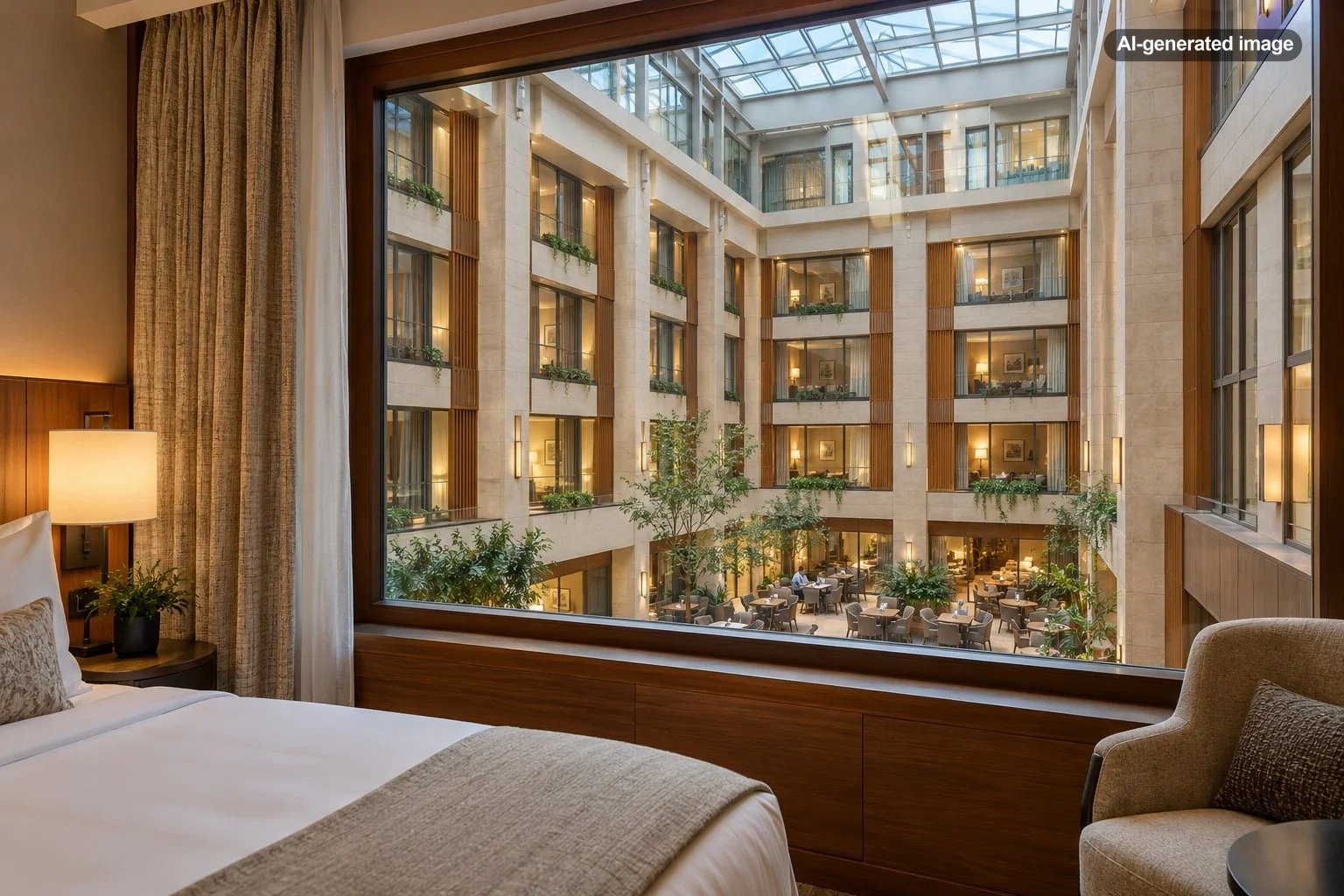
An atrium is a large interior space that connects multiple levels of a building. It may be open to a skylight, enclosed beneath a glass roof, or incorporated into a larger lobby and circulation area. Guest room corridors, balconies, and windows can surround the central opening.
In a conventional hotel layout, rooms commonly occupy the perimeter of the building, with corridors running through the interior. An atrium-centered design creates another potential arrangement: some rooms face outward, while others look into the central volume.
This approach allows architects to create a visually connected interior while accommodating room entrances, corridors, elevators, and communal areas. Depending on the building’s proportions, it may also give some rooms an outlook that would otherwise be restricted by adjacent structures or internal walls.
However, the existence of an atrium does not necessarily mean every room receives meaningful daylight. The width of the central opening, height of surrounding walls, position of the room, and amount of glazing above the space all influence the result.
Why Some Hotels Prefer an Interior-Facing Layout
Making Better Use of Challenging Building Shapes
Hotels occupy buildings of many different sizes and configurations. Some are tall and relatively narrow, while others spread across large city blocks. A building with a substantial interior footprint may have areas too far from exterior walls to accommodate conventional outward-facing guest rooms.
Introducing an atrium can provide an alternative outlook and create a central organizing feature. It does not automatically increase the number of usable rooms, because the atrium itself occupies space. Instead, it offers designers another way to balance guest accommodations, circulation, shared facilities, and architectural priorities.
Creating a Distinctive Lobby Experience
In some hotels, the atrium is an important part of the property’s visual identity. Multiple floors may rise around a central lobby, with interior balconies and windows overlooking architectural lighting, seating areas, or decorative landscaping.
For travelers who appreciate architectural design, this arrangement can be interesting. A room overlooking a spacious, well-designed atrium offers a different experience from a conventional view of neighboring buildings.
The tradeoff is that an attractive public space may also attract activity. Conversations, events, music, and movement below can affect rooms overlooking the same area, especially when interior acoustics allow sound to travel between floors.
Adapting Older Buildings for Hotel Use
Not every hotel was originally designed as a hotel. Former offices, commercial buildings, and other large structures may be converted into accommodations.
During conversion, architects must work within existing structural columns, exterior walls, floor depths, and protected architectural features. An interior courtyard or atrium may provide a practical way to organize the new layout without fundamentally rebuilding the exterior.
Some converted properties preserve existing interior openings, while others introduce new ones where structural and regulatory conditions permit. The resulting room views reflect the particular building rather than a universal hotel design standard.
Do Atrium-Facing Hotel Rooms Get Natural Light?
They can, but the amount and quality of natural light vary significantly.
A room overlooking a wide atrium beneath a large skylight may receive pleasant indirect daylight. A room several floors below the roof, however, may receive relatively little light because the surrounding building blocks much of the sky.
Even when the atrium appears bright from the lobby floor, individual rooms may experience different conditions. A room’s height, orientation within the atrium, distance from the glazing, and neighboring architectural features all matter.
It is also useful to distinguish daylight from direct sunlight. An atrium-facing room may feel adequately illuminated during the day without receiving any direct sun through its window.
For travelers who prefer waking naturally with daylight, this difference is important. A photograph showing an attractive glass-roofed atrium does not establish how bright a particular guest room will be.
Are Interior Atrium Rooms Quieter?
Not necessarily. An interior-facing room may be protected from some street-level traffic, construction, or exterior nightlife noise. Yet that does not guarantee a quiet stay.
Large atriums can carry sound through multiple floors. Hard surfaces such as glass, stone, and tile may reflect noise from conversations, restaurants, lobby gatherings, or events. The degree of disturbance depends on the building’s acoustics, room insulation, window construction, and activities occurring in the space.
A room overlooking a quiet, enclosed courtyard may be peaceful, while another overlooking a busy lobby could experience noticeable evening noise.
Travelers who prioritize sleep should investigate the specific room location instead of assuming that interior-facing automatically means quieter.
How Privacy Differs From an Exterior View
Privacy is one of the most easily overlooked aspects of an atrium-facing room.
In some designs, windows on opposite sides of the atrium face each other. Guests may be able to see into neighboring rooms, particularly after dark when interior lights are on.
Rooms overlooking balconies or walkways can have another privacy consideration: people moving through shared areas may pass within sight of the windows.
Hotels can address these issues through window placement, glazing treatments, curtains, blinds, and architectural separation. Nevertheless, the effectiveness of those measures varies by property and room.
If privacy matters, examine room photographs for the distance between facing windows and the presence of appropriate window coverings. At night, closing curtains may be necessary even when the room appears relatively secluded during daylight hours.
Atrium View Versus Exterior View: Which Is Better?
The better choice depends on what the traveler values. Neither orientation guarantees a superior room.
| Consideration | Atrium-facing room | Exterior-facing room |
|---|---|---|
| View | Interior architecture or shared spaces | Street, skyline, landscape, or adjacent buildings |
| Daylight | Depends on skylights and atrium dimensions | Depends on orientation and exterior obstructions |
| Noise | May receive sounds from interior activities | May receive traffic or neighborhood noise |
| Privacy | Other rooms or shared walkways may be visible | Nearby buildings may overlook windows |
| Sense of openness | Varies with atrium width and room position | Varies with neighboring structures and scenery |
An exterior room is not always the more spacious-feeling option. A window facing a nearby brick wall may provide less visual openness than a broad, skylit atrium. Conversely, an atrium window facing another room across a narrow opening may feel considerably more enclosed than a window overlooking a park.
What Travelers Should Check Before Booking
Hotel descriptions sometimes use terms such as interior view, atrium view, courtyard view, or lobby view. These descriptions are not interchangeable, and the same term can describe substantially different spaces across properties.
Before reserving a room, consider the following questions:
- What exactly does the window face? An interior garden, a central lobby, a corridor, and another guest room create different experiences.
- Is there an overhead skylight? If so, ask whether the particular room receives noticeable daylight.
- Can people see into the room? Check whether windows face balconies, walkways, or neighboring accommodations.
- Does the atrium host events? Dining areas, receptions, and entertainment may influence noise levels.
- Does the window open? Some hotel windows are fixed, whether they face an atrium or the exterior.
- Is an exterior-facing room guaranteed? A preferred orientation may require booking a specific room category rather than making a general request.
Room-specific photographs and a direct question to the property are often more informative than broad descriptions of the building. If orientation is particularly important, request written confirmation of what the reserved category includes.
When an Atrium-Facing Room Makes Sense
For a short business trip, the window orientation may matter less than a comfortable workspace, suitable room layout, and predictable sleeping conditions. An interior-facing room could be entirely satisfactory if the atrium is quiet and the accommodation meets those priorities.
Travelers who enjoy notable architecture may appreciate an interior outlook, especially when the atrium is spacious and visually interesting.
By contrast, someone planning a longer stay, spending substantial time in the room, or relying on natural daylight for a comfortable morning routine may place greater importance on an exterior view.
Families traveling with young children may want to consider whether lobby noise travels into rooms during early bedtimes. Light-sensitive sleepers may also need to ask about nighttime atrium lighting and the effectiveness of blackout curtains.
These are questions about individual rooms and buildings, not reasons to avoid atrium hotels altogether.
Why the Cheapest Room May Have an Interior View
In some properties, interior-facing rooms occupy a different booking category from rooms with notable exterior views. Where travelers place a premium on a skyline, waterfront, or garden outlook, the hotel may position those exterior rooms at a higher rate.
That pricing relationship is not universal. A particularly impressive atrium view could be desirable in its own right, while some exterior windows face ordinary neighboring buildings.
The important distinction is that room orientation and room quality are separate characteristics. An interior-facing room can still have comfortable furnishings, suitable dimensions, and well-designed amenities. Conversely, paying for an exterior orientation does not guarantee an attractive view.
When comparing accommodations, consider whether the view will materially affect the stay before paying more for a different category.
Affiliate disclosure: HotelInfo.com may earn a commission when you book or purchase through links on this page. This does not affect the price you pay. Learn more.
Travelers considering a different lodging layout can also browse Homes & Villas by Marriott Bonvoy when comparing accommodations. Vacation rentals offer another type of lodging arrangement, although window views, natural light, privacy, amenities, and booking conditions still need to be checked individually.
Frequently Asked Questions
Are hotel atrium windows real windows?
Yes. Atrium-facing windows are genuine architectural windows that look into an interior space rather than directly outdoors. Some are fixed, while others may have operable sections where the design and applicable requirements permit. Whether they provide fresh air depends on the specific building.
Do atrium-facing rooms have less natural light?
Some do, especially on lower floors or in narrow atriums. Others receive substantial indirect daylight from overhead glazing. The room’s position within the building is more informative than the atrium label alone.
Can you see into other hotel rooms across an atrium?
Sometimes. Inward-facing windows can create direct sightlines between guest rooms, particularly when the atrium is relatively narrow. Curtains, blinds, glazing treatments, and window placement can help protect privacy.
Are atrium-facing hotel rooms cheaper?
They may be priced below rooms with desirable exterior views, but pricing varies by property, room category, and travel dates. An atrium view should not be assumed to carry a discount.
Can you request an outside-facing hotel room?
Usually, travelers can express an orientation preference, but a request is not necessarily a guarantee. If an exterior-facing window is essential, look for a specifically described room category and confirm the reservation details directly with the hotel.
The Most Important Distinction Is the Actual Room
Hotels use interior atrium-facing windows for architectural, operational, and design reasons. The arrangement can create an engaging interior environment and accommodate building layouts that would be difficult to organize entirely around exterior views.
For guests, however, the experience depends less on the architectural label than on the actual outlook, available daylight, acoustics, privacy, and window coverings. A spacious atrium with a glass roof and a quiet interior courtyard are very different settings from a narrow opening overlooking an active lobby.
Rather than treating an interior-facing window as inherently inferior, evaluate what the specific room offers. A few targeted questions before booking can prevent a mismatch between the room’s design and the kind of stay you have in mind.