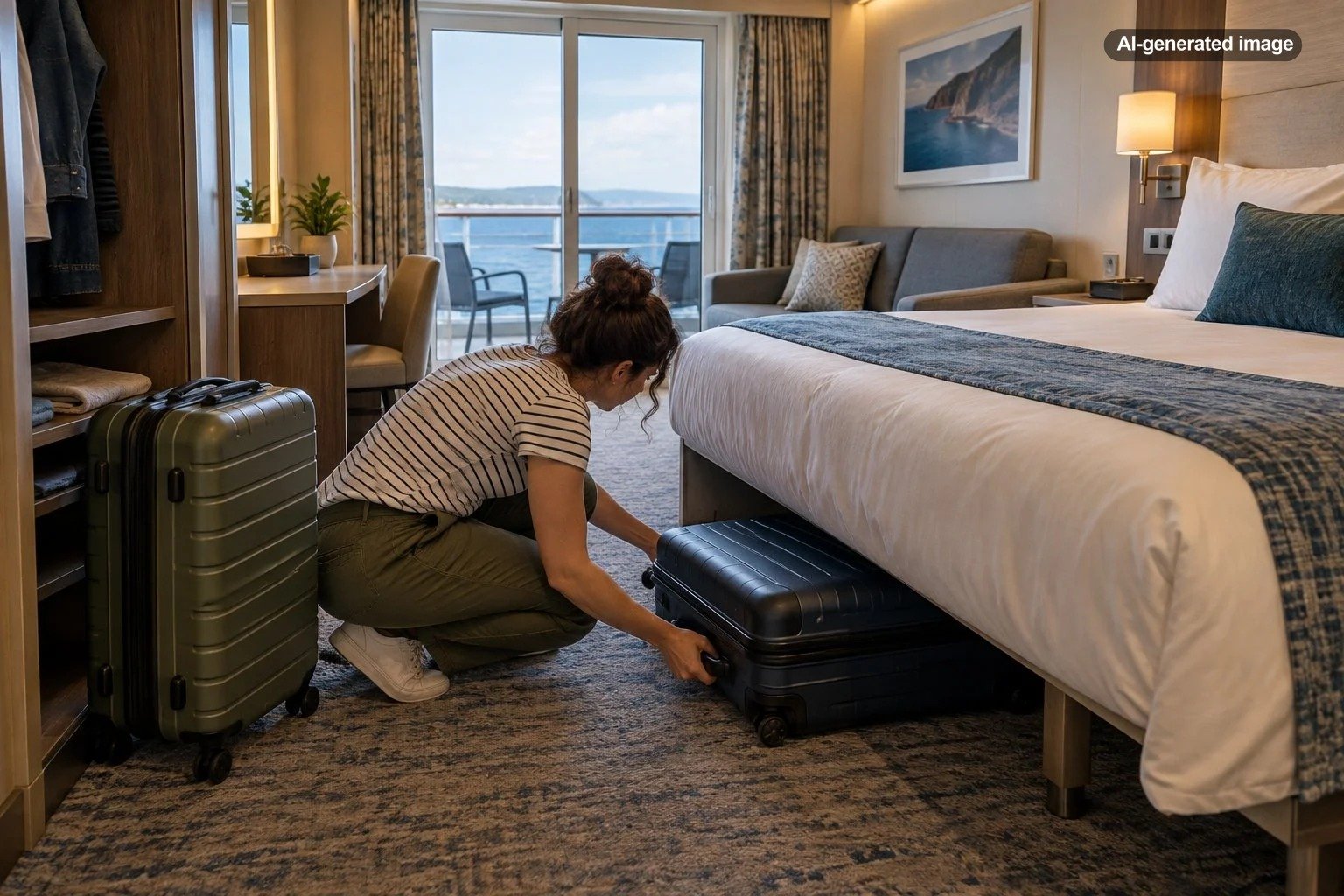
What to Do If Your Suitcases Do Not Fit Under the Cruise Cabin Bed
If your suitcases do not fit under the cruise cabin bed, start by checking whether they can be stored flat, nested inside one another, or positioned differently beneath the bed frame. If those options fail, look for a safe place inside the closet or ask your stateroom attendant whether another approved storage arrangement is available. You should not have to spend your cruise stepping around oversized luggage, but the best solution depends on your cabin layout and the type of suitcase you brought.
Under-bed luggage storage is a common cruise cabin organization strategy, yet it is not guaranteed to work in every stateroom. Bed frames, support structures, cabin configurations, and suitcase dimensions vary. A large hard-shell suitcase that looks reasonably compact when standing upright may be too deep to slide beneath a low bed.
Quick Answer: What to Try First
- Empty the suitcase completely. A packed or overstuffed bag may be thicker than its empty dimensions suggest.
- Try a different orientation. Position the suitcase flat and test whether turning it or inserting one end first improves clearance.
- Check the bed opening. Look for supports, obstructions, or a bed skirt that may make the space appear smaller than it is.
- Nest smaller luggage inside larger luggage. This reduces the number of pieces requiring separate storage.
- Ask your stateroom attendant. If the suitcase still does not fit, request guidance on safe alternatives before leaving it somewhere inconvenient.
Why Your Suitcase May Not Fit Under the Bed
The problem is often clearance rather than the overall size of the cabin. A suitcase may fit within the open space beneath the mattress but still be unable to pass through the narrower opening around the bed frame.
Hard-shell luggage is particularly unforgiving because its depth cannot be reduced significantly. Expandable luggage introduces another complication: a suitcase that fitted beneath a hotel bed before departure may be considerably thicker after the expansion zipper has been opened.
Other potential obstacles include bed support legs, structural crossbars, connecting hardware, or furnishings positioned near the bed. Cabins with beds arranged separately may provide different access from cabins configured with a combined sleeping surface.
Do not assume that every cabin on the same ship has identical under-bed storage. Even where the general furniture design is similar, accessible cabins, suites, and cabins with alternative sleeping arrangements may differ.
Try These Under-Bed Storage Adjustments Before Giving Up
Remove Everything From the Suitcase
Unpack your clothing, toiletries, and other belongings before testing the available space. Move items into drawers, closet shelves, or other designated cabin storage areas.
Close any expansion compartment, flatten exterior pockets, and tuck away loose straps. Retract the telescoping handle completely. These adjustments may make a small but useful difference.
A soft-sided suitcase may compress slightly when empty, while a rigid suitcase generally retains its original dimensions.
Change the Direction of the Suitcase
Try inserting the suitcase with its wheels or handle end leading, then rotate it if the bed structure allows. Sometimes a support leg blocks one approach but leaves another more accessible.
If the suitcase enters partway, check whether its wheels, side handles, or raised exterior features are catching against the frame.
Avoid forcing the bag into position. Excessive pressure could damage the luggage, scratch the furniture, or make the suitcase difficult to retrieve at the end of the voyage.
Check Whether the Bed Skirt Is Hiding the Opening
Some beds have fabric coverings that make the under-bed space appear inaccessible. Gently lift the fabric to inspect the opening without pulling it loose or altering the furniture.
However, a bed skirt is not proof that usable luggage storage exists beneath the bed. Check the actual clearance before attempting to slide anything underneath.
Ask About the Bed Configuration
If the bed appears to have an awkwardly positioned support or a configuration that restricts access, ask your stateroom attendant for assistance.
Some cabins have beds that can be arranged as two singles or one larger bed, subject to the ship and stateroom design. An attendant may be able to explain whether the current arrangement affects storage access.
Do not move or lift heavy bed frames yourself. Bed placement may involve secured components, limited maneuvering space, or ship-specific requirements.
Where to Store Suitcases If Under-Bed Storage Is Impossible
When the luggage simply will not fit, prioritize locations that preserve movement through the cabin and allow you to use the room comfortably.
Inside the Closet
A closet is often the first alternative worth checking. Depending on its layout, a suitcase may fit upright beneath hanging clothing or in an unused compartment.
Measure the available space visually before committing. A large suitcase positioned beneath the hanging rail may restrict access to clothing or prevent the closet door from closing.
For travelers carrying only a few hanging garments, that tradeoff may be acceptable. For a family sharing limited closet space, it may be less practical.
Inside Another Suitcase
Nesting is particularly effective when multiple travelers bring different luggage sizes. An empty carry-on can sometimes fit inside a larger checked suitcase, reducing two storage problems to one.
Test nesting before leaving home when possible. Suitcases with large wheels, rigid handles, or unusually shaped interiors may not nest well even when their advertised dimensions suggest they should.
In an Unused Cabin Corner
An upright suitcase in a genuinely unused corner can be a workable fallback, especially for a shorter voyage.
Choose a position away from doors, walking routes, and areas where someone may need to get up during the night. Make sure the suitcase is stable and will not roll or tip with ordinary ship movement.
Do not put luggage in a narrow passage merely because it technically fits. A clear route between the bed, bathroom, and cabin exit is more important than maximizing every inch of storage.
In a Storage Location Approved by the Crew
If no reasonable in-cabin arrangement works, ask your stateroom attendant whether the ship offers another luggage storage option.
Some travelers assume that crew members can automatically take oversized suitcases to a dedicated storage room. That should not be treated as a standard cruise service. Storage availability and handling procedures depend on the cruise line, ship, and circumstances.
Ask whether a suitable option exists, whether you can access the luggage during the sailing, and when it would need to be returned before disembarkation. Never leave bags in a public corridor or crew-only area without authorization.
Storage Options Compared
| Storage method | Main advantage | Important limitation |
|---|---|---|
| Under the bed | Keeps floor space open | Requires sufficient clearance |
| Inside the closet | Conceals luggage and keeps it accessible | Reduces clothing storage |
| Nested suitcases | Reduces the number of separate bags | Requires compatible luggage sizes |
| Unused cabin corner | Simple fallback without special arrangements | Occupies living space |
| Crew-approved storage | May remove bulky bags from the cabin | Availability and access are not guaranteed |
What Not to Do With Oversized Luggage
When space is tight, an apparently convenient storage location can create a larger problem than the suitcase itself.
- Do not leave luggage in the corridor. Hallways must remain clear for passengers, crew, and emergency movement.
- Do not block the cabin entrance or bathroom door. The inconvenience is especially serious at night or during unexpected movement.
- Do not cover ventilation openings or electrical equipment. Avoid storing luggage against vents, panels, or equipment that requires access.
- Do not put heavy suitcases on unstable furniture. A narrow table or unsupported shelf is not an appropriate substitute for floor-level storage.
- Do not force luggage into furniture compartments. Scratched surfaces, damaged hinges, and jammed suitcase wheels can turn a minor inconvenience into a maintenance issue.
If a suitcase contains valuable documents, medication, or items needed during the voyage, remove those belongings before considering storage outside the stateroom.
How to Manage Luggage in a Small Cabin With Multiple Travelers
The storage problem becomes more pronounced when three or four passengers share a cabin. Several suitcases, backpacks, and personal bags can quickly occupy the limited space intended for movement and everyday use.
A practical approach is to unpack everyone before deciding where the empty bags belong. Allocate drawers and closet sections according to what each person needs regularly rather than leaving frequently used items inside luggage.
Keep a small day bag available for sunscreen, a sweater, reading materials, and other items commonly taken around the ship. Store less frequently needed items in deeper drawers or higher shelves where suitable.
For families with children, establish a consistent location for shoes and small backpacks. Even when the largest suitcase cannot be moved out of sight, organizing the smaller items can make the cabin feel substantially more manageable.
Travelers with mobility limitations should be particularly careful about creating obstacles near the bed or bathroom. If an oversized suitcase interferes with required maneuvering space, seek help from the crew rather than accepting a compromised layout.
How to Avoid This Problem Before Your Next Cruise
Measure Suitcase Depth, Not Just Height
Travelers often focus on luggage height because airlines and luggage manufacturers commonly emphasize overall dimensions. For under-bed storage, the critical measurement is usually the suitcase’s thickness when lying flat, including wheels, handles, and other protrusions.
Measure the bag in its actual packed configuration if you expect to leave belongings inside. If you intend to unpack completely, check its empty, unexpanded dimensions.
Ask About the Specific Stateroom
Before departure, contact the cruise line if luggage storage is an important concern. Ask whether under-bed clearance information is available for your ship and booked cabin category.
A useful question is: ‘Is there enough clearance beneath the bed to store a suitcase that measures this many inches deep, including its wheels?’
Not every cruise line publishes precise bed-clearance measurements, and customer service may be unable to confirm them. Avoid treating an estimate for another ship or cabin as a guarantee.
Consider More Flexible Luggage
Soft-sided luggage and collapsible travel bags can be easier to store in confined spaces. Their advantage is not necessarily greater capacity but the ability to reduce their empty profile.
However, flexible luggage also has tradeoffs. It may provide less protection for fragile belongings, and fabric bags can be less convenient when navigating airports or long terminal walks.
Travelers taking a short cruise may find that one moderately sized suitcase and a compact personal bag provide more flexibility than several large rolling cases.
Review the Cruise Line’s Luggage Guidance
Check your cruise line’s published baggage guidance before packing. Recommendations about luggage quantity, dimensions, and handling vary, and airline requirements may impose separate restrictions.
Even when a cruise line allows a large suitcase onboard, that does not mean the suitcase will fit beneath your cabin bed.
Do Not Forget About Disembarkation Day
Whatever storage solution you choose, make sure the suitcases can be retrieved easily when it is time to pack again.
It may seem efficient to push several cases far beneath a bed or into the back of a crowded closet. On the final evening, however, retrieving heavy luggage from an awkward position can become frustrating.
Many cruise itineraries involve a luggage collection process before disembarkation, with specific instructions for when bags should be placed outside the cabin. These procedures differ by cruise line and sailing.
Keep a separate overnight bag for medications, travel documents, valuables, sleepwear, and anything you will need after handing over your checked luggage. Confirm your ship’s collection instructions rather than assuming the timetable will match a previous cruise.
Frequently Asked Questions
Can a cruise cabin steward store my suitcase somewhere else?
You can ask, but off-cabin luggage storage is not guaranteed. Your stateroom attendant can explain whether an approved arrangement is available on your particular ship. Do not assume the crew has access to a general-purpose luggage storage room for guests.
Can I lift the cruise cabin bed to put a suitcase underneath?
Do not attempt to raise or reposition a heavy bed frame yourself. Ask your stateroom attendant whether the furniture is designed to be moved and whether any adjustment is appropriate. In many cases, changing the suitcase orientation is a better first step.
Will a large 28-inch suitcase fit under a cruise ship bed?
It may, but the suitcase’s length is not the only relevant measurement. Depth, wheels, bed clearance, and support-frame placement determine whether it can slide underneath. There is no universal cruise ship bed-clearance measurement.
Can I leave an empty suitcase in the cabin hallway?
No. Public corridors should remain unobstructed. Keep luggage inside your cabin or use a storage arrangement specifically authorized by the ship’s crew.
Should I choose a different cabin if I travel with large luggage?
Not necessarily. Cabin storage can matter, but the number of travelers, available closets, bed configuration, and overall floor space are also important. If you routinely travel with several large cases, compare the layouts and storage details of available cabin categories before booking.
The Most Practical Solution Is Usually the Simplest
A suitcase that will not slide beneath a cruise cabin bed is an inconvenience, not necessarily a reason to change cabins or abandon your packing system. Start by emptying the bag, checking the clearance, and trying a different orientation. If it still will not fit, nesting luggage or using a suitable closet compartment may solve the problem.
When those options are unavailable, ask the stateroom attendant for guidance and prioritize clear walking space over squeezing luggage into an unsuitable location. The goal is not to make every suitcase disappear; it is to keep your cabin comfortable, accessible, and easy to use throughout the voyage.