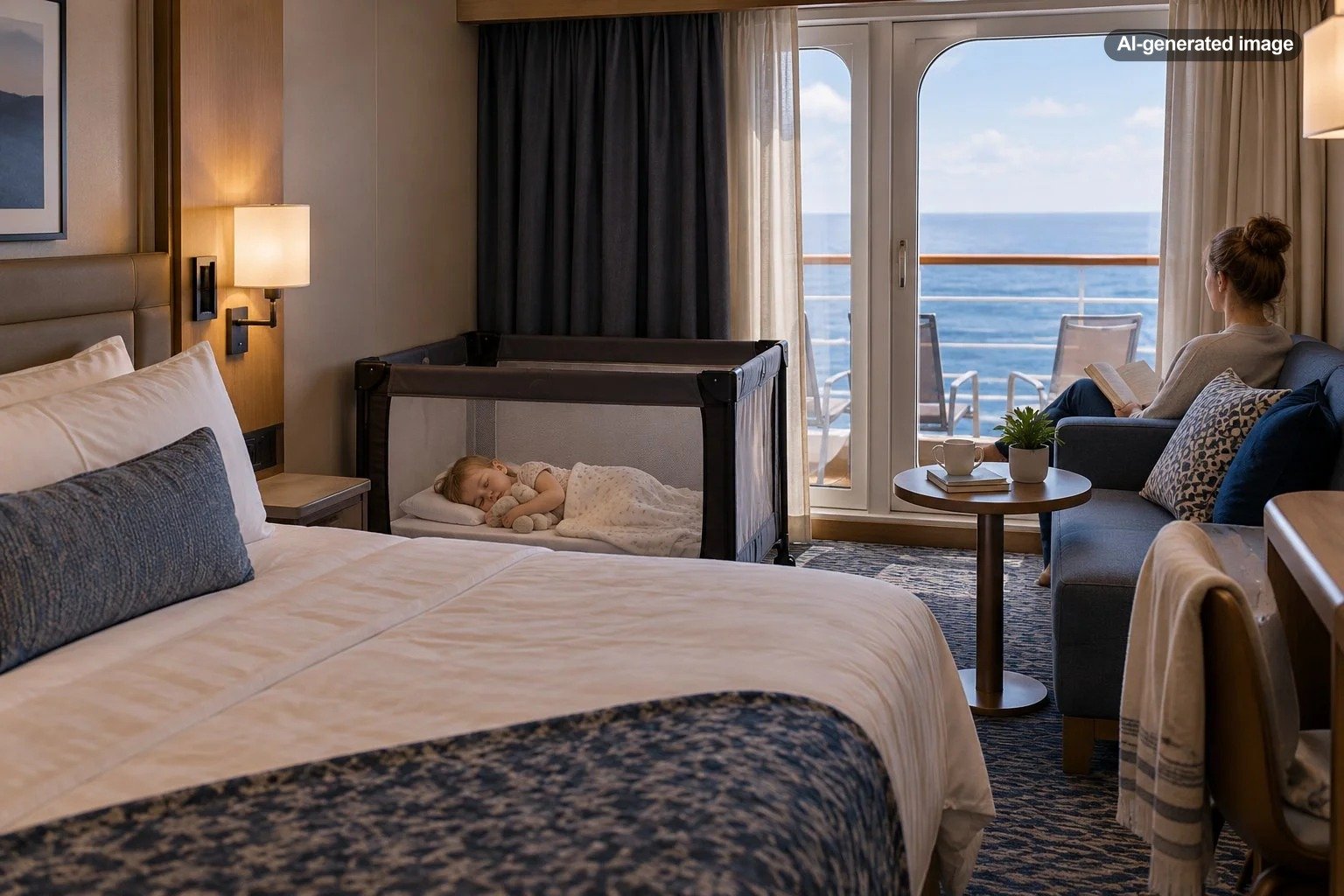
How to Choose a Cruise Cabin for a Toddler Who Still Naps
Choosing a cruise cabin for a toddler who still naps is less about finding the biggest room and more about controlling noise, walking distance, light, and interruptions. A well-positioned cabin can make it much easier to preserve a midday nap without forcing the entire family to spend the afternoon tiptoeing through the room.
The strongest choice is usually a cabin in a relatively quiet section of the ship, away from major entertainment venues and high-traffic passenger areas, while still being reasonably close to the places your family will visit most often. Cabin layout matters too: even a modest separation between the sleeping area and the rest of the room can make nap time more manageable.
Quick answer: What should parents prioritize?
- Choose a quieter deck position. Cabins surrounded by other cabins are generally preferable to rooms directly beneath or above busy public spaces.
- Keep walking distances realistic. Being close enough to return to the cabin quickly can be more useful than choosing an otherwise ideal room at the far end of the ship.
- Look carefully at the floor plan. A curtain, partial divider, separate sleeping zone, or other layout feature can make a meaningful difference during naps.
- Think about balcony access cautiously. A balcony may give adults another place to sit while a child sleeps, but families should evaluate the cabin’s door configuration and follow the cruise line’s child-safety guidance.
- Avoid relying on labels alone. A cabin marketed for families is not automatically the quietest or most nap-friendly option.
Start with what happens during the nap
Before comparing decks and cabin categories, think about what the adults actually plan to do while the toddler sleeps. Some families are comfortable reading quietly in the same room. Others want enough separation to talk softly, order room service where available, or sit somewhere outside the sleeping area.
This distinction affects the type of cabin that makes sense. If everyone will remain in the room, usable floor space and seating may matter more. If one adult expects to step out while the other stays behind, proximity to a lounge, open deck, or other comfortable public area may be more valuable than paying for additional interior space.
Also consider whether your toddler naps reliably in a stroller. A child who occasionally naps while the family is moving around the ship gives parents more flexibility. A toddler who sleeps best in a dark, familiar room makes cabin location and light control much more important.
Choose a cabin surrounded by cabins when possible
One of the simplest ways to reduce the chance of daytime disruption is to examine the ship’s deck plan and look at what sits directly above and below the cabin. A room positioned between decks that are primarily residential cabins generally presents fewer obvious noise variables than one beneath a pool deck, restaurant, theater, nightclub, sports area, or other active public space.
Daytime noise deserves particular attention because nap hours may overlap with times when many passengers are awake and using the ship’s facilities. A location that seems perfectly reasonable for nighttime sleep can still be less appealing if chairs, music, foot traffic, or activity occur nearby during the afternoon.
Elevators and stairwells are more nuanced. Being close to them can reduce walking with a tired toddler, stroller, or diaper bag. However, the immediate elevator lobby may generate more conversation and passing traffic. Families often benefit from being reasonably near a vertical circulation area without selecting the cabin closest to it.
Balance quiet with the distance back to your room
A remote cabin at the end of a long corridor may appear peaceful on a deck plan, but the tradeoff becomes obvious when nap time arrives and the family is several decks away. Cruise ships can involve substantial walking, and repeated trips back to the cabin may become tiring with a toddler.
Think about the places your family is likely to use most: children’s facilities, pools, casual dining, promenades, or outdoor areas. You do not necessarily need to be beside them. The goal is to avoid a cabin location that turns every nap into a lengthy transition.
Families using a stroller should also consider the route itself. Elevator access may matter more than raw distance, particularly when moving between decks. A cabin that looks close on a two-dimensional plan can still require an inconvenient combination of hallways and elevators.
Study the actual cabin layout, not just the square footage
Two cabins of similar size can function very differently during nap time. Look for the placement of the main bed, sofa or convertible sleeping surface, bathroom, entry door, storage, and any curtain or divider shown on the ship’s official cabin diagram.
A layout that lets a toddler sleep farther from the entrance can help when another family member needs to come and go. Likewise, even a partial visual barrier may make it easier for adults to use low lighting without immediately waking a child.
If a crib or portable sleep space will be needed, verify arrangements directly with the cruise line before departure rather than assuming where it will fit. Cabin configurations can vary within the same broad category, and a floor plan that works comfortably for adults may feel considerably tighter once additional child equipment is added.
Consider whether a balcony actually helps your routine
A balcony cabin can be appealing to parents because it may provide adults with somewhere to sit while a toddler naps inside. That can be genuinely useful for families who expect to spend significant time in the cabin during naps.
However, a balcony should not be treated as automatically superior. The additional cost may not be worthwhile if the toddler usually naps briefly, if adults are content to remain quietly inside, or if the family prefers to use public areas in shifts.
Families should also treat balcony safety as a separate consideration from convenience. Door designs and cabin configurations vary, so parents should review the cruise line’s current guidance and supervise children appropriately rather than assuming any particular barrier or lock makes the area childproof.
Think about light, announcements, and hallway activity
Many toddlers nap more easily in a dark environment, which can make an interior cabin attractive from a sleep perspective. The tradeoff is that adults also lose natural daylight and an exterior view. Ocean-view and balcony cabins provide more daylight, but families may need to manage curtains carefully during nap time.
Hallway location matters as well. Cabins near frequently used doors, service areas, or major passenger routes may experience more movement outside. That does not mean every such room will be noisy, but it is another variable worth considering when the child’s daytime sleep is a priority.
Shipboard announcements and operational sounds can also occur. Their frequency and where they are audible vary, so families should avoid assuming that any cabin can provide complete silence. A toddler who already sleeps comfortably with ordinary household background noise may adapt more easily than one who requires near-silence.
Decide whether connecting cabins or a larger suite is worth it
For families traveling with additional adults or older children, connecting cabins can create useful separation. A toddler may be able to sleep in one space while another part of the family remains awake next door. This can be especially practical on multigenerational trips.
Larger suites may offer separate or partially separate living and sleeping areas, but greater space should be evaluated against the additional cost and the family’s actual routine. If naps are short and most waking hours will be spent outside the cabin, paying substantially more solely for nap-time separation may offer limited value.
Conversely, families who know they will return to the cabin for a long nap every afternoon may get considerably more practical use from extra space than travelers who treat the cabin mostly as a place to sleep at night.
What parents often overlook
The most overlooked factor is the family’s daily transition back to the cabin. A theoretically quiet room is less useful if reaching it consistently disrupts the toddler’s nap window. Consider how long it takes to leave a meal, children’s activity, or pool area, gather belongings, wait for an elevator, and settle the child.
Another overlooked detail is where the toddler will sleep relative to the bathroom. Parents may want to shower, wash bottles or cups, or use the bathroom during nap time. A layout that allows these basic activities with less movement near the child’s sleeping position can make afternoons easier.
Finally, avoid designing the entire cruise around perfect naps. Ships are unfamiliar environments, routines change, and some naps may be shorter or later than they are at home. The objective is to remove avoidable obstacles while preserving enough flexibility for the family to enjoy the trip.
FAQ
Is an interior cabin better for a toddler who naps?
It can be helpful because it can become very dark, but darkness is only one factor. Location, surrounding noise, cabin layout, and the distance from family activities may matter just as much.
Should families avoid cabins near elevators?
Not necessarily. Moderate proximity can make returning for naps easier. The more relevant distinction is between being conveniently near an elevator bank and being immediately beside a high-traffic gathering point.
Is a balcony cabin worth paying more for because of naps?
It may be worthwhile when adults expect to spend substantial time in the cabin while the toddler sleeps and value having a separate outdoor sitting area. Families who can comfortably remain inside or take turns leaving may find less benefit.
What is the most important deck-plan detail to check?
Look at what is directly above, below, and adjacent to the cabin. A room surrounded primarily by other passenger cabins typically removes several obvious sources of public-area activity from the equation.
Should parents choose the cabin closest to the kids’ area?
Convenience is useful, but the closest room is not automatically the strongest choice. A slightly longer walk may be worthwhile if it places the cabin in a calmer section of the ship while still keeping the family’s most-used areas reasonably accessible.