Why Do Some Hotels Use Platform Beds With No Space Underneath?
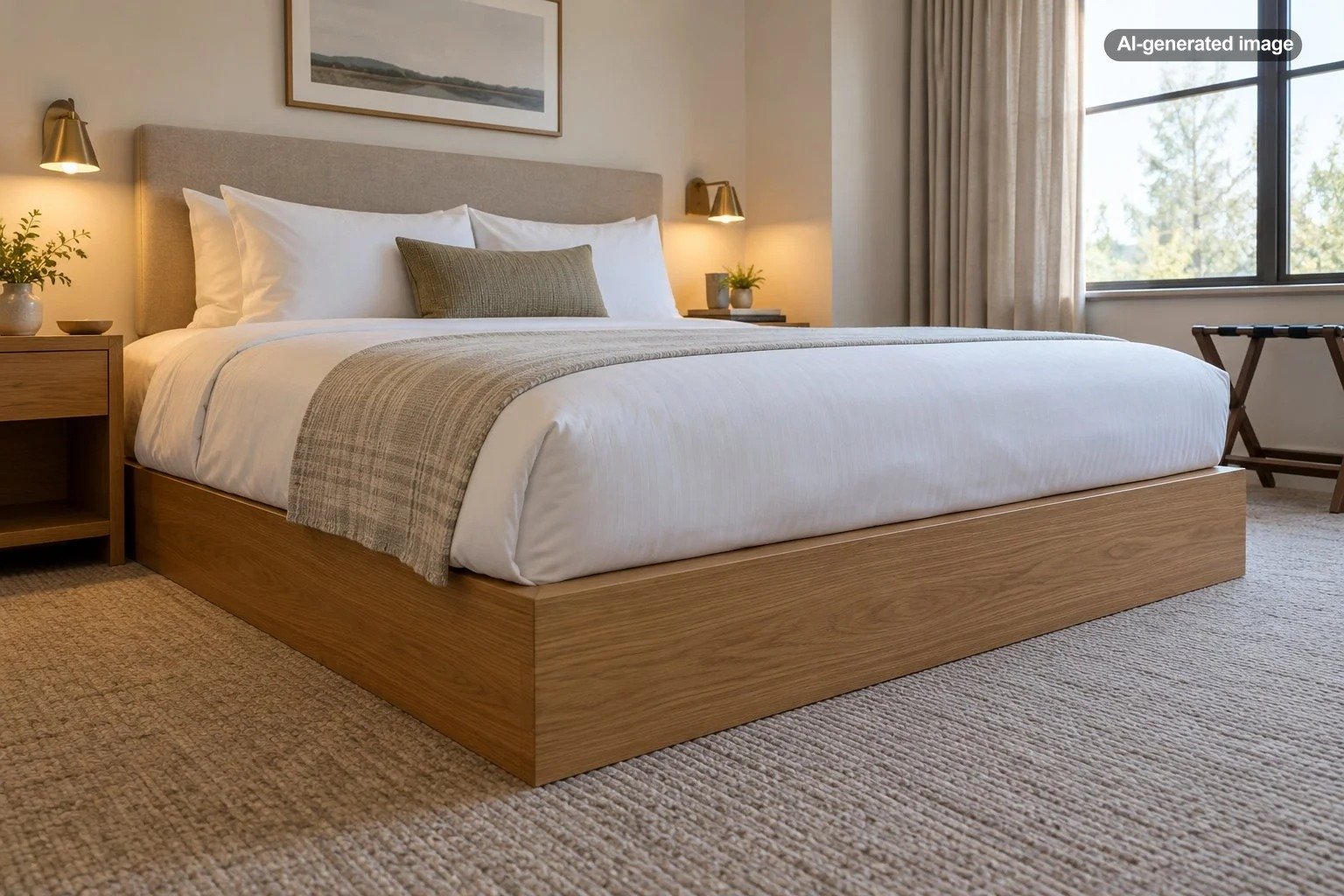
Some hotel beds sit on traditional frames with enough clearance to slide a suitcase underneath. Others appear to rest directly on the floor, with a solid base extending from the mattress to the carpet or flooring. That enclosed design is usually intentional, and it serves several purposes beyond appearance.
Hotels use platform beds with no accessible space underneath primarily to simplify housekeeping, prevent belongings and debris from collecting beneath the bed, provide durable mattress support, and create a cleaner visual design. Depending on the construction, these bases may also reduce maintenance complications and help hotels standardize furniture across many rooms. For guests, however, the missing under-bed space can create practical inconveniences, particularly when traveling with large suitcases or staying for several nights.
Quick Answer: Why Hotels Choose Enclosed Platform Beds
A hotel may select a platform bed with a solid, floor-level appearance for several overlapping reasons:
- Simpler housekeeping: An enclosed base removes or limits the difficult-to-reach area beneath a traditional bed.
- Fewer misplaced belongings: Guests cannot easily slide shoes, clothing, toys, or other possessions into an inaccessible space.
- Durable construction: Commercial bed bases can provide consistent mattress support and withstand frequent use.
- Coordinated room design: A concealed base creates a streamlined appearance that works with many contemporary hotel interiors.
- Predictable maintenance: Standardized frames and fewer exposed components may simplify routine furniture management.
The most important distinction is that a platform bed does not automatically eliminate under-bed storage. Some platforms stand on tall legs, while others contain drawers or lift-up storage compartments. Hotels that specifically choose enclosed bases are making a separate decision about access, cleaning, and guestroom design.
1. Enclosed Bases Make Routine Housekeeping More Manageable
Cleaning beneath a conventional hotel bed can be awkward. Depending on the frame height, housekeeping staff may need to bend, reach with a vacuum attachment, move furniture, or retrieve objects from a narrow space. These tasks become more consequential when repeated across a large property.
A properly enclosed bed base reduces the amount of accessible floor that requires routine vacuuming or mopping. Instead of cleaning beneath the entire mattress, staff can concentrate on the visible flooring around the bed and on the accessible surfaces of the furniture.
This advantage depends on how the bed is built. A base that merely looks enclosed but has recessed openings may still collect dust. Similarly, a poorly sealed or damaged base can create hidden maintenance concerns. An effective design must account for how the bed will be inspected and serviced when necessary.
For travelers, the practical takeaway is straightforward: eliminating the under-bed cleaning area can support a more efficient housekeeping process, but it does not prove that a room is cleaner. Overall cleanliness still depends on staff procedures, inspection standards, and regular maintenance.
2. They Prevent Suitcases and Small Objects From Disappearing Under the Bed
An open bed frame creates an inviting place for luggage, shoes, dropped clothing, and small personal items. This can be convenient when the space is intentionally used for storage, but it can also create problems.
Consider a guest preparing for an early departure. A charging cable, watch, child’s toy, or shoe may have slipped beneath the bed during the stay. If the frame is low, retrieving the item can require considerable effort. In some cases, the object may remain unnoticed until after checkout.
An enclosed platform removes much of this opportunity for belongings to disappear beneath the mattress.
It also reduces the likelihood that guests will push large suitcases into an area that is difficult for staff to inspect between stays.
There is an obvious tradeoff: the same design that prevents accidental storage also eliminates potentially useful luggage space. Someone traveling with a small carry-on may barely notice the difference, while a family sharing a compact room may find it frustrating.
3. Platform Bases Can Provide Consistent Mattress Support
Hotel beds experience frequent use by guests with different sleeping habits, body weights, and preferences. Their support structures need to remain serviceable through repeated occupancy, cleaning, and mattress changes.
A commercial platform base can provide a stable structure for a compatible mattress without requiring the same combination of components used in some traditional bed frames.
Depending on the model, the mattress may rest on a rigid deck, closely spaced slats, or a purpose-built foundation. Other enclosed hotel bases support a separate mattress foundation rather than functioning as a true platform.
This distinction matters because the terms platform bed, box base, and enclosed bed frame are sometimes used loosely when describing hotel furniture.
Does a platform make a hotel mattress firmer?
It can influence the overall feel, but the effect depends on the entire sleep system. A rigid support surface behaves differently from a flexible foundation. However, mattress construction, thickness, condition, and compatibility are usually more useful indicators of comfort than the visible shape of the frame alone.
A platform bed is not inherently more comfortable, firmer, or better for the back. Two hotels can use similar-looking enclosed bases and deliver very different sleeping experiences.
4. A Solid Bed Base Creates a Streamlined Room Appearance
Hotel furniture serves both practical and visual purposes. An enclosed platform creates a continuous shape beneath the mattress rather than exposing bed legs, rails, and the flooring below.
This can work particularly well in rooms with contemporary furniture, minimalist styling, integrated headboards, or coordinated wall panels.
Some properties use recessed platforms that make the bed appear to float. Others install upholstered box-style bases or solid plinths that visually anchor the mattress to the floor.
The absence of under-bed clearance can also make a room appear more orderly because there are fewer visible gaps and less opportunity for clutter to show around the furniture.
Still, a solid base is not necessarily a luxury feature. Similar designs may appear in budget, midrange, upscale, and extended-stay accommodations. Its presence reveals more about furniture selection than the overall quality or market position of the hotel.
5. Hotels May Find Enclosed Bed Bases Easier to Maintain
Hospitality furniture is selected with repeated use and maintenance in mind. A hotel may need to replace damaged components, service bed frames, or purchase matching furniture for multiple rooms.
Standardized enclosed bases can offer operational advantages when they are appropriately specified and constructed.
Some designs minimize exposed legs and rails. Others use replaceable panels or commercially available components. A sturdy base can also reduce certain movement-related problems when correctly installed.
However, an enclosed frame is not automatically more durable or economical than an open one. Material quality, construction methods, load capacity, installation, and access to replacement parts all influence long-term performance.
A poorly built platform may creak, shift, develop damaged panels, or become difficult to repair. The important factor is the engineering of the actual bed, not simply whether it has open space underneath.
6. Can a Solid Platform Bed Help With Pest Control?
Some travelers assume that a bed with no open space underneath must be more resistant to bed bugs or other pests. This is an understandable assumption, but it needs qualification.
Reducing inaccessible clutter and simplifying routine inspection can be useful in property maintenance. An enclosed structure may also eliminate one type of open cavity where objects and debris accumulate.
However, a solid platform bed does not prevent bed bugs. Bed bugs can hide in mattress seams, headboards, furniture joints, cracks, and other protected spaces. An enclosed base can also have seams or interior voids that require careful inspection.
Effective pest management depends on appropriate inspections, maintenance, prompt responses to reports, and professional treatment when necessary.
Travelers should therefore avoid treating the presence or absence of under-bed clearance as evidence of a hotel’s pest-control performance.
What Are the Disadvantages of Hotel Beds With No Space Underneath?
The benefits of enclosed platform beds are largely operational. For guests, the disadvantages tend to involve convenience, accessibility, and room organization.
Less room for luggage
The most noticeable problem is the inability to slide suitcases beneath the bed. In a spacious suite, this may be irrelevant. In a small city hotel room, under-bed storage could otherwise free valuable walking space.
Travelers with two large rolling suitcases may need to keep one near the closet and another beside a wall, provided neither obstructs a doorway or circulation route.
Fewer convenient places for personal belongings
Under-bed space can accommodate shoes, folded travel bags, and other items that guests prefer to keep out of sight. Without that option, available shelves, drawers, closets, and luggage racks become more important.
Potential inconvenience for certain travelers
The height of an enclosed platform can vary substantially. Some beds are unusually low, while others combine a tall base with a thick mattress.
For travelers with mobility limitations, the critical concern is the height of the sleeping surface and whether there is enough clearance and maneuvering room to transfer safely. A low platform is not automatically accessible, and a tall one is not automatically unsuitable.
Travelers who need particular bed heights, transfer space, or accessible room features should confirm those details directly with the property rather than relying on photographs.
Possible cleaning or repair complications
Although an enclosed base can simplify routine cleaning, an inaccessible interior can become inconvenient if maintenance is needed. The construction must allow staff to address damaged components, inspect concealed areas, and retrieve anything that enters through an opening.
Platform Beds vs. Traditional Hotel Bed Frames
Neither design is universally better. Their advantages depend on the room layout, the quality of the furniture, and how travelers use the space.
| Feature | Enclosed platform bed | Open bed frame |
|---|---|---|
| Under-bed luggage storage | Usually unavailable | Possible if clearance permits |
| Routine cleaning underneath | Often reduced | Floor beneath bed needs cleaning |
| Retrieving dropped objects | Less opportunity for objects to enter beneath | Objects may roll or slide underneath |
| Visual appearance | Solid, continuous base | Visible legs or floor clearance |
| Maintenance access | Depends on removable panels or construction | Under-bed area often easier to access |
| Mattress support | Depends on platform and mattress compatibility | Depends on frame and foundation |
The comparison also explains why photographs alone can be misleading. A bed may have a platform-style appearance while retaining recessed clearance, and an open frame may sit too low to accommodate even a small suitcase.
How to Manage Luggage in a Room Without Under-Bed Storage
If you discover that your hotel bed has a solid base, a few simple adjustments can make the room easier to use.
- Use the luggage rack: If provided, it can keep a frequently accessed suitcase off the floor without occupying the bed.
- Check the closet: Some rooms offer a designated luggage shelf or an open floor area inside the wardrobe.
- Unpack selectively: For a longer stay, moving frequently used clothing into drawers can reduce the need to leave a suitcase open.
- Keep walking routes clear: Avoid placing luggage in front of entry doors, bathroom doors, or other important access points.
- Store empty bags carefully: Nested luggage can reduce clutter when suitcase sizes and available space allow.
- Ask about storage options: If the room is unusually cramped, hotel staff may be able to explain available luggage arrangements, although additional storage is not guaranteed.
For a one-night stay, leaving a suitcase closed on a suitable rack may be sufficient. For a weeklong family trip, closet dimensions and overall floor space may matter considerably more.
What Travelers Often Overlook When Choosing a Hotel Room
Hotel photographs tend to emphasize the bed, lighting, windows, and overall decor. They rarely make storage capacity easy to evaluate.
A room that looks open and spacious in a photograph may have limited practical space once two travelers bring their luggage inside.
Before booking a compact room for a longer stay, consider these details:
- Bed clearance: Is the frame visibly open, or does it extend to the floor?
- Closet capacity: Is there enough space for hanging clothing and storing a suitcase?
- Luggage racks: Does the room description mention a rack, bench, or dedicated baggage shelf?
- Room layout: Can suitcases be placed somewhere without blocking access to the bathroom or entry?
- Bed height: Will the sleeping surface be comfortable for anyone who has difficulty sitting down or standing up?
These considerations are particularly relevant for longer visits, family travel, and trips involving bulky luggage. In contrast, travelers carrying only a backpack may have little reason to prioritize under-bed clearance.
If storage is an important factor in choosing accommodations, requesting a room photograph that shows the furniture layout can be more useful than asking whether the property uses platform beds. The same term can describe several different structures.
Frequently Asked Questions
Why do hotel beds sometimes look like they are attached to the floor?
Many hotels use solid box bases, plinth-style platforms, or recessed support structures that conceal the space beneath the mattress. The visual effect may make the bed appear attached to the floor even when it is a separate piece of furniture.
Do platform beds in hotels have storage drawers?
Some do, but many enclosed hotel platforms are simply support structures without guest-accessible storage. A solid base should not be assumed to contain drawers or lift-up compartments unless the room description confirms them.
Are hotel platform beds more comfortable than regular beds?
Not necessarily. Comfort depends on the mattress, support system, condition, and individual sleeping preferences. The presence of a platform alone does not establish whether a bed will feel softer, firmer, or more supportive.
Why would a hotel eliminate useful under-bed suitcase space?
A hotel may place greater value on housekeeping efficiency, furniture consistency, reduced opportunities for misplaced belongings, and room design. Those operational priorities do not always match the storage preferences of every guest.
Can you request a hotel room with space under the bed?
You can ask, but availability depends on the property’s furniture and room configurations. Hotels do not necessarily classify rooms by bed-frame design. If you need luggage clearance, explain the specific storage requirement and ask whether any suitable room is available.
The Bottom Line: A Practical Design Choice With Real Tradeoffs
Hotels use platform beds with no space underneath because an enclosed base can simplify cleaning, limit misplaced belongings, support durable furniture arrangements, and create a coordinated appearance. These are practical considerations that become especially relevant when a property manages many rooms.
For guests, the design is neither inherently superior nor inferior to a conventional bed frame. Its main drawback is the loss of under-bed storage, which may be significant in compact accommodations or during extended stays.
The smartest approach is to evaluate the entire room rather than the bed frame in isolation. A thoughtfully designed hotel room can accommodate luggage without any under-bed clearance, while a room with an open bed frame may still lack sufficient space for comfortable travel. What ultimately matters is whether the layout supports the way you intend to use the room.