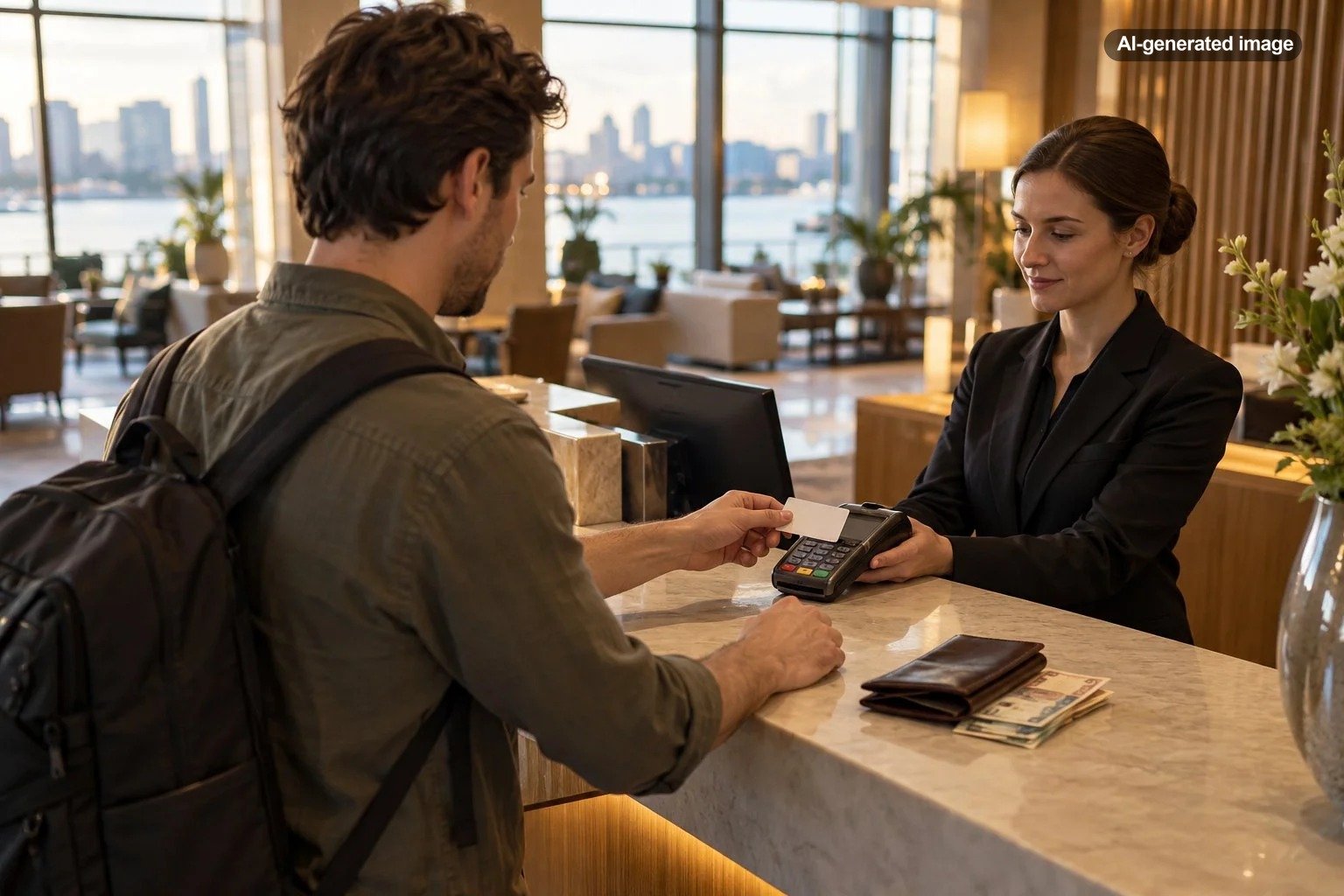
Why Do Some Hotels Require a Credit Card Even When You Plan to Pay Cash?
You arrive at a hotel with enough cash to cover your entire stay, only to discover that the front desk still requires a credit card. It can seem unnecessary, particularly when you have no intention of ordering room service, using paid amenities, or charging anything to your room. Yet the requirement is usually about more than collecting payment for the nightly rate.
Hotels often require a credit card even when guests plan to pay cash because the card provides a financial guarantee for incidental expenses, potential damage, unpaid balances, and other charges that may arise during a stay. Cash may settle the room bill, but it does not automatically satisfy the hotel’s separate security and authorization requirements. Understanding that distinction can prevent an unexpectedly difficult check-in.
Quick Answer: Why Hotels Ask for a Credit Card
- Incidental expenses: Hotels may authorize a card for parking, dining, room charges, and other optional services.
- Security: A card provides a potential payment method for documented damage or applicable policy-violation charges.
- Reservation guarantees: Hotels may require valid card details to secure a booking or enforce applicable cancellation and no-show terms.
- Authorization holds: A temporary hold confirms access to funds or credit without necessarily creating a final charge.
- Property-specific rules: Some hotels accept cash for the room but still require a card at check-in. Others may accept debit cards or alternative deposits.
The essential point is that paying for a room and providing security for a stay are two separate transactions. A hotel’s willingness to accept cash does not necessarily mean it will allow guests to check in without a card.
Paying Cash Does Not Eliminate the Hotel’s Financial Risk
Consider a guest who books a three-night stay and offers to pay the full room balance in cash upon arrival. From the guest’s perspective, the obligation has been met. From the hotel’s perspective, however, the final amount owed may not yet be known.
Additional charges can arise after check-in. The guest might purchase food and beverages, use paid parking, request a late checkout, or incur another charge permitted under the property’s terms. Certain charges may also be discovered during or after departure.
A credit card gives the hotel a payment method associated with the reservation if an authorized additional balance remains unpaid. It also allows the property to verify that an acceptable payment account is available before providing access to the room.
This does not mean every guest will incur extra charges, nor does it give hotels unlimited authority to charge arbitrary amounts. Legitimate charges remain subject to the hotel’s disclosed policies, applicable law, and the cardholder’s ability to dispute improper transactions.
What Is a Hotel Incidental Hold?
An incidental hold is a temporary authorization placed on a payment card to cover anticipated additional expenses. It is one of the most common reasons a hotel requests a card even when the room has already been paid for.
For example, imagine that a hotel requires an incidental authorization of $75 per night. For a three-night stay, that could mean a $225 hold, depending on how the property calculates its security requirement. This is an illustrative example, not a standard hotel rate or universal deposit amount.
The hold reduces available credit on a credit card or available funds in a debit-linked bank account. It is not necessarily an actual posted charge.
If no additional expenses are incurred, the unused authorization is generally released. If eligible charges are incurred, the hotel may settle those charges according to its payment procedures.
Hotel authorization practices differ substantially. Some properties authorize only an incidental amount, while others authorize the expected room balance, taxes, applicable fees, and additional incidentals together. The exact amount should be confirmed directly with the property.
Why Can a Hold Remain After Checkout?
Checkout does not always mean the authorization instantly disappears from your account. The hotel may release or reverse the unused authorization, but the card issuer or financial institution controls when the available balance is restored.
Marriott’s published digital-entry terms explain that card holds may remain with the issuing bank for up to five business days after departure under those terms. IHG’s digital check-in terms similarly warn that funds linked to a bank account may remain unavailable for at least 72 hours or longer after checkout, depending on the financial institution.
These examples illustrate why travelers should not assume an authorization will disappear immediately. Release times can differ by property, issuing bank, card type, and transaction circumstances.
Credit Card vs. Debit Card vs. Cash: What Changes?
The payment method you use can affect how much money remains available during and after your trip.
| Payment method | How it may work | Main consideration |
|---|---|---|
| Credit card | The hotel may place a temporary authorization against available credit. | Reduces available credit until released. |
| Debit card | The hotel may authorize funds linked to a checking account. | Can temporarily restrict money needed for other expenses. |
| Cash | May be accepted for the final room bill or an approved security deposit. | Does not necessarily replace a required card authorization. |
| Prepaid card | Acceptance varies by hotel and transaction type. | May not satisfy check-in authorization requirements. |
For travelers with limited funds in checking, the debit card distinction is particularly important. A substantial authorization can temporarily reduce the balance available for meals, transportation, and other expenses, even when the hotel bill will ultimately be paid in cash.
A credit card can provide a more convenient separation between a temporary hotel authorization and everyday spending money, although a hold still reduces available credit. The appropriate choice depends on the guest’s financial circumstances and the property’s acceptance rules.
Can You Pay Cash at Checkout After Providing a Credit Card?
At some hotels, yes. A property may require a valid card at check-in but allow the guest to settle the room bill in cash before departure.
However, that arrangement should never be assumed. Some properties operate with cashless payment policies, while others restrict cash acceptance to certain transactions or require advance deposits.
If a hotel accepts cash at checkout, ask the front desk how the card authorization will be handled after the cash payment is recorded. Also confirm whether any remaining incidental balance will be charged to the card.
Paying cash does not guarantee an immediate release of an existing authorization. The pending transaction may remain visible until the financial institution processes its release.
For better documentation, request an itemized final receipt showing the cash payment and any additional charges. Check the card account afterward to confirm that the final settlement matches the hotel folio.
Can You Check Into a Hotel Without Any Credit Card?
It is possible at some properties, but the answer depends on the specific hotel, reservation method, and payment rules.
Some hotels accept debit cards instead of credit cards. Others may allow a cash security deposit, particularly when arranged directly with the front desk before arrival. Certain accommodations may have alternative payment procedures, but these options should be verified rather than assumed.
Importantly, a hotel allowing a debit card for online booking does not automatically establish that it will accept the same card for every check-in scenario. The reservation guarantee and the check-in authorization can be governed by different requirements.
Hilton’s published payment guidance, for example, explains that credit or debit card details are required to guarantee its reservations, while accepted payment types at individual properties can vary. This is a useful reminder that brand-level information should not replace confirmation from the actual hotel.
Travelers without access to a credit card should contact the property directly before making a nonrefundable reservation. A clearly documented arrangement is far more reliable than hoping the front desk will make an exception after arrival.
What If Someone Else Is Paying for Your Hotel Room?
A common complication arises when an employer, family member, event organizer, or travel coordinator pays for the accommodation.
The room may already be prepaid, but the hotel can still require the arriving guest to provide a personal card for incidental charges. This is because the original payment may cover only the room and taxes, not every possible expense.
Some properties have procedures for third-party payment authorizations. Depending on the arrangement, an approved payer may cover room charges, incidentals, or specific categories of expenses. Such arrangements typically require verification and advance approval.
For business travelers, it is especially useful to ask whether the company payment covers incidentals or only the contracted room charges. A prepaid reservation alone should not be treated as proof that no personal payment method will be needed.
If another person is paying, confirm the hotel’s authorization procedure directly. Do not email complete credit card details or sensitive payment information through an unverified channel.
How to Avoid a Credit Card Surprise at Check-In
A short conversation with the hotel before arrival can prevent most payment-related misunderstandings.
Ask About Both Payment and Authorization
Instead of asking only, ‘Can I pay cash?’ ask whether the hotel requires a credit card at check-in even when the entire room balance will be paid in cash.
This wording makes it harder to confuse acceptance of cash with acceptance of a card-free stay.
Confirm the Amount and Release Process
Ask how the incidental authorization is calculated, whether it changes with the number of nights, and whether the hotel can estimate the total amount that will be held.
Also ask whether the hotel accepts debit cards, whether the authorization differs by card type, and what release timeline the property ordinarily advises guests to expect.
Verify Alternatives Before Booking
If you do not have a credit card, request explicit confirmation of any alternative arrangement. That might involve a debit card, an approved cash deposit, or a documented third-party payment procedure.
Where possible, obtain the agreed terms in writing and keep the confirmation accessible when checking in.
Review the Entire Reservation
Look beyond the nightly room rate. Review the applicable taxes, mandatory fees, parking charges, cancellation terms, and any deposit conditions disclosed during booking.
Even when a property is willing to accept cash, these additional obligations may affect the amount of money or available card credit needed at arrival.
What Travelers Often Overlook About Hotel Card Requirements
Three details are especially easy to miss.
First, a prepaid room may still require a new authorization. Payment collected by a booking platform or travel organizer does not necessarily include the hotel’s incidental security requirement.
Second, a card on file is not always enough. Some properties require the guest to present an acceptable physical or digital payment credential at check-in, sometimes alongside identification. The procedures can vary by property and payment arrangement.
Third, a released hold is not the same as a refund. If an authorization never settled as a completed charge, its release typically restores available funds or credit rather than creating a separate refund transaction. The distinction matters when reviewing account activity or contacting a bank about an apparent duplicate charge.
These details become particularly important during extended stays, multi-hotel trips, and travel involving limited available credit. Multiple simultaneous authorizations can make otherwise manageable travel expenses unexpectedly difficult to cover.
Frequently Asked Questions
Why does a hotel need my credit card if my room is already paid for?
The hotel may need a card to authorize incidental expenses, applicable additional charges, or other obligations not included in the prepaid room rate. Prepayment does not necessarily satisfy the property’s security requirements.
Will the hotel actually charge my card if I pay cash?
Not necessarily. A temporary authorization may never become a completed charge if the final bill is settled in cash and no additional eligible charges remain. However, the authorization can still temporarily affect available credit or funds.
Can I use a debit card instead of a credit card?
Some hotels accept debit cards, but acceptance and authorization requirements vary. A debit card hold can temporarily restrict access to funds in your bank account, so confirm the amount and release process before arrival.
Can a hotel refuse to check me in without a credit card?
A hotel may enforce its applicable, lawful payment and check-in requirements, which can include presenting an accepted card. Whether an alternative is available depends on the property and the terms of the reservation. Confirm requirements before booking, especially for prepaid or nonrefundable stays.
How long does it take to get a hotel incidental hold back?
There is no single universal timeline. Some authorizations clear relatively quickly, while others remain pending for several business days or longer. Processing depends on the hotel, payment network, issuing institution, and card type. If the hold persists beyond the timeframe provided by the hotel and bank, contact both parties with the reservation and transaction details.
The Bottom Line: Confirm the Guarantee, Not Just the Payment Method
A hotel asking for a credit card when you intend to pay cash is not necessarily refusing cash. In many cases, the property is separating the cost of the room from the financial guarantee required throughout the stay.
The most effective way to avoid confusion is to verify three things before arrival: whether cash is accepted for the room, which payment method is required for incidentals, and how much the hotel may authorize or collect as a deposit.
For travelers who prefer cash or do not use credit cards, a hotel with a clearly confirmed alternative policy may be a better fit than one requiring an uncertain exception. Knowing the rules in advance turns an awkward front-desk surprise into a straightforward travel-planning decision.
Sources & Further Reading
- Hilton: Payment FAQs – Official guidance on payment methods, incidental authorizations, and property-specific payment acceptance.
- Marriott: Digital Entry Terms of Use – Published terms describing credit and debit card authorization holds and potential release delays.
- IHG: Mobile Check-In Terms and Conditions – Official explanation of authorization holds, debit-linked funds, and financial institution release timing.
- Hilton: Payment for Reservations – Details about reservation guarantees, accepted payment cards, and advance-purchase charges.