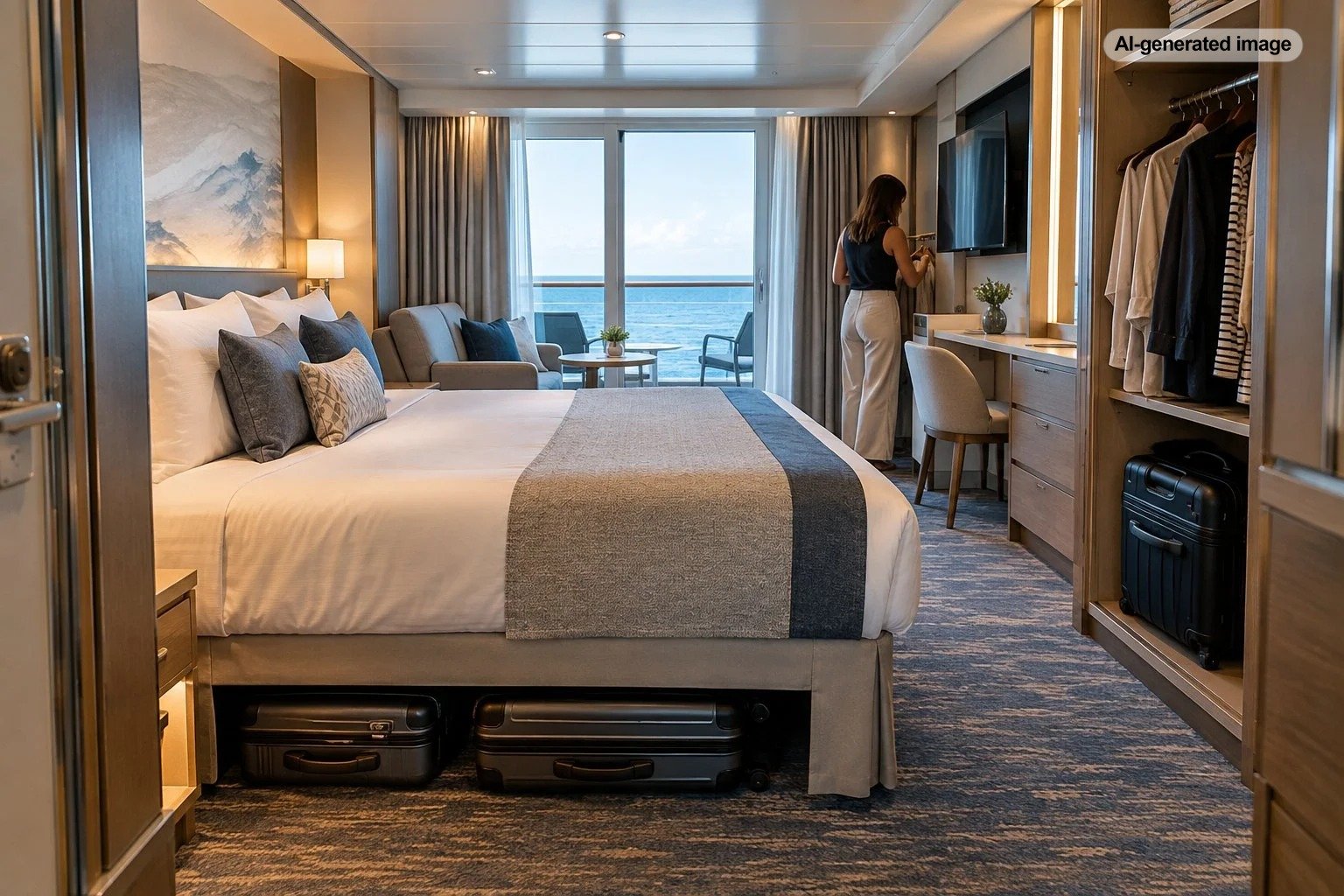
How to Store Suitcases in a Cruise Cabin After You Unpack
Once you have unpacked in your cruise cabin, the simplest place to store an empty suitcase is usually underneath the bed. Many cruise staterooms have enough clearance for standard luggage, particularly when suitcases are laid flat rather than left standing upright. However, bed frames, storage arrangements, and available floor space vary between ships and cabin categories, so it is worth checking the room before assuming every bag will fit.
A little planning makes a significant difference. The goal is not simply to hide the luggage, but to keep walkways open, preserve access to closets and drawers, and avoid repeatedly moving bulky bags throughout the voyage. The following approach works for most conventional cruise cabins, with practical alternatives for oversized suitcases, shared rooms, and unusual bed configurations.
The Quick Answer: Where Should Empty Suitcases Go?
- Under the bed: Usually the first location to try, especially for medium and large rolling suitcases.
- Inside another suitcase: Nest smaller empty bags inside larger ones before putting them away.
- Inside a closet: A possible alternative for compact luggage when there is sufficient space and the bags do not obstruct the closet.
- In an unused corner: A reasonable last resort when the bag remains stable and does not block movement or access.
- Ask your stateroom attendant: If luggage will not fit anywhere practical, ask whether another approved storage arrangement is available.
For most travelers, the best solution is to unpack fully, collapse or nest smaller bags where possible, and slide the remaining suitcases under the bed with their wheels and handles positioned so they do not protrude into the room.
Start by Checking the Space Under the Bed
Before putting clothes away, take a moment to inspect the space beneath your cabin bed. Check the height from the floor to the lowest part of the frame, including any supports or panels. The visible opening may be smaller than the available space farther underneath, and some beds have structures that limit where luggage can sit.
If the room has two separate beds, examine both sides. The arrangement may differ from a cabin with the beds joined together, and furniture placement can affect access. Avoid moving or dismantling fixed bed components to create additional storage.
Lay Hard-Shell Suitcases Flat
A rigid rolling suitcase that seems too tall when standing upright may fit comfortably when positioned horizontally. Close the telescoping handle completely, fold down any flexible carrying handles, and make sure loose luggage straps are tucked away.
Slide the suitcase under the bed slowly, keeping the wheels and corners clear of the bed frame. If it catches, pull it back and inspect the obstruction instead of forcing it forward. A large suitcase that cannot pass through the opening without pressure is not a suitable fit, even if the space beyond looks generous.
Consider Soft-Sided Luggage Differently
Soft-sided bags may offer slightly more flexibility than rigid cases, but their frames, wheels, and reinforced bases still determine the minimum height. An empty duffel or genuinely collapsible travel bag is easier to fold and tuck away than a structured rolling suitcase.
Do not compress a suitcase so tightly that its frame bends or its wheels press against nearby fittings. Proper storage should protect the bag as well as preserve cabin space.
Use the Nesting Method for Multiple Suitcases
Travelers sharing a cabin often arrive with several pieces of luggage. Rather than trying to find separate storage locations for each one, consider placing smaller empty suitcases inside larger cases. This technique is particularly effective for travelers using coordinated luggage sets with progressively different sizes.
Start with the smallest empty case. Place it inside the next size up, checking that wheels, handles, and corners do not damage the lining. Repeat the process if the dimensions permit. Close the outer suitcase without straining the zipper, then store the combined set beneath the bed.
Nesting is not always practical. Two hard-shell cases of similar dimensions may not fit inside one another, even when one appears slightly smaller. Expanding luggage, unusually shaped handles, and thick wheel assemblies can also prevent a comfortable fit.
For a couple traveling with two large checked bags and two small carry-ons, a useful arrangement is to place one carry-on inside each large suitcase. This reduces four separate pieces to two stored cases while keeping both travelers’ luggage organized for departure.
What to Do When a Suitcase Will Not Fit Under the Bed
If a large suitcase cannot fit beneath the bed, do not assume the cabin has no workable alternative. Check the closet layout, the available space beside fixed furniture, and any open area that does not interfere with normal use of the room.
Check the Closet Floor
Some cruise cabins have a closet section with enough floor space for a carry-on or relatively narrow suitcase. This arrangement is most practical when the bag does not prevent the closet doors from opening or make it difficult to reach clothing.
Think about how frequently you will need the closet. Using its floor for a suitcase can be acceptable during a short voyage, but it may become frustrating on a longer sailing if the bag must be moved every time someone wants their shoes or hanging clothes.
Use a Corner Only When Necessary
A suitcase positioned against a wall can sometimes be less disruptive than one standing directly beside the bed. However, an apparently unused corner may be needed for opening a sofa bed, accessing a balcony door, or moving safely around the cabin.
Keep luggage out of doorways and clear of access routes, cabin equipment, and electrical fixtures. Avoid stacking heavy cases where they could shift or fall. Never use the cabin balcony as a luggage storage area; exposure to moisture, wind, and salt air can damage bags, while balcony furnishings and operating rules may make the arrangement inappropriate.
Ask Before Moving Cabin Furniture
Cabin furniture may appear movable even when it is intended to remain in a particular configuration. If you think shifting a bedside table or changing the bed arrangement would solve the problem, speak with your stateroom attendant first.
The attendant may know a suitable storage location or whether an adjustment is permitted. Off-cabin luggage storage should never be assumed to be available, and access to crew or service areas is not something guests should arrange independently.
How to Organize the Cabin Before Storing Your Luggage
The most effective suitcase storage begins with an organized unpacking routine. A bag that stays half-full on the floor often becomes an unofficial dresser, taking up valuable space and making the cabin feel smaller than necessary.
Start by assigning each traveler a portion of the available hanging space, shelves, and drawers. Transfer clothing into those locations, using packing cubes to keep categories together if that makes items easier to find. Reserve a convenient drawer or shelf for things you will use daily, such as sunglasses, charging accessories, and small personal items.
Next, separate anything that should not disappear into stored luggage. Important medications, travel documents, essential electronics, and valuables should remain accessible and appropriately secured. Use the in-room safe for suitable items when one is provided, following its operating instructions.
Finally, check every suitcase pocket before closing the bags. Passport wallets, small chargers, spare glasses, and other easily overlooked belongings often end up in exterior compartments. Finding them now is much easier than retrieving a suitcase from beneath the bed later.
Keep One Small Bag Available for Shore Excursions
Storing every piece of luggage does not mean putting away every bag. Many travelers benefit from keeping one small backpack, tote, or lightweight day bag accessible for activities ashore and moving around the ship.
Choose a bag that can fit on a closet shelf or hang from an appropriate hook without blocking movement. It can hold everyday items such as sunscreen, a hat, a refillable water bottle, and other supplies suited to your itinerary.
This is particularly useful on cruises with frequent port calls. Instead of retrieving a carry-on suitcase each morning, you can prepare a compact bag the evening before and leave larger luggage undisturbed.
Adjust Your Storage Plan for Different Cabin Arrangements
Interior Cabins and Compact Oceanview Rooms
In a compact cabin, keeping the floor clear matters more than having several alternative storage spots. Prioritize under-bed space, fully unpacking your clothes, and nesting bags. Avoid keeping large suitcases beside the bed simply because they are easy to reach.
Family Cabins With Additional Sleeping Berths
Families should account for sofa beds, pull-down berths, and other sleeping arrangements that may change how the room functions at night. A corner that seems spacious during the afternoon may become an essential walkway once additional beds are in use.
Store adult and children’s suitcases according to the final sleeping configuration rather than the daytime layout. If children need regular access to their belongings, place those items in drawers or accessible shelves instead of relying on luggage stored beneath furniture.
Accessible Staterooms
Accessible cabins may have different furniture spacing and circulation requirements. Preserve the clear floor space needed for mobility devices, transfers, and access to the bathroom. A suitcase should not occupy that space simply because it fits physically.
Guests with mobility considerations may find it more comfortable to ask the attendant for assistance positioning luggage. Storage that requires repeated bending, lifting, or reaching beneath a low bed is not necessarily the best option for every traveler.
Suites and Larger Accommodations
Larger accommodations may provide additional closets or storage furniture, but these features differ significantly by ship and suite category. Extra square footage does not automatically mean an oversized suitcase has a dedicated storage location.
Use designated storage spaces where available, while preserving convenient access to personal belongings and cabin amenities.
What Travelers Often Overlook About Empty Luggage
Moisture matters. Avoid putting wet swimwear, damp towels, or moist shoes inside a suitcase before storing it. Allow items to dry in an appropriate location rather than sealing moisture inside the bag for several days.
Wheels can catch on flooring. Rolling luggage may move unexpectedly when being positioned or retrieved. Lift or guide the suitcase carefully, especially where carpet edges or bed supports create resistance.
Dirty laundry needs a separate plan. A lightweight laundry bag or an assigned drawer can keep worn clothing organized. Putting dirty clothes back into the stored suitcase every day defeats the purpose of unpacking and may make repacking less efficient.
Departure requires access. Do not bury a suitcase behind several heavy bags if you will need it before the cruise ends. Organize stored luggage so at least one case can be retrieved without dismantling the entire arrangement.
Cabin layouts vary within the same ship. A storage suggestion that works in one room may not work in another, particularly when accessible layouts, connecting cabins, or additional sleeping berths are involved.
How to Retrieve and Repack Suitcases Before Disembarkation
Plan to retrieve your suitcases before the final evening becomes crowded with packing tasks. Moving bags out from beneath the bed is easier when clothing, shoes, and smaller accessories have already been sorted.
Begin by separating the items you need on departure morning from those that can be packed away. Keep medications, travel documents, valuables, essential toiletries, and a change of clothing in a small bag that will remain with you.
Some cruise lines offer luggage collection before disembarkation, allowing guests to place tagged suitcases outside their stateroom at a designated time. The precise procedure and collection deadline depend on the ship and sailing, so follow the instructions provided onboard. Do not leave bags in the hallway during the voyage or outside the stated collection process.
If you are carrying your own luggage off the ship, make sure every suitcase is manageable without assistance and that your planned departure route accommodates it.
Frequently Asked Questions About Cruise Cabin Luggage Storage
Do Suitcases Usually Fit Under Cruise Ship Beds?
Many standard suitcases can fit beneath cruise ship beds when laid flat, but this is not guaranteed. Clearance depends on the bed design, cabin configuration, and suitcase dimensions. Check the available opening before forcing a bag underneath.
Can I Leave My Suitcase in the Cruise Cabin Closet?
Yes, if the closet has sufficient space and the suitcase does not interfere with doors, clothing access, or other cabin functions. A compact carry-on is usually easier to accommodate than a large checked suitcase.
Will the Cruise Line Store My Empty Suitcase Elsewhere?
Do not count on separate luggage storage as a standard service. If a suitcase cannot be accommodated comfortably in your cabin, ask your stateroom attendant whether any approved options exist on your particular ship.
Should I Unpack Completely on a Short Cruise?
It depends on the length of the sailing and your preferences. For a brief voyage, keeping a small number of items in a carry-on may be convenient. However, unpacking enough to clear the floor and access frequently used belongings generally makes the cabin easier to navigate.
Can I Put Empty Suitcases on the Balcony?
It is better to keep luggage inside the cabin. Balconies expose bags to moisture, salt air, and weather, and cruise line rules may restrict what can be stored outside. Use appropriate interior storage instead.
A Simple Storage Routine for a More Comfortable Cruise
Once your luggage has arrived, begin by checking under-bed clearance and identifying the best alternative locations. Unpack frequently used belongings into the cabin’s existing storage, nest smaller bags when possible, and put the larger empty suitcases away. Keep one lightweight day bag accessible and ensure that the room remains easy to move around in.
For travelers still deciding which sailing or accommodation to book, cabin photographs, deck plans, and the specific room description can help reveal likely space constraints. If comparing different ships and itineraries, you can also browse cruises with Expedia before reviewing cabin configurations directly with the cruise line.
The most important principle is straightforward: choose a storage location that keeps luggage out of the way without creating a new inconvenience. Under-bed storage will often be the easiest answer, but the best arrangement is ultimately the one that works with your actual cabin layout and the needs of everyone sharing the room.