How to Choose a Cruise Cabin for Four Adults Without Sharing a Sofa Bed
Finding a cruise cabin for four adults is relatively straightforward. Finding one where nobody has to share a sofa bed requires more careful planning. Cruise lines frequently advertise cabins that accommodate four passengers, but the number of permitted occupants tells you surprisingly little about where each person will sleep. A cabin listed for four might contain two lower beds and two upper bunks, a double bed and a pullout sofa, or several sleeping surfaces with very different levels of comfort.
The most reliable approach is to identify the exact bed configuration before selecting a cabin number. For four adults who want separate sleeping spaces, look for two lower twin beds plus two individual Pullman bunks, an explicitly documented four-bed layout, or two connecting cabins with separate beds. When floor space, accessibility, and privacy matter more than sharing one room, two cabins are often the more practical choice.
Quick Answer: Which Cruise Cabin Layouts Work for Four Adults?
- Two lower twin beds plus two Pullman bunks: Four individual sleeping spaces without using a sofa bed, provided the specific cabin has both upper berths.
- Two connecting cabins: Usually the strongest option for adult comfort, personal space, and additional bathroom access.
- Two nearby cabins: A useful alternative when connecting cabins are unavailable or unnecessary.
- A family cabin with a dedicated bunk area: Potentially suitable, but confirm that every adult has an acceptable individual bed and that the bunks are adult-appropriate.
- A larger suite with documented separate bedrooms or beds: Worth considering when privacy or additional space justifies the cost, but suite status alone does not guarantee four proper beds.
The essential distinction is between a cabin that sleeps four people and one that provides four acceptable sleeping spaces. Those are not necessarily the same product.
Why a Cruise Cabin Advertised for Four May Still Have a Sofa Bed
Cruise accommodations are commonly described by their maximum guest capacity. However, occupancy information does not always explain whether extra passengers sleep on bunks, convertible sofas, or other supplementary bedding.
On some ships, the primary bed converts from two twins into one larger bed. This offers flexibility for two adults, but the third and fourth sleeping positions may be provided by a double sofa bed. In that arrangement, two passengers could end up sharing the sofa even though the cabin technically accommodates four.
Other configurations offer a single Pullman bunk and a single sofa bed. This avoids two adults sharing one sofa, but it still does not satisfy a group that wants to avoid sofa beds entirely.
For example, Norwegian Cruise Line describes some Norwegian Pearl Family Balcony accommodations as having two convertible lower beds, one Pullman berth, and one single sofa bed. Royal Caribbean’s published deck plans also show that four-person rooms can use different combinations of Pullman bunks and sofa beds depending on the ship and category.
This is why travelers should never assume that a family cabin, quad cabin, balcony cabin, or suite automatically provides four independent conventional beds.
Option One: Find a Cabin With Two Twin Beds and Two Pullman Bunks
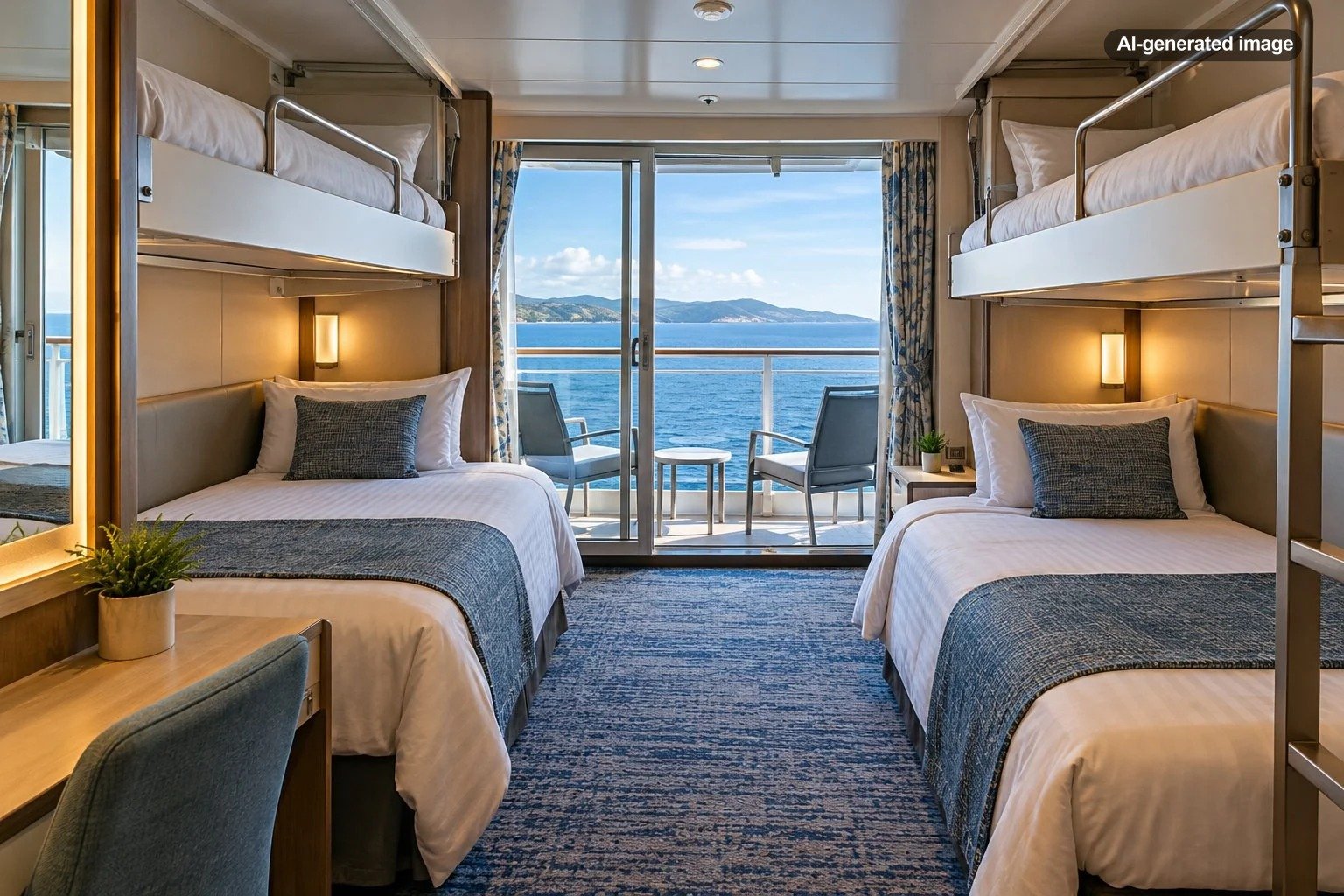
For a group determined to remain in one cabin, two lower twin beds plus two individual Pullman bunks can be the most direct solution.
Pullman beds are additional berths that fold down from the wall or ceiling. They are generally positioned above the lower sleeping area, producing a bunk-style arrangement without using a sofa bed.
On Royal Caribbean’s Vision of the Seas, for example, published configurations for certain interior and ocean-view cabins accommodate four using two convertible lower beds and two fold-down Pullman berths. This illustrates the type of arrangement worth seeking, although the actual cabin number and applicable sailing deck plan still need verification.
Who is this layout best for?
This arrangement can work well for four friends who have no objection to sharing a small cabin, younger adults comfortable with climbing into an upper berth, or travelers who prioritize keeping the accommodation budget contained.
Its disadvantages become more noticeable over a longer voyage. Upper berths require climbing, headroom can be limited, and four adults still share a bathroom, storage areas, and nighttime routines.
Check the cruise line’s restrictions for upper berths, including any applicable weight limits and mobility requirements. An available Pullman is not automatically appropriate for every adult.
Option Two: Book Two Connecting Cabins
Two connecting cabins often provide the most balanced solution for four adults who want independent beds without feeling crowded.
A connecting arrangement generally consists of two separately booked staterooms with an internal doorway between them. If each cabin accommodates two guests and its main bed separates into twins, the group can have four lower sleeping positions without relying on bunks or sofas.
This configuration offers several benefits beyond the beds. There is usually a bathroom in each cabin, more distributed storage, and greater flexibility when passengers have different sleep schedules. One pair can retire early while the other remains awake without forcing everyone into the same small room.
However, a connecting cabin is not simply a cabin located beside another. The deck plan must explicitly show a connecting doorway, and both rooms must be available for the same sailing.
Some connecting cabin pairs have differences in layout or permitted occupancy. Confirm that both rooms meet the group’s needs before making either reservation.
Option Three: Choose Two Nearby Cabins Instead
Connecting cabins may be limited, especially on popular departures or when booking relatively close to sailing. Two nearby nonconnecting rooms can provide nearly the same sleeping and bathroom advantages.
They are especially practical for two couples or four friends who value privacy and do not need an interior passage between rooms.
Depending on inventory, nearby cabins may also provide more flexibility in choosing a quiet location, balcony category, or price level. The compromise is that guests must use the public corridor to move between rooms.
Before reserving, confirm the exact cabin numbers and their positions on the deck plan. Two cabins described as being in the same section of a ship are not necessarily adjacent.
Option Four: Investigate Family Cabins and Multi-Bedroom Suites
Larger family accommodations can occasionally solve the sleeping arrangement problem, but their names deserve scrutiny.
Some family cabins feature a dedicated bunk alcove, separate sleeping area, or additional fixed berths. Others simply use a convertible sofa to expand occupancy. A category marketed toward families may be designed around parents and children rather than four adults seeking similar sleeping comfort.
Multi-bedroom suites may provide additional privacy, but their advertised guest capacity can still depend on sofa beds or supplementary sleeping arrangements. Count the actual beds and identify which guests would use them.
It is also important to distinguish four separate mattresses from four equally convenient sleeping spaces. A suite containing one large bed, two bunks, and a sofa is different from accommodations offering four lower twin beds.
For travelers concerned about nighttime access, mobility, or equitable sleeping arrangements, the layout matters more than the accommodation category’s prestige.
Compare the Main Sleeping Arrangements Before Booking
| Cabin choice | Sleeping arrangement | Main tradeoff |
|---|---|---|
| One quad cabin with Pullmans | Two lower beds and two upper bunks | Limited space and upper-berth access |
| Two connecting cabins | Potentially four lower twin beds | Requires two available connecting rooms |
| Two nearby cabins | Potentially four lower twin beds | No interior connection |
| Family cabin with bunk area | Varies by ship and room | Bunk suitability and privacy |
| Multi-bedroom suite | Depends on the specific floor plan | Potentially higher overall cost |
How to Verify the Exact Bed Arrangement Before Paying
The best protection against an unexpected sleeping arrangement is to confirm the configuration at the cabin-number level, not merely the category level.
Step 1: Open the deck plan for the correct ship and sailing
Find the official deck plan applicable to your departure date. Some cruise lines publish different deck-plan periods because configurations and room classifications can change.
Locate the individual cabin and inspect its occupancy symbols. Look for indications of third and fourth Pullman berths, sofa beds, or connecting doors.
Step 2: Read the bedding description carefully
Descriptions such as ‘sleeps up to four’ or ‘additional bedding available’ are insufficient. Look for explicit wording identifying two lower beds and two Pullman berths or another arrangement that provides four acceptable individual sleeping positions.
Be especially cautious about descriptions that say a cabin may have either a double sofa bed or Pullman bunks. That wording may describe several cabins within one category rather than guaranteeing the desired layout.
Step 3: Ask the cruise line to confirm the specific room
Contact the cruise line or booking representative and provide the ship, sailing date, cabin category, and cabin number. Ask this question directly: ‘Can four adults sleep in this cabin without anyone using a sofa bed, and what is the exact bed arrangement?’
If all four adults require separate beds, say so explicitly. Ask whether the main bed can be divided into twins and whether two individual upper berths are installed in that particular cabin.
Step 4: Request written confirmation
Where possible, obtain confirmation through an email, reservation note, or other written communication. This does not guarantee that arrangements can never change, but it creates a clearer record of the requested configuration.
If a cabin assignment changes before departure, verify the sleeping layout of the replacement rather than assuming the original arrangement carries over.
What Four Adults Often Overlook
Four beds do not guarantee four comfortable nights
A Pullman berth may be perfectly acceptable for one traveler and unsuitable for another. Before selecting bunks, discuss mobility, sleep preferences, and any limitations that make an upper bed difficult to use.
Bathroom access can be more important than cabin size
Four adults sharing a single bathroom can create congestion before dinner, during early excursions, or when several passengers want to prepare for bed at similar times. Two standard cabins with two bathrooms may function more comfortably than one larger cabin.
Storage and luggage space become shared problems
Closet space, drawers, charging outlets, and floor area can feel limited when four people bring full-size luggage. If choosing one cabin, investigate the storage layout rather than relying exclusively on its advertised square footage.
Upper beds can reduce usable headroom
When Pullman bunks are deployed, moving around the lower sleeping area may become less convenient. Check photographs or a relevant floor plan to understand where ladders and extended bunks sit.
A guarantee cabin may introduce uncertainty
When booking an unassigned or guarantee category, the cruise line typically assigns the exact room later, subject to the fare terms. That can be a poor match when a specific four-bed arrangement is essential. Verify whether your desired configuration can actually be guaranteed before choosing this booking method.
Should Four Adults Book One Cabin or Two?
The decision depends on the group’s priorities more than the advertised cabin capacity.
Choose one cabin when all four passengers are comfortable sharing close quarters, two adults are willing and able to use Pullman bunks, and keeping the overall accommodation expense lower is the main objective.
Choose two cabins when four lower beds are important, the travelers have different schedules, anyone has difficulty using a ladder, or bathroom privacy would materially improve the trip.
Compare the total cost for all four travelers, not just the advertised rate per passenger. Cruise pricing can depend on double occupancy, additional-guest fares, promotions, taxes, and other charges. One cabin for four is not automatically the best value, particularly when considering space and comfort.
If comparing ships or departure dates, it may be useful to compare available sailings before narrowing the search to specific cabin layouts.
Affiliate disclosure: HotelInfo.com may earn a commission when you book or purchase through links on this page. This does not affect the price you pay. Learn more.
Questions to Ask Before Confirming the Reservation
Before paying for a nonrefundable booking or reaching a cancellation deadline, confirm the following:
- Does the exact cabin accommodate four adults under the cruise line’s occupancy rules?
- How many individual sleeping surfaces are available without using the sofa?
- Can the primary bed be separated into two twins?
- Are there two Pullman berths, and are both suitable for the intended adults?
- Does the bedding configuration depend on the assigned cabin number?
- If booking two cabins, are they genuinely connecting or simply nearby?
- Can the requested bedding arrangement be documented on the reservation?
When a booking agent cannot confirm these details, consider a different cabin or contact the cruise line directly before finalizing the reservation.
Frequently Asked Questions
Can four adults sleep in one cruise cabin without a sofa bed?
Yes. Some cruise cabins provide two lower beds and two separate Pullman bunks. Other layouts may also work, but the exact cabin’s sleeping arrangement must be confirmed because capacity alone does not establish the bed configuration.
Can cruise ships provide four regular twin beds in one room?
Some larger or specialized accommodations may have suitable arrangements, but four conventional lower twin beds should not be assumed in a standard cabin. Two double-occupancy cabins with convertible twin beds are generally a more straightforward way to obtain four lower sleeping positions.
Are Pullman beds comfortable for adults?
Comfort depends on the traveler’s size, mobility, sleeping preferences, and the berth’s dimensions and restrictions. Pullman beds can be a practical solution for adults who are comfortable climbing into an upper bunk, but they are not equivalent to lower beds for everyone.
Is a family cruise cabin automatically better for four adults?
No. Family accommodations are designed to increase sleeping capacity, not necessarily to provide four equally convenient beds. Some contain sofa beds, narrow upper berths, or sleeping areas better suited to children. Review the actual layout before booking.
Is it cheaper to book one cabin for four rather than two cabins for two?
Sometimes, but not always. The difference depends on the cruise line, ship, sailing, available promotions, and applicable fare rules. Compare complete four-person totals for both arrangements and weigh any difference against additional space, privacy, and bathroom access.
The Best Booking Strategy for Four Adults
Start by determining whether the group truly needs four independent beds or simply wants to avoid sharing a double sofa bed. Those requirements lead to different cabin choices.
If everyone can comfortably use upper berths, a confirmed quad cabin with two Pullman bunks may be sufficient. If four lower beds, privacy, and easier bathroom access are priorities, look for two connecting or nearby cabins. Treat suites and family categories as possibilities to investigate rather than automatic solutions.
Above all, verify the exact cabin number, bed configuration, and sailing-specific deck plan before committing. A little attention to the sleeping arrangement can prevent an otherwise appealing cruise reservation from becoming an uncomfortable shared-room experience.
Sources & Further Reading
- Royal Caribbean: Vision of the Seas Deck Plans – Official cabin capacity, bedding descriptions, and connecting-room indicators.
- Norwegian Cruise Line: Norwegian Pearl Staterooms – Official examples of family balcony configurations, Pullman beds, sofa beds, and connecting accommodations.