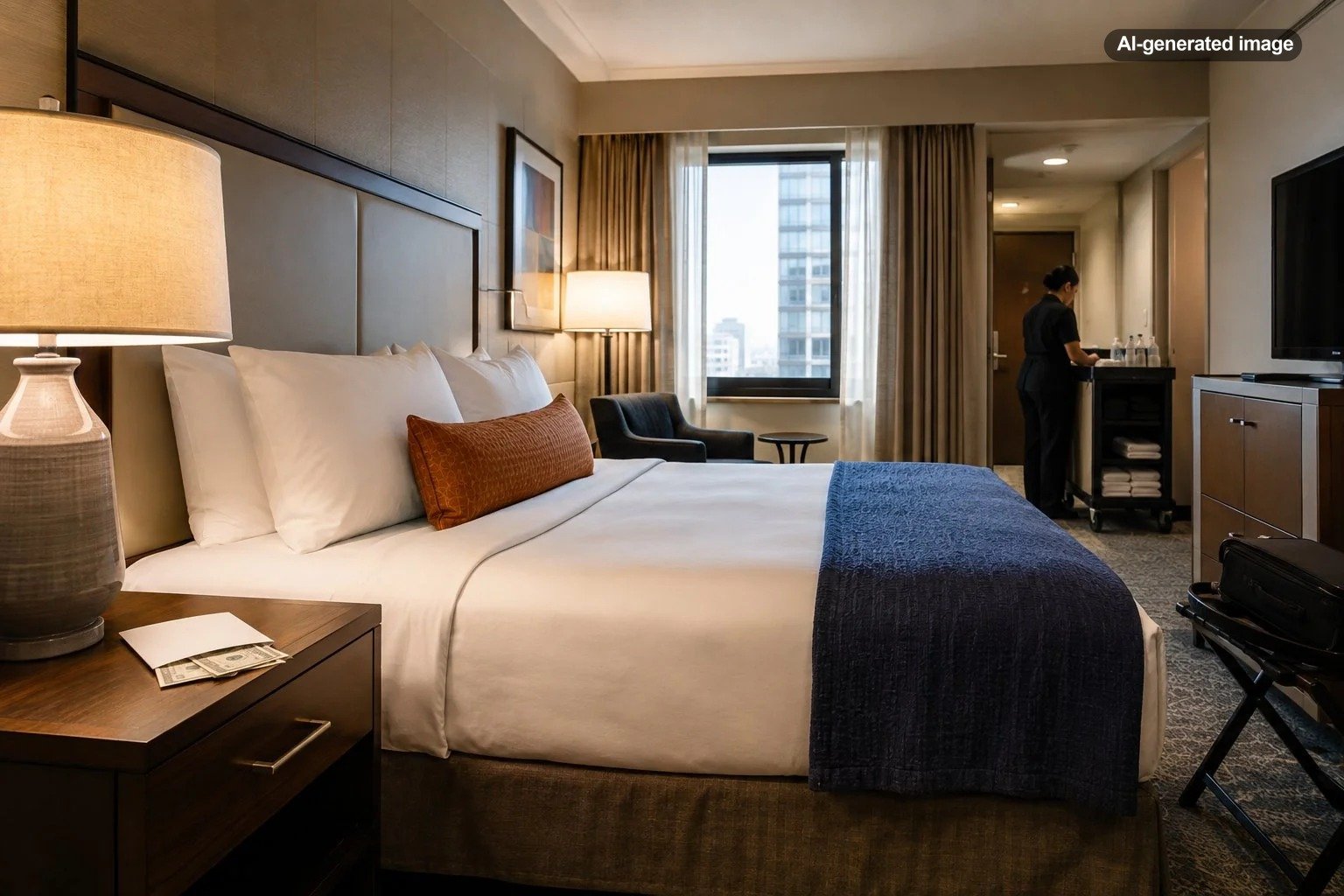
How Much Should You Tip Hotel Housekeeping for a Multi-Night Stay?
For a multi-night hotel stay in the United States, a practical starting point is to tip housekeeping about $1 to $5 per room for each day of service, with the amount adjusted for the room, number of occupants, cleaning required, and level of service. Rather than waiting until checkout, leaving a tip after each cleaning is generally the clearest approach.
Daily tipping matters because the employee who cleans your room on Tuesday may not be the same person assigned to it on Wednesday. Leaving smaller gratuities throughout the stay makes it more likely that the people who actually serviced your room receive the tip intended for them.
Quick answer: how much should you leave?
- Standard room with ordinary cleaning: Around $1 to $5 per day is a commonly used U.S. guideline.
- Larger room, suite, or several occupants: Consider tipping toward the higher end or above the usual range.
- Extra cleaning or special requests: Adding more can be appropriate when housekeeping has done substantially more work.
- Multi-night stay: Tip after each housekeeping visit rather than relying solely on one payment at checkout.
- No mid-stay cleaning: You may still choose to leave a gratuity at departure for the staff handling the final turnover.
Why tipping each day works better on a longer stay
A multi-night reservation can involve several housekeepers. Staffing schedules, days off, room assignments, and shift changes can all affect who services a particular room. A single tip left at the end of a five-night stay therefore does not necessarily reach everyone who cleaned the room.
For example, imagine that your room is serviced on the second and fourth days of a four-night stay. Leaving a clearly marked cash tip after each of those visits is more direct than leaving the entire amount on checkout morning. The approach connects the gratuity more closely with the service being recognized.
You do not need to calculate a complicated percentage of your room rate. Housekeeping tipping is generally treated as a per-day or per-service gratuity rather than a percentage of the nightly hotel bill.
When it makes sense to tip more
The size of the hotel bill alone is not the best measure of how much work housekeeping performed. A moderately priced family stay can create considerably more cleaning than an expensive room occupied by one traveler who barely uses it.
More people are staying in the room
Three or four occupants can mean additional towels, bedding, trash, bathroom use, and general tidying. Families and groups may reasonably choose a larger gratuity than a solo traveler in the same room category.
You are staying in a suite or larger space
A suite may contain multiple rooms, additional beds, more surfaces, or a kitchenette. If substantially more space is being cleaned, moving toward the higher end of your tipping range can better reflect the work involved.
You made several housekeeping requests
Extra towels, replacement linens, additional toiletries, repeated trash removal, or help addressing a spill can increase the amount of work associated with your stay. A larger tip is a simple way to acknowledge that additional service.
The room requires unusually heavy cleaning
Accidents happen while traveling. Food containers, significant spills, excessive trash, or other unusual cleanup can turn an ordinary room service into a more demanding job. When your room requires substantially more effort than normal, tipping more is considerate.
How to leave a housekeeping tip so the intent is clear
Cash remains one of the simplest ways to leave a housekeeping gratuity, but do not simply abandon a few bills somewhere in the room. Staff may be uncertain whether money on a dresser or desk is actually intended for them.
Place the cash somewhere visible and pair it with a short note such as “Thank you, housekeeping” or use a hotel-provided gratuity envelope when one is available. The goal is to make it obvious that the money is a tip rather than forgotten cash.
If your hotel offers an official digital tipping system, that may also be an option. Procedures differ among properties, so follow the instructions provided by the hotel rather than assuming that a payment sent through an unrelated app will reach the correct employee.
What if housekeeping only cleans every few days?
Hotel housekeeping schedules vary. Some properties provide routine daily service, while others clean occupied rooms less frequently or provide service on request. Your tipping approach can follow the service you actually receive.
If housekeeping enters your room twice during a five-night stay, for example, you could tip on those two service days rather than automatically leaving five separate gratuities. If you decline all housekeeping during the stay, you may still decide to leave a tip at checkout because the room must be cleaned and prepared for the next guest.
There is no need to treat tipping as a rigid formula. The useful principle is to recognize the work performed and make your gratuity easy for the intended employee to identify.
Should you leave one large tip at checkout instead?
You can, but it comes with a tradeoff. A single checkout tip is convenient, especially if you forgot to leave gratuities earlier in the stay. It may also be reasonable when your room was not serviced until departure.
For rooms receiving multiple cleanings, however, daily gratuities are usually more precise. A final tip may go to the employee handling the checkout cleaning even though other housekeepers serviced the room earlier.
If you realize at checkout that you forgot to tip during the stay, leaving something is still preferable to abandoning the idea because the timing was not perfect.
Do you need to tip if you declined housekeeping?
There is a meaningful difference between declining daily room service and eliminating housekeeping work entirely. Even when nobody enters your room during a multi-night stay, the room still requires a full turnover after you leave.
Some travelers therefore leave a checkout gratuity even if they declined mid-stay service. Others base their tipping primarily on the services they personally received. Hotel housekeeping gratuities are customary rather than a mandatory charge, so travelers ultimately have discretion.
Housekeeping tips are separate from other hotel gratuities
A housekeeping tip normally goes to the employees cleaning and preparing guest rooms. It should not be treated as a substitute for gratuities you may choose to give other employees for separate services.
For instance, tipping a bell attendant for handling luggage does not automatically compensate housekeeping, and a restaurant service charge does not necessarily have anything to do with room attendants. Different hotel departments may have different compensation and gratuity arrangements.
Likewise, do not assume that a resort fee, destination fee, or other mandatory hotel charge is distributed to housekeeping as a tip unless the property specifically states that it is. If you want to recognize a room attendant directly, use a clearly identified housekeeping gratuity.
What travelers often overlook
The biggest mistake with multi-night stays is not necessarily tipping too little. It is leaving one ambiguous pile of cash at the end and assuming it will be divided among everyone who serviced the room.
A simple routine solves most of the uncertainty: keep a few small bills available, leave a clearly labeled tip when housekeeping services the room, and adjust the amount when the room or request creates substantially more work.
It is also worth remembering that customs vary internationally. The dollar ranges commonly discussed for U.S. hotels should not automatically be applied in every destination. When traveling abroad, local tipping norms and hotel practices may differ significantly.
Frequently asked questions
Do you tip housekeeping every night or at the end of the stay?
For a multi-night stay with regular housekeeping, tipping after each service is generally the more direct option because different employees may clean the room on different days.
Is $5 a day a good housekeeping tip?
For many ordinary U.S. hotel stays, $5 per day falls at the generous end of a commonly cited $1 to $5 daily range. Larger rooms, groups, special requests, or unusually demanding cleanup may justify more.
Should you tip if housekeeping does not come every day?
You can base your gratuity on the days when service occurs. You may also choose to leave something at checkout to recognize the final cleaning, even if you declined housekeeping during the occupied portion of the stay.
Where should you put the money?
Leave it in a visible location with a note identifying it as a housekeeping tip, or use a designated gratuity envelope if the hotel provides one. Avoid leaving unidentified cash where its purpose could be unclear.
Does a resort fee include the housekeeping tip?
Do not assume it does. Mandatory hotel charges and voluntary employee gratuities are different unless the property specifically explains otherwise. If you want to tip housekeeping, a separately identified gratuity is the clearest approach.