Should You Avoid Cruise Cabins Near the Kids Club?
You do not automatically need to avoid a cruise cabin near the kids club. For families who expect to use the youth program frequently, being nearby can make drop-offs and pickups considerably easier. Travelers who prioritize quiet, take daytime naps, go to bed early, or simply prefer low-traffic hallways may be happier with a cabin farther away.
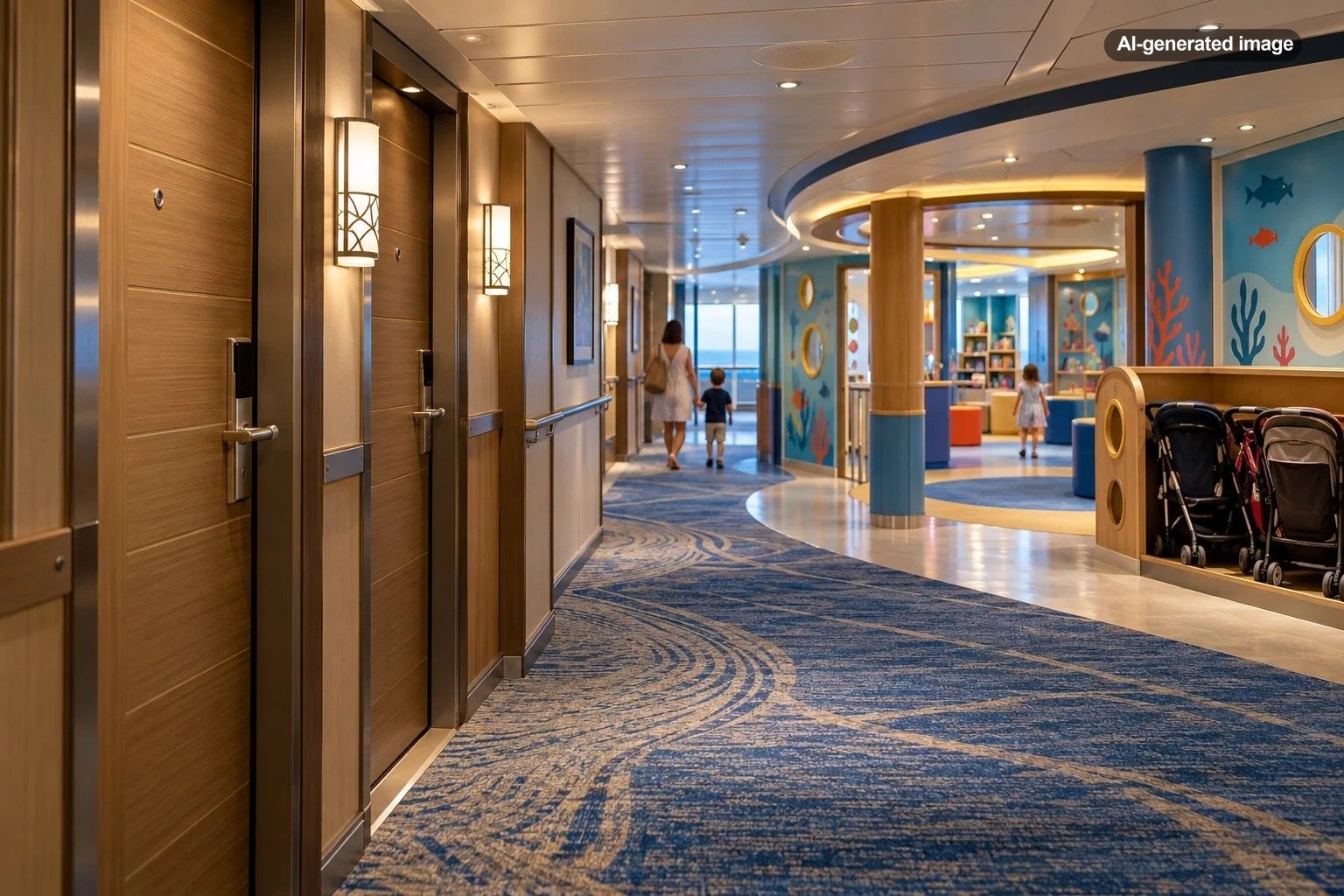
The important distinction is that “near the kids club” can describe several very different locations. A cabin one deck away may have little practical connection to the youth area, while a room directly beside an entrance, across from a busy corridor, or underneath an active space deserves closer scrutiny. The ship’s actual deck plan matters much more than the general label.
Quick answer
- Families using the kids club often: Nearby cabins can be genuinely convenient.
- Light sleepers: Consider putting more distance between your cabin and youth facilities, elevators, stairs, and activity spaces.
- Do not judge by deck number alone: Check what is beside, above, and below the cabin.
- Look at the whole area: An arcade, teen lounge, sports area, or major passenger route may matter as much as the children’s club itself.
- When uncertain: A cabin surrounded by other cabins is usually the simpler choice for travelers focused on a quieter location.
Why cabins near the kids club can be noisier
The potential issue is not necessarily constant noise coming through the wall of the club. Passenger movement can be just as relevant. Youth areas naturally create periods when families arrive, children meet friends, groups leave for activities, and parents wait in nearby corridors.
A cabin positioned directly along that traffic route may therefore experience more hallway conversation, footsteps, and door activity than one tucked into a residential section of the ship. The effect will vary significantly according to the ship’s layout, the exact cabin position, and how heavily the youth facilities are being used on a particular sailing.
It is also worth identifying what else shares the same zone. On some ships, children’s programming may be near teen spaces, video arcades, sports facilities, or other recreation areas. These combinations can make the surrounding corridor more active than a deck plan label such as “kids club” initially suggests.
When being close to the kids club is an advantage
For parents, proximity can be one of the more useful cabin-location conveniences on a family cruise. A short walk makes repeated trips less burdensome, particularly when children participate in different activities or family members frequently return to the cabin between programs.
The advantage is especially noticeable when the alternative involves several decks, long corridors, or repeated elevator trips. A cabin near the youth area can simplify the daily rhythm of the trip without requiring the family to organize every pickup and drop-off as a separate journey across the ship.
Parents should therefore avoid treating proximity as a flaw by default. If the children’s program is likely to be a major part of the cruise, a nearby cabin may be more practical than a supposedly quieter room in a distant section of the ship.
Who should consider choosing a cabin farther away
Travelers who are highly sensitive to hallway activity have more reason to be cautious. This includes adults traveling without children, couples seeking a particularly quiet retreat, families with babies or toddlers who nap at irregular times, and anyone who expects to spend substantial daytime hours resting in the cabin.
Early sleepers should also examine the broader recreation zone rather than focusing solely on programming for younger children. Teen spaces and neighboring entertainment facilities may have a different pattern of activity from the kids club itself.
None of this means that every cabin near a youth facility will be disruptive. It means that a noise-sensitive traveler has little reason to accept the uncertainty when similarly suitable cabins may be available in a quieter-looking section.
Directly beside the club is different from being one deck away
Distance on a cruise ship is not always intuitive. Two cabins described as being “near” the same facility can have very different exposure to passenger traffic.
Directly beside or across from an entrance
This deserves the most attention because passengers may gather or pass the cabin repeatedly. A room located near the beginning or end of a heavily used corridor can also receive traffic that has little to do with the club itself.
Several doors down the hallway
This may offer a useful compromise for families: close enough for convenient access without being immediately beside the main doorway. Examine where elevators, stairwells, and corridor intersections sit, because they can change how passengers move through the area.
One deck above or below
Do not assume vertical separation eliminates every concern. Check what sits directly above or below the cabin on the deck plan. A cabin under part of an activity facility deserves a different evaluation from one below a quiet corridor or enclosed service area.
Nearby but separated by elevators or another public space
This can feel much farther away in practice than the map suggests. The route passengers actually follow often matters more than the straight-line distance between the cabin and the youth facility.
Check the entire deck plan before booking
A good cabin assessment should involve at least three deck plans: your cabin’s deck, the deck above, and the deck below. Cruise lines can change deck configurations over time, so use the deck plan corresponding to the ship and sailing period you are considering rather than relying only on an old image found elsewhere.
Look for several features at once:
- The entrance to the children’s facility rather than simply the area occupied by it.
- Nearby elevators and stairwells that may funnel passengers through the corridor.
- Teen clubs, arcades, sports areas, pools, lounges, theaters, and other recreation spaces.
- Large open areas or unlabeled spaces immediately above or below the cabin that warrant further investigation.
- Whether the cabin sits in a long residential corridor or at an intersection connecting several public spaces.
This broader review is more useful than choosing a cabin based on a single nearby label.
A cabin surrounded by cabins is the conservative choice
Travelers who place quiet above convenience often use a simple cabin-selection principle: choose a room with passenger cabins beside it and passenger cabins on the decks immediately above and below. This does not guarantee silence, since neighbors and hallway traffic are unpredictable, but it reduces the number of obvious public-space variables surrounding the room.
That approach can be particularly useful when comparing two otherwise similar cabins. If one is beside a major family activity zone and the other is embedded within residential decks, the second option involves fewer location-related uncertainties for a noise-conscious traveler.
Families should balance convenience against nap schedules
Families have a more complicated calculation because the same location can be both convenient and inconvenient. Parents with school-age children who will regularly attend supervised programming may appreciate being close. Parents traveling with a baby or toddler who needs quiet daytime naps may care more about limiting corridor activity.
Consider which family routine will happen more often. If there will be several trips to the kids club each day, proximity can save meaningful effort over the course of the cruise. If one child will spend considerably more time sleeping in the room than participating in organized activities, a quieter location may deserve priority.
Do not overlook nearby elevators and stairs
It is easy to blame the kids club for every location concern when the more relevant feature may be a nearby circulation hub. Elevators and stairwells naturally attract passenger movement because they connect dining, entertainment, accommodations, and recreation areas.
A cabin between the kids club and a bank of elevators, for example, may sit directly along a common walking route. Another cabin equally close to the club but located beyond its entrance could receive much less through-traffic. Studying passenger flow can therefore be more informative than simply measuring the number of cabins between your room and the youth area.
What travelers often overlook
The most overlooked issue is that youth facilities are not positioned identically across cruise ships. Even ships operated by the same cruise line can have different layouts, and official deck plans may be updated as configurations change. Advice about one vessel should not automatically be applied to another.
Another common mistake is evaluating only the cabin’s own deck. A room that appears to be in a quiet hallway may sit below an active public space. Conversely, a cabin relatively close to the kids club may be well separated from its actual entrance and major passenger routes.
Finally, consider how much time you realistically expect to spend in the room. Travelers who use the cabin mainly for sleeping may have different priorities from someone planning afternoon naps, remote work, long balcony breaks, or substantial downtime aboard the ship.
So, should you avoid the kids club area?
Avoid it if quiet is one of your highest cabin priorities and you have equally suitable alternatives. There is little advantage in accepting a more active location if your group will rarely use the youth facilities.
Do not avoid it automatically if you are cruising with children who will use the club frequently. For many families, a conveniently positioned cabin can reduce walking and simplify the day enough to outweigh the possibility of additional corridor activity.
The strongest choice is rarely “near” or “far” in isolation. Look at the entrance, passenger flow, surrounding public spaces, and the decks above and below. That gives you a much better picture of how the cabin may function during the cruise.
Frequently asked questions
Are cruise cabins next to the kids club always noisy?
No. Noise depends on the ship’s layout, the cabin’s exact position, nearby public spaces, passenger traffic, and how the area is used. Proximity alone does not establish that a cabin will be noisy.
Is one deck away from the kids club far enough?
There is no universal distance that guarantees a quieter cabin. Check what is directly above or below the room and whether elevators, stairs, arcades, sports areas, or other activity spaces are nearby.
Is a cabin near the kids club good for families?
It can be an excellent location for families who expect frequent pickups and drop-offs. Families with children who need long daytime naps may place greater value on a quieter residential area.
What is the safest cabin-location strategy for a light sleeper?
From a noise-planning perspective, a cabin surrounded by other cabins on the same deck and on the decks above and below generally presents fewer obvious public-space concerns. Also examine proximity to elevators, stairs, connecting corridors, and recreation areas.
Should I choose a cabin near the kids club just because I am traveling with children?
Not necessarily. Choose it when the convenience fits your family’s expected routine. If your children are unlikely to use the program much, another cabin location may offer advantages that matter more to your trip.