Forward vs. Aft Cruise Cabin: Which Location Has More Motion?
Forward cabins generally experience more noticeable pitching, especially when a ship travels through head seas, while aft cabins may feel more vibration, shuddering, or side-to-side movement depending on the ship and conditions. Travelers who are sensitive to motion will usually be more comfortable in a lower-deck, midship cabin than at either end of the vessel.
That does not automatically make an aft cabin a better choice than a forward cabin. Each location has advantages involving views, access, atmosphere, and price position. The right choice depends on the kind of motion that bothers you, the ship’s layout, and where you expect to spend most of your time.
Quick Answer: Forward or Aft?
- Forward cabins: More likely to amplify the ship’s up-and-down pitching motion in rough water.
- Aft cabins: May have less dramatic pitching than the bow but can experience vibration, engine-related hum, or occasional shuddering.
- Most stable choice: A cabin near the center of the ship on a lower passenger deck.
- Best for expansive wake views: An aft-facing balcony, if the added walking distance and possible vibration are acceptable.
- Best for quick access to forward venues: A forward cabin near theaters, observation lounges, or adult-only deck areas located toward the bow.
Why Forward Cabins Often Feel More Motion
A cruise ship moves in several ways, but pitching is especially relevant when comparing the bow and stern. Pitching occurs as the front of the ship rises and falls while traveling through waves. Because forward cabins are farther from the vessel’s central pivot area, that vertical movement can feel more pronounced than it does midship.
The effect is not constant. On a calm sailing, a forward cabin may feel perfectly comfortable. Motion becomes more noticeable when the ship encounters larger waves, unfavorable wind direction, or open-ocean conditions. A high-deck forward cabin can intensify the sensation because it combines distance from the ship’s center with greater height above the waterline.
Some travelers enjoy the feeling of being near the bow, particularly when the location provides convenient access to observation areas or quieter corridors. Others find that the repeated rising and falling sensation interferes with sleep or makes reading difficult.
What Motion Feels Like in an Aft Cabin
Aft cabins are not motion-free. They can still feel pitching and rolling, particularly in rough conditions. However, the character of the movement may be different from what travelers notice near the bow.
Depending on the vessel, an aft cabin may have more vibration from propulsion systems, thrusters, or mechanical equipment. Some passengers describe this as a low hum or a subtle trembling rather than the stronger lifting sensation associated with the bow. During docking or maneuvering, vibration may become temporarily more noticeable.
Very aft-facing cabins can also experience a rhythmic side-to-side or fishtailing sensation in certain sea conditions. This is not guaranteed, and ship design matters considerably, but it is worth considering if vibration bothers you more than vertical movement.
Forward vs. Aft Cabin Comparison
| Factor | Forward Cabin | Aft Cabin |
|---|---|---|
| Typical motion | More noticeable pitching in rough water | Possible vibration, shuddering, or rolling |
| Best feature | Access to forward venues and observation areas | Wake views and access to aft dining or pool areas |
| Potential drawback | Greater sensitivity to rising and falling motion | Long walks, vibration, or noise on some ships |
| Best for | Travelers prioritizing forward attractions or quieter hallways | Travelers who value wake views and aft amenities |
| Less suitable for | Travelers highly sensitive to pitching | Travelers bothered by vibration or extended walking |
Which Location Is Better for Seasickness?
For travelers concerned about seasickness, the most reliable strategy is usually to avoid both extremes. Choose a cabin close to midship and on a lower passenger deck. This places you nearer the vessel’s center of movement, where pitching and rolling are often less pronounced.
If the available choice is strictly between forward and aft, an aft cabin will often be the more comfortable option for someone who is sensitive to strong pitching. However, this is not a universal rule. A high aft cabin on a ship known for noticeable stern vibration may be less comfortable for a traveler who is particularly sensitive to mechanical movement.
It is also useful to consider the itinerary. A sheltered coastal route may involve less sustained motion than an itinerary with multiple open-ocean sea days. Weather cannot be guaranteed, but the route and season can help you judge how heavily cabin stability should influence your decision.
Noise and Vibration Can Matter as Much as Motion
Cabin comfort is not determined by waves alone. The deck plan above, below, and beside the cabin can have a greater effect on sleep than the difference between forward and aft.
Forward cabins may be located near theaters, crew areas, anchor equipment, or bow thrusters. A cabin close to the anchor area can be noisy during early port arrivals. Aft cabins may sit beneath outdoor dining spaces, pool decks, late-night venues, or areas affected by engine and thruster vibration.
Before booking, examine several decks rather than only the cabin’s immediate hallway. A room between other passenger-cabin decks is generally a safer choice for travelers who prioritize quiet. Avoid assuming that an expensive balcony category is automatically quieter or more stable.
When a Forward Cabin Makes Sense
A forward cabin can be a practical choice when you value access to venues near the bow. Depending on the ship, these may include the main theater, observation lounge, spa, fitness center, or adults-only retreat. Staying nearby can reduce repeated walks through a very large vessel.
Forward hallways may also receive less pass-through traffic because fewer guests need to walk beyond the cabins at the end of the corridor. This can create a quieter atmosphere between scheduled activities, although nearby entertainment or operational spaces can offset that advantage.
A forward cabin is best suited to travelers who are not especially prone to motion sickness, prefer the location’s nearby venues, and are comfortable accepting more movement if sea conditions become unsettled.
When an Aft Cabin Is Worth Considering
Aft cabins can be especially appealing on ships with dining rooms, buffet areas, pools, or outdoor promenades near the stern. They may suit travelers who plan to spend substantial time in those spaces and want to avoid crossing the entire ship several times a day.
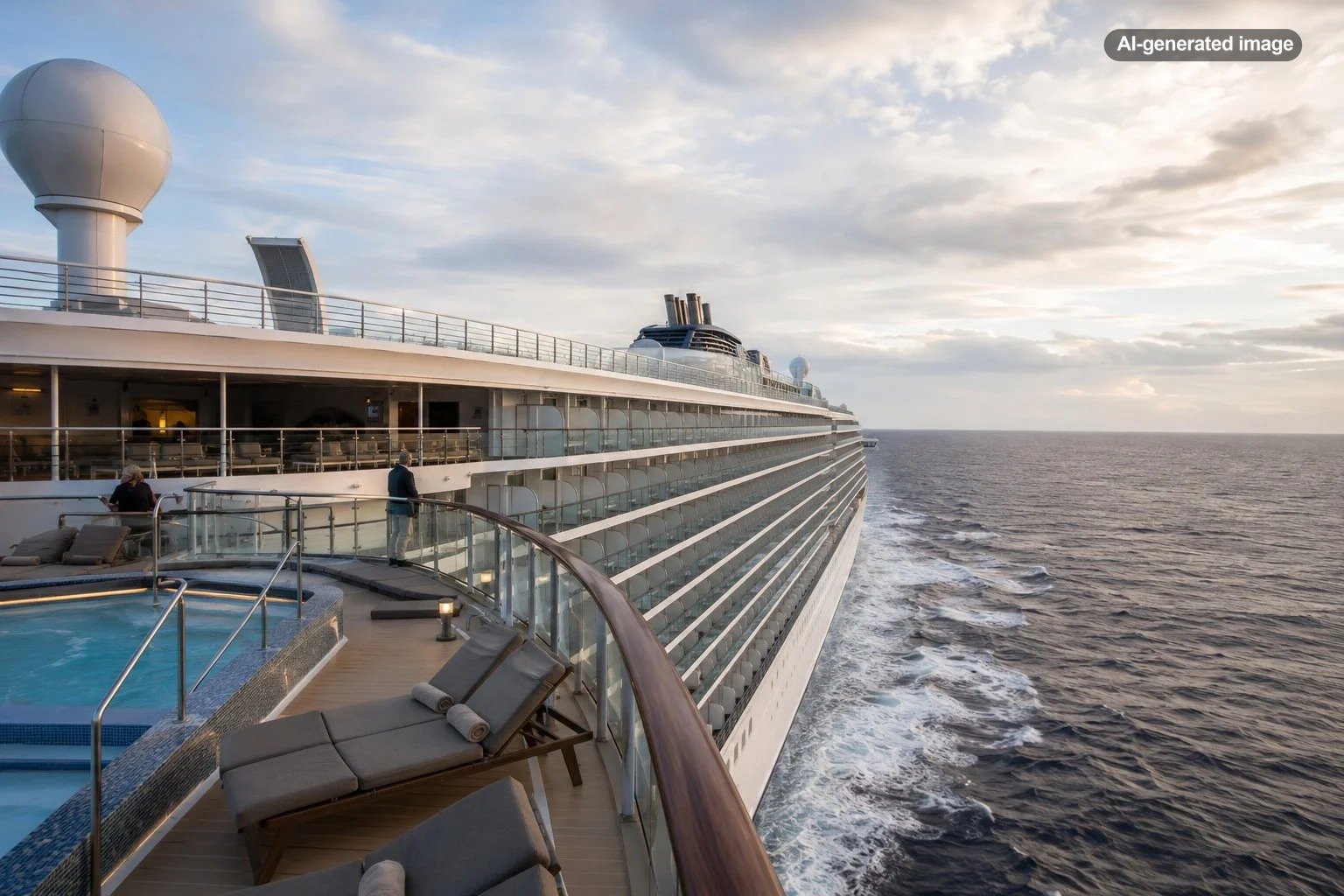
Aft-facing balconies are also popular for their broad views of the ship’s wake. The perspective can feel more private and visually dramatic than a standard side-facing balcony. The tradeoffs may include a longer walk to forward venues, possible soot or spray exposure in some conditions, reduced privacy on tiered stern designs, and more vibration during maneuvering.
Travelers with limited mobility should review walking distances carefully. A cabin at the extreme stern may be a considerable distance from elevators or activities at the opposite end of the ship.
How to Choose the Best Cabin for Your Priorities
Choose forward when:
- You regularly use venues located near the bow.
- You prefer a corridor with less pass-through traffic.
- You are not particularly sensitive to pitching motion.
- The forward cabin offers a better layout or value than the available alternatives.
Choose aft when:
- You want a stern-facing balcony or wake view.
- You prefer quick access to aft dining, pools, or lounges.
- You would rather risk vibration than stronger bow movement.
- You do not mind longer walks to forward venues.
Choose midship when:
- You are prone to seasickness.
- You want more balanced access to the entire ship.
- You are booking for an older traveler, a first-time cruiser, or someone uncertain about sea motion.
- Stability matters more than a specialized view or location.
Affiliate disclosure: HotelInfo.com may earn a commission when you book or purchase through links on this page. This does not affect the price you pay. Learn more.
Once you know which cabin location fits your preferences, you can compare available sailings and review ship layouts, routes, and cabin categories. Fares, taxes, gratuities, itineraries, onboard charges, and cancellation terms vary, so review the current booking details before making a decision.
What Travelers Often Overlook
The labels “forward” and “aft” cover large sections of a ship. A cabin slightly forward of midship may behave very differently from one directly behind the bridge. Likewise, a cabin in the aft third of the ship is not the same as a stern-facing room at the vessel’s extreme end.
Cabin height also matters. Higher decks tend to amplify movement more than lower decks. A low-deck forward cabin may feel more stable than a high-deck aft cabin, even though aft is often described as the less motion-prone end.
Finally, think about your daily routine. Choosing the theoretically smoothest cabin may not improve the trip if it creates long walks to every venue you use. Stability, noise, elevator access, views, and convenience should be evaluated together.
Frequently Asked Questions
Is the front or back of a cruise ship rougher?
The front usually feels more up-and-down pitching because the bow rises and falls through waves. The back may feel more vibration or shuddering, especially during docking and low-speed maneuvering.
Are aft balconies more stable than forward balconies?
They may experience less dramatic pitching than balconies near the bow, but they are not necessarily more stable in every condition. Ship design, deck height, wind, waves, and vibration all affect comfort.
What is the best deck for avoiding motion?
A lower passenger deck near midship is generally the preferred location for minimizing perceived movement. Avoid choosing solely by deck number; also check what is located above and below the cabin.
Do larger cruise ships have less motion?
Larger ships may feel steadier in some conditions, but no vessel is immune to movement. Hull design, stabilizers, speed, wave direction, and weather also influence how much motion passengers feel.
Should a first-time cruiser book forward or aft?
A first-time cruiser who is unsure about motion sensitivity should usually prioritize a midship cabin. When only forward and aft options remain, aft may be preferable for reducing strong pitching, provided the traveler is comfortable with possible vibration and longer walking distances.
The Bottom Line
Forward cabins usually have more noticeable pitching, while aft cabins may trade some of that vertical movement for vibration, shuddering, and longer walks. Neither end is universally better. Motion-sensitive travelers should look for a lower-deck midship cabin, while travelers choosing between the two ends should match the location to the type of motion, view, and onboard convenience they value most.