How to Tell If a Cruise Cabin Balcony Is Near a Smoking Area
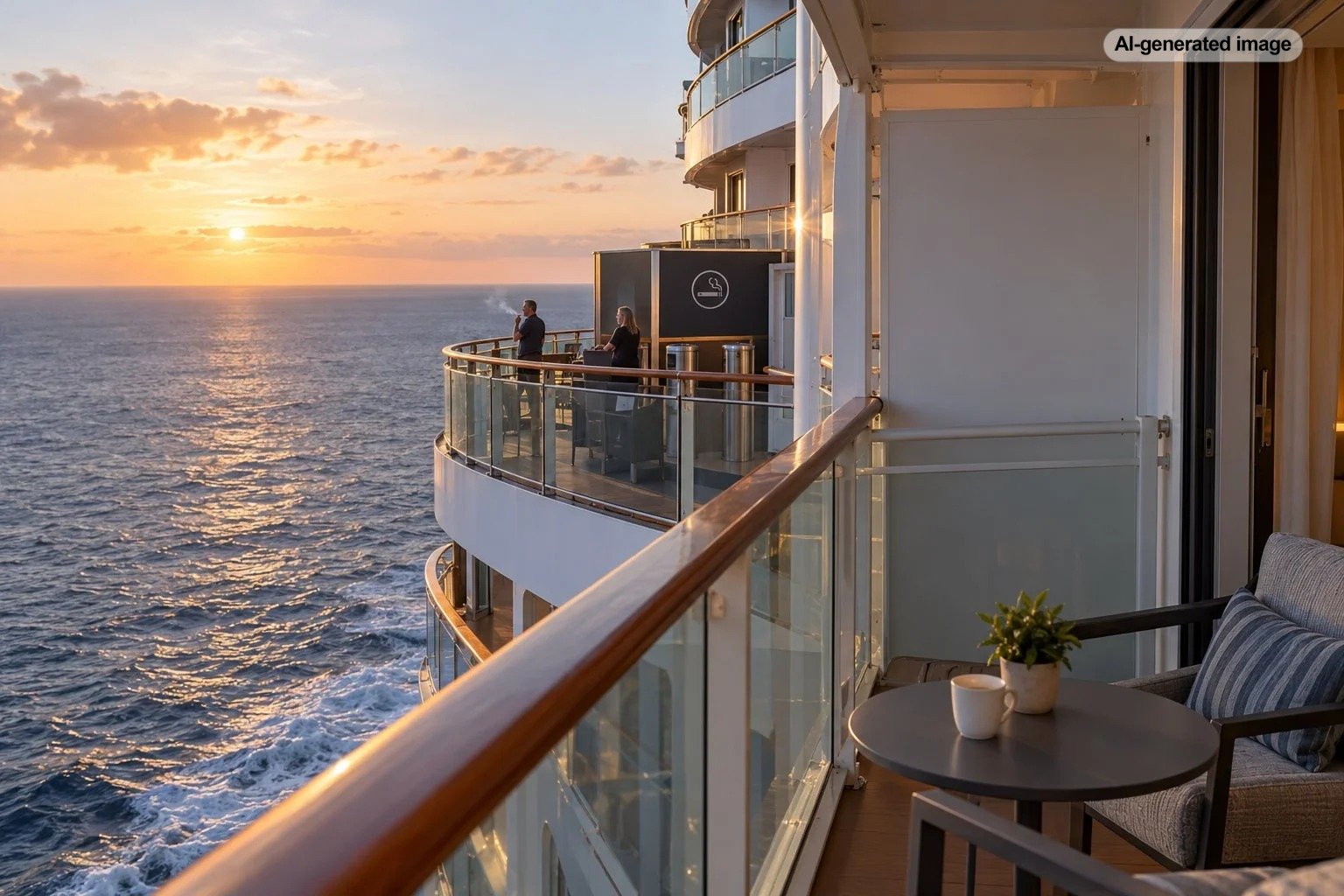
A cruise balcony can look perfectly positioned on a deck plan and still be uncomfortably close to a designated smoking area. The concern is not necessarily that someone will smoke on the neighboring balcony. On many cruise ships, smoking is prohibited on private cabin balconies, but designated outdoor smoking sections may sit near passenger accommodations. Depending on the ship’s layout and conditions outside, smoke from those sections can sometimes reach nearby balconies.
To determine whether a particular cruise cabin is near a smoking area, identify the ship’s designated smoking locations, compare them with the cabin’s position on the official deck plans, and ask the cruise line to confirm the arrangement for your specific sailing. The deck number alone is not enough. The side of the ship, the location of open-air decks, and whether the cabin sits above, below, or beside a smoking section can all matter.
Quick Answer: How to Check Before Booking
- Find the ship’s smoking policy. Look for designated outdoor smoking areas rather than relying only on the general statement that cabin balconies are nonsmoking.
- Identify exact locations. Note the deck number, port or starboard side, and whether the smoking area is forward, midship, or aft.
- Compare deck plans. Examine the candidate cabin’s deck and the decks immediately above and below it.
- Ask about vertical exposure. A smoking section on an open promenade or pool deck may be relevant even if it is not on the cabin’s deck.
- Confirm with the cruise line. Ask whether your specific cabin is adjacent to, directly above, directly below, or otherwise exposed to an authorized outdoor smoking area.
Start With the Smoking Policy for the Exact Ship
The most important distinction is between a cruise line’s overall smoking policy and the smoking locations assigned to a particular vessel. A policy explaining that smoking is limited to designated areas does not necessarily tell you where those areas are situated.
Royal Caribbean, for example, prohibits smoking in staterooms and on stateroom balconies while allowing smoking in designated areas of its ships. Carnival likewise prohibits smoking on private cabin balconies and publishes a ship-specific guide identifying authorized smoking locations. These policies establish where smoking is permitted, but they do not guarantee that smoke will never be noticeable elsewhere.
Smoking arrangements can differ across ships belonging to the same cruise line. An outdoor smoking section might be near a pool deck on one vessel and along a lower exterior promenade on another. Some vessels also have designated casino smoking areas, subject to applicable restrictions. The existence of an indoor smoking venue does not automatically mean that an adjacent exterior balcony is affected.
Use the precise ship name, rather than only the cruise line or ship class, when researching. If the vessel has been renovated, renamed, or reassigned, confirm that the information reflects its current arrangement.
Compare Smoking Locations With the Ship’s Deck Plans
Once you know where smoking is permitted, open the official deck plan for the ship and locate your potential cabin. Many cruise lines publish deck plans that identify individual cabin numbers and major public spaces.
Start by recording three details: the cabin’s deck number, its position along the ship, and whether it faces port or starboard. Then find the corresponding locations of the designated smoking areas.
Check the same deck
A cabin on the same deck as an outdoor smoking section deserves closer examination, especially if both occupy the same side of the vessel. However, sharing a deck number does not automatically establish proximity. A smoking area near the stern may be a substantial distance from a forward cabin, and walls or enclosed spaces may separate the locations.
Check the deck immediately below
One frequently overlooked arrangement involves private balconies overlooking a lower open-air public deck. If that deck contains an authorized smoking section, some smoke may move upward toward nearby balconies under certain wind conditions.
Look for exterior promenade decks, open-air seating areas, and other public spaces beneath the cabin. A balcony directly overlooking a designated smoking section deserves more scrutiny than a balcony merely sharing the same side of the ship.
Check the deck immediately above
Upper-deck smoking locations can also be relevant. A balcony beneath an open deck may be affected by the arrangement of that deck, although smoke movement cannot be predicted from vertical position alone.
Examine whether the balcony is sheltered by an overhang, located under an outdoor seating section, or positioned near the exterior edge of a public deck. These structural details help frame a useful question for the cruise line, but they are not reliable evidence of how much smoke will reach the balcony.
Pay Attention to Port, Starboard, Forward, and Aft
On a cruise ship, port means the left side when facing toward the bow, while starboard means the right. Forward refers to the front of the ship, and aft refers to the rear. These distinctions are particularly useful because smoking locations are sometimes described using exactly this terminology.
For example, a published smoking location described as Deck 11, starboard, aft would direct your attention to cabins near the rear of the ship on the starboard side, particularly those overlooking or immediately bordering that area. A cabin on Deck 11 near the bow would not have the same direct relationship to the smoking section.
Do not assume that every ship puts smoking areas on the same side. Even within one cruise line, arrangements may vary by vessel. Carnival’s published ship-specific smoking guide demonstrates why checking individual ships is more useful than applying a universal port-side or starboard-side rule.
When reviewing cabin positions, also consider whether a large open deck extends around the ship’s corners. A balcony around a forward or aft corner may have a different relationship to a smoking area than a simple side-view diagram suggests.
Why a Nonsmoking Balcony Can Still Be Exposed to Smoke
Private balcony smoking bans and freedom from neighboring smoke are two different questions. A cruise line can enforce a nonsmoking balcony policy while still maintaining an approved smoking section elsewhere on the vessel.
Outdoor airflow is variable. Ship movement, prevailing winds, local turbulence around the vessel’s structure, and the design of open decks can influence where smoke travels. Consequently, a smoking area that appears to be downwind on one occasion might affect different nearby spaces when conditions change.
This makes it difficult to establish a universally safe distance between a cabin and a smoking area. Two cabins separated by the same number of doors can experience different conditions because one overlooks an open deck while the other is shielded by part of the ship’s structure.
It is also worth distinguishing occasional smoke odors from persistent exposure. Being near a smoking area does not mean that smoke will constantly enter the cabin or cover the balcony. Conversely, a smoking area that is not immediately adjacent may sometimes be noticeable. Deck plans help identify possible exposure, not predict exact air quality.
Where to Find More Precise Smoking-Area Information
The most reliable starting point is the cruise line’s official website. Search for the ship name together with terms such as designated smoking areas, outdoor smoking locations, or smoking policy. When a cruise line provides a vessel-by-vessel list, use that rather than a general policy summary.
Compare that information with the latest official deck plan. Third-party cabin diagrams can be useful for understanding a layout, but they may not reflect recent operational changes. An older discussion mentioning a smoking section is worth investigating, not treating as definitive.
Passenger photographs and cabin reviews can add useful context. In particular, look for photographs showing the view directly beneath a balcony, an exterior promenade, or ashtrays and smoking-area signs. A review mentioning cigarette odor near a specific cabin can identify a potential concern, but it is only one observation from a particular sailing.
Give more weight to recent, cabin-specific reports than to broad statements about an entire deck. Reports describing the same recurring issue from multiple sailings may justify additional questions, although they still cannot establish what conditions will be like on your departure.
Questions to Ask the Cruise Line Before Selecting a Cabin
A general question such as ‘Is this a nonsmoking cabin?’ is unlikely to resolve the issue. On cruise lines that prohibit balcony smoking, the answer could be yes even when the cabin is located above an authorized outdoor smoking section.
Instead, contact the cruise line or booking representative with the ship name, departure date, and candidate cabin numbers. Ask:
- Where are the designated outdoor smoking areas on this particular ship?
- Which decks and sides of the vessel contain those areas?
- Is cabin number [your cabin number] directly above, below, beside, or overlooking an outdoor smoking area?
- Is there an authorized smoking section on a public promenade or open deck beneath this balcony?
- Are any changes to the smoking-area locations expected for this sailing?
- If I choose a different cabin, which nearby locations are farther from designated smoking sections?
If avoiding smoke is especially important, request the answer in writing when possible. A written response is useful for keeping track of what was represented before booking, although it does not guarantee that onboard arrangements or weather conditions will remain unchanged.
Choosing Between Two Balcony Cabins
Suppose you are considering two similarly priced balconies. Cabin A is on an upper deck with convenient access to a pool, but the outdoor smoking section is located on a nearby portion of that public deck. Cabin B is several decks lower, with other passenger cabins directly above and below it.
If your priority is minimizing the possibility of smoke exposure, Cabin B may be the more sensible candidate, provided the deck plans and ship-specific policy confirm that it is farther from authorized smoking locations. Cabin A might be more convenient for pool access, but that convenience may come with a proximity concern.
A different comparison might involve two cabins on the same deck: one directly overlooking a promenade smoking area and another farther forward on the opposite side. The second could present a lower obvious exposure risk, although no placement can guarantee an odor-free balcony.
For travelers who are particularly sensitive to smoke, selecting a cabin surrounded by other passenger accommodations, away from designated smoking spaces and open public decks, is a reasonable precaution. Other cabin considerations, such as noise, obstructed views, elevators, and motion, still deserve attention.
What If You Are Booking a Guarantee Balcony Cabin?
A guarantee booking generally means purchasing a specified cabin category or minimum category while allowing the cruise line to assign the actual cabin. The terms vary, and the final position may not be known when you commit to the reservation.
This arrangement can complicate efforts to avoid smoking areas because you may not be able to inspect the specific balcony location before booking. Even when the eventual room meets the purchased category, its proximity to an outdoor smoking section might not match your preferences.
If smoke exposure is a significant concern, choosing an available cabin number yourself may offer more control than accepting an unassigned guarantee. Before paying extra for that control, verify the applicable booking terms, since cabin assignments can sometimes change for operational reasons.
Travelers still comparing ships and itineraries can explore cruise options, then examine the individual ship’s smoking policy and cabin layout before making a final selection.
What to Do if You Notice Smoke After Boarding
If cigarette or cigar smoke repeatedly reaches your balcony, document the location and approximate times when it occurs. Then contact onboard Guest Services and explain the issue without assuming that another passenger is violating the rules.
Ask whether the odor may be coming from a designated smoking section and whether any practical solution is available. Depending on the circumstances, staff may be able to clarify the source, investigate a possible policy violation, or discuss alternative accommodations. Availability and remedies are not guaranteed.
If you observe someone smoking on a private balcony where that activity is prohibited, report the concern to ship personnel rather than confronting the passenger. The crew is responsible for interpreting and enforcing its onboard policies.
If a move is offered, inspect the proposed replacement cabin’s location as carefully as possible. A different balcony is not necessarily farther from every smoking area.
Common Mistakes When Checking Balcony Locations
Assuming a balcony smoking ban eliminates the problem. Such rules address where passengers may smoke, not where smoke can travel from authorized areas.
Looking only at one deck. A relevant smoking section may be on a public deck directly above or below the balcony.
Using the ship class instead of the individual ship. Similar vessels can have different designated smoking locations or operational arrangements.
Relying on old deck plans. A current cabin map and updated smoking-location guidance are more useful than diagrams from an earlier configuration.
Treating distance as a guarantee. Outdoor smoke movement depends on conditions that a static deck plan cannot show.
Waiting until boarding to raise the issue. Cabin choice is usually easier to evaluate before the reservation is finalized, especially when you have several available cabins to compare.
Frequently Asked Questions
Can someone smoke on the balcony next to my cruise cabin?
On major cruise lines such as Royal Caribbean and Carnival, smoking is prohibited on private stateroom balconies. Policies differ across operators, so check the rules for the cruise line you are booking. A prohibition does not guarantee that every passenger will comply.
Is a balcony above a smoking area always a bad choice?
No. It presents a potential exposure concern, but the actual experience depends on the distance, ship structure, smoking-area usage, and outdoor conditions. Travelers especially concerned about smoke may prefer a cabin with greater separation.
Can I identify smoking areas from a cruise deck plan alone?
Not always. Some deck plans identify public facilities without explicitly labeling smoking sections. Compare the deck plan with the cruise line’s ship-specific smoking information and ask a representative when details are unclear.
Are higher balcony decks less likely to smell smoke?
Not necessarily. A higher cabin might be farther from a lower smoking area but closer to a smoking section on an upper open deck. The relative location matters more than deck height by itself.
Can I change cabins if smoke reaches my balcony?
You can request assistance from Guest Services, but a complimentary move, refund, or other remedy is not automatic. The response depends on the cruise line’s policies, available accommodations, and circumstances.
The Most Reliable Way to Make Your Choice
For travelers who want a balcony without unnecessary smoke exposure, the strongest approach is to combine three checks: the current smoking-area locations for the exact ship, the official deck plans surrounding the proposed cabin, and direct confirmation from the cruise line.
Prioritize separation from designated outdoor smoking sections rather than relying on deck height or a general nonsmoking policy. Although no cabin selection can control the wind or guarantee a completely odor-free experience, careful research before booking can substantially improve the quality of the decision.
Sources & Further Reading
- Royal Caribbean: Guest Health, Safety, and Conduct Policy – Official guidance on stateroom balcony smoking restrictions and designated smoking areas.
- Carnival Cruise Line: Locations Where You Can Smoke – Ship-specific information identifying designated smoking locations by deck and area.
- Carnival Cruise Line: Drug Free Zones – Official clarification of smoking restrictions in staterooms and on balconies.