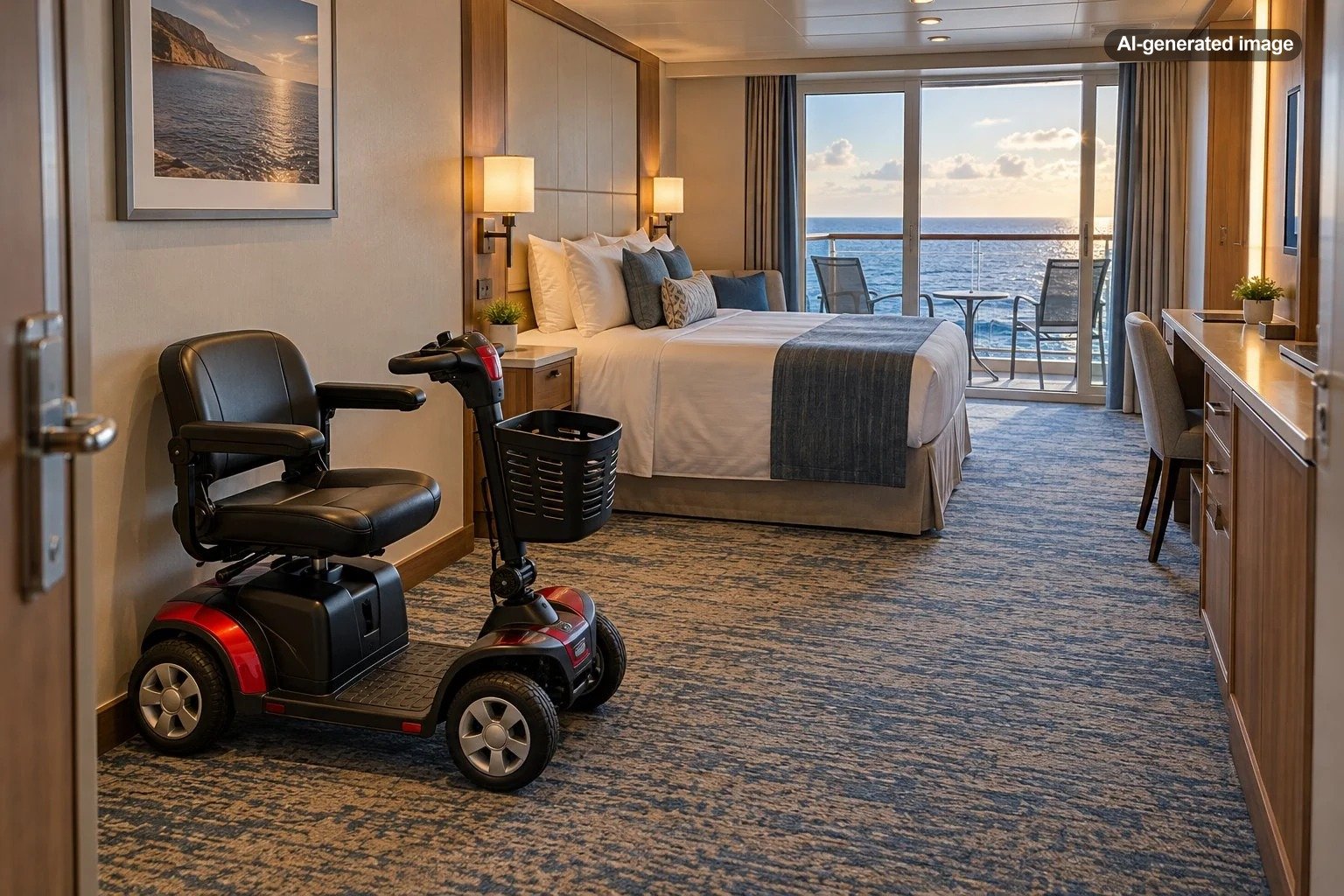
How to Choose a Cruise Cabin With Space for a Mobility Scooter
Choosing a cruise cabin when traveling with a mobility scooter requires more than finding a room labeled accessible. The scooter must fit through the doorway, have a permitted storage and charging location, and leave enough clear floor space for the traveler to move safely between the bed, bathroom, and exit. A cabin that technically accommodates a scooter may still feel cramped if its layout does not suit the person using it.
The most reliable approach is to measure the scooter, understand the differences between cabin accessibility categories, and obtain confirmation from the cruise line about the exact ship and stateroom before committing to a reservation.
Quick Answer: What Makes a Cabin Suitable?
- Doorway clearance: The scooter must pass through the actual usable opening, not merely fit within the advertised cabin dimensions.
- Indoor storage: There must be enough space to park the scooter without blocking the exit or essential walking routes.
- Charging arrangements: The cruise line must permit the scooter and its battery type to be charged in the designated location.
- Bathroom access: Travelers who need to use a scooter or wheelchair inside the cabin should confirm the bathroom doorway, threshold, and turning space.
- Written confirmation: Verify the exact cabin number, device measurements, and any special requirements with the cruise line’s accessibility team.
Measure the Scooter Before Comparing Cabins
Begin with the dimensions of the scooter as it will actually enter and occupy the stateroom. Record its overall width at the widest fixed point, total length, height, and weight. Include accessories such as armrests, baskets, mirrors, or rear-mounted holders if they increase the dimensions.
If the scooter folds or disassembles, record both its operating and stored measurements. However, do not assume that disassembly will satisfy a cruise line’s requirements. Some operators specifically require a scooter to fold or collapse when used in particular cabin categories.
The scooter’s turning radius is another useful measurement. A device may pass through a doorway but require more maneuvering space than the cabin provides. Travelers who cannot comfortably lift, reposition, or disassemble their scooter should prioritize a layout that allows straightforward entry and parking.
Keep the manufacturer’s model information and battery specifications available. Accessibility departments may ask for these details when reviewing whether a device can be accommodated.
Understand the Difference Between Accessible Cabin Types
Not every cabin described as accessible offers the same features. Cruise lines may distinguish between fully accessible staterooms, partially accessible accommodations, and cabins intended for guests who can walk but benefit from additional support.
Fully Accessible Staterooms
Fully accessible cabins are generally the strongest starting point for travelers who regularly rely on a mobility scooter or wheelchair. Depending on the ship and cabin, they may provide wider entry doors, more usable floor space, accessible bathroom arrangements, and improved routes around furniture.
Nevertheless, an accessible designation does not establish that every scooter will fit. Equipment dimensions, furniture placement, and the available parking area still matter.
Ambulatory Accessible Cabins
Some cruise lines offer ambulatory accessible cabins designed primarily for travelers who can walk but need features such as grab bars. These rooms may retain standard-width entrances or bathroom thresholds that make scooter use difficult.
For example, Carnival distinguishes its fully accessible cabins from ambulatory accessible cabins. Its published guidance explains that ambulatory accessible accommodations are not intended for travelers who regularly depend on scooters or similar devices.
Someone who uses a scooter for long distances but walks independently inside the cabin may have more flexibility. Even then, the scooter must comply with doorway, storage, and charging requirements.
Check the Actual Doorway Clearance
Door measurements deserve particular attention because cruise lines use different standards. Royal Caribbean states that its standard stateroom entry doorways are at least 23 inches wide, while accessible stateroom doorways are at least 32 inches wide.
Carnival identifies approximately 22-inch entry doorways for standard and ambulatory accessible cabins, while its fully accessible cabins generally have wider, approximately 32-inch doorways. Carnival also applies specific scooter-width and storage requirements when selecting a cabin.
These examples demonstrate why a general statement about cruise ship door widths is insufficient. Travelers should confirm the requirements of their chosen cruise line and ship rather than assuming the dimensions are universal.
Ask whether the published measurement describes the usable clear opening with the door fully open. Consider whether the scooter can approach the entrance at a practical angle, particularly when neighboring walls or corridor conditions limit maneuvering.
A scooter that measures only slightly less than the opening may be difficult to move through comfortably. Allowing a practical clearance margin is preferable to relying on a nearly exact fit.
Calculate the Space Needed Inside the Cabin
The square footage advertised for a cruise cabin does not explain how much unobstructed space remains after furniture, closets, and bathroom fixtures are considered. Layout is often more important than the room’s headline size.
Imagine two cabins with similar overall floor areas. One has a clear open section beside the bed where a scooter can park. The other has a narrow route between the bed and a desk, leaving no convenient parking position. The first may be considerably more functional despite having no meaningful size advantage.
When reviewing a deck plan or cabin diagram, look for a direct route from the entrance to the intended storage position. Confirm that parking the scooter will not obstruct the door, bathroom access, closet, or the traveler’s route to the bed.
Also consider the number of occupants. Two travelers sharing a cabin need space for luggage and personal belongings as well as the scooter. If the room includes a sofa bed or another sleeping arrangement, ask how that configuration changes the available floor area.
Confirm Storage and Charging Rules
One of the most consequential planning mistakes is assuming a mobility scooter can be left outside the cabin overnight. Cruise lines commonly prohibit storage in corridors because equipment can interfere with circulation and emergency evacuation.
Royal Caribbean requires mobility scooters and other assistive devices to be stored and recharged inside guest staterooms. Carnival similarly prohibits storing mobility devices in corridors and public areas and requires that the cabin retain a clear, safe exit route.
Before booking, confirm where the scooter can be parked, whether an appropriate electrical outlet is accessible, and whether the manufacturer’s charger and battery type are permitted. Ask about any restrictions on extension cords, charging equipment, or battery chemistry rather than bringing an unapproved electrical accessory.
If the scooter will be rented, request its model specifications from the rental provider before arranging delivery. Do not assume that a device marketed for cruise travel automatically complies with every ship’s requirements.
Evaluate Bathroom Access Separately
A wider cabin doorway does not guarantee that the bathroom will be usable for every traveler. Bathroom access depends on the doorway, threshold, shower configuration, grab-bar placement, and available space for transfers.
Travelers who can leave the scooter near the cabin entrance and walk to the bathroom may need a different configuration from someone who uses a wheelchair indoors or needs a roll-in shower.
Ask whether the bathroom has a raised threshold, whether the shower is level-entry, and whether a shower seat or other accessibility equipment is provided. Confirm which side of the toilet has clearance if assisted or independent transfers are important.
These details should be evaluated according to the traveler’s actual mobility requirements. Selecting the largest available room does not necessarily solve a poorly positioned bathroom entrance.
Consider Cabin Location and Ship Accessibility
Once the cabin itself appears suitable, examine its position on the ship. Convenient access to elevators can reduce the amount of travel required between the stateroom and dining rooms, entertainment venues, or outdoor decks.
However, being near an elevator is not automatically preferable. Travelers sensitive to corridor activity may value a quieter location, provided the route remains manageable.
Consider whether the relevant elevator banks serve the decks the traveler expects to use. Some ships have areas that require alternative routes or involve narrow approaches. Request ship-specific accessibility information rather than assuming all public spaces offer identical access.
It is also worth distinguishing onboard mobility from shore access. A ship may accommodate a scooter comfortably while certain ports, tender operations, or excursions present separate limitations. These should be checked independently when choosing an itinerary.
Compare Sailings Only After Establishing Cabin Suitability
Travelers sometimes begin by comparing departure dates and itineraries, then investigate accessibility after selecting a sailing. Reversing that sequence can prevent disappointment. First identify ships and cabin categories that meet the traveler’s needs, then compare suitable sailings.
Accessible accommodations can be limited, and available cabin categories may differ considerably between ships. An itinerary that looks appealing on paper may be a poor fit if the remaining staterooms cannot safely accommodate the scooter.
Affiliate disclosure: HotelInfo.com may earn a commission when you book or purchase through links on this page. This does not affect the price you pay. Learn more.
For an initial overview of itineraries and departure options, travelers can browse cruises with Expedia. However, a general cruise-search listing should not be treated as confirmation that a specific accessible stateroom is suitable or available. That verification should come directly from the cruise line.
Questions to Ask Before Paying for the Cabin
Contact the cruise line’s accessibility or guest services department with the exact ship, sailing date, proposed cabin number, and scooter specifications. A focused conversation is more valuable than a general assurance that the ship is accessible.
- What is the usable entry doorway width for this specific stateroom?
- Can my scooter enter without being disassembled?
- Where can it be parked and charged inside the cabin?
- Will the scooter block the exit or normal movement around the bed?
- Does this cabin have a roll-in shower, bathroom threshold, or other relevant accessibility features?
- Are there battery, charger, or mobility-device documentation requirements?
- Does the cruise line require an accessibility form before sailing?
- Are there ship-specific restrictions affecting this cabin or scooter model?
Where possible, request written confirmation of the arrangements and retain a copy with the reservation documents. If a travel advisor is involved, make sure the information is confirmed with the cruise line rather than relying exclusively on a booking description.
What Travelers Often Overlook
A balcony is not automatically scooter accessible. Even when a cabin provides enough indoor space, the balcony entrance may have a threshold or insufficient clearance. Confirm balcony access separately if it is important to the trip.
Bed configuration changes usable space. Twin beds, a combined bed, or a deployed sofa bed may alter how easily a scooter can maneuver. Ask whether the preferred arrangement preserves the required accessible route.
Rental equipment measurements matter. A replacement scooter from a rental provider may have different dimensions from the originally requested model. Verify the actual equipment before departure.
Traveling with two scooters creates additional constraints. Even a cabin that accommodates one device may not provide safe storage for two. Cruise lines may require a different cabin category.
Accessible room inventory is not interchangeable. A fully accessible cabin and an ambulatory accessible cabin may differ in ways that directly affect the ability to use a scooter. Do not accept a substitution without reviewing the relevant measurements.
Frequently Asked Questions
Can a mobility scooter fit in a regular cruise cabin?
Sometimes. It depends on the scooter’s dimensions, whether it folds, the cabin’s usable doorway clearance, available storage space, and the cruise line’s policies. A standard cabin should not be booked for scooter use without confirming those details.
Do I need a fully accessible stateroom?
Not every scooter user does. Travelers who can walk inside their cabin and use a sufficiently compact scooter may have more options. Those who regularly depend on mobility equipment or require accessible bathroom features should generally begin by evaluating fully accessible staterooms.
Can I leave my scooter in the hallway overnight?
Do not plan to do so. Major cruise lines including Royal Caribbean and Carnival require mobility devices to be stored inside staterooms and prohibit corridor storage. Confirm the policy applicable to your sailing.
Can I charge my scooter in the cabin?
Many cruise lines provide for charging permitted mobility scooters inside guest staterooms. Battery type, charger specifications, and electrical safety requirements may apply. Obtain approval for the particular device before traveling.
Should I reserve an accessible cabin early?
Early planning is advisable because accessible staterooms are limited and their layouts are not necessarily interchangeable. Begin by identifying the features you genuinely require, then confirm a suitable cabin before finalizing your itinerary.
The Most Reliable Way to Choose
A suitable cruise cabin is one that accommodates the scooter as part of everyday use, not merely one with a sufficiently wide entrance. The traveler should be able to bring the device indoors, park and charge it according to the ship’s rules, move between essential parts of the room, and exit safely.
Measure the equipment first, distinguish fully accessible accommodations from ambulatory accessible rooms, examine the specific cabin layout, and confirm the arrangements directly with the cruise line. Those steps make it easier to select a cruise based on practical comfort and independence rather than an accessibility label alone.
Sources & Further Reading
- Royal Caribbean: Mobility Disabilities and Accessible Cruising – Official guidance on scooter storage, entry doorways, and accessible accommodations.
- Royal Caribbean: Guest Special Needs – Information about accessibility requests and mobility-equipment specifications.
- Carnival Cruise Line: Wheelchair Users and Mobility Disabilities – Official distinctions between cabin types and requirements for scooters.
- Carnival Cruise Line: Safety Information – Policies concerning safe mobility-device storage and cabin exit clearance.