Why Do Some Resorts Have Pool Chairs in Water That Is Too Deep for Comfortable Lounging?
Resort pool chairs placed directly in the water are intended to offer a comfortable middle ground between swimming and sunbathing. Yet some guests discover that the water reaches surprisingly high on the chair, soaking their clothing or making it difficult to sit comfortably. The arrangement can seem especially puzzling when the furniture looks designed for relaxed, nearly dry lounging.
The explanation usually involves a mismatch between the depth of the pool’s submerged shelf, the design of the lounge chair, and the actual operating water level. Some installations intentionally provide a deeper immersion experience, while others are less successful combinations of otherwise functional equipment. Understanding the difference helps travelers decide whether an in-water lounge area is an appealing amenity or merely an attractive feature in resort photographs.
Quick Answer: Why Are Some Pool Loungers So Deep?
- The shelf may be deeper than expected. Not every tanning ledge is designed for ankle-deep water.
- The chairs may be poorly matched to the shelf. A low-profile lounger can sit uncomfortably deep when installed in water beyond its intended range.
- Water levels can vary. Operating levels, rainfall, and pool adjustments can affect how deeply a chair sits.
- The design may prioritize appearance or immersion. Some arrangements are intended for substantial water contact rather than mostly dry reclining.
- Chair placement matters. Furniture positioned near a shelf transition may behave differently from furniture on a consistently shallow surface.
What Is an In-Water Pool Lounge Area?
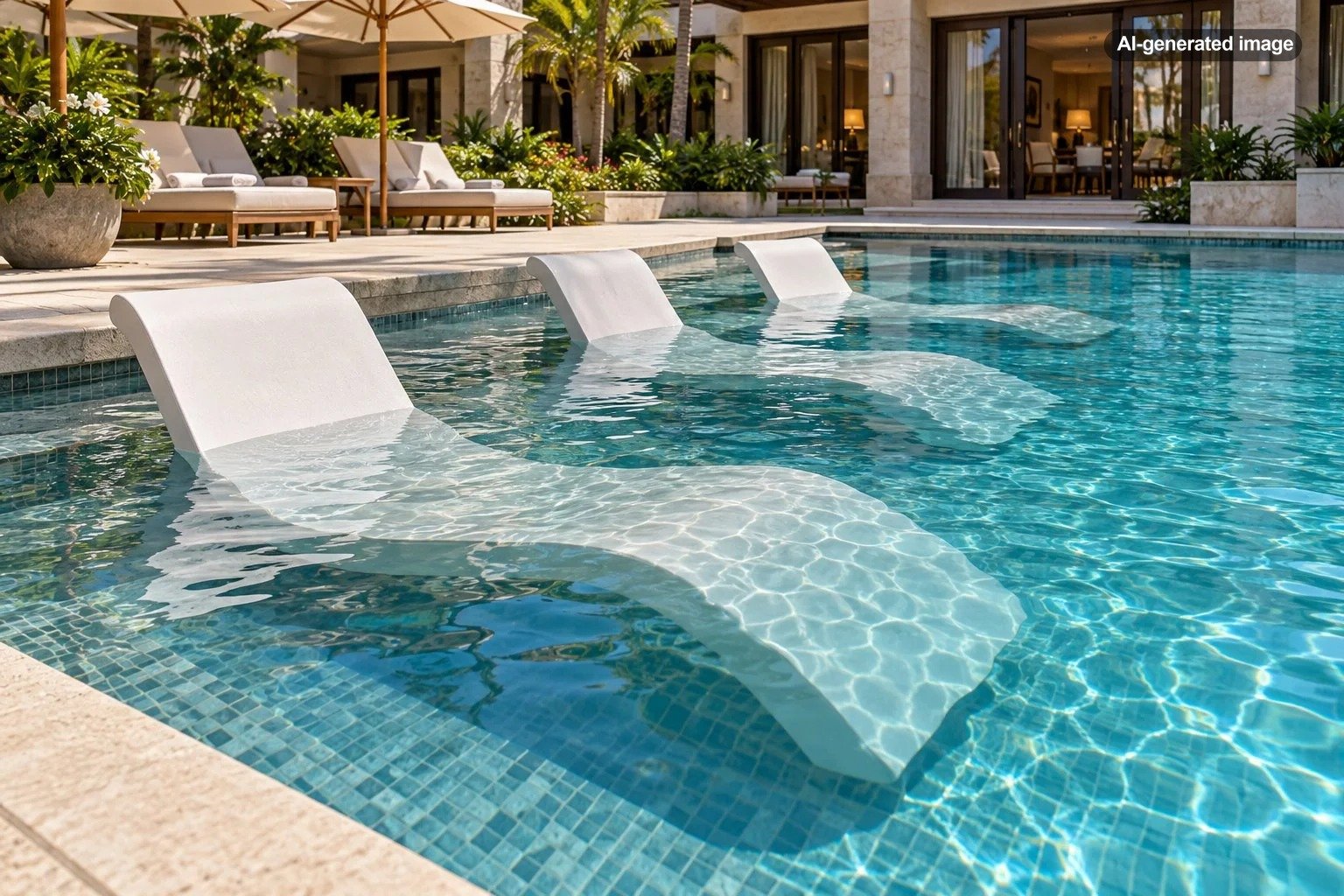
Many resort pools incorporate a broad submerged platform often called a tanning ledge, sun shelf, Baja shelf, or lounging shelf. Unlike the main swimming area, this surface is designed to accommodate people who want to remain partially in the water without swimming.
Some shelves are shallow enough that a reclining guest experiences only light water contact. Others allow water to reach the seat, hips, or lower torso, depending on the furniture and the person’s position.
The terminology can be confusing because there is no single universal depth implied by the words tanning ledge or Baja shelf. Two resorts may advertise visually similar amenities even though their actual lounging experiences are substantially different.
A submerged chair also differs from an ordinary poolside chaise. Its dimensions, weight, stability, and intended water-depth range may be designed for underwater placement. However, not every piece of furniture that appears suitable for pool use will perform equally well at every depth.
The Most Common Reason: Shelf Depth and Chair Height Do Not Match
The most direct explanation for unexpectedly deep seating is the relationship between the pool floor and the chair’s seating surface.
Consider two hypothetical arrangements. In the first, a shallow shelf holds a molded lounger with a raised seat. Only the lower portion of the chair is submerged, leaving most of the occupant above the waterline. In the second, a deeper shelf holds a flatter chair whose seat rests close to the pool floor. Water may cover the seating surface and reach a reclining guest’s waist or higher.
Both arrangements can look elegant from a distance. Their practical differences become obvious only when someone sits down.
Manufacturers may specify compatible water depths for particular in-pool furniture models. A chair intended for shallower installation may not provide its expected seating experience on a deeper platform. Even chairs with similar silhouettes can have different seat heights and immersion characteristics.
For travelers, the useful question is not simply whether a resort has submerged loungers. It is how much of the body remains above water when those loungers are occupied.
Some Resorts Intentionally Favor a More Immersive Experience
Not every deeply submerged chair represents a design mistake. Pool designers may deliberately create lounging areas where guests remain significantly immersed.
In a warm destination, deeper water contact can feel refreshing, particularly during hotter parts of the day. A guest who wants to read briefly, socialize, or cool off without entering the main swimming area may appreciate this arrangement.
However, that experience differs from the expectations created by conventional sun loungers. Someone hoping to keep a swimsuit cover-up dry, rest a book on their lap, or avoid prolonged contact with chlorinated or salt-treated pool water may find the setup impractical.
The distinction is especially important because marketing photographs can emphasize the attractive geometry of the chairs and water surface without clearly communicating the intended immersion depth.
How Water Levels Change the Lounging Experience
Swimming pools are operated within a designed water-level range. The actual waterline can vary because of rainfall, evaporation, replenishment, water-management systems, and maintenance activities.
These variations usually do not explain a dramatic mismatch between an extremely deep shelf and a low chair. They can, however, make an already marginal arrangement noticeably wetter.
For example, a chair that normally keeps much of its seating surface close to the waterline may become more submerged when the pool is operating at the upper end of its intended range.
Changes should not automatically be interpreted as maintenance problems. Pool circulation, overflow arrangements, and operating requirements vary by design. Guests generally cannot determine whether a pool is at an appropriate level through appearance alone.
What matters for comfort is the waterline relative to the chair when someone is actually using it.
Chair Shape Can Matter as Much as Water Depth
Two chairs on the same submerged platform can offer surprisingly different experiences.
Low-Profile Reclining Loungers
These chairs often have a sculpted surface that positions the body close to the shelf. Their smooth curves can be visually appealing, but deeper water may reach the occupant’s hips, abdomen, or upper body depending on the reclining angle.
Raised-Seat Pool Chairs
A chair with a higher seating surface may keep more of the occupant above water, even on the same shelf. Its more upright posture may also make conversation or reading easier.
Adjustable Versus Fixed Reclining Angles
Many submerged loungers have fixed shapes rather than adjustable backs. This creates a predictable seating position but limits how much the guest can adapt the chair to changing water contact.
A nearly horizontal position can also make standing up more awkward, particularly when the seat is underwater and the guest has limited leverage.
Body Size and Preferred Posture
People experience the same chair differently. A taller guest may distribute weight across the lounger differently from a shorter guest, while someone who prefers sitting upright may find a deeply reclined design uncomfortable regardless of the water depth.
These differences help explain why one guest describes a submerged lounger as relaxing while another finds it essentially unusable.
Why the Chair’s Location on the Shelf Matters
A submerged lounging platform is not necessarily uniform across its entire surface. Some incorporate transitions, changes in elevation, or adjoining features that influence furniture placement.
A chair positioned on the shallower part of an appropriately designed shelf may offer a different immersion experience from one placed farther into a deeper section.
However, guests should not assume pool furniture is safe to reposition. In-water chairs can be heavy, designed for specific depths, or intended to remain in designated locations. Moving them may create instability, interfere with circulation features, or place furniture too close to a drop-off.
If a chair seems unusually submerged or unstable, the sensible approach is to ask resort staff about its intended placement rather than attempting to relocate it.
Why Attractive Resort Photographs Can Be Misleading
In-water loungers are photogenic. Their repeated shapes, reflected sunlight, and proximity to the pool create a polished visual effect that works particularly well in architectural photography.
Yet an overhead image often does not reveal the chair’s actual elevation above the pool floor. Clear water can make depth difficult to judge, and an unoccupied lounger provides little reference for the position of a person’s body.
Even photographs showing guests may offer an incomplete picture. Someone reclining with their upper body elevated can appear comfortably dry while their lower body remains substantially submerged.
When reviewing resort images, look for photographs taken from pool level rather than relying exclusively on aerial or elevated promotional views. Images showing people actually seated in the loungers are more informative than photographs of empty furniture.
Recent guest photographs can also help, although they may reflect temporary conditions or furniture arrangements that have since changed.
Which Travelers Are Most Likely to Notice the Difference?
The ideal amount of water contact depends on how a guest expects to use the pool area.
- Guests seeking relief from the heat: Deeper immersion may be desirable when the goal is cooling off rather than staying dry.
- Readers and relaxed sunbathers: A shallower arrangement may be preferable when keeping books, towels, and personal belongings away from water is important.
- Families with children: A shelf that looks shallow in photographs should never be assumed to have uniform depth or to be appropriate for unsupervised children.
- Guests with mobility limitations: The chair’s height, fixed reclining position, submerged surface, and distance from pool steps may be more important than its appearance.
- Travelers who prefer minimal water exposure: Traditional deck loungers may provide greater comfort and flexibility.
The most useful evaluation considers the complete seating experience rather than treating submerged furniture as inherently more luxurious than conventional poolside seating.
How to Evaluate This Amenity Before Booking
For travelers who plan to spend substantial time relaxing by the pool, a few specific questions can reveal whether a resort’s in-water chairs are likely to meet expectations.
- Ask whether the chairs sit on a shallow tanning shelf or in a deeper lounging area.
- Request the approximate water depth at the chair location, recognizing that operating levels may vary.
- Ask whether the chairs are intended for mostly dry reclining or significant immersion.
- Check whether the loungers have raised seats, upright backs, or fixed reclining surfaces.
- Determine whether conventional dry deck loungers are also available nearby.
- Ask whether the submerged seating is part of a family pool, an adults-only area, or another designated section, if that distinction matters to your stay.
It is also worth distinguishing the presence of an amenity from its availability. Resort pool areas may have limited seating, designated usage arrangements, or changing operating policies. A photograph does not guarantee that a particular chair will be available throughout a stay.
For travelers comparing traditional hotels with accommodations that offer more control over their outdoor space, it may be useful to browse Homes & Villas by Marriott Bonvoy as another lodging option. Pool features differ by property, and any particular amenity should be confirmed before booking.
What Travelers Often Overlook
Water depth is only one factor in the usability of submerged furniture. Several smaller details can make a considerable difference during an extended poolside afternoon.
Entry and exit: Getting into a low reclining chair may be straightforward, while rising from it on a wet surface requires more effort. Guests who value easy transfers should ask about accessible pool facilities and seating arrangements.
Sun exposure: Sitting in water does not eliminate ultraviolet exposure. Reflected sunlight and exposed skin remain considerations, and pool loungers may be positioned away from umbrellas or other shade.
Personal belongings: A submerged lounger offers no naturally dry place for a phone, book, eyeglasses, or towel. A nearby table or dry ledge can substantially improve the experience.
Water movement: Even a chair that sits at a comfortable depth in still water may experience splashing or small waves from other swimmers.
Temperature: Shallow pool shelves may feel warmer or cooler than other parts of a pool depending on sunlight, circulation, and operating conditions. Deeper immersion changes how much of the body is exposed to that water.
Seat availability: A visually prominent row of submerged loungers may contain only a small number of seats. Travelers should not assume that a large pool automatically offers plentiful in-water seating.
Frequently Asked Questions
Are pool chairs supposed to be underwater?
Some chairs are specifically manufactured for placement on submerged pool shelves. Their intended water-depth range depends on the model. Being designed for underwater use does not mean the chair is comfortable or suitable at every possible depth.
How deep should a resort tanning ledge be?
There is no single depth that suits every design or intended use. Shallow shelves support light water contact, while deeper platforms provide greater immersion. The appropriate depth depends on the pool design, furniture specifications, and applicable requirements.
Why does water reach my waist when I sit down?
The seating surface may be low relative to the waterline, or the platform itself may be relatively deep. Your posture and the chair’s reclining angle also influence how much of your body is submerged.
Can guests move pool loungers into shallower water?
Guests should not move submerged furniture without staff permission. Chairs may be heavy or designed for specific placement conditions, and a new position may be unsuitable. Ask resort staff whether another seating arrangement is available.
Are in-water loungers better than regular pool chairs?
Neither design is universally better. In-water loungers can be appealing for cooling off while remaining seated, whereas conventional deck chairs generally offer a drier and more flexible setting for reading, resting, and keeping personal items nearby.
The Best Pool Lounger Is One That Matches Its Intended Use
Resort pool chairs that appear too deeply submerged are often the result of a particular combination of shelf depth, furniture geometry, and water level. Sometimes the greater immersion is intentional. In other cases, the installation may simply be less comfortable than its appearance suggests.
Travelers evaluating a resort pool should look beyond the presence of attractive in-water furniture and consider how the chairs actually function. A clear understanding of seating height, water contact, ease of entry, and nearby dry seating is far more useful than an impressive promotional photograph.
Ultimately, a thoughtfully designed pool lounge area should support the kind of relaxation its guests expect, whether that means sitting almost entirely above the water or enjoying a refreshing, partially submerged seat.