Can You Request a Fridge or Microwave If Your Hotel Room Does Not Have One?
Yes, you can ask a hotel for a refrigerator or microwave when your room does not include one. The hotel may deliver the appliance, move you to a room that has it, direct you to a shared microwave, or explain that none are available. The important distinction is that a request is not necessarily a guarantee.
Availability varies by property, room category, electrical capacity, fire-safety practices, and the number of portable appliances the hotel keeps on hand. Some hotels provide them without charge, some assess a fee, and others reserve refrigerators for medical needs. Asking before arrival gives the property more time to confirm what it can reasonably provide.
Quick answer
- You may request a refrigerator, microwave, or both, but the hotel does not have to provide them unless they are included in the room description or otherwise confirmed as part of your reservation.
- Contact the individual property directly instead of relying only on a general brand description.
- Ask whether the appliance is guaranteed, subject to availability, or associated with a fee.
- If you need refrigeration for medication, describe that need clearly because the appropriate solution may differ from a standard food refrigerator.
- For an extended stay or frequent meal preparation, booking a room with a kitchenette is usually more dependable than requesting portable equipment.
Check what the room actually includes first
Start with the description of the exact room category you booked. A hotel’s general amenities page may mention refrigerators or microwaves even when those features appear only in suites, kitchenettes, premium rooms, or selected accessible configurations. Look at the room-level amenity list rather than assuming that every room is equipped alike.
The terminology can also be imprecise. A minibar may be stocked, electronically monitored, or intended for hotel merchandise rather than guest groceries. A compact beverage cooler may not maintain the temperature range needed for perishable food or medication. If refrigeration matters, ask what kind of appliance the room contains and whether guests may use it for their own items.
Make the request before you arrive
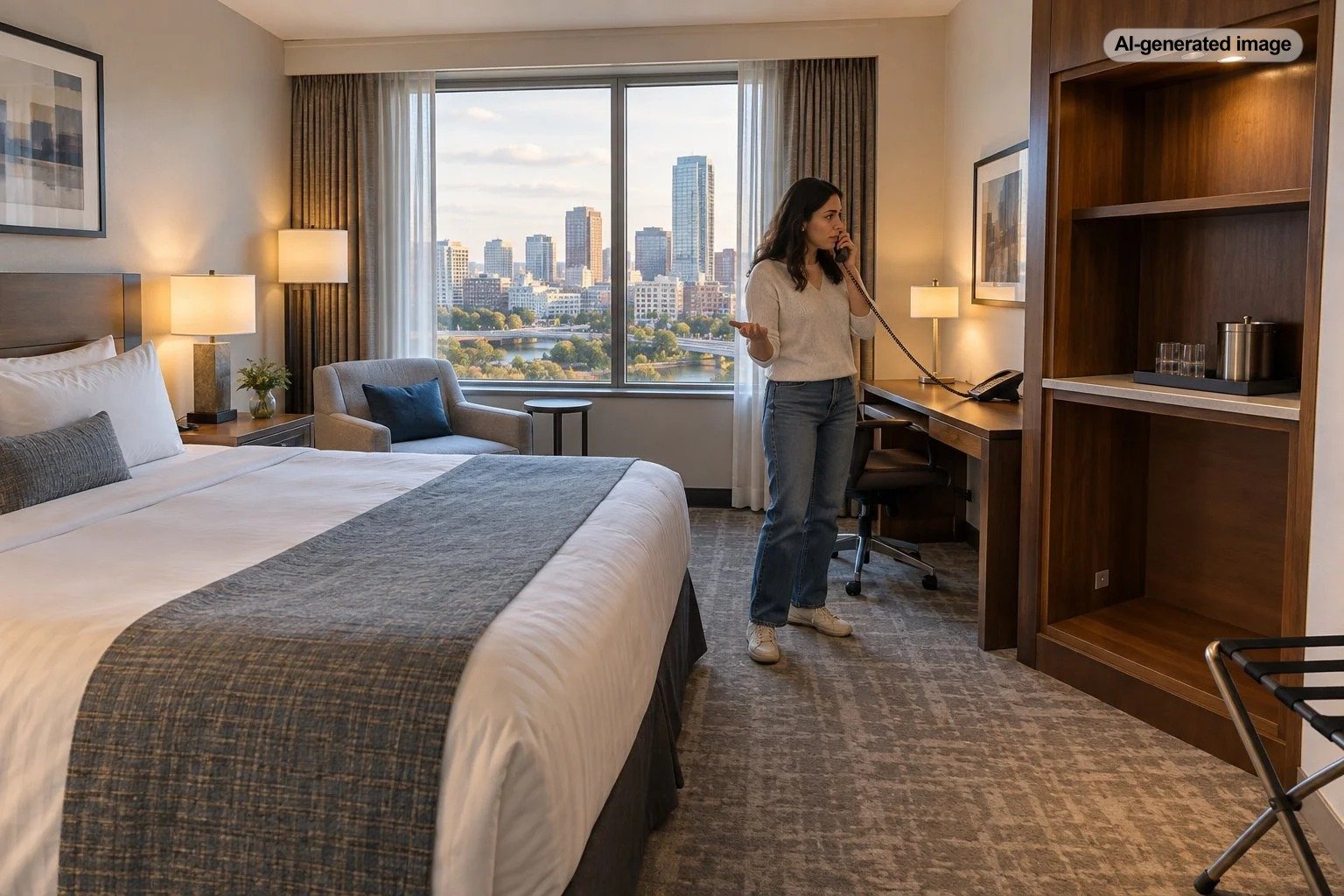
Call or message the property after booking and provide your confirmation number, dates, and exact request. A useful question is: Does my reserved room include a guest-use refrigerator and microwave? If not, can either appliance be provided, and is that guaranteed or subject to availability?
Requesting the equipment early may improve the chance that staff can reserve a limited unit or identify a suitable room category. However, adding a note to a reservation does not automatically make the amenity part of the booking. Marriott, for example, provides separate guidance on locating room amenities and submitting special requests, illustrating why travelers should distinguish between a listed feature and a requested one.
Record the name or department of the person who responds and retain any written confirmation. A day or two before arrival, contact the hotel again if the appliance is essential. This is especially worthwhile when your initial confirmation describes the request as subject to availability.
Expect different answers for refrigerators and microwaves
Refrigerators may be easier to arrange
Compact refrigerators are relatively common, but practices still vary. A property might place one in every room, keep a limited supply for delivery, offer them only in particular room types, or prioritize medically necessary requests. Delivery can also take time, so a refrigerator requested at check-in may not be immediately available.
Microwaves may be restricted to certain areas
Microwaves can be less flexible because hotels must consider space, ventilation, electrical load, cleaning, odors, and fire prevention. Instead of delivering one, a hotel may have a shared microwave near an ice machine, in a lobby market, or in a breakfast area during specified hours. One official Hyatt property FAQ, for example, identifies mini refrigerators in guestrooms while directing most guests to shared microwaves outside standard rooms. That arrangement should be treated as a property-specific example, not a chainwide rule.
Ask about fees, delivery, and access
Before accepting an appliance, clarify the complete arrangement. Ask whether there is a nightly fee, a one-time delivery charge, a refundable deposit, or no charge at all. Also confirm whether the unit will be placed in the room before arrival or delivered after check-in.
If the hotel offers a communal microwave, ask where it is and when it is accessible. A microwave several floors away may be workable for an occasional snack but inconvenient for preparing multiple meals, feeding a young child, or managing mobility limitations. Likewise, a refrigerator that arrives late on the first evening may not solve a need that begins as soon as you check in.
Handle medication refrigeration as a separate request
If medication must remain within a specified temperature range, do not describe the need merely as wanting a mini fridge. Tell the hotel that the request is medication-related and ask what accommodation it can confirm. A standard guestroom cooler may not maintain a stable or sufficiently cold temperature, and settings can vary.
Ask whether the hotel offers an appropriate in-room unit, secure refrigerated storage through another department, or a different established procedure. Confirm how you will access the medication outside regular hours. Follow the medication manufacturer’s storage instructions and guidance from your pharmacist or health care professional rather than assuming any hotel appliance is suitable.
Know when changing room types is the better solution
A request is reasonable when you need to chill drinks, store a few groceries, or reheat an occasional meal. A confirmed kitchenette or extended-stay room is a better fit when cooking facilities are central to the trip.
Families preparing bottles or simple meals, travelers with dietary restrictions, and guests staying for a week or longer may value certainty more than the possibility of receiving portable equipment. Compare the cost of a kitchen-equipped room with appliance fees, restaurant meals, delivery charges, and the inconvenience of shared facilities. The room with the higher initial rate may still be the more practical choice, although the calculation depends on the trip.
What travelers often overlook
- A request note may not be a guarantee: Look for explicit written confirmation if the appliance is essential.
- A minibar is not automatically guest storage: Removing stocked items can create confusion or charges at some properties.
- Cooling performance differs: A beverage cooler and a food-safe refrigerator are not necessarily interchangeable.
- Outside appliances may be prohibited: Do not bring a hot plate, toaster oven, or personal microwave without checking hotel rules.
- Housekeeping may need access: Ask how food should be stored and what happens to refrigerated items during a room change.
- International terminology varies: Specify whether you mean a refrigerator for personal food, an empty minibar-style cooler, or a microwave oven.
Frequently asked questions
Can I request a fridge or microwave at check-in?
Yes, but waiting until check-in may reduce your options. Portable units can already be assigned, and rooms with built-in appliances may be unavailable. Contacting the hotel before arrival is preferable.
Will a hotel charge for the appliance?
It depends on the property. Ask about nightly fees, delivery charges, and deposits before confirming the request. Do not assume that a medically related request or a loyalty-program membership automatically eliminates a fee.
Can I bring my own microwave?
Only if the property expressly permits it. Hotels may restrict personal cooking appliances because of electrical, ventilation, odor, and fire-safety concerns. Request written guidance from the hotel first.
What if the hotel cannot provide either appliance?
Ask whether there is a shared microwave, staff-assisted refrigeration, an ice machine, or another room category with the required features. If the amenity is essential and cannot be confirmed, consider changing rooms or properties before the cancellation deadline.
Does every extended-stay room have a full kitchen?
No. Kitchen facilities differ by brand, property, and room type. Some rooms have a refrigerator and microwave, while others add a cooktop, sink, dishwasher, or cookware. Verify the exact room description before booking.