Can You Request a Different Mattress Configuration After Boarding a Cruise?
Yes, you can often request a different mattress or bed configuration after boarding a cruise, particularly when the change involves separating two convertible beds or combining them into one larger sleeping surface. Many cruise ship cabins are designed to accommodate either arrangement, and the stateroom attendant may be able to make the adjustment during your sailing. However, the available options depend on the ship, cabin category, existing furniture, and safety requirements.
The important distinction is between rearranging beds already installed in your cabin and requesting a different mattress or additional sleeping furniture. The first is frequently possible. The second may be limited by the cabin’s design and the cruise line’s available equipment.
Quick Answer: What Can You Change After Boarding?
- Two separate beds instead of one: Often possible when the cabin has convertible twin beds.
- One combined bed instead of two: Frequently possible in cabins designed for a larger shared sleeping arrangement.
- A different mattress type or firmness: Not a standard guaranteed option. Ask whether any comfort adjustments are available.
- An additional sleeping surface: Usually limited to the cabin’s designated occupancy and approved sleeping arrangements.
- Best time to request a change: As soon as you reach your cabin, preferably before the evening housekeeping schedule.
For an ordinary bed rearrangement, your first point of contact is generally the stateroom attendant. For a request involving accessibility, an unsuitable sleeping arrangement, or a problem the attendant cannot resolve, Guest Services can help identify the appropriate next step.
How Cruise Ship Bed Configurations Work
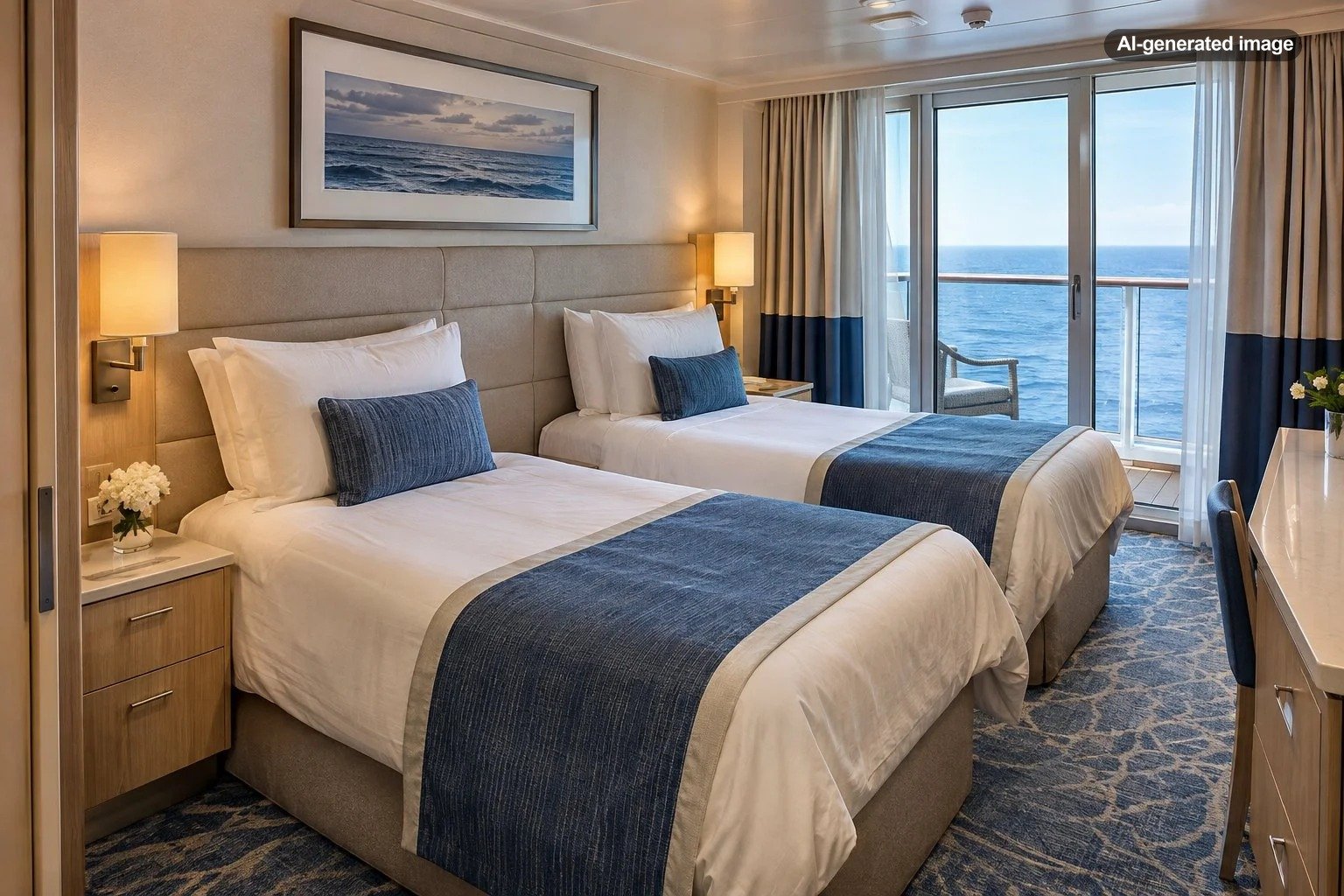
Many modern cruise cabins use two individual beds that can be positioned separately or placed together to create a larger shared bed. Cruise lines may describe the combined arrangement as a queen, king, or proprietary bed configuration, depending on the ship and cabin category.
Although the combined arrangement can resemble a conventional larger bed, it is not necessarily constructed like a single residential mattress. The sleeping surfaces may remain separate beneath the bedding, and their exact construction varies between vessels.
This flexibility is useful because the same cabin may accommodate a couple on one sailing and two friends or relatives on another.
Two Twin Beds
Separate beds give each traveler an individual sleeping surface and can make sharing a cabin more comfortable for friends, siblings, or travelers with different sleep preferences.
Depending on the cabin layout, separating the beds may also change access to bedside furniture, outlets, or the space between the beds. The attendant will need to work within the room’s available floor area.
One Larger Combined Bed
Combining two convertible beds creates a shared sleeping arrangement for couples or anyone who prefers a larger continuous sleeping area.
The attendant may need to reposition mattresses, adjust bed bases, and replace individual bedding with linens suitable for the combined arrangement.
The exact size of the resulting bed should not be assumed from the term king or queen. Cruise lines use different terminology and cabin specifications.
Fixed Beds and Specialized Layouts
Not every cabin has interchangeable beds. Some suites contain fixed larger beds, while certain compact cabins, accessible accommodations, and rooms with additional berths have restrictions on how the sleeping surfaces can be arranged.
For example, Royal Caribbean notes that some suite categories have Royal King beds that cannot be separated into twin beds. Carnival’s published deck plans also distinguish between convertible beds and beds that cannot be converted.
These restrictions explain why an arrangement available in one cabin category may be impossible in another, even aboard the same ship.
How to Request a Bed Change Once You Are Onboard
The process is usually straightforward when the cabin supports the requested arrangement.
Step 1: Check the Cabin Before Unpacking Completely
When you first enter your stateroom, confirm that the beds are arranged as expected. A reservation may show your preferred configuration, but the setup you encounter onboard is what matters.
If the arrangement is incorrect, raise the issue early rather than assuming it will be corrected automatically.
Step 2: Contact Your Stateroom Attendant
Your cabin attendant is generally the most practical person to ask about separating or combining convertible beds.
A clear request is sufficient: ‘Could you please arrange the beds as two separate twins?’ Alternatively, you could ask, ‘Would it be possible to combine these beds into one larger bed?’
Royal Caribbean expressly advises that guests can request bed-configuration changes onboard through housekeeping staff. Its guidance provides a useful example of how such requests are handled, although procedures differ among cruise lines.
Step 3: Ask When the Change Can Be Completed
The attendant may need to coordinate the rearrangement with other housekeeping duties, particularly on embarkation day when crews are preparing numerous cabins.
Ask whether the change can be completed before bedtime. An immediate adjustment should not be assumed, especially if new linens or additional assistance are required.
Step 4: Confirm the Finished Arrangement
After the beds are rearranged, make sure the setup works for everyone using the cabin. Check whether there is comfortable access around the beds, whether bedding fits properly, and whether essential pathways remain clear.
If the arrangement does not meet your needs, explain the specific problem rather than simply requesting that the beds be moved again.
Can You Request a Completely Different Mattress?
Changing the bed layout and changing the physical mattress are two different requests.
Moving convertible beds together or apart is an established accommodation feature on many cruise ships. Replacing a mattress with a softer, firmer, thicker, or different-size model is much less predictable.
Unlike a large hotel that may have some flexibility with room assignments, a cruise ship operates within a fixed inventory of cabins, furniture, storage space, and approved sleeping arrangements.
If the existing mattress is uncomfortable, tell your attendant what is causing the problem. Depending on the ship’s supplies and policies, the team may be able to investigate an available comfort adjustment or address a maintenance issue.
Do not assume that a mattress topper, specialty mattress, or alternative bedding is available merely because another traveler reports receiving one on a different cruise.
If you have a medical or accessibility-related sleeping requirement, contact the cruise line before departure whenever possible. Explain the functional accommodation you need and obtain confirmation of what the ship can provide.
What Changes Are Possible in Cabins With Three or Four Guests?
Sleeping arrangements become more complicated when a cabin accommodates additional passengers.
Triple- and quadruple-occupancy cabins may use a combination of lower beds, convertible sofas, or upper Pullman berths. These arrangements are designed around the cabin’s approved capacity and available floor space.
In some configurations, the position or use of additional berths affects whether the main beds can be combined.
Carnival’s published cabin diagrams, for example, identify certain arrangements in which twin beds cannot be converted to a king configuration when specified upper berths are in use.
That means a couple traveling with children may not have the same bed-layout choices as two adults occupying that cabin alone.
Ask the attendant which approved arrangements are available for the actual number of occupants. Do not attempt to move upper berths, rearrange heavy furniture, or modify the sleeping setup yourself.
What If Your Cruise Cabin Cannot Accommodate the Request?
If the attendant explains that the configuration cannot be changed, first establish whether the limitation is temporary or structural.
A temporary limitation might involve housekeeping workload or the need for additional bedding. A structural limitation means the cabin itself is not designed to support your preferred arrangement.
For a structural restriction, ask Guest Services whether another practical option exists. However, switching cabins should not be considered a routine solution. Any reassignment depends on available accommodations, occupancy rules, operational considerations, and the cruise line’s discretion.
If the issue involves an accessibility requirement, communicate that clearly and request assistance from the ship’s appropriate guest-support team.
For a simple preference rather than an essential requirement, it may be more practical to use the approved arrangement already provided.
Should You Arrange Your Bed Preference Before the Cruise?
Yes. Although onboard changes are often possible, making the request before departure gives the cruise line an opportunity to record your preferred setup.
Royal Caribbean allows eligible guests to select a bed arrangement through their reservation management tools, subject to cabin-category restrictions and availability. Other cruise lines may handle preferences through a booking interface, customer service representative, or travel advisor.
Before sailing, consider these steps:
- Review the cabin details to see whether the bed configuration is listed.
- Select the preferred arrangement when the reservation system permits it.
- Ask whether your chosen cabin has fixed or convertible beds.
- Confirm arrangements for third and fourth passengers, including the type of additional berth.
- Contact the cruise line in advance about accessibility or specialized sleeping requirements.
- Check the arrangement once onboard, even if the preference appears in your reservation.
A recorded preference helps communicate what you want, but it does not override the physical limitations of your cabin.
What Travelers Often Overlook About Cruise Ship Beds
A Combined Bed May Still Have a Center Seam
Two beds placed together do not necessarily feel identical to a single uninterrupted mattress. Travelers who are particularly sensitive to seams or differences between sleeping surfaces should ask how the cabin’s combined arrangement is constructed.
Bed Placement Affects the Usable Space
Separating beds can change circulation around the cabin, while combining them can alter access to nightstands or nearby furniture. An arrangement that seems preferable for sleeping may be less convenient during the day.
Suite Categories Are Not Automatically More Flexible
A larger or more expensive cabin may have a fixed bed rather than two convertible sleeping surfaces. Travelers who require separate beds should verify the precise suite layout instead of assuming that a premium category provides more options.
A Sofa Bed Is Not Always an Alternative to Twin Beds
Some passengers assume that a cabin with a sofa bed can automatically provide a separate sleeping arrangement. However, the sofa may not convert into a bed, may be intended only for approved additional occupancy, or may be unsuitable for a particular guest’s needs.
Confirm the actual sleeping furniture rather than relying on a general cabin photograph.
Frequently Asked Questions
Can you separate a king bed into two twins after boarding?
Often, yes, if the larger bed is constructed from two convertible sleeping surfaces. A fixed king bed cannot necessarily be separated. Ask your stateroom attendant to confirm the cabin’s capabilities.
Can you combine two cruise ship twin beds into one?
Many cruise cabins support this arrangement. However, fixed layouts, suites, additional berths, and certain cabin configurations can limit conversion options.
Will the cruise line charge for changing the bed arrangement?
A routine housekeeping rearrangement of convertible beds is generally treated as a cabin service rather than a room upgrade. Nevertheless, charges or policies for specialized equipment, additional accommodations, or other requests should be confirmed with the cruise line. Do not assume every sleeping-related request is complimentary.
Can you ask for a bed change on the second day of a cruise?
Yes, you can still ask after embarkation day. Whether the change can be made depends on the cabin and housekeeping arrangements. Requesting it earlier is preferable if the current setup affects your sleep.
Can you request an extra bed for another passenger?
Not necessarily. Cruise cabins have designated occupancy limits and approved sleeping configurations. Adding a passenger or sleeping surface is different from rearranging existing beds and may not be permitted. Contact the cruise line for any occupancy-related request.
The Best Approach Once You Board
If your cruise cabin has the wrong bed arrangement, start by speaking with your stateroom attendant. A request to separate convertible twins or combine them into one larger bed is often a manageable housekeeping adjustment, especially when raised early in the voyage.
For a fixed mattress, unusual cabin layout, additional berth, or specialized comfort requirement, the answer is less certain. The most effective approach is to explain precisely what you need, ask which configurations the cabin supports, and allow the crew to identify an approved solution.
For travelers whose sleeping arrangement is essential rather than merely preferred, advance confirmation remains the most reliable planning step. A few questions before departure can help avoid discovering an important cabin limitation after the ship has sailed.
Sources & Further Reading
- Royal Caribbean: Modifying a Reservation and Changing Bed Configuration – Official guidance confirming that guests may request bed changes through housekeeping once onboard and explaining restrictions in certain suites.
- Royal Caribbean: Choosing a Bed Arrangement Before Sailing – Official information about selecting bed preferences and cabin-category limitations.
- Carnival Cruise Line: Carnival Magic Deck Plans and Accommodation Configurations – Official deck-plan information identifying convertible twin beds, nonconvertible arrangements, and additional-berth restrictions.
- Princess Cruises: Diamond Princess Accommodation Information – Official examples of cabin categories offering twin or combined bed arrangements and ship-specific accommodation differences.