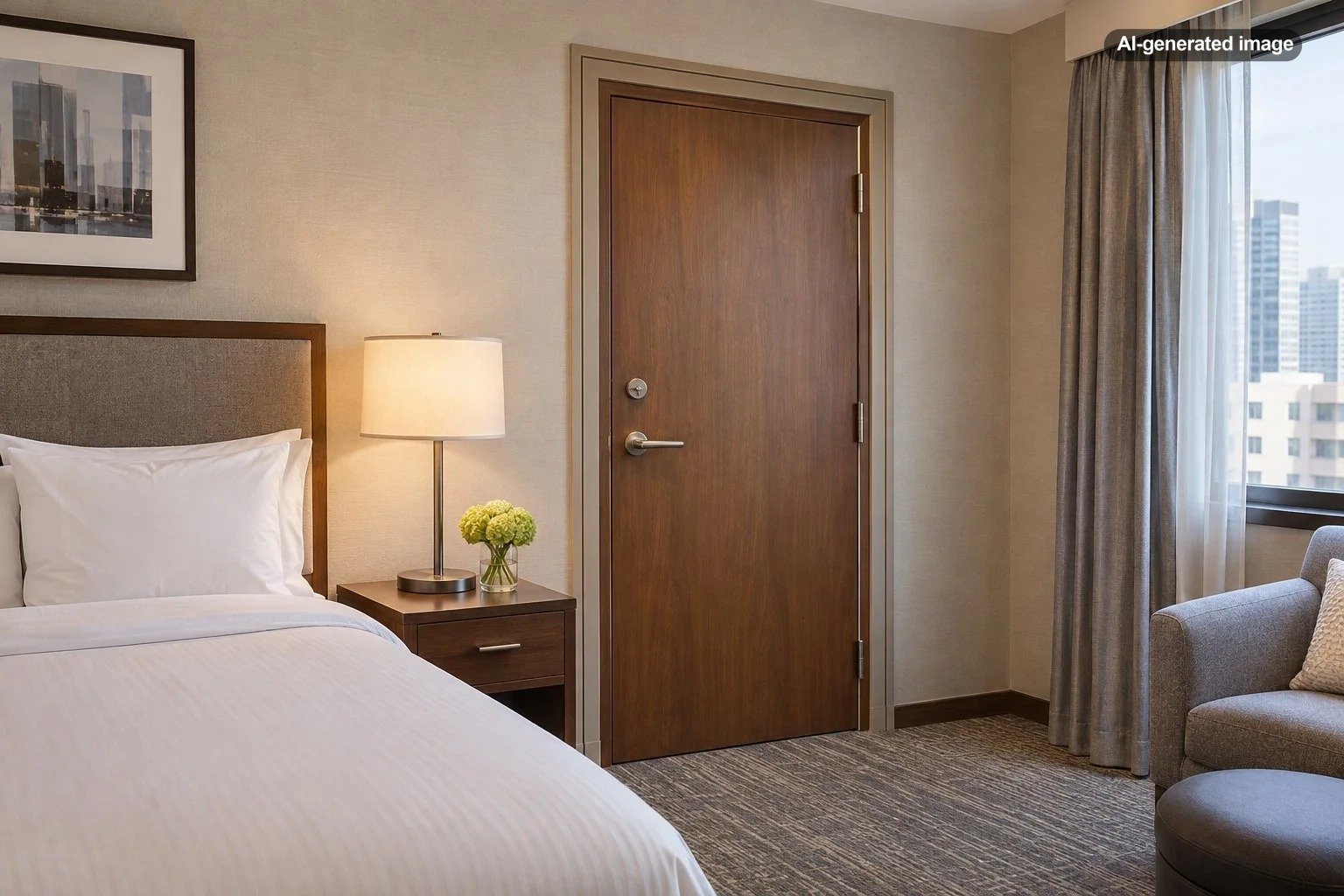
Why Do Some Hotel Rooms Have Connecting Doors Even When Booked Separately?
Some hotel rooms have connecting doors even when the guests on either side booked completely separate reservations. The explanation is straightforward: connecting doors are permanent features of the hotel’s room layout, not arrangements created for individual bookings. Hotels use these rooms flexibly, accommodating families and groups who want internal access while also assigning the same rooms independently when connecting accommodations are not needed.
Finding a locked door in your hotel room that appears to lead directly into another guest’s accommodation can feel unexpected. However, its presence does not mean the rooms share a reservation, that another guest has permission to enter, or that the hotel made an assignment mistake. Understanding how connecting rooms function helps travelers evaluate privacy, noise, and room preferences before and during a stay.
Quick Answer: Why Is There a Connecting Door in My Hotel Room?
- Permanent room design: Connecting doors are built into the hotel’s floor plan and remain there regardless of who books the rooms.
- Flexible occupancy: Hotels can assign connecting rooms to one traveling party or to unrelated guests.
- Independent reservations: Each room can be sold, occupied, and managed separately without opening the connecting doorway.
- Separate locking: Connecting doors generally have locking arrangements intended to prevent unauthorized passage between independently occupied rooms.
- Room preferences: Guests who prefer accommodations without a connecting doorway can request a different room, although availability varies.
Connecting Doors Are Part of the Building, Not the Reservation
Hotels design their guest room floors long before individual reservations are accepted. Some neighboring rooms are constructed with an internal doorway between them. This creates the option of combining two accommodations into a larger arrangement without permanently removing the separation between them.
Consider a hotel floor with several pairs of connecting rooms. On one night, a family traveling with grandparents might reserve a pair and ask for the connecting doors to be opened. On another night, two unrelated business travelers might occupy those same rooms under separate reservations. The physical arrangement stays identical; only the permitted access changes.
This flexibility is valuable because demand for connecting rooms changes from day to day. If hotels reserved every connecting pair exclusively for groups, otherwise available accommodations could become more difficult to sell during periods when few guests needed the connecting feature.
A connecting door therefore indicates a capability of the room rather than the relationship between its occupants.
Why Hotels Build Connecting Rooms in the First Place
Families Can Stay Close Without Sharing One Room
Families are among the most obvious beneficiaries of connecting rooms. Parents traveling with children, extended families traveling together, and relatives with different sleeping schedules may appreciate having separate sleeping spaces with convenient internal access.
Depending on room configurations and property rules, connecting accommodations can provide additional beds, bathrooms, and space while allowing members of the same party to move between rooms without entering a public hallway.
For travelers with children, however, a connecting doorway should not automatically be treated as a substitute for appropriate supervision. Room occupancy rules, child safety considerations, and the specific door arrangement still matter.
Groups Can Combine Privacy With Convenience
Connecting rooms may also appeal to friends, wedding parties, sports teams, and colleagues traveling together. Each person or subgroup can have a separate space while retaining the option of moving between rooms conveniently.
The arrangement offers a different experience from sharing a large suite. With connecting rooms, guests may have separate entrances, bathrooms, and sleeping areas while enjoying direct internal access when both sides agree to open the connecting doors.
Hotels Can Serve Different Guests With the Same Inventory
From an operational perspective, connecting rooms provide flexibility. A hotel can accommodate a group requiring linked rooms without making those rooms permanently unavailable to independent travelers.
Hotels also need to account for arrivals, departures, cleaning schedules, room categories, maintenance, and existing reservations. Those considerations can influence which available room is assigned to each arriving guest.
Consequently, a solo traveler might receive a connecting room simply because it is an appropriate available room in the booked category. The assignment does not necessarily indicate that the hotel expected the traveler to be part of a group.
Are Hotel Connecting Doors Safe and Private?
Connecting hotel rooms typically use a door arrangement designed to separate independently occupied accommodations. A common configuration has two doors, one controlled from each room. When both are closed and secured, guests cannot ordinarily pass freely between the accommodations.
Other designs may use different locking hardware. The precise mechanism depends on the property, building, and door system, so travelers should not assume every connecting doorway operates identically.
A connecting doorway should not give the neighboring guest unrestricted access to your room. If you are uncertain how the door locks, ask the front desk to explain or verify the mechanism.
Upon entering a room with a connecting doorway, it is reasonable to check that the door is closed and that any guest-operated lock is properly engaged. There is no need to force the handle, manipulate unfamiliar hardware, or attempt to open a door leading into an occupied room.
If the door appears damaged, does not secure properly, or opens unexpectedly, contact hotel staff immediately and request an inspection or alternative accommodations. A door that does not function as intended is a different issue from the ordinary presence of a connecting doorway.
Can You Hear More Noise Through a Connecting Hotel Door?
Possibly. One practical drawback of a connecting room is that an internal doorway can sometimes transmit more sound than an uninterrupted wall.
The difference depends on construction details, door materials, perimeter seals, the space between paired doors, and the behavior of guests next door. A well-fitted double-door arrangement may provide satisfactory separation, while another configuration might allow conversations, television audio, or other sounds to travel more noticeably.
Noise is not limited to connecting doors, of course. Hallways, elevators, neighboring bathrooms, and shared building systems can also affect how quiet a hotel room feels.
For a traveler with a particularly sensitive sleep schedule, though, a non-connecting room may be worth requesting. This is especially relevant for guests preparing for early flights, business presentations, or important events.
If noise becomes disruptive during a stay, contact the front desk rather than confronting an unfamiliar guest through the connecting doorway. Staff can assess the situation and explain what alternatives are available.
Connecting Rooms vs. Adjoining Rooms: What Is the Difference?
Hotel terminology is not always consistent, particularly across countries, brands, and booking websites. The most useful distinction concerns whether guests can pass directly between two accommodations.
- Connecting rooms: Separate rooms with an internal doorway allowing direct passage when access is authorized and the doors are opened.
- Adjoining rooms: Often means rooms located immediately beside one another, although some hotels use the term interchangeably with connecting rooms.
- Adjacent rooms: Generally indicates rooms located near each other, without necessarily guaranteeing a shared wall or internal doorway.
This distinction matters when reserving accommodations for a family or group. Asking for adjoining rooms may produce two nearby rooms that still require guests to use the hallway to move between them.
When direct internal access is essential, describe the requirement explicitly: two rooms connected by an interior door. Ask whether that feature is confirmed or merely recorded as a preference.
Can You Request a Hotel Room Without a Connecting Door?
Yes. Travelers who dislike connecting doorways can generally ask the hotel for a non-connecting room. Whether the request can be accommodated depends on the property’s inventory, room categories, and occupancy during the stay.
Before Booking
Contact the hotel directly if a non-connecting room is an important requirement. Ask whether the desired room category includes accommodations without connecting doors and whether the property can confirm that preference in advance.
If booking through a third-party website, remember that a special-request field may communicate your preference without guaranteeing the assignment. It is useful to confirm directly with the property when the distinction materially affects your stay.
Before Arrival
If you already have a reservation, contact the hotel and request that your preference be added to the booking. Explain the reason briefly if it is relevant, such as sensitivity to noise or a need for uninterrupted sleep.
A courteous, specific request is more useful than assuming the property will automatically avoid assigning connecting rooms to solo travelers.
At Check-In
Ask whether your assigned room has an internal connecting doorway. If it does and you prefer another arrangement, request a suitable alternative before unpacking.
Changing rooms may be easier before settling in, but no particular room location or configuration should be assumed available. The hotel may have limited alternatives during busy periods.
What If You Actually Want Connecting Rooms?
For families and groups, the central challenge is usually the opposite: securing two rooms that genuinely connect rather than merely sit near each other.
Some hotel booking systems offer confirmed connecting-room options at participating properties. Others accept requests that remain subject to availability until arrival. The distinction should be clear before making a reservation that depends on internal access.
When planning a group stay, verify the number of connecting rooms needed, the bed configurations, occupancy limits, and whether the internal doorway is included in the confirmed booking arrangement.
If different members of the party book separately, provide the hotel with the relevant reservation details and ask whether those bookings can be coordinated. Separate reservations do not necessarily prevent a connecting assignment, but they do not establish one automatically either.
For groups prioritizing a shared living area or a single self-contained accommodation, a suite or larger vacation rental may be more appropriate than two conventional rooms. Such alternatives have different tradeoffs involving layout, privacy, housekeeping, and available services, so comparing the actual accommodation descriptions is important.
What Travelers Often Overlook About Connecting Rooms
The connecting feature may not appear prominently in the room description. A booking may identify bed size, view, and broad room category without indicating whether the specific assigned accommodation has a connecting doorway.
Separate reservations do not determine room construction. Two unrelated guests can occupy a connecting pair without receiving access to each other’s rooms.
A connecting room is not necessarily an inferior room. It may have the same advertised room category and standard amenities as an otherwise similar non-connecting accommodation. Its suitability depends partly on individual preferences.
A room request is not always a guarantee. Travelers should distinguish between a hotel noting a preference and explicitly confirming a specific room feature.
Door security and sound separation are different questions. A properly secured connecting doorway can still transmit some noise. Travelers should evaluate both concerns independently.
Frequently Asked Questions About Hotel Connecting Doors
Why did I get a connecting room when traveling alone?
The hotel may have assigned an available room matching your reservation category. Connecting rooms are routinely used as independent accommodations when they are not needed by a group.
Can the people next door open the connecting door?
Connecting door systems are generally designed to prevent unauthorized passage when the rooms are independently occupied. Because hardware varies, ask hotel staff to verify the locking mechanism if you are concerned.
Do connecting rooms cost more?
Not necessarily. A standard room containing a connecting doorway may be priced like other rooms in its category. However, certain hotels offer separately bookable confirmed connecting-room arrangements that may carry different rates. Check the actual terms before booking.
Can I refuse a connecting room after checking in?
You can request a different room, but availability and room-change procedures depend on the hotel. Explain your preference to the front desk and ask what alternatives are possible.
Does a connecting door mean the hotel can enter through the neighboring room?
The presence of a connecting doorway does not by itself establish an additional guest-access arrangement or change the hotel’s stated room-entry procedures. If you have questions about access controls, ask the property directly.
The Bottom Line: A Connecting Door Is a Flexible Room Feature
Hotel rooms have connecting doors even when booked separately because the building is designed to accommodate different types of guests. The same pair of rooms can serve a family requiring convenient internal access on one occasion and two unrelated travelers requiring independent accommodations on another.
For most guests, a closed and properly secured connecting doorway is simply another architectural feature of the room. Those who value maximum sound separation or prefer an uninterrupted shared wall can request a non-connecting accommodation. Travelers who need direct access between rooms should seek an explicitly confirmed arrangement rather than relying on proximity alone.
The practical lesson is to distinguish between the room’s physical layout and the conditions of your reservation. Knowing that difference makes it easier to ask the right questions, understand what is guaranteed, and choose accommodations that fit your needs.