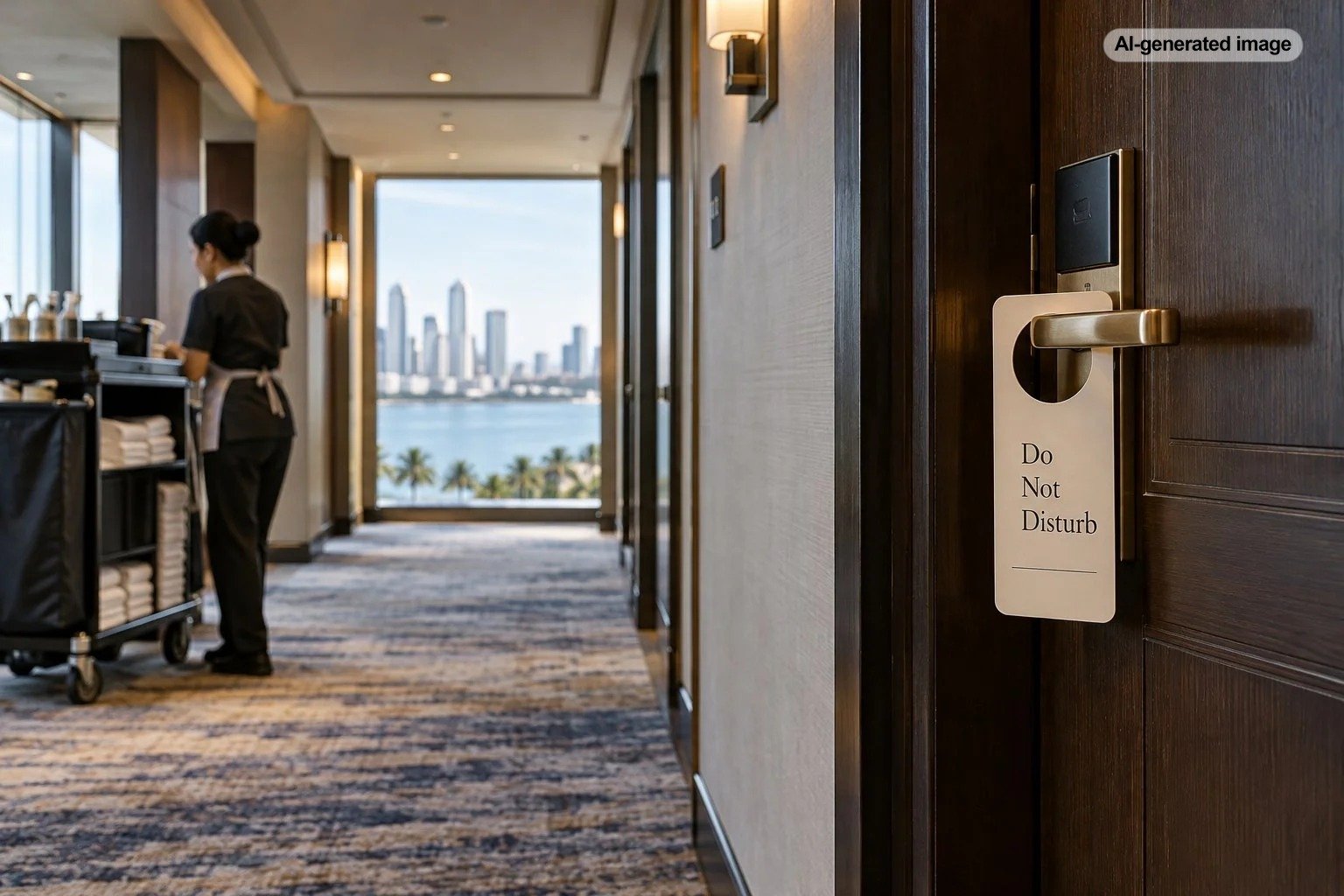
Can a Hotel Enter Your Room When the Do Not Disturb Sign Is Up?
Yes, a hotel can sometimes enter your room even when a Do Not Disturb sign is displayed. The sign tells hotel employees that you do not want routine interruptions, but it generally does not prevent authorized entry for emergencies, safety checks, or other circumstances permitted by hotel policy and applicable law. The important distinction is between declining ordinary housekeeping and preventing all access to a room, which are not necessarily the same thing.
For travelers who value privacy, whether they are sleeping after an overnight flight, working remotely, or simply enjoying an uninterrupted afternoon, understanding this distinction can prevent unpleasant surprises. Hotel entry policies are not identical, and some properties have more explicit inspection requirements than others.
Quick Answer: What Does a Do Not Disturb Sign Actually Mean?
- Routine housekeeping: Staff will generally avoid cleaning a room displaying a Do Not Disturb sign.
- Emergencies: Hotels may enter when immediate action is necessary to protect people or property.
- Safety inspections: Some properties require periodic room checks even when guests request privacy.
- Maintenance: Urgent repairs may justify entry, while nonessential work can often be scheduled.
- Property-specific rules: The hotel’s written policies determine much of what guests should expect, subject to applicable law.
A Do Not Disturb sign is therefore a request for privacy rather than an unconditional guarantee that nobody will enter.
Why Hotels May Enter Despite a Do Not Disturb Sign
Hotels have responsibilities beyond providing an undisturbed room. They must also respond to emergencies, maintain their buildings, and address situations that could affect other guests. These obligations help explain why properties retain some ability to access occupied rooms.
Emergencies and Immediate Safety Concerns
If staff suspect a fire, water leak, medical emergency, or another urgent threat, a Do Not Disturb sign generally will not prevent an appropriate response.
Consider a bathroom pipe that begins leaking into the room below. If hotel employees cannot reach the registered guest, they may need to enter to prevent further damage. Similarly, an active fire alarm or credible concern about someone’s immediate welfare could require prompt access.
These situations differ substantially from a housekeeper wanting to replace towels. The urgency and reason for entry matter.
Scheduled or Periodic Safety Checks
Some hotels conduct room inspections even when guests have declined housekeeping. Such checks may be intended to assess guest welfare, identify hazards, or confirm the condition of occupied rooms.
For example, Hyatt Regency Trinidad publishes a policy stating that occupied rooms are entered at least once within a 24-hour period, even when a guest requests privacy. The policy also states that appropriate efforts are made to provide advance notice.
Walt Disney World Resort similarly reserves the right to enter its resort hotel rooms for maintenance, safety, security, or other purposes, even when a Room Occupied sign is displayed.
These examples illustrate an important point: there is no universal 24-hour rule governing every hotel. Inspection practices and notice procedures depend on the property, its operating policies, and applicable local requirements.
Urgent Maintenance and Building Problems
Hotels may need to investigate malfunctioning equipment, plumbing problems, or other building concerns. The distinction is whether the work reasonably requires access at that time.
A routine inspection of a television or replacement of a functioning light bulb can often wait. A significant leak affecting multiple rooms may require immediate attention.
If you are informed about maintenance during your stay, ask whether it is urgent and whether you can be present when the work occurs.
Security Concerns or Suspected Misconduct
Hotels may also retain authority to investigate credible safety concerns or suspected prohibited activity. The precise circumstances justifying entry vary according to property policies and local law.
For example, Park South Hotel in New York publishes a Do Not Disturb policy explaining that management may enter during emergencies or when illegal activity is suspected.
That does not mean every employee has unrestricted discretion to disregard privacy requests. A legitimate reason for entry and the procedures followed are important considerations.
Does the Hotel Have to Knock Before Entering?
Under ordinary circumstances, guests should generally expect hotel employees to knock, identify themselves, and allow an opportunity to respond before entering an occupied room. However, exact procedures depend on hotel policy, applicable law, and the urgency of the situation.
A typical nonemergency interaction might involve an employee announcing housekeeping or maintenance at the door, waiting for a response, and following the property’s established access procedure.
An emergency can change that sequence. Staff responding to a serious water leak, for instance, may have less time to seek permission than someone carrying out a routine room inspection.
If a property requires periodic inspections, ask whether it provides advance calls, messages, or scheduled inspection windows. Some hotels may be able to coordinate an inspection around your plans, although they may not agree to cancel it.
Can You Refuse Housekeeping Without Refusing a Safety Check?
Yes. Declining housekeeping and declining all room access are separate requests at many properties.
A guest might reasonably prefer to keep the same towels for two nights, avoid interruptions during work calls, and skip daily bed-making. None of those preferences necessarily conflicts with a hotel’s requirement to conduct a brief inspection.
However, displaying a Do Not Disturb sign does not automatically establish an agreement about when or how a separate inspection will occur.
For a longer stay, it is worth clarifying three questions with the front desk:
- Can daily housekeeping be declined for the entire reservation?
- Are periodic room inspections still required?
- Can any necessary inspection be arranged for a specific time?
This conversation is particularly useful for remote workers, families managing children’s naps, travelers recovering from overnight journeys, or anyone who needs predictable periods of quiet.
What If You Leave the Sign Up for Several Days?
A Do Not Disturb sign that remains displayed throughout a multiday stay may receive more attention than one used for a few hours.
At properties with periodic inspection policies, staff may need to establish contact with the guest or inspect the room according to their procedures. The timing is not necessarily based on the number of consecutive days a guest has declined cleaning.
Travelers should not assume that leaving the sign on the door indefinitely will prevent every room visit. If you plan to avoid housekeeping throughout a lengthy stay, notify the front desk directly instead of relying exclusively on the sign.
It is also worth asking how trash removal, towel replacement, and maintenance requests work when regular room service is declined. These practical arrangements can help preserve privacy without creating unnecessary inconvenience.
Does a Door Latch or Secondary Lock Prevent Hotel Entry?
Hotel rooms frequently have an interior deadbolt, swing-bar latch, or another secondary locking mechanism. These features are intended to improve privacy and control access while the room is occupied.
However, their operation varies. Some hotel access systems provide authorized emergency entry methods, while certain secondary locks may require special procedures or equipment to bypass.
Do not assume that an interior latch makes entry impossible under every circumstance. Equally, do not assume that all hotel employees can bypass every lock.
Use the security features provided as intended, and contact the front desk if a lock is damaged or does not function properly. Avoid adding improvised devices that could interfere with emergency access or evacuation.
What Should You Do If Staff Enter While the Sign Is Displayed?
Unexpected room entry can be unsettling, particularly when you are sleeping, changing clothes, or away from the property. The appropriate response depends on what happened and whether there was a legitimate reason for access.
If You Are Inside the Room
Identify yourself, tell the employee that you do not want routine service, and ask why entry is necessary. If the situation is not urgent, request that the employee leave and coordinate any required access through the front desk.
If someone enters without identifying themselves or you feel threatened, prioritize your immediate safety and contact hotel security or emergency services as appropriate.
If You Discover Someone Entered While You Were Away
Contact hotel management and ask what type of entry occurred. Housekeeping, maintenance, security, and management inspections can involve different procedures.
Explain that the Do Not Disturb sign was displayed, and ask whether the visit was authorized under the property’s policy. If belongings were moved, damaged, or are missing, document your concerns promptly and ask about the hotel’s incident-reporting procedure.
If the Explanation Is Unsatisfactory
Request a review by the manager on duty. Provide the approximate time, room number, and relevant details without assuming that entry was automatically improper simply because the sign was displayed.
For serious privacy concerns, keep a written record of the interaction and any response from management. Whether an entry violated hotel policy or applicable law depends on the facts and local rules.
How to Get More Privacy During Your Hotel Stay
The most effective approach is to communicate your needs rather than relying on a door sign alone.
- Ask about entry rules at check-in. Find out whether the property requires daily inspections or other scheduled access.
- Request housekeeping only when needed. Ask whether cleaning can be skipped or arranged around meetings, naps, or other commitments.
- Communicate longer privacy periods. Tell the front desk when you would prefer not to be interrupted.
- Clarify inspection procedures. If room checks are required, ask how notice is provided and whether you can be present.
- Use the room’s locks appropriately. Follow the hotel’s instructions for security features without obstructing emergency exits.
- Keep valuables secured. Follow reasonable precautions even when you expect the room to remain undisturbed.
For business travelers, uninterrupted daytime work may be more important than daily cleaning. Families may need predictable afternoon quiet. Travelers who work overnight shifts might need privacy during hours when housekeeping typically operates. Explaining the specific need often makes it easier for the property to suggest a workable arrangement.
What Travelers Often Overlook About Hotel Room Privacy
The wording on the door sign is not always the complete privacy policy. Some properties use Room Occupied or Privacy Please instead of the traditional Do Not Disturb message. Those signs may communicate a preference about housekeeping while preserving the hotel’s inspection rights.
Another overlooked distinction is that a request to avoid cleaning does not necessarily prevent maintenance, security, or management visits. These activities may be handled by different departments.
Finally, hotel policies can vary even among properties operating under the same broad hospitality brand. Travelers with unusually strict privacy requirements should verify the specific property’s current practices rather than relying on assumptions about a chain.
Frequently Asked Questions
Can housekeeping ignore a Do Not Disturb sign?
Routine housekeeping should generally respect the sign, but hotel policies may permit exceptions or require other authorized personnel to enter. If cleaning occurs unexpectedly, ask management to explain why.
Can a hotel enter your room when you are not there?
Yes, under circumstances permitted by the property’s policies and applicable law. Maintenance, authorized inspections, and emergencies may involve entry while the guest is absent. A Do Not Disturb sign does not universally prohibit that access.
Is there a 24-hour Do Not Disturb rule at every hotel?
No. Some hotel policies provide for inspections within 24 hours, but this is not a universal standard. Check the specific property’s rules to understand the relevant schedule and notice procedures.
Can you ask the hotel never to enter your room?
You can request that staff avoid nonessential entry, but a property may be unable to guarantee that no one will enter under any circumstances. Safety, maintenance, and other authorized access requirements may still apply.
Does a Do Not Disturb sign protect your legal right to privacy?
The sign helps communicate your expectation of privacy, but it does not by itself determine all your legal rights. Hotel agreements, the reason for entry, and applicable laws affect whether a particular entry is permissible.
The Bottom Line: Privacy Is Expected, but Not Absolute
A Do Not Disturb sign is an important courtesy signal and should ordinarily prevent unnecessary interruptions. It is not, however, an absolute barrier against hotel employees entering an occupied room.
The most useful question is not simply whether hotel staff can enter, but why they are entering, what policy allows it, and how they are expected to notify you. Understanding those details helps travelers distinguish a legitimate safety inspection from an avoidable intrusion.
If privacy is especially important during your stay, ask about the property’s access policy before settling into the room. A brief conversation at check-in can establish clearer expectations than a door sign alone.
Sources & Further Reading
- Park South Hotel – Hotel Policies: Published Do Not Disturb provisions and exceptions for emergency entry or suspected illegal activity.
- Hyatt Regency Trinidad – Hotel Policies: Published occupied-room inspection practices and advance-notice guidance.
- Walt Disney World Resort – Property Rules: Official rules describing hotel room entry rights despite a Room Occupied sign.
- Walt Disney World Resort – Housekeeping Service: Guidance on declining housekeeping and the property’s retained entry rights.