Where to Stay in Jaipur for Palace Access Without Staying in a Remote Heritage Hotel
Jaipur has no shortage of magnificent heritage hotels, but staying in a historic palace does not always mean staying conveniently close to the city’s principal attractions. Some of the most atmospheric properties sit beyond the urban center, where a simple evening outing or early sightseeing departure can involve substantial driving. Travelers who want easy access to City Palace, Hawa Mahal, and Jaipur’s traditional bazaars should focus instead on the Pink City, its immediate surroundings, and established central neighborhoods such as Civil Lines and the areas around MI Road.
The strongest choices combine a practical city location with the kind of atmosphere or comfort that makes returning to the hotel pleasant after sightseeing. Fortunately, Jaipur offers everything from intimate restored havelis within its historic streets to substantial luxury hotels a short drive away. The important distinction is between staying near the palaces you plan to visit and staying inside a palace hotel that happens to be far from them.
Quick Answer: Where Should You Stay in Jaipur?
- Old Jaipur and the Pink City: Best for travelers prioritizing City Palace, Hawa Mahal, Jantar Mantar, and traditional markets.
- Amer Road and the northern edge of the old city: A useful compromise between central palace sightseeing and trips toward Amber Fort.
- MI Road and Sansar Chandra Road: Practical central locations with a mixture of heritage accommodation and urban conveniences.
- Civil Lines: Well suited to travelers wanting spacious hotel grounds and a calmer atmosphere without leaving Jaipur itself.
- C-Scheme and surrounding central districts: Good for contemporary hotels, restaurants, and a more modern city-hotel experience.
Planning snapshot: Allow approximately two or three days for Jaipur’s main city sights and a visit to Amber Fort. For a sightseeing-focused stay, prioritize the hotel’s exact location and vehicle access over a romantic description of its surroundings. Budget expectations range from modest independent accommodation to high-luxury palace hotels. Most visitors will find a hired car with a driver, taxis, and carefully planned walking routes more practical than relying on walking for every attraction.
How Jaipur’s Palace Geography Should Shape Your Hotel Choice
Jaipur’s attractions fall into different geographic clusters. City Palace, Jantar Mantar, and Hawa Mahal are concentrated in the historic Pink City. The major bazaars are also within this broader central area, making it attractive for visitors who want to move between architecture, shopping, and restaurants without repeatedly crossing town.
Amber Fort, also called Amer Fort, is farther north, outside the historic city center. Jaigarh Fort and other excursions around the surrounding hills require separate transportation planning. Choosing a hotel near Amber Fort can make one excursion easier while making repeated visits to Jaipur’s old city less convenient.
For most first-time visitors, a central hotel is therefore the more versatile base. A single planned trip to Amber Fort is generally easier to accommodate than a daily commute from an outlying property into the historic city.
Samode Haveli: Heritage Atmosphere Within Old Jaipur
Best for: Couples and design-conscious travelers who want an upscale heritage experience without retreating to a distant countryside palace.
Samode Haveli occupies a historic property in old Jaipur, offering traditional architecture, decorative interiors, and courtyards within the urban environment. Its location distinguishes it from Samode Palace, a separate property in rural Samode village. That distinction matters: travelers searching for the Samode name should confirm which hotel they are actually booking.
Samode Haveli is an especially appealing choice for someone who wants the architectural character of Rajasthan to continue beyond the day’s sightseeing. Rather than choosing between atmosphere and proximity to central attractions, guests can enjoy both.
Positioning: Upscale to luxury heritage accommodation. Tradeoff: Its historic urban setting means surrounding streets can be busy, and vehicle access or walking conditions should be checked before arrival. Travelers seeking a contemporary international-style hotel may prefer a property outside the old city.
The Raj Palace: A Grand Palace Stay on Amer Road
Best for: Travelers who want a substantial palace-hotel experience while retaining practical access to Jaipur’s principal sightseeing areas.
The Raj Palace stands near Jorawer Singh Gate on Amer Road, placing it north of the historic center rather than at a remote countryside address. The restored royal residence combines ornate architectural spaces, courtyards, heritage interiors, and an established luxury-hotel operation.
Its position makes it worth considering for itineraries that include both the Pink City and attractions toward Amer. Guests interested in historic interiors and a more ceremonial hotel atmosphere may find the property particularly compelling.
Positioning: High luxury heritage hotel. Tradeoff: Despite the central-northern address, guests should not assume every attraction is comfortably walkable. Road crossings, traffic, and the location of hotel entrances can affect practical access. It is also a considerably more elaborate accommodation choice than a straightforward city hotel.
Jaipur Haveli: An Intimate Stay in Johari Bazaar
Best for: Independent travelers who value historic streets, traditional architecture, and close access to the Pink City’s major landmarks.
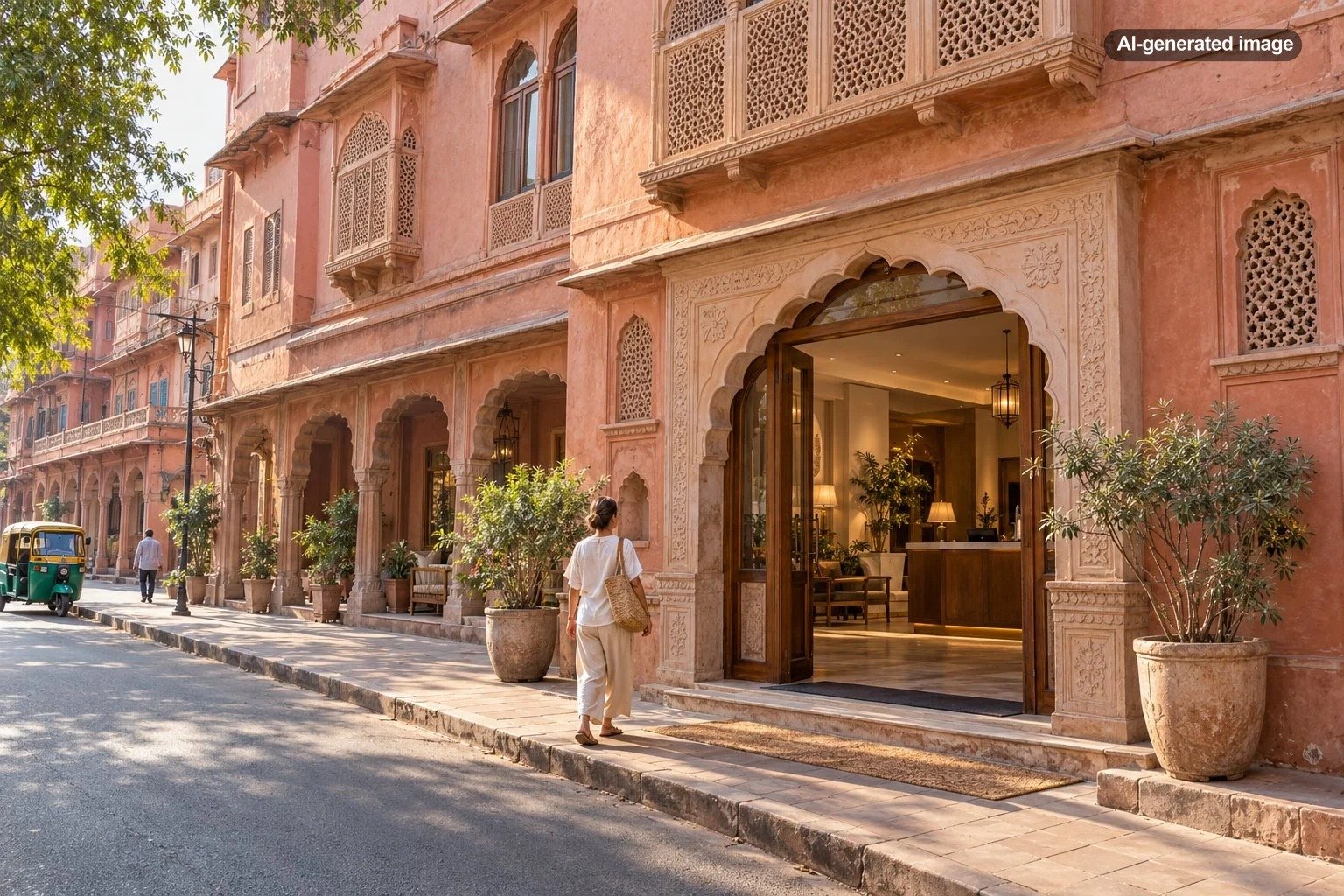
Jaipur Haveli, also known as Haveli Patnawala, occupies a family heritage property in the Johari Bazaar area. Its official website identifies a location near Hawa Mahal and City Palace, making it one of the most directly relevant options for visitors whose sightseeing priorities are concentrated in the old city.
The experience differs from a large palace hotel. Expect a smaller-scale historic residence rather than extensive resort-style grounds. That can be a benefit for travelers who prefer character, neighborhood immersion, and the ability to begin exploring without arranging a lengthy transfer.
Positioning: Boutique heritage accommodation, with a different service scale from large luxury hotels. Tradeoff: The dense bazaar setting may be less convenient for substantial luggage, uninterrupted vehicle access, or travelers particularly sensitive to street activity. Confirm the precise arrival procedure before booking.
Alsisar Haveli: A Heritage Base Near MI Road
Best for: Travelers who want an established historic hotel while remaining outside the most congested portions of the Pink City.
Alsisar Haveli is located on Sansar Chandra Road, in a central district that provides access to Jaipur’s older quarters and modern commercial streets. The property offers a heritage-hotel setting without requiring guests to stay in a distant palace complex.
This location is useful for visitors planning a mixture of cultural excursions, shopping, and evening meals in different neighborhoods. It can also appeal to travelers who want a historic atmosphere but are not determined to sleep within the old city walls.
Positioning: Upscale heritage hotel. Tradeoff: Central does not mean immediately beside City Palace. Most guests should plan to use a vehicle for the major monuments, particularly during hotter weather or when carrying shopping.
Hotel Narain Niwas Palace: Traditional Character South of the Historic Center
Best for: Travelers who appreciate a heritage setting but want to combine palace visits with museums, shopping, and other parts of central Jaipur.
Hotel Narain Niwas Palace occupies a historic residence associated with the Kanota family. Its architecture and traditional accommodation make it a logical alternative to the more remote palace retreats outside Jaipur.
The hotel suits travelers who regard the accommodation itself as part of the cultural experience but do not need to walk directly from their room to Hawa Mahal. It provides a different geographic balance from properties situated in the northern old city.
Positioning: Upscale heritage accommodation. Tradeoff: Visitors should expect road transfers to City Palace and Amber Fort rather than treating either as a doorstep attraction. Check the particular room category and access arrangements instead of assuming that all rooms in a historic property share an identical layout.
Jai Mahal Palace: Palace Grounds in Civil Lines
Best for: Couples, families, and travelers looking for a luxurious palace stay with more space around the property.
Jai Mahal Palace, operated by Taj, is located on Jacob Road in Civil Lines. The property offers a palace-hotel experience with landscaped surroundings while remaining within Jaipur’s main urban area.
This is a particularly useful alternative for visitors attracted to Rajasthan’s royal-hotel tradition but reluctant to commit to a secluded resort outside the city. The hotel can provide a more self-contained setting after a day of sightseeing while keeping central Jaipur accessible by road.
Positioning: Luxury palace hotel. Tradeoff: Civil Lines is not the Pink City’s pedestrian sightseeing core. Travelers should budget time for vehicle transfers and recognize that the large-property experience differs from staying among historic bazaars and lanes.
ITC Rajputana, A Luxury Collection Hotel: Heritage-Inspired City Luxury
Best for: Travelers who prefer an established full-service luxury hotel and a central base over an intimate historic residence.
ITC Rajputana, A Luxury Collection Hotel, Jaipur draws on the architectural language of traditional Rajasthani havelis while functioning as a substantial urban luxury hotel. Its location in central Jaipur makes it a practical candidate for visitors dividing their time between historic attractions and other parts of the city.
For guests who value organized hotel services, dining options, and the familiarity of a large property, it provides a useful contrast to older, smaller havelis. A heritage-inspired environment can deliver visual character without necessarily having the room configurations or circulation patterns of a centuries-old residence.
Positioning: Luxury city hotel. Tradeoff: It does not place travelers within immediate walking distance of every Pink City attraction. Visitors specifically seeking an authentic historic residence may find a restored haveli more distinctive.
Holiday Inn Jaipur City Centre: Contemporary Convenience
Best for: Families, business travelers extending a trip, and visitors who prioritize modern hotel facilities over heritage architecture.
Holiday Inn Jaipur City Centre provides a contemporary accommodation option in Jaipur’s central urban area. Its official hotel information emphasizes access to the city’s well-known attractions, including City Palace, Hawa Mahal, Jantar Mantar, and Amber Fort.
This is a sensible option for travelers who expect to spend most of the day visiting monuments and want a more conventional hotel environment when they return. It can also make sense for mixed-purpose trips involving business appointments, restaurant visits, and sightseeing.
Positioning: Upscale contemporary city hotel. Tradeoff: The hotel is not a palace or restored haveli, and palace sightseeing still requires road transportation. Its appeal lies more in everyday practicality than immersion in Jaipur’s architectural heritage.
Hilton Jaipur: Modern Comfort on Hawa Sadak
Best for: Travelers who want recognizable international hotel standards, contemporary interiors, and access to both tourist and commercial districts.
Hilton Jaipur is located at Geejgarh House on Hawa Sadak. The hotel’s official information describes dining venues, an outdoor pool, a spa, and meeting facilities, establishing it as a full-service urban property rather than a remote heritage retreat.
It suits travelers who are comfortable using taxis or a hired driver for sightseeing and who appreciate having a contemporary base between outings. The location can also work for visitors incorporating shopping or business into their itinerary.
Positioning: Upscale to luxury city hotel. Tradeoff: Hilton Jaipur is farther from the historic sightseeing cluster than a property in Johari Bazaar or near Jorawer Singh Gate. Travelers planning several short returns to their hotel throughout the day may find that less efficient.
Which Part of Jaipur Is the Most Practical?
| Area | Main advantage | Main compromise |
|---|---|---|
| Pink City and Johari Bazaar | Closest to landmark clusters and bazaars | Busy streets and less straightforward vehicle access |
| Amer Road | Useful for old-city and northern excursions | Walking convenience varies by address |
| MI Road vicinity | Central urban convenience | Most monuments require transportation |
| Civil Lines | More spacious hotel settings | Not in the pedestrian heritage core |
| C-Scheme and Hawa Sadak | Modern hotels and city amenities | Longer transfers to some historic sites |
How to Plan Palace Sightseeing From a Central Hotel
Group the Pink City landmarks together
City Palace, Jantar Mantar, and Hawa Mahal work naturally as a concentrated sightseeing outing. Staying nearby reduces the need to coordinate separate trips across town. However, proximity on a map does not automatically guarantee easy pedestrian movement. Busy intersections, uneven walking surfaces, heat, and traffic may all affect how comfortable a route feels.
Give Amber Fort its own excursion
Amber Fort is best treated as a separate outing from the dense central sightseeing cluster. A hired driver or arranged transfer can simplify the journey, particularly when combining the fort with other northern attractions. Travelers do not need to choose a hotel in the Amer area solely to visit the fort once.
Think about returning to the hotel during the day
A hotel close to the Pink City is especially useful if travelers want to return for a rest, change clothes, or drop off purchases between outings. A more distant central hotel can still be convenient for someone who prefers leaving after breakfast and staying out until dinner. This daily rhythm can matter more than a small difference in straight-line distance.
What Travelers Often Overlook Before Booking
- Similar hotel names: Confirm that a hotel belongs to the Jaipur location you intend to book, particularly when a hospitality group operates multiple heritage properties.
- Entrance location: The main entrance may not face the street or landmark suggested by a map pin. Ask where vehicles can actually stop.
- Heritage-building layouts: Older buildings may feature stairs, internal courtyards, and unusual room configurations. Verify accessibility needs directly with the property.
- Noise expectations: A central location can be wonderfully atmospheric without being uniformly quiet. Ask about room position if street noise matters.
- Booking conditions: Review taxes, cancellation terms, meal inclusions, and any transport arrangements for your exact dates rather than relying on general hotel descriptions.
- Driver arrangements: If you intend to visit several attractions in one day, discuss pickup locations and the day’s route before setting out.
Frequently Asked Questions
Is it better to stay near City Palace or Amber Fort?
For a first visit focused on multiple Jaipur landmarks, staying near City Palace or elsewhere in central Jaipur is generally more versatile. Amber Fort is an important excursion, but it is geographically separate from the main Pink City sightseeing cluster.
Can you stay in a heritage hotel without leaving central Jaipur?
Yes. Samode Haveli, The Raj Palace, Alsisar Haveli, Jaipur Haveli, and Hotel Narain Niwas Palace demonstrate that heritage accommodation is available in urban Jaipur. Their locations, scales, and levels of luxury differ substantially.
Is Civil Lines too far from Jaipur’s palaces?
No, provided you are comfortable using road transportation. Civil Lines can be a practical base for visitors who value hotel grounds and a calmer setting more than immediate access to the old-city streets.
Do you need a rental car in Jaipur?
Not necessarily. For travelers concentrating on the city and its major monuments, taxis, hotel-arranged cars, or a hired driver may be simpler than navigating and parking a self-drive vehicle. A rental car becomes more relevant when Jaipur is part of a longer self-drive journey through Rajasthan.
Which hotel style is best for a short Jaipur visit?
For a short sightseeing-focused stay, a small property in the Pink City or an established hotel near its edge can minimize unnecessary transfers. For a longer stay or a trip combining sightseeing and relaxation, an upscale hotel in Civil Lines or another central district may offer a more comfortable balance.
The Bottom Line: Choose Urban Access Before Palace Prestige
Jaipur rewards travelers who distinguish between the appeal of a heritage building and the actual convenience of its address. A countryside palace can be memorable, but it may not suit a trip built around repeated visits to City Palace, Hawa Mahal, historic markets, and central restaurants.
For the strongest combination of traditional atmosphere and urban access, begin with Samode Haveli, The Raj Palace, Jaipur Haveli, and Alsisar Haveli. Consider Jai Mahal Palace when spacious luxury grounds matter more than walkability. For contemporary convenience, ITC Rajputana, Holiday Inn Jaipur City Centre, and Hilton Jaipur provide alternatives that keep the visit centered on the city rather than an isolated resort.
The most successful choice is not automatically Jaipur’s grandest hotel. It is the property that lets you enjoy the city’s palaces without spending an unreasonable portion of your visit traveling between them.
Sources & Further Reading
- Samode – Samode Haveli official property information
- The Raj Palace – Official hotel website and location
- Jaipur Haveli – Official accommodation and location information
- Alsisar Haveli – Official hotel website
- Hotel Narain Niwas Palace – Official hotel website
- Taj Hotels – Jai Mahal Palace Jaipur
- ITC Hotels – ITC Rajputana Jaipur
- IHG – Holiday Inn Jaipur City Centre
- Hilton – Hilton Jaipur location and transportation