What Is an Infinite Veranda Cabin and Who Should Avoid It?
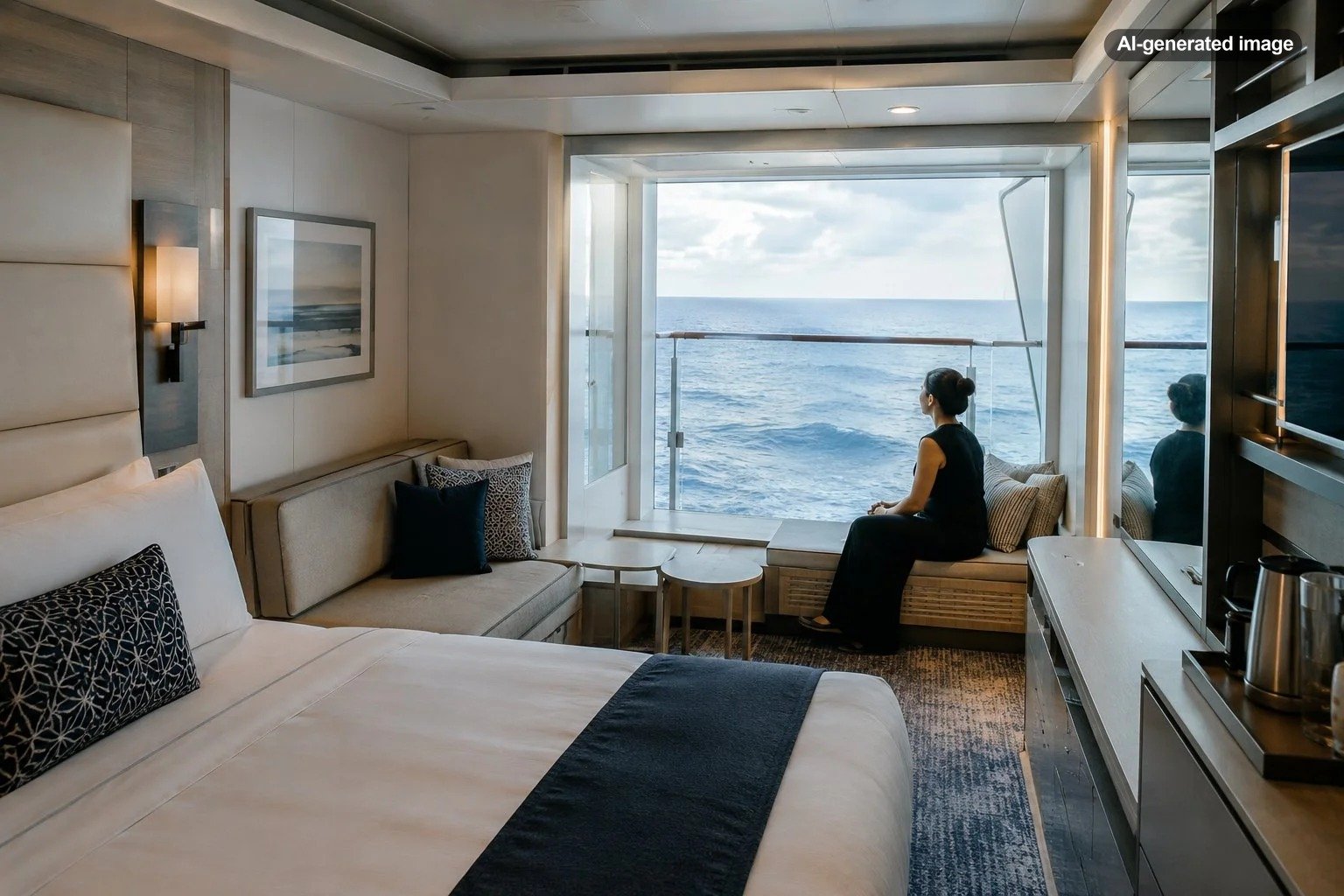
An Infinite Veranda cabin is a cruise stateroom that brings the balcony area into the main room rather than placing a permanently separate outdoor balcony beyond a sliding door. On Celebrity Cruises’ Edge Series, the best-known version uses floor-to-ceiling glass and a powered upper window that can lower to create an open-air connection to the sea. Close the window, and the same area functions as part of the climate-controlled interior.
That design can make a cabin feel larger and more flexible, but it does not feel exactly like a conventional balcony. Travelers who picture stepping through a door onto a completely separate outdoor platform should understand the distinction before booking.
Quick answer: what makes an Infinite Veranda different?
- The veranda is integrated into the cabin. There is no permanently separate exterior balcony in the usual sense.
- A powered window creates the open-air effect. Lowering the upper glass panel lets fresh air and outside conditions enter the veranda area.
- Closing the window adds usable indoor space. The seating area can function as an extension of the room when the window is shut.
- It suits travelers who value views and interior space. The design can feel especially appealing in poor weather, when a traditional balcony might go unused.
- Traditional-balcony fans may prefer another cabin. If having a clearly separate outdoor retreat is important, an Infinite Veranda can feel fundamentally different.
How an Infinite Veranda cabin actually works
Celebrity Cruises describes its Edge Stateroom with Infinite Veranda as a design that extends the living space toward the water. The veranda zone sits behind floor-to-ceiling glazing at the outer edge of the cabin. A movable upper window can be lowered electronically, while interior doors or partitions can help define the veranda area from the rest of the room.
With the exterior window closed, the veranda seating occupies space that feels largely incorporated into the cabin. Open the window, and that outer section becomes exposed to sea air, outside temperature, humidity, and ship sounds. The transition is therefore less like opening a conventional balcony door and more like converting the end of the room between enclosed and open-air use.
This distinction matters because the two designs encourage different habits. On a traditional balcony, one person can often sit outside while another remains inside behind a closed exterior door. In an Infinite Veranda arrangement, opening the exterior window changes the environment in the veranda zone and can affect the way the entire cabin feels.
Infinite Veranda vs. a traditional balcony cabin
| Feature | Infinite Veranda | Traditional balcony |
|---|---|---|
| Outdoor separation | Veranda is integrated with the room | Balcony is normally a distinct exterior area |
| Weather flexibility | Outer area remains useful indoors when closed | Outdoor balcony may be less useful in poor weather |
| Fresh-air experience | Powered window opens the veranda area | Door opens directly onto an exterior platform |
| Privacy between uses | Indoor and veranda functions are more connected | One traveler can generally remain outside while another stays indoors |
| Best fit | Travelers prioritizing views and flexible interior space | Travelers who strongly value a separate outdoor retreat |
Why some travelers prefer Infinite Veranda cabins
The strongest argument for the design is flexibility. On a cold, windy, rainy, or extremely humid day, a conventional balcony can become space that exists but receives little use. An Infinite Veranda allows the outer seating area to remain enclosed while retaining expansive views.
The design can also create a pleasing visual effect. Because the room extends toward the glass rather than stopping at a conventional balcony doorway, the cabin may feel more connected to the scenery. Travelers who spend time reading, working, having coffee, or simply watching the ocean from inside may appreciate that arrangement more than travelers who judge a veranda primarily by how it feels outdoors.
It can be particularly practical for cruisers who like natural light but do not spend long stretches sitting on a balcony. They can enjoy the view from the room and open the window when they specifically want fresh air.
Who should avoid an Infinite Veranda cabin?
Travelers who consider a separate balcony essential should think carefully before booking one. The Infinite Veranda experience is not simply a conventional balcony with different glass doors. Its integrated design changes how the room and outdoor area interact.
Couples with different balcony habits
Imagine one traveler who wants to sit outside early in the morning while the other wants to sleep in a dark, climate-controlled cabin. A traditional balcony naturally separates those activities. An Infinite Veranda provides less complete separation between the person enjoying open air and the person using the interior.
Travelers who spend hours outdoors
Some cruisers treat their balcony almost like a private patio. They read outside, eat there when practical, photograph ports, watch sailaways, and spend long stretches listening to the water. Those travelers may find a conventional veranda more satisfying because it remains a clearly defined outdoor space at all times.
Anyone who wants indoor climate control while someone else sits outside
Opening an Infinite Veranda introduces outside air into the outer portion of the cabin. Exact operating behavior can vary by ship and conditions, but travelers should not assume the cabin will behave exactly as it would with a sealed interior room and a completely separate balcony beyond it.
Travelers who dislike powered windows and automated room features
The design depends more heavily on powered controls than a simple balcony door. Travelers who strongly prefer straightforward, manually operated spaces may find a conventional veranda more intuitive.
Who is most likely to enjoy one?
An Infinite Veranda can make considerable sense for a traveler who thinks of a balcony primarily as a way to enjoy expansive views and occasional fresh air. It can also appeal to cruisers sailing routes where weather may make constant outdoor balcony use less attractive.
Solo travelers may appreciate having a flexible seating area without feeling that a large portion of their cabin is permanently outside. Couples with similar routines can also enjoy the design, particularly when both travelers tend to open or close the veranda at the same time.
The key is to evaluate how you actually use a cruise balcony rather than assuming that every cabin labeled as a veranda delivers the same experience.
What travelers often overlook before booking
Cabin-category names can obscure meaningful architectural differences. A traveler comparing two cruises might see the word veranda in both descriptions and assume that the physical experience will be comparable. It may not be.
Look at the ship’s official deck plans, cabin photographs, floor plans, and category descriptions before choosing. Celebrity’s Edge Series, for example, also includes certain veranda accommodations that use more conventional outdoor spaces. Availability and category names vary by ship, so the precise room description matters more than the broad word veranda.
Also consider your daily routine. If the balcony is mostly a place to stand for five minutes while entering a port, an Infinite Veranda may offer more flexibility than you need. If you traditionally spend several hours outside every sea day, the difference becomes much more important.
Frequently asked questions
Is an Infinite Veranda a real balcony?
It provides private open-air access, but its architecture differs from a traditional projecting or recessed balcony. The veranda area is incorporated into the cabin and becomes open to the outdoors when the powered window is lowered.
Can you keep the Infinite Veranda closed?
Yes. With the exterior window closed, the veranda area remains enclosed, allowing it to function more like additional interior living space while preserving the large ocean-facing glass.
Does an Infinite Veranda make the cabin feel bigger?
It can. Because the veranda zone is integrated with the room rather than permanently separated outside, the usable enclosed area can feel more spacious. Celebrity currently lists its standard Edge Stateroom with Infinite Veranda at 243 square feet of total living space, including a 42-square-foot veranda area, although dimensions and configurations depend on the specific cabin category and ship.
Is an Infinite Veranda better in bad weather?
It can be more versatile because the veranda area remains usable as enclosed space when the exterior window is shut. Whether that is preferable depends on whether you value flexible indoor space more than a permanently separate balcony.
Should you book one for your first cruise?
There is no universal answer. If you mainly want ocean views, natural light, and occasional fresh air, it can be an appealing choice. If your mental picture of cruising includes sitting on a distinct private balcony while the cabin remains closed behind you, choosing a traditional veranda is the safer match for that expectation.