Should You Book a Cruise Cabin Near the Front or Back Elevators?
If you are deciding between a cruise cabin near the front elevators and one near the back elevators, neither location is automatically better. The more useful question is which elevator bank puts you closest to the places you expect to use most often. Forward cabins can be convenient for theaters, observation spaces, spas, or other venues positioned toward the bow on a particular ship, while aft cabins may reduce the walk to dining rooms, buffet areas, lounges, pools, or outdoor spaces located toward the stern. Ship layouts vary considerably, so the deck plan matters more than a general rule about front versus back.
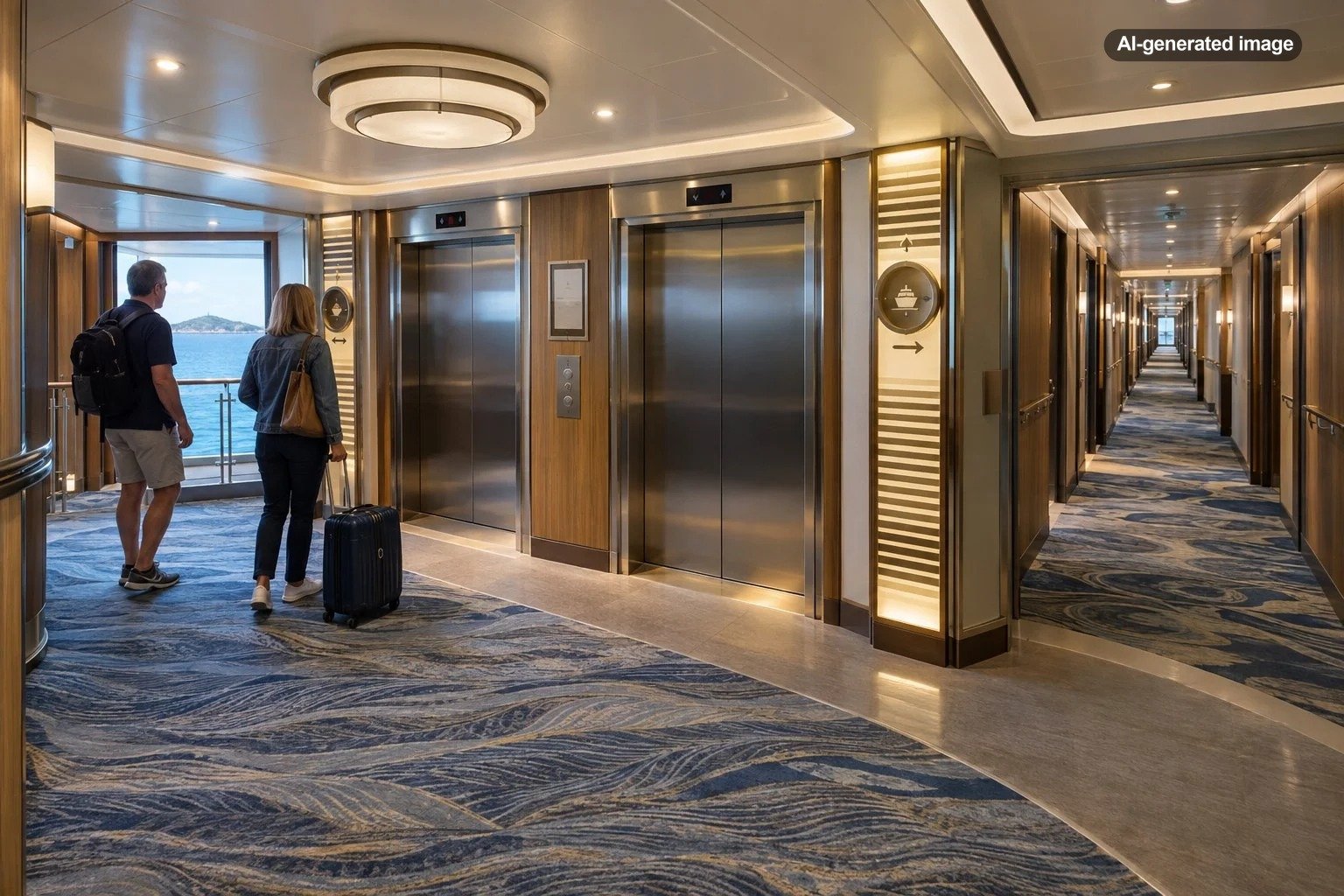
Elevator proximity itself is usually a convenience advantage, especially on large ships, but the precise cabin position also matters. A room a short distance down the corridor from an elevator lobby can provide easy access without placing the door directly beside one of the ship’s busiest circulation areas.
Quick answer: front or back elevators?
- Choose the front elevators when the venues you will use most are concentrated toward the bow.
- Choose the back elevators when your preferred dining, pool, lounge, or outdoor areas are primarily aft.
- Do not choose by elevator location alone. Check what is above, below, and across from the cabin.
- Motion-sensitive travelers may prefer a more central location. If minimizing movement is a priority, the middle of the ship can matter more than choosing between forward and aft.
- A cabin near, but not directly beside, an elevator lobby often provides the best balance between convenience and corridor activity.
Front elevators can be convenient for forward-focused days
The strongest reason to choose a cabin near the front elevators is simple: your daily destinations are also near the front of the ship. Depending on the vessel, forward areas may include a main theater, observation lounge, spa, fitness facilities, youth spaces, or access to upper-deck attractions.
This can be particularly useful if you expect to visit the same forward venue repeatedly. Crossing a large modern cruise ship several times a day can add substantial walking, especially when your cabin and preferred activities are at opposite ends.
The tradeoff is that a forward cabin can leave you with a longer trip to venues concentrated aft. If breakfast, dinner, and evening drinks repeatedly take you toward the stern, the location may feel less convenient than it appeared when you booked.
Back elevators can simplify access to aft dining and leisure areas
Aft elevator banks can be appealing when a ship places major restaurants, buffet areas, lounges, pools, or outdoor decks toward the back. For travelers who organize their day around meals and relaxed outdoor time, this can make an aft location surprisingly practical.
It can also be useful for families or multigenerational groups that prefer to minimize long corridor walks. Instead of focusing only on the distance from the cabin to an elevator, trace the complete route from the cabin to the places your group will visit most frequently.
The disadvantage is essentially the reverse of a forward cabin: theaters and other bow-oriented venues may require more walking. There is no universal aft advantage because the arrangement changes from one ship class to another.
Being near an elevator is not necessarily the same as being in a noisy cabin
Travelers sometimes avoid all cabins near elevators because they assume the area will be loud. That is too broad a rule. The more important distinction is between being conveniently near the elevator bank and having a cabin door immediately beside a heavily used elevator lobby, staircase, or gathering point.
Passenger traffic often increases around elevator banks before dinner, around show times, during port arrivals, and when large numbers of guests are moving between decks. A cabin positioned a few doors down a corridor can still provide excellent elevator access while creating some separation from that flow.
Also look for features near the elevator lobby that might create additional activity, such as public restrooms, lounges, restaurants, kids’ areas, or major entrances to entertainment venues. The elevator itself may be less significant than everything surrounding it.
For motion sensitivity, front versus back may be the wrong comparison
If you are particularly sensitive to ship movement, choosing between the front and back elevators should not be your first priority. Movement can feel more noticeable toward the ends of a vessel than closer to its center, although conditions vary with the ship, sea state, route, weather, and cabin deck.
A traveler concerned about motion may therefore prefer a cabin closer to the middle of the ship, potentially on a lower passenger deck, even if that cabin is not near the preferred forward or aft elevator bank. Convenience is useful, but it may not outweigh comfort for someone who already knows that motion affects them.
Check the decks above and below before choosing either location
One of the most common cabin-selection mistakes is studying only the cabin’s own deck. Once you find a promising room near the front or back elevators, check the corresponding space directly above and below it.
A cabin surrounded by other cabins is generally a simpler location to evaluate than one beneath a high-traffic public area. Depending on the ship, areas above or below could include restaurants, lounges, theaters, pools, fitness facilities, service areas, or outdoor decks. The relevant concern is not that every public space creates a problem, but that your cabin choice should account for how that space is used and at what times.
Also inspect nearby staircases. Stairs can be extremely useful for moving one or two decks without waiting for an elevator, so a cabin near a combined stair-and-elevator core can be especially convenient for travelers comfortable using them.
Match the elevator bank to your daily routine
The best way to choose is to make a short list of the places you expect to use repeatedly. You do not need to predict every hour of the cruise. Three or four priorities are enough.
For example, travelers who expect to attend evening performances frequently may prefer the elevator bank closest to the main theater. Someone who spends much of the day near an aft pool or dining area may value the opposite end. Families may prioritize proximity to youth facilities, while travelers booking spa treatments may care more about an efficient route to the wellness area.
Think vertically as well as horizontally. A cabin directly below your favorite venue can sometimes be more convenient than a cabin on the same deck but at the opposite end of a very long ship. Elevators make vertical distance easy; long corridors still require walking.
What travelers often overlook when comparing front and back
Embarkation convenience should not dominate the decision. The entrance used when you first board may not represent the routes you will use during the rest of the cruise.
Elevator demand changes throughout the day. The closest elevator is not always the fastest during busy periods. Being comfortable using nearby stairs for short trips can make location much less important.
Your cabin category may limit the choice. Certain cabin types, views, connecting rooms, accessible accommodations, or layouts may only be available in particular sections of a ship. A more suitable cabin can be worth a slightly longer walk.
Ships within the same cruise line can have different layouts. Do not assume that a location you liked on one vessel will function the same way on another. Review the deck plan for the exact ship and, when applicable, the deck-plan version corresponding to your sailing period.
A practical way to choose your cabin
Start with the cruise line’s deck plan and identify the exact cabin you are considering. Then locate the nearest elevator and staircase, followed by the three or four venues you expect to use most. Check the decks immediately above and below the cabin and note any major public spaces beside the elevator lobby.
If the front and back options still seem equal, choose based on your personal priorities. Travelers who value shorter walks should favor the end containing their most-used venues. Travelers concerned about motion may want to move closer to midship instead. Light sleepers can look for a cabin slightly removed from the elevator lobby and surrounded by other cabins.
The key is to treat the elevator bank as part of the ship’s overall layout rather than as an isolated feature. A well-positioned cabin can make a large vessel feel much easier to navigate.
Frequently asked questions
Is it bad to book a cruise cabin near an elevator?
Not necessarily. Being near an elevator can be very convenient. If noise or foot traffic concerns you, consider a cabin a few doors away rather than one opening directly onto the elevator lobby.
Is the front or back of a cruise ship quieter?
There is no universal answer. Noise depends on nearby venues, passenger routes, service spaces, stairways, and what is located above and below the cabin. The deck plan provides more useful information than the simple forward-or-aft label.
Which end is better for travelers who dislike long walks?
Choose the end closest to the venues you will use repeatedly. On a large ship, matching your cabin to your daily routine can eliminate unnecessary trips from one end to the other.
Should motion-sensitive travelers choose the front or back elevators?
Neither end is automatically ideal for someone focused on reducing perceived movement. A more central cabin may be a better starting point, with elevator proximity considered after location on the ship.
How close should a cabin be to the elevators?
There is no required distance. Many travelers find that being a short walk down the corridor provides a useful compromise: the elevator is easy to reach, but the cabin is somewhat separated from the busiest part of the lobby.