Should You Avoid Cruise Cabins Near the Main Dining Room?
You do not automatically need to avoid cruise cabins near the main dining room. In fact, being close to a major restaurant can be convenient, particularly on larger ships where reaching different public areas involves considerable walking. The important distinction is whether your cabin is simply near the dining room or shares a wall, ceiling, or floor with an active dining, kitchen, or service area.
A cabin one corridor away from the dining room may be perfectly comfortable, while a cabin directly underneath a busy galley could experience sounds from equipment, cleaning, or food-service operations. The answer depends on the ship’s layout, the cabin’s exact position, and how sensitive you are to noise.
Quick Answer: When Should You Avoid These Cabins?
- Usually acceptable: Cabins near the dining room but separated from it by corridors, stairwells, or other passenger accommodations.
- Worth investigating: Cabins immediately above or below dining-room seating, especially where furniture movement or cleaning activity could be audible.
- Potentially more concerning: Cabins adjoining galleys, crew service entrances, or food-preparation spaces.
- Convenient for some travelers: Cabins offering straightforward access to dining facilities without being directly exposed to operational activity.
- Safest general choice for quiet: A cabin surrounded by passenger cabins above, below, and beside it.
Rather than rejecting an entire section of a ship, examine the specific cabin and the spaces surrounding it on multiple decks.
Why the Main Dining Room Can Affect Cabin Noise
The main dining room is different from a nightclub or theater. It generally does not produce continuous amplified entertainment, although some ships incorporate announcements, music, special meals, or other events. Its primary purpose is seated meal service, which often makes it a less obvious noise concern than major entertainment venues.
Nevertheless, a large dining room is an active operational space. Passenger conversation, furniture movement, table preparation, cleaning, and nearby food-service activity can all contribute to noise.
Dining Room Activity Is Not Limited to Dinner
Passengers often evaluate cabin locations by imagining what happens during dinner. However, some main dining rooms also serve breakfast or lunch, depending on the cruise line, ship, and itinerary.
Preparation can begin before guests arrive, and cleanup can continue after the last diners leave. These activities do not mean every nearby cabin will be noisy, but they make the exact location more important than published dining hours alone.
The Galley May Matter More Than the Dining Room
A ship’s galley is its food-preparation and kitchen area. Depending on the layout, it may sit behind, beside, or on another level from the passenger dining space.
Galleys can involve rolling carts, kitchen equipment, supply movement, dish handling, and crew circulation. These activities may occur outside the main dining room’s guest-service periods.
If a cabin is directly above, below, or adjacent to a galley or associated service corridor, investigate it more carefully than a cabin beside a relatively quiet dining-room seating area.
Is It Worse to Stay Above or Below the Main Dining Room?
Neither position is universally worse. Sound transmission depends on construction, equipment placement, the activities taking place, and what separates the cabin from the public space.
Cabins Directly Above the Dining Room
A cabin above dining-room seating may experience relatively little disruption, especially if the room below is primarily used for seated meals. However, furniture movement, amplified sound, or special events could occasionally be noticeable.
The more significant question is whether the space beneath the cabin is actually the dining room or an adjoining galley, pantry, crew workspace, or service area. Two cabins on the same deck can have very different exposures.
Cabins Directly Below the Dining Room
Cabins beneath a dining room may be more exposed to impact noise transmitted through the floor above. Footsteps, chairs being moved, cleaning equipment, and carts are possible sources.
This does not make every cabin beneath a dining room unsuitable. Structural separation and the exact activities overhead make a substantial difference. Still, light sleepers should give these cabins additional scrutiny, especially if early-morning or late-evening operations are a concern.
Cabins Beside the Dining Room
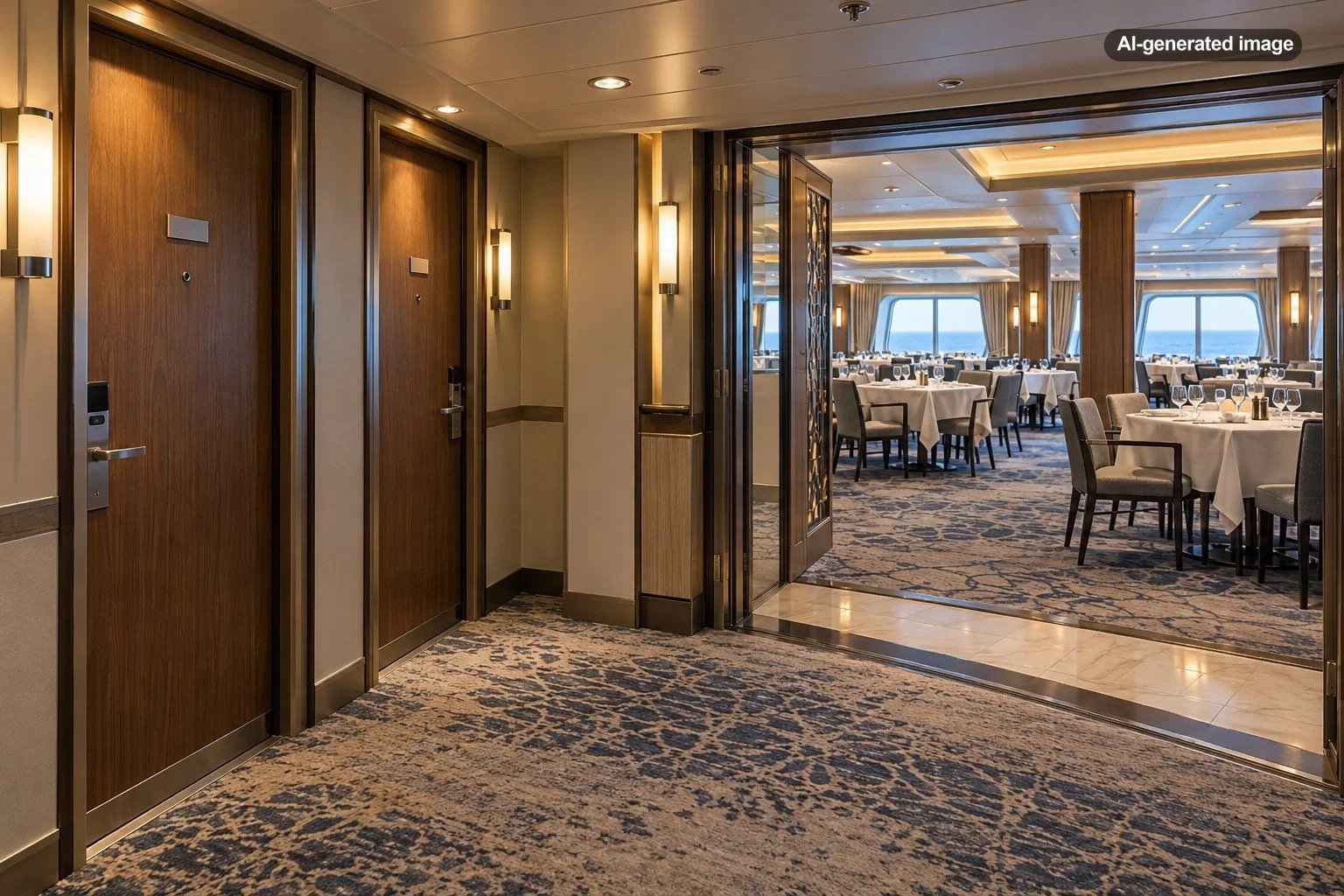
Being on the same deck as the dining room can be less concerning when your cabin is separated from the restaurant by a passenger corridor or another buffer space.
However, a cabin near a busy dining-room entrance may experience passing conversations or concentrated foot traffic before and after meals. A cabin adjacent to a crew entrance or service door raises different concerns, including repeated door activity and cart movement.
How Different Dining Room Locations Compare
| Cabin location | Main consideration | Practical recommendation |
|---|---|---|
| Near dining room, with separation | Convenience versus passing traffic | Often reasonable |
| Directly above dining seating | Events and furniture movement | Check the exact space below |
| Directly below dining seating | Footsteps, chairs, and cleaning | Investigate if noise-sensitive |
| Adjacent to galley or service area | Carts and operational activity | Consider alternatives |
| Near main dining entrance | Passenger gatherings and corridor noise | Check door and hallway positions |
| Surrounded by passenger cabins | Fewer immediate public-space exposures | Good starting point for quiet |
These are general planning considerations rather than predictions for a particular cabin. A ship-specific deck plan and reliable reports about the exact location are more informative.
When Being Near the Main Dining Room Is Actually Helpful
Proximity to the main dining room has advantages that are easy to overlook when concentrating on possible noise.
Travelers Who Prefer Shorter Walks
On large cruise ships, dining rooms can be several decks away from passenger accommodations. Staying nearby may reduce walking and elevator use, especially for travelers who prefer to limit unnecessary trips through the ship.
However, proximity to the restaurant does not necessarily mean convenient access. A dining room may have entrances on selected decks, and some corridors do not connect directly to every area that looks adjacent on a map.
Families With Children
Families may appreciate returning to their cabin quickly after dinner or before an evening activity. A shorter route can also be helpful when someone needs to retrieve a forgotten item.
That convenience should be balanced against sleep schedules. Families with young children who go to bed early may prefer a cabin buffered from dining-room entrances and other busy public spaces.
Travelers Who Regularly Use the Main Dining Room
Some passengers eat most meals in the main dining room, while others prefer the buffet, specialty restaurants, or more casual venues.
If you expect to use the main dining room frequently, a well-positioned nearby cabin may make daily routines easier. If you anticipate dining elsewhere most of the time, proximity offers less practical value.
How to Check a Cruise Cabin Before Booking
The most reliable approach is to examine the ship’s deck plans before choosing a cabin number. Looking at just the deck containing the cabin is not enough.
Step 1: Identify the Exact Cabin Position
Find the cabin number on the cruise line’s current deck plan for your ship. Note whether it is forward, midship, or aft, and identify the nearest public spaces.
Pay attention to dining-room entrances, stairwells, elevators, and marked service areas. A short distance on the plan does not always mean a direct walking route.
Step 2: Examine the Deck Above and Below
Compare the cabin’s approximate footprint with spaces on the adjacent decks. Look for restaurant seating, food-service facilities, public lounges, theaters, open decks, and passenger accommodations.
Some dining rooms extend across two levels, so the venue may occupy more vertical space than its primary entrance suggests.
Deck plans are also not complete engineering diagrams. Unlabeled or shaded spaces may conceal crew facilities or operational areas rather than being empty.
Step 3: Look for Reports About the Specific Cabin
Search for experiences associated with the ship name and cabin number. If information on that precise cabin is unavailable, look at nearby cabins in the same section.
Give more weight to detailed reports describing what was heard and when. A comment about audible carts early in the morning is more useful than a general statement that an entire deck is noisy.
Also distinguish between observations about a particular sailing and conditions that may be consistent across voyages. Crew routines, special events, and passenger behavior can vary.
Step 4: Ask About Unmarked Areas
If the deck plan shows a large unidentified space adjoining your cabin, ask the cruise line or your travel advisor whether its purpose can be confirmed.
They may be able to clarify the location, but not every staff or service space will be identified in publicly available information. Avoid interpreting an unanswered question as proof that the area is quiet.
Step 5: Compare the Alternatives Before Paying More
When several cabins in the same category are available, compare their surroundings before deciding whether a different location justifies any price difference.
A modest change in cabin position can sometimes provide better separation from public spaces without requiring a different accommodation category. Conversely, a more expensive cabin does not automatically have a quieter location.
If you are still selecting a sailing, you can compare available sailings while considering ship layout, itinerary, and cabin-selection options. Review the cruise line’s current deck plans before settling on a particular room.
What Travelers Often Overlook About Dining Room Noise
The dining room may not be the only nearby venue. A cabin close to the restaurant could also sit near a lounge, theater, atrium, elevator lobby, or another gathering space. The combined surroundings matter more than the restaurant label alone.
Sound can travel from operational spaces. A cabin that does not directly touch the dining room may still be near a service corridor, stairwell, or crew door. These areas can generate intermittent noise unrelated to passenger meals.
Restaurant hours do not describe the entire workday. Cleaning, preparation, and service activities can take place when passengers are not dining.
Cabin doors and corridors matter. Even if sound transmission through walls and floors is limited, conversations in a busy hallway may be noticeable near the cabin entrance.
Cabin location should be considered as a whole. Moving farther from the dining room could place you closer to an elevator lobby, entertainment venue, pool deck, or another area with greater noise potential.
Ship-specific differences are substantial. Dining-room placement, galley arrangements, passenger circulation, and cabin construction vary. A rule that works well on one ship may be unhelpful on another.
Which Cabin Location Is Best for Light Sleepers?
If quiet is your primary concern, begin by looking for cabins with other passenger cabins directly above, below, and on either side. This arrangement reduces immediate exposure to public venues, although it cannot eliminate noise from neighboring guests or ship operations.
Consider the length of nearby corridors and their proximity to elevator banks, crew access points, and major public areas. A cabin that is not on a main route between restaurants and entertainment spaces may experience less passing traffic.
If you are an especially light sleeper, choose a location with fewer unknowns rather than relying solely on the expectation that a dining room will be quiet overnight.
Remember that no cabin can be guaranteed silent. Ship movement, mechanical equipment, neighboring passengers, and other circumstances may still affect the experience.
Frequently Asked Questions
Are cruise cabins above the main dining room noisy at night?
Not necessarily. Some passengers report little disturbance from dining rooms below their cabins. Others may notice furniture movement, events, or nearby operational activity. The exact cabin location and the space immediately beneath it are more important than a blanket rule.
Can you hear people talking in the dining room from your cabin?
It is possible in some locations, but ordinary conversation is not necessarily transmitted clearly into cabins. Structural separation, distance, sound levels, and the presence of connecting spaces all affect what might be audible.
Are cabins near a cruise ship galley worse than cabins near the dining room?
They may present a greater concern for travelers sensitive to operational noise. Food preparation, carts, cleaning, and crew movement can extend beyond regular dining hours. However, the actual impact depends on the galley’s location and the ship’s construction.
Should you avoid cabins near dining-room elevators?
Not automatically. Elevators can be convenient, especially for travelers who prefer shorter walks. The main concern is often passenger traffic and conversation near elevator lobbies rather than the elevators themselves. A cabin directly beside a busy waiting area deserves closer examination.
Is it better to book a higher deck to avoid dining-room noise?
A higher deck is not automatically quieter. Cabins on upper levels may be close to pools, buffets, sun decks, or entertainment venues. Look for good separation from active public spaces rather than choosing a deck solely because it is higher.
The Bottom Line: Avoid Problematic Adjacencies, Not the Entire Dining Room Area
There is no compelling reason to reject every cruise cabin near the main dining room. Proximity can provide meaningful convenience, and many nearby cabins may have no notable dining-related disturbance.
Be more selective when a cabin shares a boundary with a galley, service corridor, dining-room entrance, or active seating area. These locations merit closer examination, particularly for travelers who are sensitive to noise or maintain early sleeping hours.
The strongest booking strategy is to compare the exact cabin with the decks above and below it, investigate unidentified spaces, and balance potential noise against convenience. A thoughtfully chosen cabin near the main dining room can be just as sensible as one farther away.