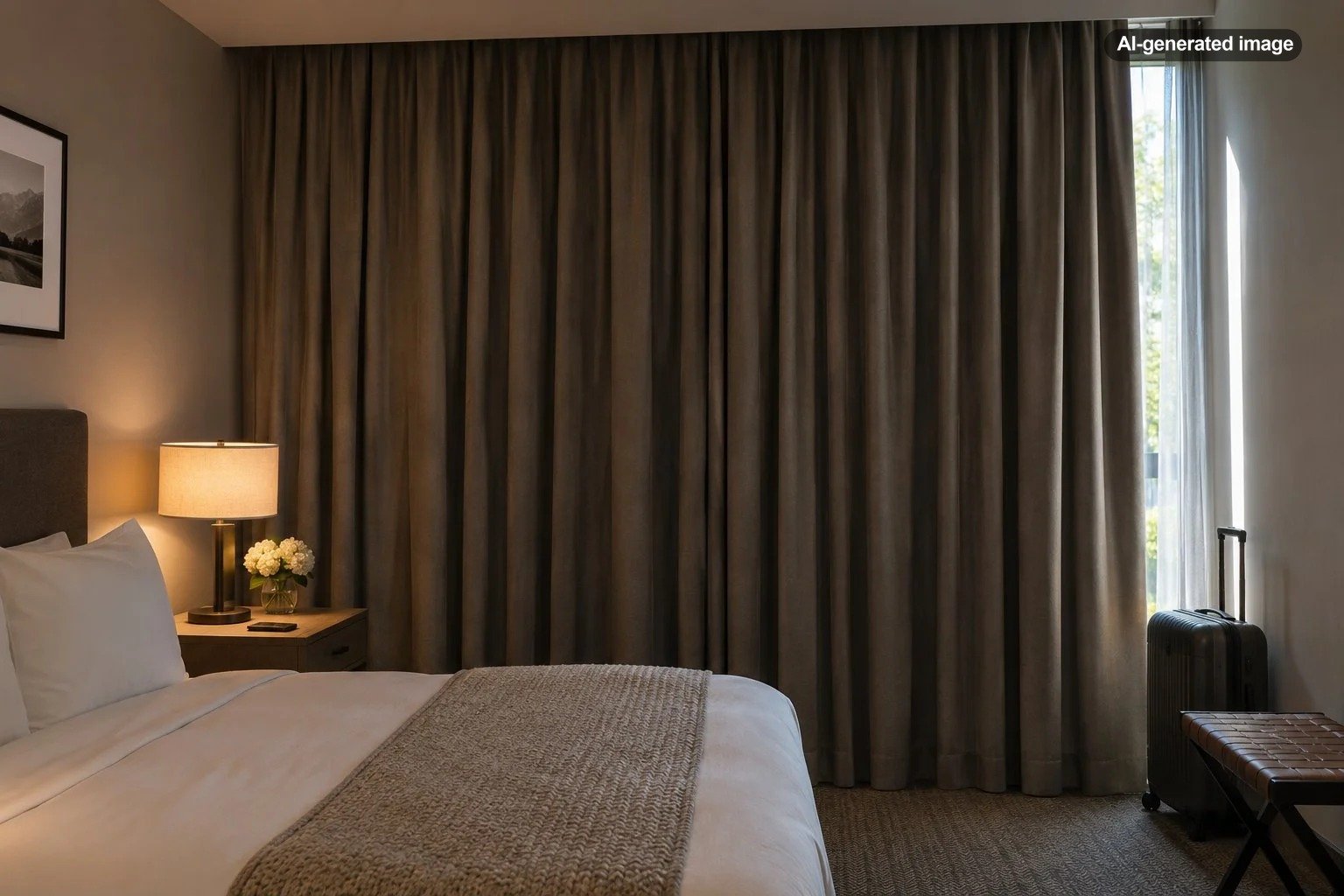
How to Tell If a Hotel Room Has Blackout Curtains That Actually Block Light
Blackout curtains are one of those hotel amenities that sound straightforward until sunlight starts streaming across the pillow at 6 a.m. A room can advertise blackout curtains and still have noticeable light entering around the window, through gaps between curtain panels, or above the curtain track.
The most reliable way to tell whether hotel blackout curtains actually block light is to examine the entire window covering system, not simply the fabric. Look for substantial overlap at the center, coverage beyond the window edges, minimal gaps at the top, and an opaque backing or separate blackout shade. Before booking, photographs, guest reviews, and a specific question to the hotel can help distinguish genuinely effective light control from ordinary room-darkening curtains.
Quick Answer: What Makes Hotel Blackout Curtains Effective?
- Opaque fabric: The material should prevent most or all direct light from passing through the curtain itself.
- Side coverage: Curtains should extend beyond the window edges rather than ending exactly at the glass.
- Center overlap: Two curtain panels should overlap when closed instead of leaving a bright vertical seam.
- Top coverage: A recessed track, enclosed curtain pocket, or covered header helps prevent light from entering above the fabric.
- Proper installation: Even excellent blackout material performs poorly when the curtain is too narrow, too short, or difficult to close completely.
For travelers who need a particularly dark sleeping environment, these installation details matter more than the color, thickness, or appearance of the curtains in a promotional photograph.
Blackout Curtains and Room-Darkening Curtains Are Not the Same
Hotels sometimes use the terms blackout, room darkening, and light filtering loosely in amenity descriptions. Although these treatments can look similar, they serve different purposes.
Blackout Curtains
Blackout curtains use opaque material or a specialized backing intended to prevent light from passing directly through the fabric. Properly installed blackout curtains can produce a very dark sleeping environment, but the material alone does not guarantee a completely dark room.
A bright line of daylight may still enter along the sides or between the panels. This is particularly noticeable when the window faces the rising sun or a brightly illuminated exterior surface.
Room-Darkening Curtains
Room-darkening curtains reduce incoming light without necessarily eliminating it. They may be perfectly adequate for ordinary nighttime sleeping but less suitable for daytime rest, early summer sunrises, or travelers with strong light sensitivity.
A thick decorative curtain can also appear light-blocking when photographed at night, even if it allows a noticeable glow during the day.
Sheer Curtains With a Separate Blackout Layer
Many hotel rooms use two window treatments: a translucent privacy curtain and a heavier outer drape or retractable blackout shade.
This arrangement can work exceptionally well when the blackout layer covers the entire window opening. However, travelers should confirm that the heavier layer is functional rather than decorative and that both sides can close completely.
How to Evaluate Blackout Curtains From Hotel Room Photos
Booking photos rarely show the curtains under the lighting conditions that matter most. Hotels generally photograph rooms with attractive daylight, open curtains, and visible views. Those images are designed to communicate the room’s appearance, not demonstrate its ability to become dark.
Still, certain architectural details provide useful clues.
Look at the Curtain Track and Ceiling
Pay attention to where the curtains attach. A ceiling-mounted track or enclosed curtain pocket may allow the fabric to hang close to the upper edge of the window, reducing the path for incoming light.
A curtain rod mounted well above the window can also work when the fabric extends sufficiently beyond the opening. The key is whether light can travel over the top of the curtain and spread across the ceiling.
An exposed track with fabric hanging noticeably below it may create a persistent horizontal light gap.
Check Whether the Curtains Extend Beyond the Window
Effective blackout curtains generally cover more than the visible glass. Ideally, the fabric continues past the sides of the window opening and toward the wall.
When curtains stop exactly at the window frame, sunlight can escape around their edges. A room can therefore have genuinely opaque curtains but still become surprisingly bright after sunrise.
Notice How the Curtains Meet in the Middle
Large hotel windows frequently have two curtain panels that close toward the center. If the panels merely touch, a narrow gap can create a concentrated stripe of light.
Look for overlapping panels or a track arrangement designed to bring one panel slightly in front of the other. A visible center overlap is generally more promising than two separate edges meeting without any extra fabric.
Look for an Additional Roller Shade
A room with blackout roller shades behind decorative curtains may offer more effective light control than one relying on curtains alone.
However, roller shades also have potential gaps. A shade mounted inside a window recess may leave narrow openings along both sides. Side channels or a carefully designed surrounding structure can reduce those gaps.
Photographs cannot confirm the performance of every window covering, but they can help identify rooms worth investigating further.
What to Look for in Hotel Reviews
Guest reviews are often more informative than amenity lists because they describe how a room performs during an actual stay.
Search reviews for expressions such as blackout curtains, morning sunlight, bright room, curtain gap, light leakage, sunrise, and dark room. Reviews discussing sleep quality may also reveal whether exterior lighting becomes bothersome at night.
Pay attention to specificity. A review saying the room was comfortable provides little evidence about light control. A review explaining that morning sunlight entered above the curtains offers a much clearer indication of a potential problem.
Consider the room category and date as well. Hotels may have different window configurations across room types, floors, and building sections. An observation about a corner suite may not apply to a standard room facing an interior courtyard.
Likewise, recent photographs or reviews are generally more useful than older descriptions when furnishings or window treatments may have changed.
Questions to Ask the Hotel Before Booking
When darkness is an important requirement, contacting the hotel directly can provide more useful information than relying on an amenity filter.
Instead of asking only whether blackout curtains are available, ask how the coverings work and whether they provide substantial coverage around the window.
- Do the guest rooms have true blackout curtains or only room-darkening drapes?
- Are there blackout roller shades behind the decorative curtains?
- Do the curtain panels overlap when fully closed?
- Is there noticeable light leakage along the top or sides?
- Are some room categories better equipped for daytime sleeping than others?
- Can the hotel accommodate a request for a room with particularly effective light-blocking window treatments?
The last question is especially useful for travelers arriving after an overnight flight, working unusual hours, or planning to sleep during daylight.
Hotel staff may not know technical details about the curtain installation, so an answer describing the actual setup is more useful than a simple assurance that the rooms have blackout curtains. Requesting a recent photograph of the window coverings in their fully closed position may help when the hotel can provide one.
How to Test the Curtains Once You Enter the Room
If you arrive while daylight is available, testing the curtains takes less than a minute and can reveal problems before unpacking.
- Close every curtain panel or shade completely.
- Turn off the room’s interior lights.
- Allow your eyes a short time to adjust.
- Inspect the center seam, side edges, top, and bottom of the window coverings.
- Check whether incoming light falls directly onto the bed or reflects onto the ceiling.
- Confirm that the curtains remain closed rather than sliding apart.
It is helpful to distinguish between a small amount of indirect ambient light and a concentrated beam of sunlight reaching the sleeping area. A minor gap on the far side of the room may be less disruptive than a narrow opening that directs morning light toward the pillow.
If you arrive after dark, inspect the curtain edges using available exterior illumination, but recognize that nighttime conditions cannot reliably predict the amount of daylight entering the room the following morning.
Why Good Blackout Fabric Can Still Leave a Bright Room
Light blocking depends on both material and geometry. A fully opaque curtain can still leave several routes for light to enter.
Light Entering Above the Curtains
A gap between the curtain’s upper edge and the ceiling or window frame can allow light to spread across the ceiling. This may make the room feel brighter even when the fabric itself is completely opaque.
Light Leaking Around the Side Edges
When curtains hang several inches away from the wall, daylight can enter from the sides. This is particularly common when the curtains are installed for visual appeal without sufficient attention to edge coverage.
A Visible Center Seam
Two panels that meet without overlapping can separate slightly as they hang. A bright vertical opening may result, especially when air movement shifts the fabric.
Light Beneath the Curtains
Curtains that stop well above the floor can permit light beneath the fabric, especially when the window extends close to floor level. Floor-length curtains generally provide better lower-edge coverage, provided the installation does not create other gaps.
These issues explain why curtain installation is often more important than fabric weight alone.
Which Hotel Rooms Are Most Likely to Have Light-Control Challenges?
Certain room layouts deserve closer examination, although none automatically indicates poor blackout performance.
Floor-to-ceiling windows: Large glass areas create more perimeter where light may leak. Good coverage requires attention to the full height and width of the installation.
Corner rooms: Windows on multiple walls can introduce light from different directions. This may complicate efforts to make the room uniformly dark.
Rooms with glass balcony doors: Door handles, hardware, and unusual framing can make continuous curtain coverage more difficult.
Rooms facing sunrise: East-facing windows may receive direct early-morning sunlight, making small gaps more noticeable. The actual exposure depends on season, nearby buildings, and local geography.
Rooms overlooking illuminated streets or signage: Nighttime light from exterior sources may become a concern even when early-morning sunlight is not.
Travelers should not assume that higher floors, more expensive room categories, or luxury positioning automatically provide superior blackout performance. Window design and maintenance are more useful indicators than room price.
What to Do If Your Hotel Curtains Do Not Block Enough Light
If the window coverings fall short of expectations, start with simple adjustments that do not damage the room.
Check whether an additional blackout shade is hidden behind the curtains or operated by a separate wall switch. Some motorized systems have controls that are easy to overlook.
Next, make sure the panels are fully drawn across the window. Moving the curtain edges into their intended positions may reduce light leakage.
If the panels will not remain closed, contact the front desk rather than attaching tape, pins, or improvised hardware that could damage the fabric or wall surfaces.
Ask whether housekeeping or maintenance can adjust the existing curtains, whether a different room is available, or whether the property has rooms with better light control. A room change is not guaranteed, and the effectiveness of the curtains may vary even within the same property.
For travelers who routinely sleep during daylight, a comfortable, properly fitted sleep mask can provide an additional layer of light control. It should supplement the room’s window treatments rather than substitute for investigating a major problem.
What Travelers Often Overlook About Blackout Curtains
One overlooked distinction is the difference between blocking direct sunlight and creating total darkness. Even with excellent curtains, light may enter through a bathroom doorway, hallway door gaps, glass partitions, or illuminated electronic controls.
Another consideration is that blackout curtains do not necessarily provide soundproofing or thermal insulation. Some heavier curtains can reduce certain environmental effects, but darkness, noise control, and temperature performance are separate characteristics.
Finally, hotel listings generally describe the presence of amenities, not their measured performance. A blackout-curtain listing does not establish how much daylight will enter a particular room under actual conditions.
For travelers whose sleep schedule depends on darkness, the most practical approach is to combine amenity information with room-specific reviews and direct confirmation before arrival.
Frequently Asked Questions
Do hotel blackout curtains block 100% of sunlight?
Not necessarily. Blackout fabric may prevent light from passing through the material while allowing daylight around the edges. The overall result depends on window dimensions, curtain overlap, mounting details, and installation quality.
Can you tell whether curtains are blackout just by looking at them?
Appearance alone is unreliable. Dark colors and thick fabric do not guarantee complete opacity. An opaque backing can be a useful clue, but the most meaningful test is closing the curtains in daylight and inspecting the room for light leakage.
Are blackout roller shades better than blackout curtains?
Neither is automatically superior. Roller shades with effective side channels and top coverage can offer excellent light blocking. Properly installed curtains with generous side and center overlap can also perform well. The design of the entire system matters more than the treatment category.
Should you request a specific room if you need complete darkness?
Yes, particularly when sleeping during the day is essential. Explain your needs and ask whether the property can recommend a room with effective window coverings and limited exterior light exposure. The hotel may be able to identify suitable room types, although requests remain subject to its policies and availability.
Can blackout curtains help with jet lag?
They can help create a darker environment when a traveler’s intended sleep period occurs during daylight. However, managing jet lag involves more than darkening a room, including the timing of sleep and light exposure. Complete darkness is not necessarily desirable at every point in the adjustment process.
The Bottom Line: Judge the Whole Window, Not the Curtain Label
Hotel blackout curtains are only as effective as their fabric, dimensions, installation, and ability to close without leaving substantial gaps. The most promising rooms combine opaque materials with generous edge coverage, overlapping panels, and a well-designed top mounting system.
Before booking, inspect room photographs, search reviews for specific references to morning light, and ask the hotel about the window coverings in the room category you intend to reserve. Once you arrive, test the curtains while daylight is available whenever possible.
A room advertised as having blackout curtains may still admit some light, but careful evaluation can substantially improve your chances of finding accommodations that support the sleeping environment you need.