How to Check Whether a Hotel Has Separate Reading Lights for Each Side of the Bed
Separate reading lights on each side of a hotel bed can make a surprisingly meaningful difference when two guests have different nighttime routines. One person may want to finish a chapter, review documents, or read on a tablet while the other prefers to sleep. The important feature is not simply having two lamps beside the bed, but having independently controlled lighting that allows one side to remain illuminated without disturbing the other.
To check whether a hotel offers this arrangement, examine room photographs for individual bedside fixtures, read descriptions for terms such as individual reading lights or independently controlled bedside lamps, and contact the property to confirm the exact setup in your intended room category. Photographs alone rarely establish whether the lights operate separately.
Quick Answer: What to Check Before Booking
- Look for two distinct reading fixtures: Ideally, each side of the bed has its own focused light rather than relying entirely on a shared overhead fixture.
- Confirm independent controls: Ask whether either guest can turn on a reading light without illuminating the opposite side.
- Check the specific room category: Lighting arrangements may differ between standard rooms, upgraded accommodations, and suites.
- Examine where the light falls: Adjustable, directional fixtures are generally more useful for reading than broad decorative lamps.
- Request written confirmation: A brief message from the property can clarify details that photographs and amenity lists leave uncertain.
Understand What Separate Reading Lights Actually Means
Hotels use several approaches to bedside lighting, and the distinction matters when one guest wants to read while another sleeps. A photograph showing two lights does not necessarily indicate two independent reading zones.
Individual directional reading lights
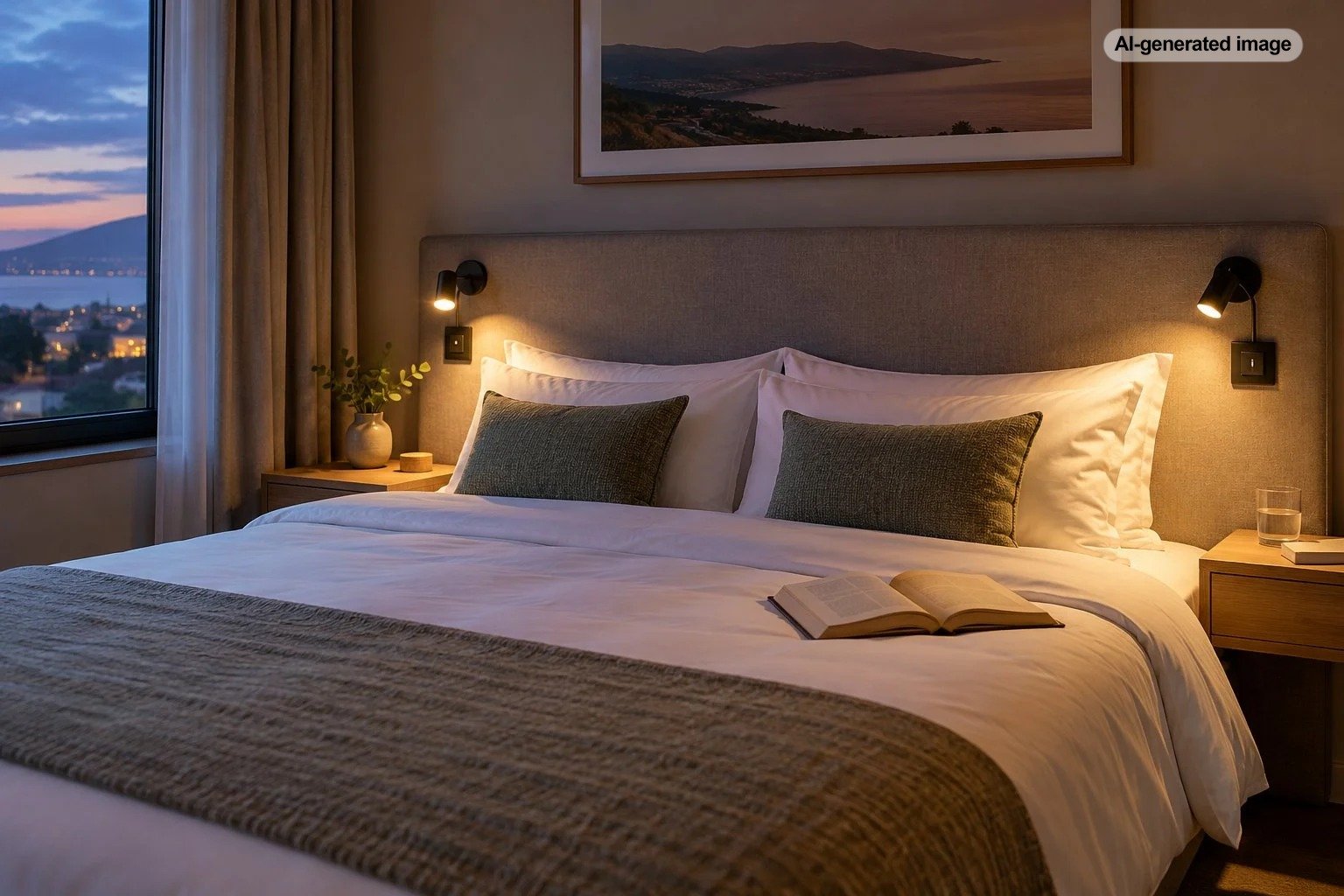
A particularly useful arrangement features a compact, adjustable light on each side of the headboard. These fixtures may be mounted directly into the headboard or attached to the wall. Each typically has a narrow beam intended to illuminate a book or similar reading surface.
When the fixtures operate independently, one guest can use a reading light while the other keeps their side dark. Adjustable heads also allow readers to direct illumination toward their lap or book rather than across the mattress.
Separate bedside lamps
Two traditional lamps on separate nightstands may also work well, especially when each has its own accessible switch. However, broad lampshades often distribute light throughout the room. Even with independent controls, the illuminated lamp may noticeably brighten the opposite side of the bed.
This arrangement can be perfectly adequate for travelers who occasionally read before sleeping. Guests who are particularly sensitive to light may prefer focused fixtures.
Shared headboard and overhead lighting
Some rooms use a continuous light strip behind the headboard, a central decorative fixture, or ceiling-mounted lights above the bed. These designs may look attractive in photographs while offering less flexibility for guests following different schedules.
A shared light is not necessarily inconvenient if the room also includes individual reading fixtures. The important question is whether the available controls permit genuinely independent use.
Start With the Hotel’s Room Photographs
Room photographs are the most accessible first step, but they should be treated as clues rather than definitive evidence.
Begin with the official property website, selecting the precise room category you are considering. Examine photographs that show the entire bed and headboard, rather than relying exclusively on close-ups of decorative furnishings.
Look for small cylindrical lights, flexible reading arms, recessed headboard fixtures, or paired lamps positioned within reach of each sleeping position. Wall-mounted directional lights may be easier to identify when photographed from an angle.
Also inspect photographs taken in daylight. Nighttime promotional images sometimes emphasize ambient lighting, making it difficult to distinguish reading lamps from decorative illumination.
Pay attention to the relationship between the fixtures and the bed itself. A room may have a lamp on each nightstand but only one dedicated reading light. A king-bed photograph may also show a different configuration from a twin-bed room.
What photographs cannot establish: Whether the switches work independently, whether the fixtures are functional, whether a master control overrides them, or whether every room in the category has the same setup.
Read the Room Description for Specific Language
Hotel amenity descriptions frequently mention desks, televisions, blackout curtains, and coffee facilities without explaining the bedside lighting arrangement. Searching for more precise terminology may help.
Useful phrases include individual reading lights, adjustable bedside lamps, reading lamps on both sides, and independent bedside lighting controls. These terms provide more meaningful information than a generic reference to ambient lighting or bedside lamps.
Be cautious with descriptions such as modern lighting, thoughtful bedside design, or mood lighting. Such phrases describe appearance or atmosphere rather than the practical ability to illuminate one side of the bed independently.
Where available, compare the full room description on the hotel’s official website with the information displayed by a booking platform. Different descriptions may highlight different features, and neither necessarily covers every detail.
Contact the Property With a Precise Question
When independent lighting is important, direct confirmation is the most reliable practical step. A short, specific inquiry is more effective than asking whether the room has good lighting.
For example, ask: Does the king room have a separate reading light on each side of the bed, and can each light be switched on or off without affecting the other side?
This wording distinguishes three separate requirements: the presence of two fixtures, their position beside the bed, and their independent operation.
If focused lighting matters, add a question about whether the lamps are adjustable or direct light toward the individual sleeping position.
When contacting the property, identify the exact room category and, if relevant, the bedding arrangement. A hotel employee may be familiar with the general room design but not every variation across its inventory.
Email or another written messaging channel offers a useful record of the response. If the answer remains uncertain, ask whether the property can confirm the layout for the assigned room closer to arrival. Room assignments may not be finalized when the reservation is made.
Check Whether Both Guests Can Reach the Controls
Independent lighting is only part of the practical equation. The switches should also be accessible from the intended sleeping positions.
Some fixtures include an individual button built into the lamp housing. Others use controls on the headboard, wall, or bedside panel. A switch placed centrally behind the pillows may be less convenient than one positioned beside each guest.
Integrated control panels introduce another distinction. A room may have individual reading-light buttons alongside a master lighting switch. This can work well, provided the reading fixtures can be operated without turning on the room’s general illumination.
Travelers with mobility limitations, shoulder discomfort, or difficulty reaching overhead may particularly benefit from confirming the switch position before arrival.
Consider the Kind of Reading Light You Prefer
Two independently controlled lights are useful, but they do not guarantee the same reading experience. Fixture design can affect comfort as much as the switching arrangement.
Focused illumination versus broad illumination
A narrow beam generally keeps more light concentrated on the reading material. This is helpful when one traveler needs darkness. A traditional lamp can illuminate a wider area, making it useful for organizing belongings or reading while sitting upright, but potentially more disruptive to a sleeping companion.
Adjustability and reading position
Directional fixtures are especially useful when guests prefer different reading positions. A flexible arm or rotating head allows light to be aimed toward a book while sitting upright or reclining.
Fixed fixtures may be less adaptable, particularly when a guest changes pillow arrangements or reads farther down the bed.
Brightness and dimming
Separate switches do not necessarily mean separate dimmers. If brightness adjustment matters, ask specifically whether each reading light can be dimmed. A bright fixed-output fixture may still create unwanted spill light, even when aimed away from the other guest.
Compare Lighting Arrangements Before Choosing a Room
The most suitable arrangement depends on how regularly the occupants read in bed and how sensitive they are to nearby light.
| Lighting arrangement | Practical advantage | Potential limitation |
|---|---|---|
| Two adjustable reading lights | Focused lighting for each guest | Beam strength and adjustment range vary |
| Two separate table lamps | Simple individual operation | Light may spread across the bed |
| Shared headboard lighting | Even ambient illumination | May disturb the other sleeper |
| One bedside lamp | Adequate for some solo stays | Limited flexibility for two guests |
For couples with different bedtimes, two independently controlled directional lights are often the more practical choice. Solo travelers may find a single accessible reading lamp sufficient, while guests who rarely read in bed may prioritize other room features.
Verify the Actual Room Category, Not Just the Hotel
A recurring booking mistake is assuming that a lighting feature visible in one room photograph applies throughout the property.
Hotels may have different headboard designs across room categories, building sections, or individual accommodations. Even rooms marketed under similar names may differ in layout or furnishings.
When comparing options, record the exact room name and bedding configuration associated with the photograph or description. If the hotel confirms independent reading lights, ask whether that confirmation applies to all rooms in the category or only certain layouts.
For longer stays, travelers may also compare hotels with professionally managed vacation rentals, where bedroom lighting layouts can differ considerably between individual properties. An option such as Homes & Villas by Marriott Bonvoy provides another way to explore accommodations, but individual listing photographs and direct property-specific confirmation remain important.
Whether choosing a hotel room or a rental, do not assume that an upscale interior, a modern headboard, or two nightstands automatically provides two independent reading lights.
What Travelers Often Overlook
One overlooked issue is the distance between the light and the reading position. A fixture mounted high above the headboard may look elegant but be poorly aimed for someone reading while reclining.
Another is light spill. Even if a fixture has its own switch, its beam may cross the center of the bed or reflect off nearby surfaces. Guests particularly sensitive to light should ask about directional adjustment rather than independent switching alone.
Travelers should also consider bedside power outlets. Someone reading from an electronic device may value convenient charging access as much as the lamp itself. Outlets and reading lights are separate amenities and should be verified individually.
Finally, distinguish between a confirmed room feature and a special request. A property might be willing to note a preference for a particular layout without guaranteeing that the preferred room will be available. If independent lighting is essential, consider whether the property’s response provides enough certainty before committing to a restrictive reservation.
Frequently Asked Questions
Do hotels normally have a reading light on each side of the bed?
There is no universal arrangement. Some rooms have individual directional fixtures, others provide separate bedside lamps, and some rely on shared lighting. The configuration depends on the property and room design.
Can two bedside lamps share one switch?
Yes. Two visible fixtures do not guarantee independent controls. Some room lighting systems operate multiple lights together, so confirm whether each lamp can be switched on and off separately.
Are built-in headboard lights better than table lamps?
Neither design is automatically superior. Adjustable headboard reading lights often provide better directional control, while table lamps may offer broader illumination. The better choice depends on the intended reading position and the other guest’s sensitivity to light.
Should I ask the hotel before making a reservation?
If individual bedside lighting is important to your comfort, asking before booking is sensible. Include the exact room category and ask specifically about fixture placement and independent controls.
Can a hotel guarantee a room with separate reading lights?
That depends on the property and its room inventory. A hotel may be able to confirm that a feature is standard in a specific category, while requests for a particular layout may remain subject to room assignment. Obtain clarification directly rather than assuming a preference is guaranteed.
Make the Lighting Check Part of Your Booking Decision
Checking hotel reading lights requires only a few focused steps: inspect photographs of the exact room, look for descriptive details, confirm that each side has an individually controlled fixture, and ask about adjustability when it matters.
The distinction between two visible lamps and two genuinely independent reading lights is small but important. For travelers sharing a bed with different evening routines, confirming that detail in advance can make the room more comfortable without allowing an easily overlooked amenity to become a nightly inconvenience.