Can You Use a Hotel Freezer for Food or Travel Ice Packs?
You may be able to use a hotel freezer for food or travel ice packs, but access is never guaranteed. Many guest rooms have refrigerators without a true freezer compartment, while shared hotel kitchens and staff-only freezers may be unavailable to guests for sanitation, security, or liability reasons. The practical solution is to ask the hotel before arrival and confirm what it can actually accommodate.
The answer also depends on what you need frozen. A sealed gel pack is usually easier for a hotel to handle than homemade food, an open container, or an item requiring careful temperature control. If uninterrupted refrigeration is medically necessary, do not rely on an informal promise about a staff freezer; request detailed storage information and prepare a backup plan.
Quick answer
- A room refrigerator may keep food cold but often cannot freeze an ice pack solid.
- Some hotels will place clearly labeled, sealed ice packs in a staff freezer, but policies vary.
- Hotels may decline to store guest food because of space, sanitation, or cross-contamination concerns.
- Confirm freezer access directly with the property rather than relying only on a general amenity description.
- For temperature-sensitive medication, contact the hotel and follow the storage instructions supplied by a qualified medical professional or the manufacturer.
Why a hotel refrigerator may not be a freezer
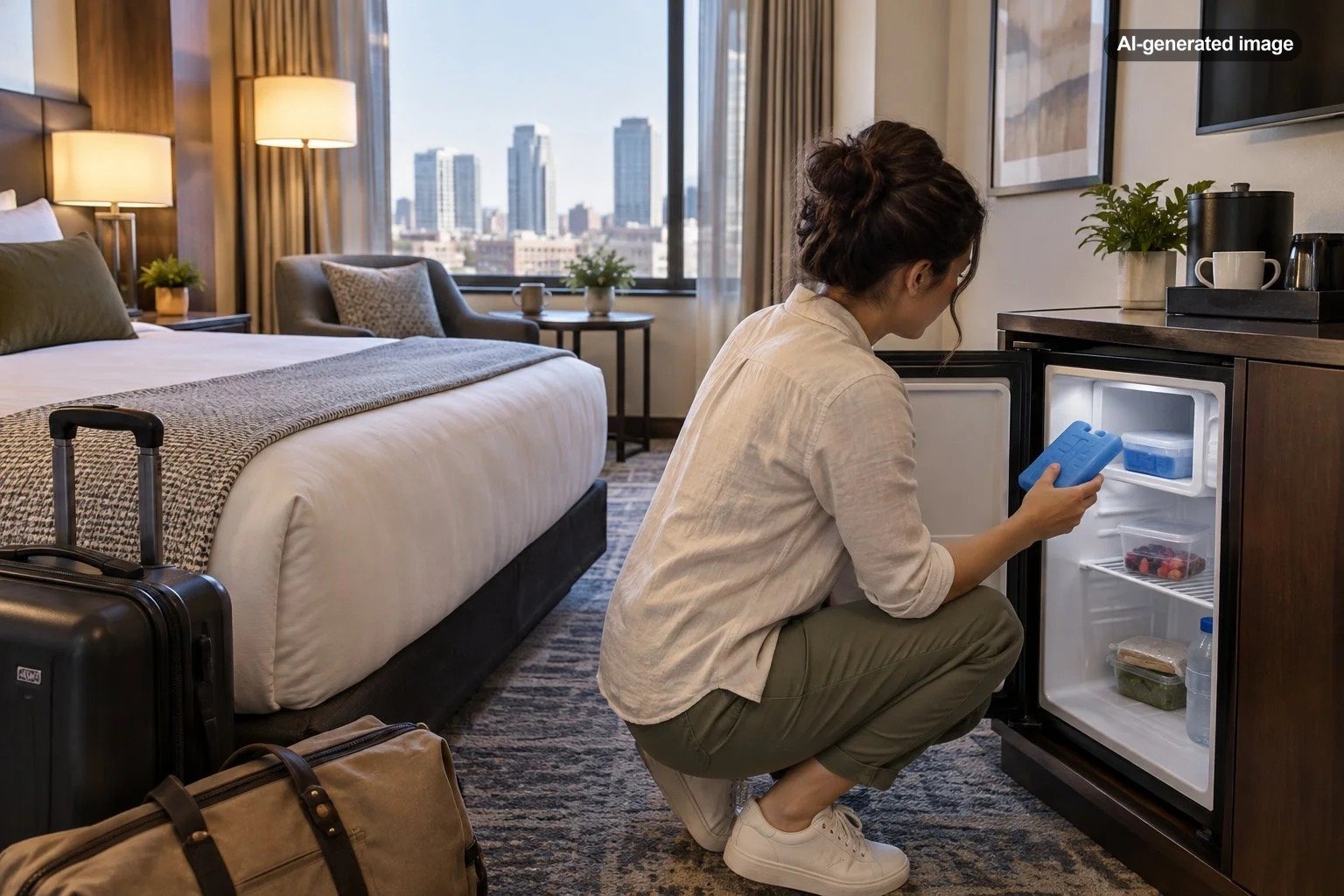
A refrigerator in a guest room can take several forms. It may be a compact refrigerator, a beverage cooler, an honor bar, or part of a kitchenette. These appliances do not necessarily maintain the same temperature, and a small compartment that looks like a freezer may only be designed to make ice slowly or keep already-frozen items cold for a limited period.
A beverage cooler deserves particular caution. It may be intended for drinks rather than perishable food and may not stay at or below 40 F. Even a conventional compact refrigerator can vary in temperature when it is placed inside cabinetry, filled tightly, or opened frequently. If safe food storage matters, a small appliance thermometer provides more useful information than the temperature dial alone.
Do not assume that the coldest setting will freeze a gel pack overnight. A refrigerator can be operating correctly while remaining far too warm to create a solidly frozen pack. Likewise, placing food against a cold interior surface can cause uneven freezing without proving that the rest of the compartment is sufficiently cold.
When the hotel may be able to help
A full-service hotel, extended-stay property, or lodging with an accessible guest kitchen may have more options than a limited-service property with only room coolers. However, the presence of a restaurant or banquet kitchen does not mean its freezer is available for guest belongings. Commercial food-service areas commonly control access and may be unable to accept outside items.
Call the property directly and describe the request precisely. Instead of asking whether the room has a refrigerator, ask whether there is a freezer capable of freezing a reusable gel pack solid. If food is involved, explain whether it is commercially packaged, sealed, already frozen, or perishable. Useful questions include:
- Is the freezer inside the guest room, in a shared guest kitchen, or in a staff-only area?
- Can guests access the item at any hour, or only when a particular department is open?
- Does the hotel accept sealed ice packs but not food?
- Must the item be labeled with the guest’s name, room number, and departure date?
- Is freezer space limited or offered only as available?
Record whom you spoke with and when, but recognize that operational circumstances can change. A second confirmation shortly before arrival is sensible when the freezer is central to the trip.
Using a hotel freezer for food
Food creates more complications than an ice pack. A hotel may have rules against accepting outside food in staff storage, especially if the container could leak, contains allergens, requires preparation, or is not clearly labeled. Even when staff agree to help, the hotel may not be able to monitor the item’s temperature continuously or accept responsibility for spoilage.
Bring food in leakproof, compact containers or sealed bags. Label each item clearly and avoid handing over loose takeout boxes. Separate raw foods from ready-to-eat items, and never expect hotel staff to repackage or determine whether food remains safe.
According to the U.S. Food and Drug Administration, refrigerators should remain at or below 40 F and freezers at 0 F. Perishable food generally should not remain at room temperature for more than two hours, or more than one hour when the surrounding temperature is above 90 F. These limits continue to matter while traveling between the airport, vehicle, hotel desk, and room.
If you cannot verify that a room appliance holds a safe temperature, use an insulated cooler with adequate cold sources. The U.S. Department of Agriculture recommends keeping perishable food at 40 F or below and notes that ice, frozen gel packs, and frozen beverages can serve as cold sources. A fuller cooler generally holds its temperature better than a half-empty one, especially when it stays closed and out of direct sun.
Using a hotel freezer for travel ice packs
Reusable gel packs are often the simplest freezer request because they are compact, sealed, and do not create the same food-handling concerns. Place each pack in a clean zippered bag and add a durable label. If staff storage is the only option, ask for a claim tag or confirm the collection procedure.
Allow enough time for the pack to freeze completely. A large or thick pack may need longer than a few hours, and an overloaded freezer may work more slowly. Carrying two smaller packs can be more practical than depending on one large pack, particularly when one can remain in use while the other freezes.
Air travelers should also account for security screening. The Transportation Security Administration states that frozen gel ice packs are permitted in carry-on baggage, but they generally must be frozen solid when presented for screening. Partially melted or slushy packs may be subject to the usual liquid restrictions. Different provisions can apply when packs are used to cool medically necessary items, so travelers should review current screening guidance before departure.
Medication requires a more dependable plan
A hotel freezer should not be treated as a universal solution for medication. Some medicines must be refrigerated but should never be frozen, while others can tolerate limited periods at room temperature. Freezing a medication that is meant only to remain cool may damage it.
Follow the product’s official storage instructions and consult a pharmacist or other qualified medical professional when the requirements are unclear. Ask the hotel whether the in-room refrigerator is a conventional refrigerator, whether its temperature can be checked, and whether backup storage is available during a power interruption or room change.
Keep medication in its original packaging when practical, use an insulated medical travel case suited to its storage requirements, and avoid direct contact between the medicine and a frozen pack unless the instructions specifically allow it. A staff refrigerator or freezer can also create access problems if a dose is needed late at night, so confirm retrieval arrangements in advance.
What travelers often overlook
Access may matter more than capacity
A large staff freezer is not useful if the item cannot be retrieved before an early departure. Confirm the hours and the department responsible for storage. For a predawn flight or tour, collect the item the night before and move it into a reliable insulated cooler if that can be done safely.
A room change can disrupt storage
If an appliance is not cooling properly, report it promptly. Do not leave perishable food inside while waiting several hours for maintenance. Ask whether the hotel can replace the appliance, move the room, or identify another approved storage option.
Vacation rentals can offer more control
Travelers preparing meals, carrying substantial quantities of food, or needing daily freezer access may be better served by accommodations with a documented full kitchen. Even then, verify that the listing specifically includes a refrigerator-freezer rather than assuming that every kitchen or kitchenette has one.
Staff cannot determine whether food is safe
Cold appearance, texture, and smell do not reliably establish food safety. If perishable food has been held above a safe temperature for too long, freezing it later does not reverse the risk. When the storage history is uncertain, discarding the food is safer than trying to rescue it.
Frequently asked questions
Can a hotel freeze an ice pack overnight?
Sometimes. A staff freezer or full refrigerator-freezer may be able to do so, but an in-room refrigerator often cannot. Ask whether the hotel can freeze the pack solid and when it can be collected.
Can I put frozen food in a hotel mini-fridge?
You can place it there if hotel rules allow, but a mini-fridge may only refrigerate it rather than keep it frozen. Use a thermometer when temperature matters, keep the food sealed, and follow safe time and temperature limits.
Will the front desk store food in a freezer?
Policies differ by property. Some hotels accept sealed items, while others prohibit guest food in staff areas. Call ahead with the item’s dimensions, packaging, and storage needs.
What should I do if the hotel cannot freeze my ice packs?
Use an insulated cooler with fresh ice, replace the ice as needed, or obtain additional frozen packs locally. For medical use, follow professional storage guidance and arrange a suitable alternative before traveling.
Should freezer access affect which hotel I choose?
Yes, when reliable freezing is essential. Prioritize properties that can confirm a full in-room freezer, an accessible guest kitchen, or another suitable arrangement. A vague reference to a mini-fridge is not enough.