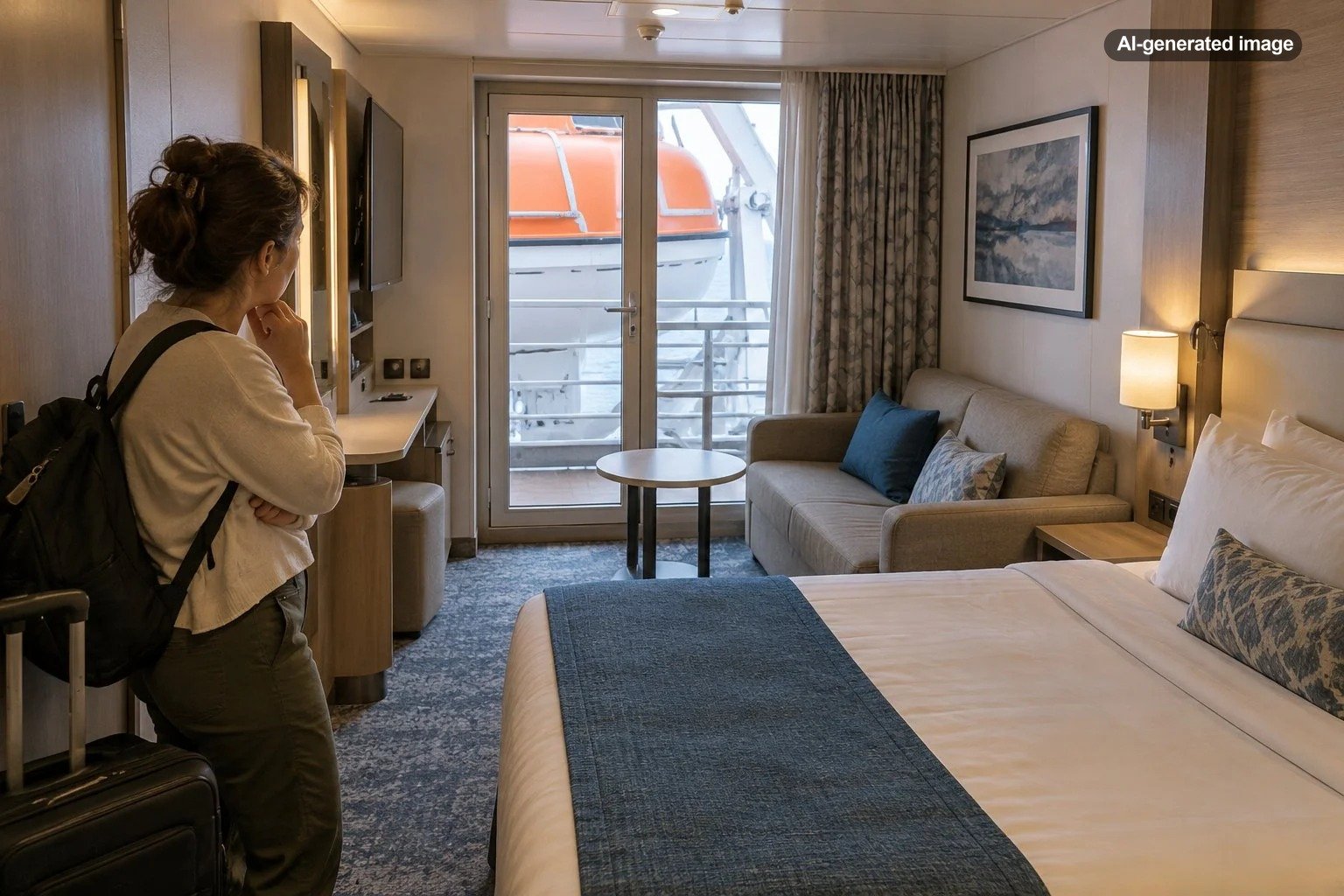
What to Do If Your Guaranteed Cruise Cabin Assignment Is Terrible
A guaranteed cruise cabin can be appealing when you care more about the general cabin category than the exact room number. The tradeoff is that the cruise line, rather than you, chooses the specific cabin. If the assignment finally appears and the location looks terrible, the most useful response is to evaluate the actual problem, check what your booking permits, and contact the cruise line or your travel advisor before assuming you are stuck.
Some assignments that initially look undesirable turn out to be perfectly workable. Others can create legitimate concerns involving noise, accessibility, sleeping arrangements, obstructed views, distance from elevators, or separation from people traveling together. The important distinction is whether you simply dislike the location or whether the assigned cabin creates a meaningful problem for your trip.
Quick answer: what to do after a bad cabin assignment
- Confirm the exact cabin number, deck, category, and any stated limitations.
- Study the ship’s deck plan before judging the location solely by the cabin number.
- Identify the specific problem you want solved, such as noise exposure, an obstruction, or separation from companions.
- Review the conditions attached to your guarantee fare because flexibility varies by cruise line, fare, and booking.
- Contact the cruise line or the travel advisor who controls the reservation and ask what options are currently available.
First, determine whether the cabin is actually a bad assignment
A cabin that looks inconvenient on a deck plan is not automatically a poor cabin. Start by locating it precisely. Note what is directly above, below, beside, and across from the room. Large blank spaces on deck plans can represent operational areas, crew spaces, mechanical areas, or simply parts of the ship that are not passenger cabins, so avoid making assumptions when the plan does not identify them.
Location preferences are also personal. A cabin near an elevator may concern a traveler seeking maximum quiet, while another traveler with limited stamina may consider the same location excellent. A room far forward or aft may involve longer walks, but some passengers prefer being away from heavily traveled corridors. Evaluate the assignment according to the way you actually cruise rather than according to a generic list of supposedly good and bad cabins.
Look for practical issues rather than an imperfect deck number
Pay particular attention to factors that can materially affect your trip. These may include proximity to late-night public areas, unusual bed configurations, an obstructed or partially obstructed outlook, connecting doors, accessibility requirements, or excessive distance from the places you expect to visit frequently.
If you are traveling with another household, also check whether the cabins are anywhere near each other. A guarantee booking generally gives the cruise line more control over location, so travelers who need neighboring rooms should not assume independently booked guarantee cabins will be placed together.
Understand what the word guarantee actually guarantees
The central misunderstanding with guarantee bookings is that the word guarantee sounds broader than it is. In practice, these fares are generally structured around receiving at least the booked cabin category or the applicable guarantee category, while the cruise line retains substantial control over the specific room assignment.
That means a balcony guarantee, for example, should not be interpreted as a promise of a preferred deck, a central location, a particular side of the ship, proximity to traveling companions, or an unobstructed outlook unless the booking terms specifically provide otherwise. The exact conditions depend on the fare and cruise line, so your confirmation and applicable booking terms matter more than general advice found online.
This distinction is important when requesting a change. If the assigned room satisfies the contractual guarantee but simply is not where you hoped to be, your options may be narrower than they would be if the cabin does not meet a documented booking requirement.
Check whether another cabin can be requested
Once you understand the issue, contact whoever controls the reservation. If you booked directly, that generally means contacting the cruise line. If a travel advisor made the reservation, the advisor may need to handle changes on your behalf.
Keep the request specific. Instead of saying that the cabin is terrible, explain the problem and ask whether another assignment is permitted under your fare. For example, you might ask whether another cabin within the same eligible category is available, whether you can pay to move into a cabin that can be selected, or whether another accommodation option exists.
Do not assume that a visible cabin on a public booking page can simply be substituted for yours. Inventory, pricing, occupancy limits, fare rules, and the inventory available to an agent can differ. A room that appears open to a new booking may not necessarily be available as a no-cost reassignment.
Ask about a paid change when location matters enough
If a complimentary reassignment is unavailable, a paid change may sometimes be worth considering. The useful comparison is not whether paying more feels annoying; it is whether the specific problem is important enough to affect your enjoyment of the entire sailing.
A traveler who is merely disappointed about being one deck lower than expected may reasonably keep the assignment. Someone who booked a long cruise and knows that a particular location will cause a significant practical problem may place much greater value on changing it.
Before accepting any paid change, ask for the complete effect on the reservation. Changing cabin categories or fares can potentially affect the booking conditions or promotional components attached to a reservation. Have the representative explain the revised terms before authorizing a change.
Separate genuine problems from cabin-location anxiety
Cruise deck plans encourage close inspection, and it is easy to become increasingly dissatisfied once you begin searching forums for comments about a particular cabin. Individual reviews can provide useful clues, but they are subjective. One passenger’s intolerable corridor noise may barely register for another.
Consider how much time you expect to spend in the room and which characteristics actually matter to you. Travelers who use the cabin primarily for sleeping and changing may care less about a long walk to the elevators. Someone planning quiet afternoons on a balcony may care considerably more about the balcony environment.
It can also help to distinguish a known issue from a hypothetical one. A clearly identified obstruction is different from worrying that a cabin might be noisy because it is several doors from an elevator lobby. Prioritize concrete disadvantages over imagined ones.
Be especially careful when your concern involves accessibility
Accessibility requirements should be treated differently from ordinary preferences. If the assigned cabin does not work with a traveler’s documented mobility or accessibility needs, contact the cruise line or booking representative promptly and explain the specific requirement.
Do not rely on an informal cabin swap after boarding as an accessibility strategy. Ships have limited inventories of cabins designed for particular needs, and the appropriate process should be handled through the cruise line using the booking information and assistance procedures applicable to your sailing.
Do not cancel and rebook without calculating the consequences
Seeing a better cabin available online can make canceling the existing reservation and starting over seem like an easy solution. It can be an expensive mistake if the existing booking is subject to cancellation penalties, a nonrefundable deposit, different current pricing, or promotional terms that would not carry to a new reservation.
Before making any irreversible change, compare the entire reservation rather than just the cabin. Ask what would happen to the fare, deposit, included benefits, payment status, and cancellation terms. A more attractive room is not necessarily a better deal once the whole booking is considered.
If nothing can be changed, make the assignment work for you
If the cruise line will not move the cabin and paying for a different option does not make sense, shift from trying to perfect the assignment to managing its disadvantages. A long walk can become less important once you learn the nearest elevator bank. A cabin near a busy area may be easier to live with when you know which corridor provides the quieter route. Travelers sensitive to ordinary environmental noise may also want to plan their sleep routine accordingly.
Most importantly, keep the cabin issue in proportion to the rest of the trip. Unless the assignment creates a significant functional problem, the cabin is only one part of the cruise experience.
Use the experience when booking your next cruise
A disappointing guarantee assignment can clarify how much cabin location actually matters to you. If you discover that you strongly prefer midship rooms, need to be near an elevator, want cabins close to family members, or care about what is above and below you, selecting a specific cabin may be worth the additional cost or different fare structure on a future trip.
Affiliate disclosure: HotelInfo.com may earn a commission when you book or purchase through links on this page. This does not affect the price you pay. Learn more.
If you are still deciding on a future itinerary and want to compare different ships or sailing dates, you can browse cruises with Expedia. Before booking another guarantee fare, compare the savings or other benefits with the value you place on choosing your exact cabin.
What travelers often overlook
The biggest overlooked factor is that the best response depends on why the assignment bothers you. A preference, a practical inconvenience, and an accessibility need are not the same problem and should not be approached in the same way.
It is also worth acting reasonably quickly after an assignment appears. Cabin inventory can change as a sailing approaches, and waiting does not create additional flexibility. At the same time, avoid making an expensive change before understanding exactly what your existing guarantee fare includes.
Frequently asked questions
Can I refuse a guaranteed cruise cabin assignment?
You can ask what alternatives are available, but whether the cruise line permits a change depends on the terms of the booking and the options available at that time. A guarantee fare generally gives the cruise line substantial discretion over the specific cabin.
Can I ask for a different cabin in the same category?
You can ask, but a same-category swap should not be assumed. Some guarantee terms restrict changes after assignment. Contact the cruise line or the travel advisor managing the reservation for the rules that apply to your booking.
What if my assigned cabin has an obstructed view?
Review the exact category and booking description first. Some guarantee products can include cabins with view limitations. If the assignment appears inconsistent with what your confirmation promised, raise that specific discrepancy with the booking representative.
Should I wait and hope my cabin changes automatically?
Do not build your plans around an automatic change. If the current assignment presents a meaningful concern, contact the appropriate booking representative and ask what options exist rather than assuming another cabin will eventually appear.
Is a guarantee cabin worth booking again?
It depends on your priorities. Guarantee fares tend to suit travelers who are comfortable surrendering control over the exact location. If deck, position, adjacency, view, or proximity to elevators strongly affects your trip, choosing a specific cabin may be a better fit next time.