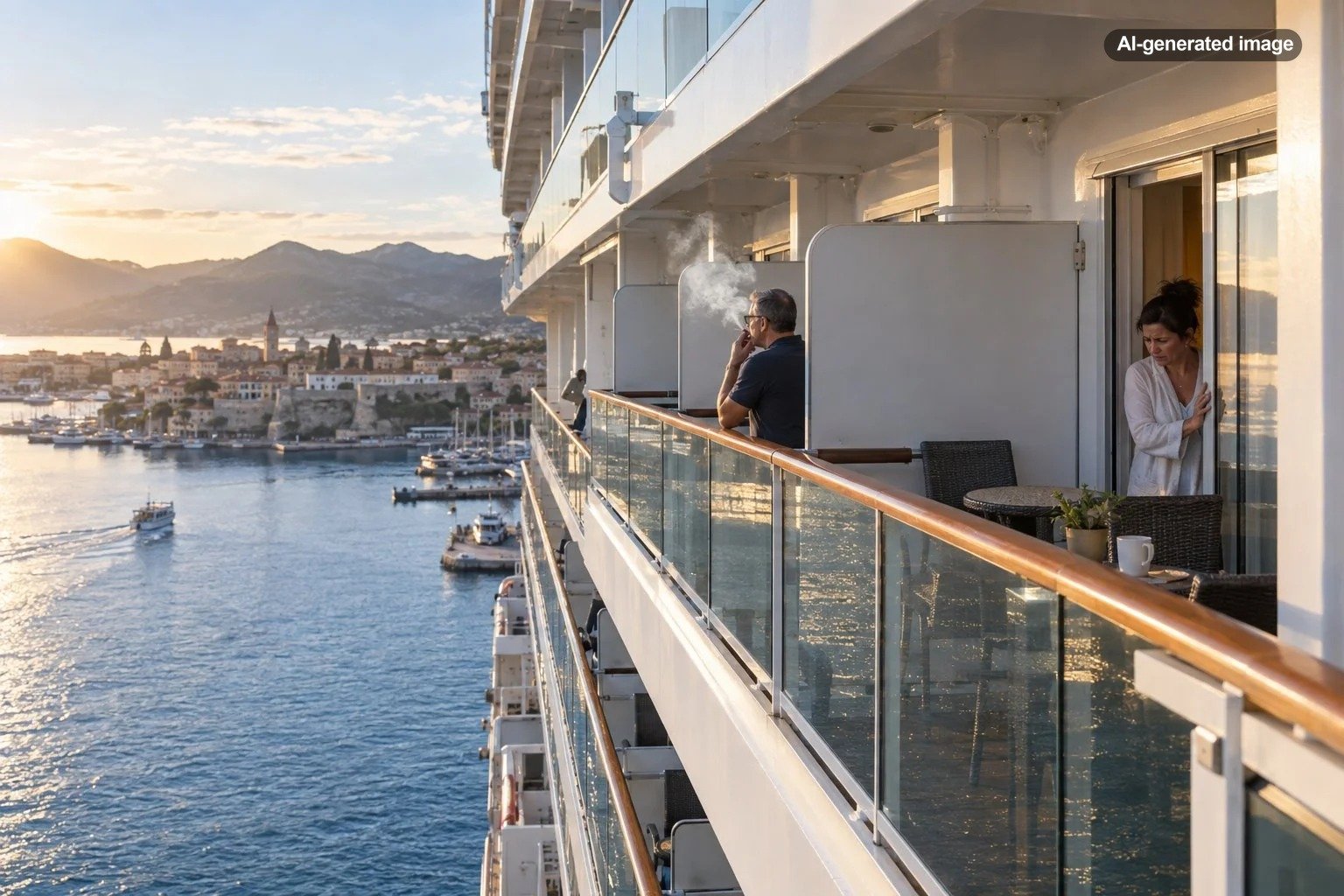
What to Do If Your Cruise Neighbor Smokes on the Balcony
If your cruise neighbor is smoking on the balcony and smoke is drifting into your space, the most practical response is to go inside, close the balcony door, note when the problem occurred, and contact Guest Services. Avoid turning the situation into a direct confrontation when the ship’s crew can address the applicable onboard policy.
Balcony smoking rules vary by cruise line, but major operators including Royal Caribbean and Carnival currently prohibit smoking on stateroom balconies and limit smoking to designated areas. That does not mean every cruise line follows identical rules, so check the policy for your specific operator. If smoke is repeatedly entering your balcony or cabin, reporting it promptly gives the crew a chance to investigate while the issue is happening.
Quick answer: what should you do?
- Move inside and close the balcony door if smoke is entering your cabin.
- Write down the approximate time and, if useful, where the smoke appears to be coming from.
- Contact Guest Services or the appropriate onboard service desk rather than assuming the neighbor knows or is following the rules.
- Report repeated incidents each time they occur so the crew has useful information about the pattern.
- If smoke exposure is causing significant breathing difficulty or another urgent health problem, contact the ship’s medical staff.
Check the cruise line’s actual smoking policy
Start with the rules that apply to your ship rather than relying on assumptions about cruising in general. Cruise lines typically publish smoking policies online and may also list designated smoking areas in onboard materials or through Guest Services.
For example, Royal Caribbean states that smoking and vaping are not permitted inside staterooms or on stateroom balconies, while designated smoking areas are available elsewhere aboard its ships. Carnival similarly states that its staterooms, suites, and outside balconies are non-smoking and restricts smoking to specified areas.
Policies can change and may contain ship- or itinerary-specific details, so the cruise line’s current published rules should be treated as the authority for your sailing. This distinction matters because smelling smoke does not necessarily tell you whether the person is smoking in a prohibited location. A designated smoking area on another deck, for instance, can occasionally create drifting smoke depending on conditions.
Report the problem while it is happening
If you believe the smoke is coming from a neighboring balcony, contacting Guest Services while the incident is occurring is usually more useful than waiting until later. Give the crew concise information: your stateroom number, the approximate time, how frequently it has happened, and whether smoke is entering your room or making the balcony difficult to use.
You do not need to identify the neighbor with certainty. In fact, it is better to describe what you can actually observe than to make an accusation you cannot verify. Saying that cigarette or vape smoke appears to be drifting from the balcony immediately beside yours is more useful than insisting that a particular passenger is responsible when you cannot see the source.
If the problem happens repeatedly, keep brief notes of the times. A pattern can help the crew investigate an intermittent issue that is difficult to confirm after the smoke has disappeared.
Why direct confrontation is usually unnecessary
A polite conversation between neighbors can sometimes resolve a minor problem, but you are not responsible for enforcing the cruise line’s smoking policy. You also may not know the full situation, including whether the smoke is coming from the balcony you suspect.
Using Guest Services keeps the issue focused on onboard rules instead of turning it into a disagreement between passengers. Crew members can determine which policy applies, investigate the source, and decide what response is appropriate under the cruise line’s procedures.
This approach is especially sensible if the other passenger has already ignored a posted rule, if you are traveling with children, or if you simply do not feel comfortable approaching someone you do not know.
What if smoke keeps entering your cabin?
Close the balcony door when smoke is present and report that the odor is entering the stateroom, not merely affecting your ability to sit outside. Be specific about what is happening. Crew members cannot necessarily observe conditions from your room unless they know when and where the problem occurs.
If the issue persists after an initial report, follow up with Guest Services and reference the earlier complaint. Ask what practical steps are available. The appropriate response depends on the circumstances, ship operations, available accommodations, and the cruise line’s procedures, so it is better to ask what can actually be done than to assume a room change or another remedy will automatically be offered.
Secondhand smoke is more than an annoyance
The Centers for Disease Control and Prevention states that there is no safe level of exposure to secondhand tobacco smoke and that even brief exposure can have harmful effects. That makes it reasonable to take recurring smoke exposure seriously, particularly for travelers who are sensitive to smoke or have health concerns that may be aggravated by it.
If exposure causes significant shortness of breath, chest discomfort, a severe asthma episode, or another concerning medical symptom, move away from the smoke and seek appropriate medical assistance onboard. Guest Services handles the conduct or policy issue; the ship’s medical facility is the appropriate resource when the concern becomes medical.
Do not assume every smoke odor comes from your neighbor
One detail travelers often overlook is that wind around a moving ship can make the source of an odor difficult to judge. Smoke may travel vertically or horizontally from another location. That is another reason to report observations rather than confront a specific cabin without clear evidence.
Likewise, distinguish a one-time faint odor from a repeated pattern that prevents normal use of your balcony or enters the room. Both can be reported, but detailed information about recurring incidents gives the crew more to work with.
What to do before your next cruise
If avoiding tobacco smoke is particularly important to you, review the cruise line’s current smoking policy before booking and again shortly before sailing. Look for information about where designated smoking areas are located and whether the operator prohibits smoking and vaping on private balconies.
That research cannot guarantee that another passenger will follow the rules or that outdoor smoke will never drift, but it can help you understand the environment you are booking. Travelers who are especially sensitive to smoke may also want to consider the location of designated smoking areas when evaluating ships and cabin locations, where that information is available from the cruise line.
Frequently asked questions
Can passengers normally smoke on private cruise balconies?
It depends on the cruise line. Several major operators prohibit smoking on private stateroom balconies and provide designated smoking areas elsewhere. Always check the current policy for your specific cruise line rather than assuming the rule is universal.
Should I knock on my neighbor’s door?
You can choose to make a polite request if you feel comfortable, but it is not necessary. Reporting suspected prohibited smoking to Guest Services allows the crew to handle enforcement and avoids an unnecessary passenger-to-passenger dispute.
What information should I give Guest Services?
Provide your cabin number, the approximate time, how often the problem has occurred, where the smoke appears to originate, and whether it is entering your cabin. Stick to what you observed rather than making assumptions about who is responsible.
What if Guest Services cannot confirm the smoking?
If the problem happens again, report it again while it is occurring. Keeping a simple record of times can make an intermittent problem easier to investigate.
Can I demand another cabin?
You can ask what solutions are available if the problem continues, but cabin changes should not be assumed. Availability, operating circumstances, and cruise-line procedures can determine what alternatives are possible.