Do Hotels Provide Cribs, and Should You Trust Them?
Many hotels provide cribs, portable cribs, bassinets, or play yards upon request, but travelers should not assume that one will automatically be available or suitable for their child. The term crib is also used loosely: what arrives may be a compact commercial crib, a folding play yard, or another infant sleep product rather than a traditional full-size crib.
A hotel-provided sleep space can be a practical option, particularly when flying or traveling with limited luggage. It should still be treated as equipment that requires confirmation and inspection. A reservation note is not a guarantee, and a familiar hotel brand does not eliminate the need to check the specific unit placed in the room.
Quick answer
- Many hotels offer cribs or play yards free of charge, while others charge a fee or do not provide them.
- Request one during booking, then confirm directly with the property shortly before arrival.
- Ask what type of product the hotel normally supplies and whether availability can be guaranteed.
- Inspect the equipment, mattress, sheet, hardware, and placement before use.
- For an infant, use a firm, flat sleep surface with only a properly fitted sheet, following current safe-sleep guidance.
What hotels mean when they say they provide a crib
The word crib does not always identify a particular product. Hotels may use it as a general label for several forms of infant sleep equipment.
Commercial or compact cribs
Some properties maintain compact cribs designed for repeated use in hospitality settings. These may have rigid sides and a mattress platform but be smaller than the crib a family uses at home. Their condition can vary depending on age, storage, maintenance, and how frequently they are moved between rooms.
Portable cribs and play yards
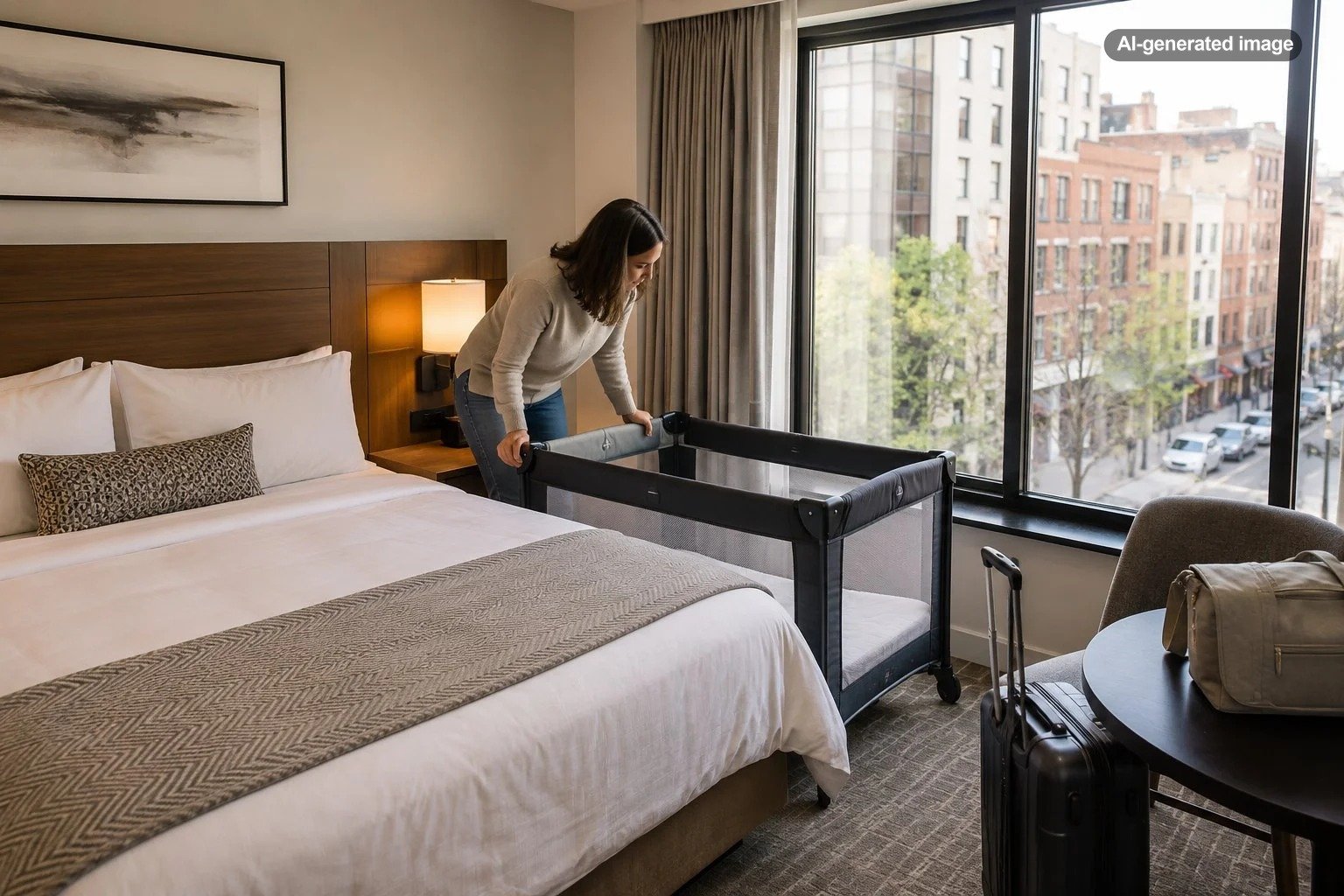
A folding play yard is often the most common hotel option. It is easier for staff to store and transport than a rigid crib. A play yard can provide an appropriate sleep space when it is a product intended for infant sleep, is assembled correctly, meets applicable requirements, and is used according to its instructions.
Bassinets
Bassinets are less consistently available and have stricter size, weight, and developmental limits. Parents should not request a bassinet without confirming that their baby remains within the product manufacturer’s stated limits.
Because these options are not interchangeable for every child, ask the property to describe what it provides. Useful questions include whether it is a crib or play yard, whether the original mattress or pad is included, and whether the hotel supplies a fitted sheet designed for that model.
Why a crib request is rarely a firm guarantee
Cribs are commonly treated as limited-request items rather than permanently assigned room amenities. A property may own only a small number, and several families can request them for the same night. Equipment can also be removed from service because it is damaged, incomplete, or awaiting cleaning.
When booking, ask the agent to add the request to the reservation, but also ask whether the item is confirmed or merely requested. Those words matter. A request may be visible to the hotel without reserving a specific crib for your stay.
Contact the property directly a few days before arrival and again on the day of check-in when the crib is essential. Record the name of the department or staff member who confirmed the arrangement. This does not create an absolute guarantee, but it can expose a misunderstanding while there is still time to consider another plan.
Should you trust a hotel crib?
A hotel crib should not be trusted automatically, nor should it be rejected automatically. The better approach is to evaluate the exact product delivered to the room.
In the United States, cribs provided by hotels and other places of public accommodation are subject to federal crib requirements. That regulatory framework is important, but it does not tell a parent whether an individual unit has been assembled correctly, damaged after repeated use, altered with an unsuitable mattress, or placed beside a cord or other room hazard.
Trust should therefore depend on inspection. If the equipment is stable, complete, correctly assembled, appropriate for the child, and arranged as a bare sleep space, it may be a reasonable solution. If anything appears questionable, stop and ask the hotel to replace or remove it.
How to inspect a hotel crib or play yard
Complete the inspection before the child is tired and ready for bed. Turn on the room lights and examine the entire product rather than checking only the sheet.
- Confirm stability: Press gently on the frame and rails. The unit should not wobble, lean, collapse, or shift unexpectedly.
- Check assembly: Folding rails should be fully locked, and the floor or mattress support should sit flat. Do not improvise if the frame will not lock correctly.
- Look for damage: Reject equipment with broken parts, protruding hardware, sharp edges, torn mesh, cracked plastic, splintered wood, missing fasteners, or exposed padding.
- Inspect the mattress or pad: It should be firm, flat, and designed to fit the product without dangerous gaps. Do not add a second mattress, cushion, folded blanket, or foam topper.
- Examine the sheet: Use a clean, tight-fitting sheet intended for that sleep surface. A loose full-size sheet folded around a small pad can bunch or come free.
- Remove extra items: Pillows, loose blankets, quilts, stuffed animals, bumper pads, positioners, and decorative bedding should not remain in an infant’s sleep space.
- Check the surroundings: Move the crib away from blind cords, curtain cords, telephone cords, lamps, wall decorations, unstable furniture, heaters, and anything the child could pull into the sleep space.
Ask the hotel for another unit if the first one fails any part of the inspection. Do not attempt to repair unfamiliar equipment with tape, towels, luggage straps, or furniture from the room.
Safe sleep guidance still applies away from home
Travel changes the setting, not the basic safe-sleep principles. Current guidance from the American Academy of Pediatrics, the Centers for Disease Control and Prevention, and the U.S. Consumer Product Safety Commission supports placing babies on their backs for sleep on a firm, flat surface intended for infant sleep.
The sleep space should remain bare except for a properly fitted sheet. Room sharing is different from bed sharing: a baby can sleep in a separate crib, bassinet, or play yard in the same hotel room as the caregiver. An adult bed, sofa, armchair, improvised floor nest, or cushioned chair is not an equivalent substitute.
Parents should also consider the child’s developmental stage and the limits printed on the product. A child who can climb out, exceeds a stated height or weight limit, or has reached another manufacturer-defined milestone may need a different arrangement.
When bringing your own travel crib makes sense
Bringing a familiar travel crib gives families more control over availability, setup knowledge, and cleanliness. It can be especially useful during road trips, extended stays, late-night arrivals, visits to several properties, or travel to destinations where hotel equipment is less predictable.
The tradeoff is transportation. A travel crib may add checked-baggage costs, occupy valuable vehicle space, or be difficult to carry alongside a stroller and car seat. It also needs to be assembled according to its instructions every time. Familiarity helps, but personal ownership does not make incorrect setup safe.
A hotel crib is often the more convenient choice for a short flight-based trip when the property can clearly explain what it provides. Bringing your own may be more reassuring when uninterrupted access to a known product matters more than packing light.
What to do if the promised crib is unavailable
Ask whether the hotel has another approved crib, portable crib, play yard, or bassinet appropriate for the child’s age and size. Staff may also be able to check another department or, at a multi-property complex, a nearby affiliated building. Inspect any replacement in the same way as the original.
Do not accept makeshift alternatives such as couch cushions, a drawer, a padded luggage rack, or an adult mattress surrounded by pillows. If the hotel cannot provide a suitable sleep space, families may need to use a travel crib they brought, obtain an appropriate product locally, use a reputable baby-equipment rental service after evaluating its procedures, or move to lodging with a confirmed arrangement.
What travelers often overlook
Room layout can matter as much as the crib. Even a sound crib may be difficult to position safely in a crowded room. Consider whether the property offers enough clear floor space away from cords, windows, heating units, and busy walkways.
Housekeeping schedules require communication. Let staff know not to add blankets, pillows, or decorative items to the crib. If the crib is folded or moved during cleaning, inspect and relock it afterward.
Vacation rentals require separate verification. A listing that mentions a crib may refer to equipment owned by the individual host. Ask for the product type and current condition rather than assuming that hotel procedures or commercial inventory practices apply.
International standards and terminology differ. A cot may mean an infant crib in one country and a folding adult bed in another. Confirm the intended user’s age, the product type, and the sleep surface rather than relying on a single word in a booking form.
Frequently asked questions
Do hotels usually charge for cribs?
Many provide them without a separate fee, but policies vary by property. Ask about charges before booking and avoid assuming that a brand-wide practice applies to every location.
Are hotel crib sheets provided?
They often are, but travelers should confirm. The sheet should be clean, secure, and correctly fitted to the supplied mattress or pad.
Can I reserve a crib through a booking website?
You can often submit a request, but third-party reservation forms may not guarantee inventory. Confirm directly with the property, particularly when the crib is essential.
Should I sanitize a hotel play yard?
You may wipe appropriate hard surfaces according to the product’s care instructions, but avoid soaking materials, applying unapproved chemicals, or creating residue on surfaces a child may touch. Ask the hotel to replace visibly unclean equipment.
Is a hotel crib safer than bed sharing?
A correctly assembled, appropriate crib or play yard provides a separate infant sleep surface. Current safe-sleep guidance recommends room sharing without bed sharing and advises using a firm, flat sleep surface intended for infant sleep.
The practical conclusion
Hotels frequently provide cribs or play yards, but the most useful question is not simply whether the amenity appears on a list. Parents should determine what product will be supplied, whether it is genuinely reserved, and whether the individual unit is suitable when it reaches the room.
Confirm the request, maintain a backup plan when possible, inspect every component, and follow the same safe-sleep practices used at home. Convenience is valuable, but it should never replace a careful look at the equipment and the surrounding room.
Sources & further reading
- U.S. Consumer Product Safety Commission: Hotels, Motels and the New Federal Crib Standards
- U.S. Consumer Product Safety Commission: Safe Sleep – Cribs and Infant Products
- American Academy of Pediatrics: Hotel Safety Tips for Parents of Young Children
- American Academy of Pediatrics: How to Keep Your Sleeping Baby Safe
- Centers for Disease Control and Prevention: Helping Babies Sleep Safely