Can You Ask a Cruise Line to Move You Because of Noise?
Yes. If persistent noise is seriously affecting your ability to sleep or use your stateroom, you can ask the cruise line to move you. The important limitation is that a cabin change is not guaranteed. Ships frequently sail with most or all staterooms occupied, so Guest Services may have few alternatives even when your complaint is reasonable.
Your best approach is to report the problem promptly, explain exactly what you are hearing and when it occurs, and give the crew an opportunity to investigate. Depending on the cause, the most practical solution may be stopping the noise rather than relocating you.
Quick answer
- You may ask Guest Services for another stateroom when excessive noise is disrupting your cruise.
- A move generally depends on whether another suitable cabin is available.
- Report recurring noise as early as possible instead of waiting until the final night of the sailing.
- The crew may first investigate or address the source of the noise before considering a move.
- If relocation is impossible, ask what other practical remedies are available rather than assuming compensation is automatic.
Why a cruise line may not be able to move you
A cruise ship has a fixed inventory of staterooms, and there is no equivalent of simply sending a guest to another hotel across town. If the ship is sailing near capacity, Guest Services may not have an unoccupied cabin in your category, or possibly any vacant passenger stateroom at all.
Royal Caribbean, for example, currently tells travelers that changing or upgrading a room onboard is very unlikely because most rooms are occupied. That does not mean you should avoid reporting a legitimate noise problem. It means that asking for a move and actually receiving one are two different things.
Availability can also be more complicated than whether a door appears unused. A cabin may be unavailable for operational reasons, reserved for another purpose, undergoing maintenance, or unsuitable for the number of people in your party. A family of four, for example, cannot necessarily be transferred into an empty cabin designed for two.
Report the noise while it is actually happening
One of the most useful things you can do is contact Guest Services while the disturbance is occurring. A complaint such as “there was a loud noise last night” gives the crew less to investigate than a report that the vibration begins around midnight and is continuing at that moment.
Be specific without exaggerating. Explain whether you are hearing amplified music, repeated banging, voices from a neighboring cabin, chairs moving overhead, machinery, crew activity, elevator traffic, or another identifiable sound. Mention how long it has continued and whether it has happened repeatedly.
This distinction matters because different problems have different solutions. Music from a neighboring cabin might be addressed through a noise complaint. A rattling fixture could require maintenance. Noise caused by a nearby entertainment venue may be inherent to that location and therefore harder to eliminate without relocating you.
Some cabin locations are naturally noisier than others
Not every noisy stateroom indicates that something has gone wrong. Cruise ships are working vessels containing theaters, restaurants, bars, kitchens, stairwells, elevators, mechanical systems, pools, fitness facilities, service areas, and thousands of people.
Norwegian Cruise Line’s current passenger information specifically notes that some staterooms can be noisier because of ship operations or their proximity to areas such as nightclubs, elevators, staircases, galleys, fitness facilities, youth areas, and tender operations. That is useful context when deciding whether you are experiencing an unusual disturbance or the predictable consequences of a particular cabin location.
Location-related noise is also why choosing a cabin carefully before departure can be easier than trying to change one onboard. Travelers who are especially sensitive to sound may prefer a stateroom with passenger cabins directly above and below it and some distance from major entertainment spaces, elevator banks, service areas, and high-traffic corridors.
What happens after you complain
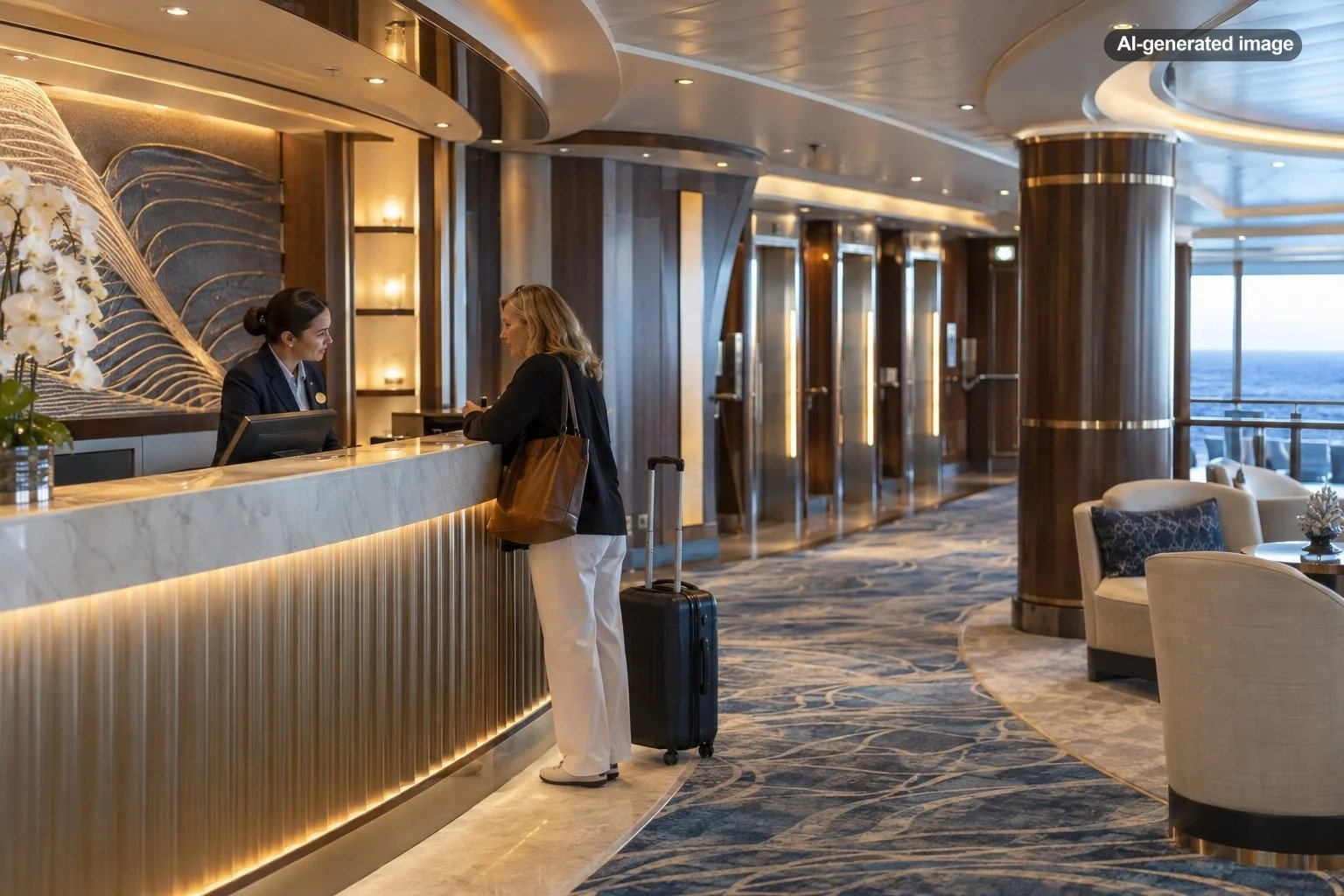
The response will depend on the cause and the individual ship. Guest Services might send someone to investigate, contact another passenger, involve security when inappropriate guest behavior is involved, request maintenance assistance, or document the complaint and monitor whether the disturbance continues.
For example, Royal Caribbean’s published guest conduct policy prohibits loud radios and other noise nuisances. Policies like this give ship personnel a route for dealing with disruptive behavior when another passenger is creating the problem.
If the noise cannot reasonably be stopped and another appropriate cabin exists, a relocation may be considered. Do not assume, however, that the replacement will have exactly the same deck, location, view, bedding arrangement, or configuration as your original reservation. Before accepting a move, ask what will change.
Should you ask immediately for a cabin change?
You can, but framing the conversation around solving the problem is usually more productive than demanding a particular outcome. Tell Guest Services that the noise is preventing you from sleeping and ask what options are available. If the disturbance continues after an attempted solution, return and explain that it remains unresolved.
Keeping a simple record can help with a recurring problem. Note the approximate time, type of noise, duration, and when you reported it. You do not need an elaborate evidence file; the goal is simply to give the crew a clear pattern they can investigate.
What if there are no cabins available?
If relocation is impossible, ask what can realistically be done about the source. A maintenance problem might be repairable. Disruptive neighboring passengers may be addressed by ship personnel. Noise from scheduled entertainment could potentially be managed by explaining when it normally ends so you can decide whether the problem is tolerable.
You can also ask Guest Services whether another solution is available, but avoid assuming that a noisy room automatically entitles you to a refund, onboard credit, upgrade, or other compensation. Remedies vary with the circumstances, the severity of the issue, the cruise line’s policies, and what the crew can verify.
If you have not sailed yet, prevention is easier
If you already know that you are highly sensitive to noise, study the ship’s deck plan before selecting a stateroom. Look not only at your own deck but also at the decks immediately above and below it.
A cabin surrounded primarily by other passenger cabins can reduce exposure to some predictable sources of late-night or early-morning activity. By contrast, a room underneath a pool deck, entertainment venue, galley, gym, or other active facility may involve sounds that are simply part of the ship’s normal operation.
Guarantee or cruise-line-assigned cabin categories may offer less control over exact location, so travelers for whom quiet is a major priority should consider that tradeoff before booking.
What travelers often overlook
Noise can change throughout the voyage. A sound that occurs during docking, tender operations, or another specific ship activity may not be continuous throughout the cruise.
An apparently better cabin can have different drawbacks. Before moving, ask about its location and configuration. Escaping nighttime music only to move beneath an early-morning activity area may not improve the situation.
Waiting weakens your options. Reporting a serious problem on the first or second night gives the crew more opportunity to investigate and respond than raising it shortly before disembarkation.
There is a difference between inconvenience and abnormal disruption. Normal footsteps in a corridor are different from sustained late-night shouting, repeated mechanical banging, or amplified sound severe enough to interfere with sleep. Describe what is actually happening rather than relying only on the word “noisy.”
Frequently asked questions
Can I demand another cabin because mine is noisy?
You can request one, but generally cannot assume a move will be available. Stateroom inventory is limited once a cruise is underway, and the crew may first try to resolve the source of the noise.
Will the cruise line upgrade me for free?
Do not count on an upgrade. Any move depends on available accommodations and the cruise line’s handling of the specific situation. A legitimate complaint does not automatically create complimentary premium-cabin inventory.
Should I complain about noisy passengers myself?
For significant or repeated disturbances, contacting Guest Services is generally preferable to escalating a confrontation with another passenger. Ship personnel can determine the appropriate response under the cruise line’s conduct rules.
Can I change my cabin before the cruise instead?
Depending on your booking terms and available inventory, changes may be possible before departure. If noise sensitivity is important to you, addressing cabin location before sailing usually offers more flexibility than waiting until you are onboard.
Is some cruise-ship noise unavoidable?
Yes. Cruise ships operate around the clock, and some amount of corridor activity, ship operation, docking activity, neighboring-room sound, and vibration can occur. The more important question is whether the disturbance is unusually severe, persistent, or potentially correctable.
The practical takeaway
You absolutely can ask a cruise line to move you because of noise, and you should report a serious disturbance promptly. Just approach the request with realistic expectations. The crew may be able to stop the source, repair a problem, or relocate you, but another cabin is never assured on a full ship.
The strongest strategy is straightforward: report the problem while it is occurring, describe it precisely, allow the crew to investigate, and follow up if it continues. If quiet is particularly important to you, careful cabin selection before sailing remains the most reliable way to reduce the risk.