Can You Put a Rollaway Bed in Any Hotel Room?
No, you cannot put a rollaway bed in just any hotel room. A hotel may own portable beds and still prohibit them in certain rooms because of limited floor space, maximum occupancy rules, fire-safety requirements, blocked walkways, or the layout of the selected room type.
The safest approach is to confirm both the hotel’s rollaway-bed policy and the eligibility of your exact room category before booking. A general amenity listing that says rollaway beds are available does not necessarily mean one can be added to every reservation.
Quick answer
- Rollaway beds are usually available only in selected room types.
- A room’s maximum occupancy does not automatically increase when an extra bed is added.
- Hotels may limit rollaways because they can obstruct doors, corridors, furniture, or emergency exit paths.
- Inventory is often limited, so a request may not be guaranteed.
- An extra-person or rollaway fee may apply even when the bed is permitted.
Why some hotel rooms cannot take a rollaway bed
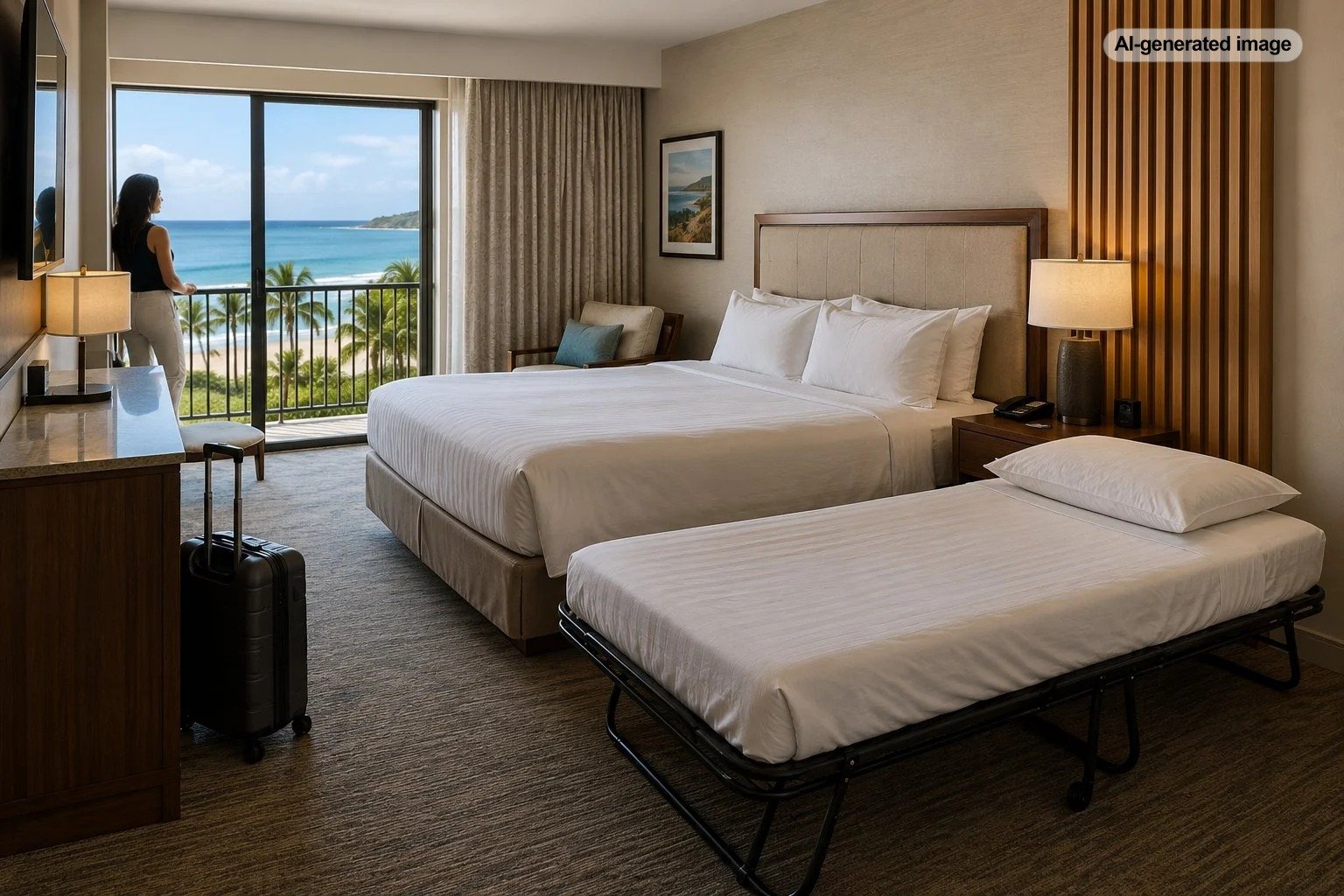
A rollaway bed is compact when folded, but it requires a meaningful amount of clear floor space when opened. The hotel must consider more than whether the bed can physically fit between the wall and the existing furniture.
Guests and staff still need to move through the room safely. The bed should not block the entry door, bathroom access, connecting door, balcony door, closet, heating or cooling unit, or the path between the sleeping area and the exit.
This is why compact city rooms are less likely to permit rollaways than larger suburban rooms or suites. A room with one king bed may appear spacious in photographs but still have a narrow circulation path that cannot safely accommodate another sleeping surface.
Maximum occupancy matters more than available floor space
Every room type has an approved maximum occupancy. That limit may be influenced by the room’s size, permanent bedding, building regulations, hotel policy, and the number of guests the property can safely register in that space.
Adding a rollaway bed does not necessarily add another legal occupant. For example, a room listed for two guests may remain limited to two guests even if there appears to be enough open floor space for a portable bed.
Hotels also need an accurate record of everyone staying in the room. Do not book for fewer guests and assume that an unregistered traveler can be added later with a rollaway. The property may refuse the request, require a room change, charge an additional-guest fee, or enforce its stated occupancy limit.
Rollaway availability can vary by room category
A hotel’s policy is often more specific than a simple yes-or-no answer. Rollaways may be allowed in suites but not standard rooms, in king rooms but not double-bed rooms, or only in designated layouts within the same category.
Two rooms carrying similar names may also have different dimensions because of the building’s architecture. This is common in converted historic buildings, urban hotels, and properties with irregular floor plans. The reservation system may therefore show an extra-bed option for one room but not another.
Pay attention to the exact room description during booking. A statement such as “rollaway available on request” is more useful when it appears under the selected room type than when it appears only on a general hotel-amenities page.
A request is not always a guarantee
Many hotels maintain only a small number of rollaway beds. Requests may be handled on a first-come, first-served basis, and availability can change before arrival.
Adding a note to an online reservation is helpful, but it may not constitute confirmation. Contact the hotel directly and ask whether the rollaway can be guaranteed for the entire stay. Request written confirmation when the extra bed is essential to your sleeping arrangement.
It is also worth reconfirming shortly before arrival. This is particularly important during holidays, school breaks, conventions, weddings, and other periods when family and group travel increases demand for extra bedding.
Expect possible fees and age restrictions
A hotel may charge for the rollaway itself, for an additional adult, or for both. Taxes may also apply. Policies can differ between children and adults, and the age at which a guest is considered an adult varies by property.
Ask for the complete nightly cost rather than asking only whether a rollaway is available. Useful questions include:
- Is the fee charged per night or per stay?
- Is there a separate additional-person charge?
- Does the fee include taxes?
- Is the bed suitable for an adult or intended mainly for a child?
- Can the request be guaranteed before arrival?
A slightly larger room with a sofa bed may provide better value than paying recurring rollaway and additional-guest fees, especially on a longer stay.
Rollaway bed, sofa bed, crib, and cot are not interchangeable
Hotel terminology can be inconsistent, so clarify what the property is offering. In the United States, a rollaway bed generally means a portable single bed on a folding frame. In other places, the term “extra bed” or “cot” may be used for a similar item.
A sofa bed is built into the room and may be included in the stated sleeping capacity. A crib is intended for an infant or very young child and does not replace an adult-size extra bed. Some hotels use “cot” to mean a rollaway, while others use it for a smaller or lighter sleeping platform.
Ask about the actual bed size and intended user. A narrow portable bed that works for a child may not be comfortable or appropriate for a tall adult.
Better alternatives when a rollaway is not permitted
When the hotel cannot add a portable bed, changing the room arrangement is usually better than trying to force another sleeper into the original booking.
Book a room with two permanent beds
This is often the simplest choice for three or four travelers. Confirm the bed sizes because two double beds provide a different sleeping arrangement from two queen beds.
Choose a room with a sofa bed
A sofa bed may offer an additional approved sleeping space without creating the same circulation problems as a rollaway. Check whether linens are supplied and whether the sofa bed is included in the room’s maximum occupancy.
Upgrade to a suite
A suite may provide a separate living area, more floor space, and a better degree of privacy. However, the word “suite” does not guarantee extra bedding, so review the room configuration carefully.
Reserve connecting or adjoining rooms
This can be the most practical arrangement for families with older children, groups of adults, or travelers who need multiple bathrooms. Connecting rooms have an interior door between them, while adjoining rooms may simply be near each other. Confirmed placement policies vary.
How to request a rollaway bed correctly
Start by entering the correct number and ages of all guests during the room search. This helps the booking system display room types that are intended for your party size.
Before completing the reservation, review the room’s maximum occupancy, permanent bed configuration, extra-bed language, and additional-person terms. Then contact the hotel using the property’s direct telephone number or messaging system.
Give the representative your travel dates, number of adults and children, selected room category, and the age or approximate size of the person who will use the rollaway. Ask the hotel to add the confirmed arrangement to the reservation record.
At check-in, verify the request before settling into the room. If the assigned room cannot accommodate the bed, addressing the issue immediately gives the front desk a better chance of finding another eligible room.
What travelers often overlook
The person using the rollaway may have less privacy, limited access to electrical outlets, and a sleeping position close to the room entrance or bathroom. Once opened, the bed may also make luggage storage and nighttime movement more difficult.
Housekeeping procedures can affect convenience as well. Some properties fold the bed during the day, while others leave it open. Guests with mobility concerns should consider whether the narrower pathways created by an extra bed will remain comfortable throughout the stay.
Most importantly, never bring an unauthorized air mattress or portable bed without asking the hotel. The property may prohibit additional bedding for the same occupancy, space, or fire-safety reasons that prevent it from supplying a rollaway.
Frequently asked questions
Can a rollaway bed be added to a room with two beds?
Sometimes, but this layout is commonly restricted because two permanent beds already occupy much of the usable floor space. The hotel’s policy for the exact room type determines whether another bed is allowed.
Can three adults stay in a king room with a rollaway?
Only when the room is approved for three adults and the hotel permits a rollaway in that category. A king room is not automatically eligible simply because it has one permanent bed.
Are hotel rollaway beds guaranteed?
Not always. Many are offered on request and subject to limited inventory. Ask whether the hotel can guarantee the bed and place that confirmation in the reservation notes.
Do hotels charge for rollaway beds?
Many do, although fees and billing methods vary. A hotel may also charge an additional-person fee, so request the complete cost for your dates.
Should I book first and request the bed later?
Confirm eligibility before booking when the rollaway is essential. Otherwise, you could reserve a nonrefundable room that cannot legally or safely accommodate your party.