Complete Guide to Moroccan Souks
Moroccan souks are working marketplaces, artisan districts, neighborhood shopping streets, and social spaces rather than attractions created only for visitors. Exploring them well requires more than knowing how to bargain. Travelers also need to understand how different cities specialize, how to recognize workmanship, when to walk away, and how to move through a busy medina without turning every conversation into a purchase.
This guide explains where to find the most distinctive souk experiences, what is commonly sold, how negotiation usually works, and which practical details can make shopping more enjoyable. The goal is not to collect the greatest number of souvenirs. It is to make deliberate purchases while appreciating the people, skills, and commercial traditions behind them.
Moroccan souk planning snapshot
- Best fit: Travelers interested in crafts, design, food, local commerce, and traditional urban life.
- Best-known cities: Marrakech and Fez offer the most extensive medina shopping, while Essaouira, Taroudant, Rabat, and other cities provide different scales and specialties.
- Time needed: Allow at least half a day for a focused visit and more time if you plan to compare carpets, leather, metalwork, or other significant purchases.
- Payment: Carry some Moroccan dirhams, especially for small shops and food stalls, while confirming accepted payment methods before committing to a larger purchase.
- Navigation: Download an offline map, note the nearest major gate or landmark, and expect narrow lanes that may not follow an obvious grid.
What is a Moroccan souk?
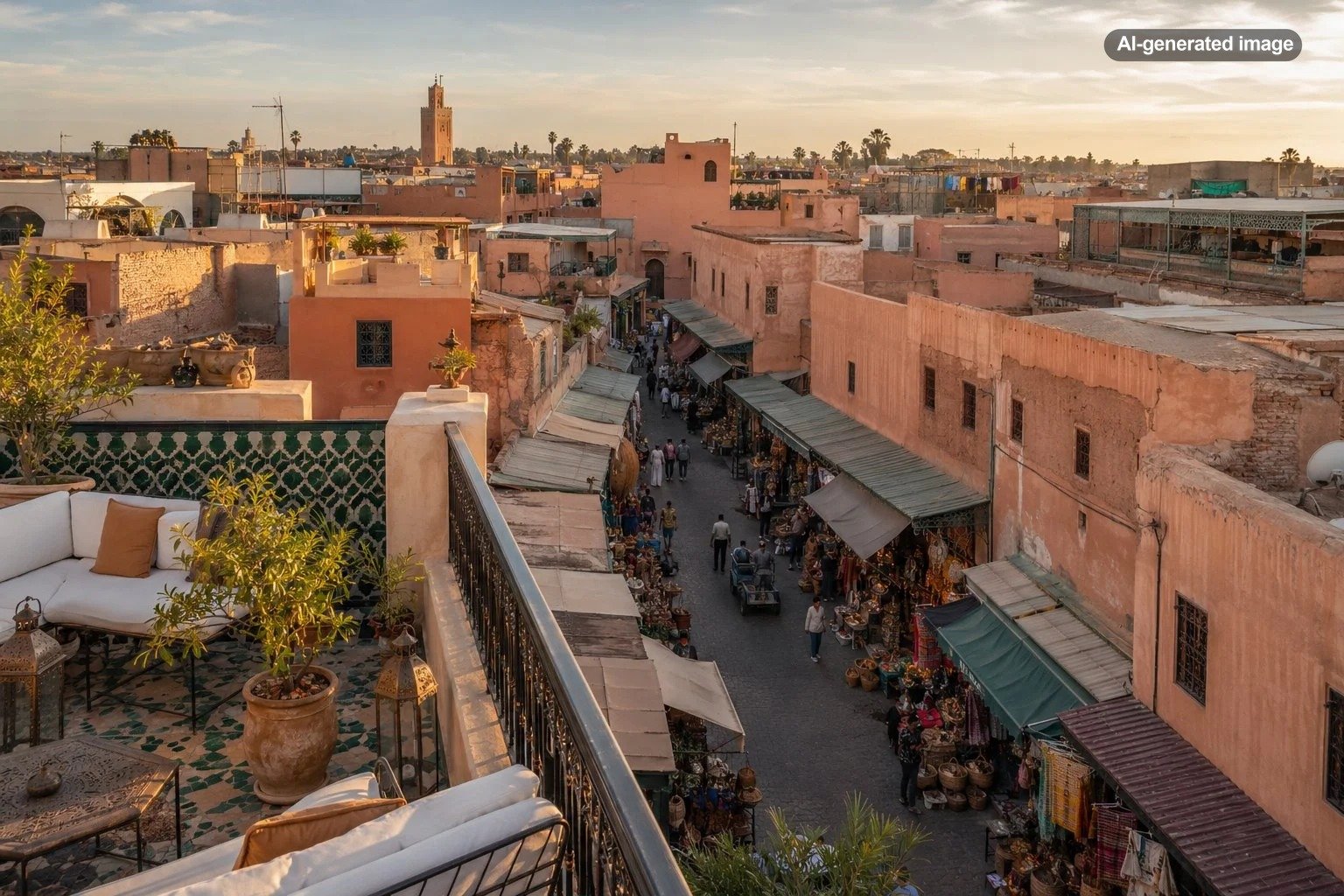
A souk is a market, although the word can describe several kinds of commercial space. Some souks consist of covered lanes filled with small workshops and shops. Others are open neighborhood markets selling vegetables, household goods, clothing, spices, or livestock. In historic medinas, related trades may cluster in the same area, creating sections associated with textiles, metalwork, leather, wood, jewelry, or food.
This organization developed for practical reasons. Artisans shared customers, materials, tools, and professional knowledge. Today, the boundaries are less rigid in many places, particularly in visitor-oriented districts, but travelers can still notice shifts in sound, smell, merchandise, and workshop activity as they pass from one section to another.
A souk is also different from a conventional shopping mall. Prices may not be displayed, conversations can take time, and the person selling an item may know its maker or production process. At the same time, not every object is handmade locally. Souks contain exceptional craftsmanship, ordinary household goods, imported products, reproductions, and merchandise designed for tourists. Asking careful questions is therefore more useful than assuming every item is traditional or unique.
How the major souk cities differ
| Destination | Character | Strongest fit | Main tradeoff |
|---|---|---|---|
| Marrakech | Large, energetic, visually dense, and heavily visited | First-time visitors seeking variety | More sales pressure in popular lanes |
| Fez | Deeply woven into a complex historic medina | Travelers interested in traditional trades | Navigation can be demanding |
| Essaouira | Smaller, calmer, and easier to combine with a coastal stay | Travelers who prefer a gentler pace | Less sheer variety than Marrakech or Fez |
| Taroudant | Regional, traditional, and less overwhelming | Travelers exploring southern Morocco | Requires more deliberate itinerary planning |
| Rabat | More compact and restrained | Visitors wanting an accessible introduction | Not as immersive as the largest medinas |
Marrakech: the broadest introduction
The souks north of Jemaa el-Fna form one of Morocco’s most recognizable shopping environments. Travelers encounter lamps, ceramics, slippers, leather bags, textiles, spices, metalwork, baskets, woodwork, and contemporary decorative goods. The scale makes Marrakech useful for comparing styles, but its popularity also means visitors may receive frequent invitations to enter shops.
Marrakech works well for travelers who want variety and can remain unhurried. It is less suitable for anyone expecting quiet browsing or fixed-price simplicity. Moving beyond the most heavily traveled approaches often reveals workshops and stores with a more focused selection.
Fez: traditional trades within a living medina
Fez el-Bali is known for its dense urban fabric, artisan workshops, leather production, metalwork, woodcraft, textiles, and specialized commercial lanes. Shopping here feels closely connected to the functioning of the old city. Deliveries, workshops, residents, religious buildings, food vendors, and visitors all share the same confined routes.
Fez is especially rewarding for travelers who want to understand how objects are made. The tradeoff is orientation. Streets can branch unexpectedly, map accuracy may vary in narrow passages, and some workshops are difficult to locate without local knowledge. A licensed guide can be useful when the priority is craft history rather than independent wandering.
Essaouira: a slower shopping experience
Essaouira’s medina is generally easier to navigate and can feel less intense than the largest inland souks. Woodwork, textiles, jewelry, art, leather goods, and decorative objects are commonly encountered. The city suits travelers who want to browse between other activities instead of devoting an entire day to shopping.
The smaller scale improves accessibility but limits comparison. A traveler seeking a highly specific carpet, antique object, or extensive selection may find more choice in Marrakech or Fez.
What to buy and what to inspect
Carpets and woven textiles
Moroccan carpets vary by region, weaving community, materials, pattern, age, and construction. Ask whether a piece is wool, cotton, synthetic fiber, or a blend. Examine the back, edges, fringe, consistency of the weave, repairs, and any visible wear. Natural irregularities can be part of handmade production, but they should not be used to excuse structural weakness.
Carpet presentations can be lengthy. State your preferred size, colors, and approximate spending limit early. Do not discuss shipping or final pricing until you have identified a piece you would genuinely consider owning.
Leather goods
Leather slippers, poufs, belts, bags, jackets, and accessories are widely sold. Inspect stitching, lining, closures, edge finishing, color transfer, and odor. A strong smell does not by itself prove authenticity or quality. For poufs and other soft goods, confirm whether the price includes filling and consider luggage space before purchasing.
Ceramics
Look for cracks, chips, unstable bases, uneven handles, and flaws around rims. Decorative ceramics may not be suitable for food, heat, dishwashers, or microwaves. Ask about intended use rather than assuming every painted plate or tagine is functional cookware.
Metal lamps, trays, and decorative work
Check seams, hinges, wiring components, sharp edges, and whether a lamp can be adapted safely for use at home. Electrical compatibility should be evaluated by a qualified professional after travel. For trays and tea service pieces, ask about the base metal and whether the finish requires special care.
Spices, oils, and cosmetic products
Buy consumable or skin-contact products from sellers who can explain ingredients, packaging, storage, and intended use. Unlabeled powders, herbal mixtures, perfumes, and oils can be difficult to evaluate. Be cautious when a product is accompanied by sweeping medical, cosmetic, or therapeutic claims.
How bargaining works
Negotiation is common in many traditional shops, but it is not required in every store. Fixed-price cooperatives, galleries, contemporary boutiques, pharmacies, food businesses, and clearly labeled retailers may operate differently. Look for posted prices or ask whether the price is fixed before beginning.
When negotiation is appropriate, start by deciding what the item is worth to you. Ask the price, respond calmly, and make a counteroffer that leaves room for movement without becoming theatrical or disrespectful. The exact percentage matters less than maintaining a reasonable conversation.
- Negotiate only for an item you are seriously considering.
- Keep the tone friendly and avoid criticizing the merchandise to force a discount.
- Confirm whether the final amount is in dirhams and whether it covers every item under discussion.
- Do not accept tea, demonstrations, or extended service as creating an obligation to buy.
- Walk away politely when the price and your budget remain too far apart.
Comparing several shops before buying can improve judgment, particularly for common goods. For one-of-a-kind pieces, however, walking away may mean losing that exact item. That is a real tradeoff rather than a negotiation trick.
How to navigate without unnecessary stress
Begin with a recognizable entrance, square, mosque exterior, museum, or medina gate. Save your lodging location offline and carry its written address. In Marrakech, Jemaa el-Fna provides a useful orientation point for the main souk area. In Fez, major gates such as Bab Bou Jeloud can serve as practical reference points, although the interior network quickly becomes more complex.
Expect handcarts, delivery animals, motorcycles in some areas, uneven paving, low awnings, and crowded intersections. Keep to one side where possible and pay attention when vendors or residents call out a warning. Comfortable closed shoes are generally more practical than delicate footwear.
Unsolicited directions may lead to a shop, tannery viewpoint, or requested tip. That does not make every offer dishonest, but it is better to agree on expectations before following someone. For a structured visit, arrange a licensed guide through a reputable local operator or lodging provider rather than selecting an unknown guide inside the medina.
Souk etiquette that improves the experience
Ask before photographing people, workshops, or merchandise at close range. Some artisans welcome interest, while others prefer not to be photographed. A purchase does not automatically include permission to photograph everyone involved.
Dress and behavior should reflect that medinas are residential and religious environments as well as commercial districts. Avoid blocking doorways, touching food, entering workshop areas without invitation, or treating active production as a staged display.
A greeting can change the tone of an interaction. Simple expressions such as as-salaam alaykum for hello and shukran for thank you are widely understood. French is also commonly used in commercial settings, while language patterns vary by region and seller.
Common mistakes to avoid
- Shopping immediately: Buying from the first stall prevents meaningful comparison of quality and price.
- Assuming handmade means flawless: Handmade work can show variation, but construction and durability still matter.
- Confusing age with authenticity: A worn appearance does not establish that an object is antique.
- Ignoring transportation: Large lamps, ceramics, carpets, and metal pieces can be expensive or difficult to carry and ship.
- Starting negotiations without intent: Lengthy bargaining for entertainment wastes the seller’s time.
- Relying on memory for navigation: Similar-looking lanes and covered passages make saved landmarks more reliable than visual recall alone.
- Accepting broad health claims: Treat herbal, cosmetic, and food products with the same caution you would use at home.
What travelers often overlook
The best souk visit may include very little shopping. Watching a metalworker shape a tray, noticing how goods are delivered through narrow lanes, or seeing residents buy bread and produce can explain more about the medina than a bag of souvenirs.
Travelers also tend to focus on famous products while overlooking practical crafts. Hardware, baskets, kitchen tools, simple textiles, tailoring, and household ceramics often reveal how the market serves local life. These areas can feel less polished, but they provide important context.
Finally, quality and fairness are not determined by achieving the lowest possible price. A well-made object from a skilled artisan may reasonably cost more than a mass-produced alternative. The strongest purchase is one whose workmanship, usefulness, price, and personal value still make sense after the excitement of negotiation has passed.
Frequently asked questions
Which Moroccan city has the best souks for a first visit?
Marrakech offers the widest and most accessible introduction for many first-time visitors. Fez is often stronger for travelers primarily interested in historic urban structure and traditional craft production.
Do I need to bargain for everything?
No. Bargaining is common in many traditional shops, but some stores use fixed prices. Ask before assuming that negotiation is expected.
Are credit cards accepted in Moroccan souks?
Acceptance varies. Larger shops may accept cards, while small stalls and food vendors may prefer cash. Confirm the payment method and final amount before completing a purchase.
Is it worth hiring a guide?
A licensed guide can add value in a complex medina such as Fez, especially when the goal is to locate specific crafts or understand local history. Independent exploration may suit travelers who prefer flexibility and are comfortable navigating unfamiliar lanes.
How can I tell whether an item is genuinely handmade?
Ask where it was made, what materials were used, and whether the seller can explain the production process. Inspect construction closely and compare similar pieces. No single imperfection, label, story, or sales claim proves that an object is handmade.