Why Do Some Cruise Cabins Have Partially Enclosed Balconies?
Some cruise cabins have partially enclosed balconies because of the ship’s exterior design, structural configuration, and the need to balance outdoor space with shelter and privacy. Instead of a conventional balcony with a wide, open railing, these cabins may have solid sidewalls, a substantial overhead covering, or an opening framed by the ship’s hull. The result is a different outdoor experience, not necessarily an inferior one.
A partially enclosed balcony can provide welcome protection from wind and greater separation from neighboring cabins. However, it may also restrict panoramic views, reduce direct sunlight, or make the outdoor area feel more enclosed. Understanding these differences is particularly useful when comparing cabins that appear similar in price and square footage.
Quick Answer: Why Are Some Cruise Balconies Enclosed?
- Ship architecture: The balcony may sit within the hull rather than projecting outward from the exterior.
- Structural design: Solid walls and surrounding ship structures help define the exterior layout.
- Weather exposure: A recessed or sheltered configuration can reduce exposure to certain winds and weather conditions.
- Privacy: Solid partitions and recessed openings may limit direct sightlines from adjacent balconies.
- Cabin variety: Cruise lines offer different balcony configurations to accommodate the ship’s design and different passenger preferences.
The important distinction is that a partially enclosed balcony can still be a genuine outdoor space. The amount of enclosure, usable seating area, and unobstructed visibility depend on the specific ship and cabin.
How Cruise Ship Architecture Shapes Balcony Design
Modern cruise ships have complex exterior profiles. Their sides are not necessarily flat, and the position of balconies changes around lifeboats, public decks, structural sections, and the ship’s bow and stern.
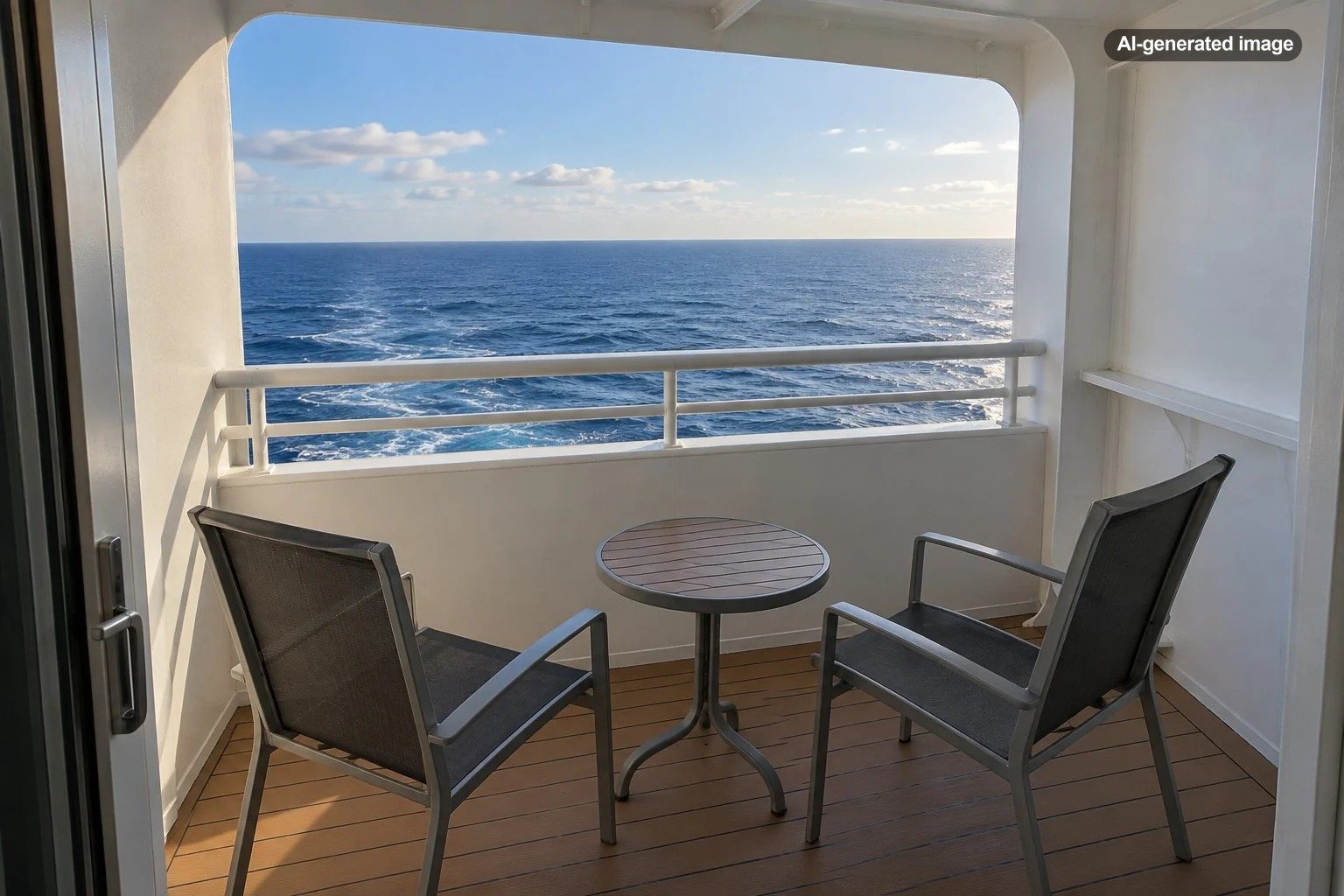
On some vessels, balconies extend outward behind glass or metal railings. On others, they are recessed into the ship’s exterior. This latter arrangement can create a substantial frame around the opening, with solid surfaces above, below, and on either side.
These spaces are sometimes informally described as hull balconies, sheltered balconies, or recessed balconies. The terms are not interchangeable across every cruise line, and individual ships may use their own category names.
A balcony surrounded by solid structural surfaces may offer a different sense of separation from the ocean than one with glass railings. Passengers seated inside a deeply recessed balcony might see mostly the horizon directly ahead, while someone standing closer to the opening could enjoy a broader view.
Different Types of Partially Enclosed Balconies
Not every enclosed-looking cruise balcony has the same design. Several configurations are worth distinguishing before booking.
Recessed or Hull-Style Balconies
A recessed balcony sits partly within the ship’s exterior rather than extending fully beyond it. Its opening may be framed by substantial metal or structural surfaces.
This design can create a sheltered atmosphere. However, the surrounding frame may limit visibility toward the water immediately below or toward the sides of the ship. It is especially important to assess the view from a seated position rather than judging only the outward-facing photograph.
Balconies With Solid Lower Walls
Some balconies are open above the railing but have solid lower barriers instead of transparent panels. These are meaningfully different from balconies enclosed around their entire perimeter.
Disney Cruise Line, for example, identifies white-wall verandahs on certain ships. The solid lower wall can provide greater visual separation, but passengers seated behind it may have a restricted view of the water compared with a transparent railing.
Navigator’s Verandahs
Disney Cruise Line also uses the term Navigator’s Verandah for a particular balcony category. On Disney Magic and Disney Wonder, this configuration includes an enclosed balcony with a large open-air porthole, creating a more sheltered environment while still admitting fresh air and natural light.
Importantly, the same category name does not necessarily indicate identical construction throughout a cruise line’s fleet. Disney explains that Navigator’s Verandahs on other ships can feature obstructed views without the same enclosed design. The specific vessel matters more than the category name alone.
Covered Balconies With Open Railings
A balcony may appear partially enclosed simply because the deck above extends over it. Such balconies can retain conventional outward-facing railings while receiving substantial overhead shade.
Unlike a deeply recessed hull balcony, this arrangement may preserve broad views while providing protection from direct overhead sunlight. The actual amount of shade changes with the ship’s orientation, the sun’s position, and surrounding structures.
Does an Enclosed Balcony Provide Better Wind Protection?
Potentially, but it should not be considered windproof. Solid sidewalls and recessed openings can shield occupants from certain wind directions, making some partially enclosed balconies feel more comfortable when exposed balconies are breezy.
Nevertheless, wind conditions change with ship speed, direction of travel, and weather. Air can still enter through the open portion of a sheltered balcony, and the arrangement of surrounding surfaces can create unexpected drafts.
Travelers who enjoy reading outdoors or sitting with a morning coffee may appreciate a sheltered configuration. Those seeking unobstructed ocean views and a more open-air sensation may favor a conventional balcony.
Neither design guarantees that the balcony will be comfortable or accessible in all conditions. Cruise operators may restrict balcony access during certain weather situations.
Are Partially Enclosed Balconies More Private?
They can be, although privacy depends on the precise arrangement of walls, neighboring balconies, and public areas.
Solid partitions may reduce side-to-side visibility. A recessed balcony may also be less exposed to passengers looking down from decks above, particularly when the overhead structure extends outward.
However, enclosure alone does not guarantee privacy. Some balconies are visible from nearby passenger areas, adjacent cabins, or elevated decks.
P&O Cruises specifically advises passengers to review ship deck plans and cabin notes because balcony visibility, shade, and obstruction vary with the shape of individual vessels.
For travelers prioritizing privacy, a photograph of the balcony taken from inside the cabin is not enough. The surrounding exterior arrangement is equally important.
What Are the Main Disadvantages?
The most significant drawback is often the view. A partially enclosed balcony may provide excellent visibility straight ahead while restricting views downward, upward, or toward either side.
Other potential compromises include:
- Less direct sunlight: Overhead structures can create persistent shade during portions of the day.
- A more confined atmosphere: Solid surrounding walls can make a balcony feel smaller even when its listed dimensions are comparable.
- Limited seated visibility: A solid barrier or elevated opening may require passengers to stand to see the ocean clearly.
- Different photographic opportunities: Structural framing can interfere with wide ocean photographs or views along the coastline.
- Variation within a category: Two cabins sold under similar descriptions may have noticeably different balcony arrangements.
These compromises matter most when the balcony itself is a major reason for choosing a particular cabin.
How Is a Partially Enclosed Balcony Different From an Obstructed-View Balcony?
The terms describe different characteristics, although a cabin can have both.
Partially enclosed describes the physical construction of the balcony: walls, overhead coverings, recessed openings, or other surrounding surfaces.
Obstructed view describes a limitation on what passengers can see. Lifeboats, railings, structural elements, and other ship features may block part of the outward view, regardless of whether the balcony itself is enclosed.
Princess Cruises, for example, explains that obstructed-view balcony rooms can retain the features of conventional balcony accommodations while having sightlines partly blocked by ship structures.
A conventional glass-fronted balcony can therefore have an obstructed view. Conversely, a partially enclosed balcony may provide an excellent view of the horizon through its opening.
Travelers should evaluate enclosure and obstruction separately rather than assuming one automatically means the other.
Who Should Consider a Partially Enclosed Balcony?
A sheltered balcony may be an appealing choice for passengers who value a quieter-feeling outdoor retreat, reduced exposure to certain winds, or more separation from neighboring cabins.
It can also suit travelers who mainly want a private place to enjoy fresh air rather than an expansive photographic viewpoint. Someone who plans to spend brief periods outside between activities may find the restricted side views relatively unimportant.
By contrast, travelers who expect to spend hours watching coastal scenery, photographing arrivals into port, or enjoying an uninterrupted ocean panorama may prefer a balcony with transparent railings and fewer surrounding structural elements.
Families should also consider how the view works for seated passengers and children. A solid lower wall may conceal much of the ocean from a child’s seated perspective. Regardless of the balcony design, children require appropriate supervision, and all passengers should follow the cruise line’s balcony safety rules.
What to Check Before Booking Your Cabin
A standard deck plan is a useful starting point, but it rarely conveys the complete experience of standing or sitting on a particular balcony.
Before selecting a cabin, review the following details:
- Exact cabin number: Verify the configuration of the individual stateroom, not merely its general category.
- Official cabin description: Look for terms such as sheltered, white-wall, obstructed view, partially obstructed, or recessed.
- Balcony photographs: Seek images showing the railing, sidewalls, overhead covering, and outward view.
- Exterior ship photographs: Identify where the cabin sits within the vessel’s overall profile.
- Decks above and below: Check for public areas, promenades, and structures that may affect visibility or privacy.
- Seated sightlines: Determine whether the ocean remains visible without standing.
- Usable outdoor space: Compare balcony dimensions and furnishings separately from the interior cabin area.
If the booking information is unclear, ask the cruise line or booking provider to clarify the exact balcony configuration. A category description should not be treated as a guarantee that every cabin has an identical view.
Should You Choose a Sheltered Balcony or an Open Balcony?
The decision is best approached as a comparison of how you intend to use the outdoor space.
If your priority is sitting outside with a book, a sheltered balcony may be particularly appealing. Its solid surfaces can create a more protected setting, though the amount of wind protection will vary.
If your priority is watching changing scenery from a comfortable chair, consider a balcony with an unobstructed glass railing. A wide opening matters less if a solid wall blocks the horizon from your preferred seating position.
For an itinerary with substantial scenic cruising, the quality of the view may deserve greater weight. For a trip centered on activities aboard the ship and time in port, the balcony’s exact construction may be less consequential.
Price differences should also be judged in context. An enclosed or partially obstructed balcony is not automatically cheaper than an open balcony. Fares depend on the cruise line, ship, sailing, cabin category, and booking conditions.
Affiliate disclosure: HotelInfo.com may earn a commission when you book or purchase through links on this page. This does not affect the price you pay. Learn more.
When comparing itineraries and cabin categories, travelers can browse cruises with Expedia as one starting point. Always verify the exact stateroom configuration with the cruise operator before booking, especially when balcony style is a deciding factor.
Frequently Asked Questions
Is a Partially Enclosed Cruise Balcony Still Outdoors?
Usually, yes. A partially enclosed balcony generally retains an opening to the outside, providing fresh air and an ocean-facing space. It should not be confused with an enclosed interior room or a virtual balcony display.
Do Sheltered Balconies Receive Less Sunlight?
Some do. Solid overhead surfaces and recessed openings can reduce direct sunlight, but exposure depends on the ship’s orientation, surrounding structures, and time of day. A sheltered balcony is not necessarily shaded at all times.
Can You See the Ocean While Sitting Down?
That depends on the balcony. Transparent railings generally provide better seated visibility than solid lower walls. Some enclosed designs have openings positioned high enough to restrict the view from certain chairs.
Are Enclosed Balconies Safer Than Open Balconies?
Do not assume so. All passenger balconies are subject to the ship’s applicable safety requirements, and an enclosed appearance does not eliminate risks. Follow onboard rules, supervise children, and never climb or lean over balcony barriers.
Can You Request a Different Balcony After Booking?
Changing cabins may be possible, depending on availability, fare conditions, the cruise line’s policies, and the timing of the request. A change may also involve a different price. Travelers should review the applicable booking terms rather than assume a complimentary adjustment is available.
The Most Important Detail Is the Actual View
Partially enclosed cruise balconies are generally a result of ship design rather than an indication that a cabin is defective or undesirable. They can offer privacy, shelter, and a distinctive outdoor setting, while sometimes sacrificing sunlight or panoramic visibility.
The most reliable way to choose is to examine the specific cabin’s balcony rather than relying on the room category alone. For some travelers, a sheltered space will be preferable to an exposed balcony. For others, the ability to sit comfortably and see the full ocean horizon will justify selecting a more open design.
Neither arrangement is universally better. The right choice depends on whether you value shelter, privacy, sunlight, or the widest possible view.
Sources & Further Reading
- Disney Cruise Line: Types of Verandah Stateroom Balconies – Official descriptions of standard, white-wall, and Navigator’s verandahs.
- P&O Cruises: Choosing a Balcony Cabin – Guidance on balcony shade, privacy, visibility, and restrictions.
- Princess Cruises: Balcony Staterooms – Official explanation of balcony accommodations and obstructed views.