Connecting Cruise Cabins vs. Family Suite for Parents With Kids
For parents traveling with kids, connecting cruise cabins are often the stronger choice when privacy, two separate sleeping spaces, and potentially more bathroom access matter most. A family suite can be better when the priority is keeping everyone within one accommodation, gaining a larger shared living area, or receiving suite benefits that the family will actually use. Neither option is automatically better; the right choice depends on the children’s ages, the exact cabin layout, the number of bathrooms, sleeping arrangements, and the total price for the sailing.
The important comparison is not simply two rooms versus one bigger room. Cruise accommodations vary significantly by ship, and labels such as family suite, family stateroom, and connecting cabin can represent very different layouts. Parents should compare the actual deck plan and occupancy details for the specific ship before booking.
Quick answer: which setup works better for families?
- Choose connecting cabins if you want a real door between separate rooms, additional privacy, and more flexibility when parents and children have different sleep schedules.
- Choose a family suite if your family values one larger shared space and the suite has a layout that meaningfully separates sleeping and living areas.
- Count bathrooms, not just square footage. Morning and bedtime routines can be easier when a family has access to more than one bathroom.
- Check actual beds. A room that technically accommodates a family may rely heavily on sofa beds, pull-down berths, or other convertible sleeping arrangements.
- Compare the complete price. Two standard cabins can sometimes be a better practical fit than a premium suite, but the relative cost changes by ship, date, cabin category, and occupancy.
Connecting cruise cabins give parents two genuinely separate rooms
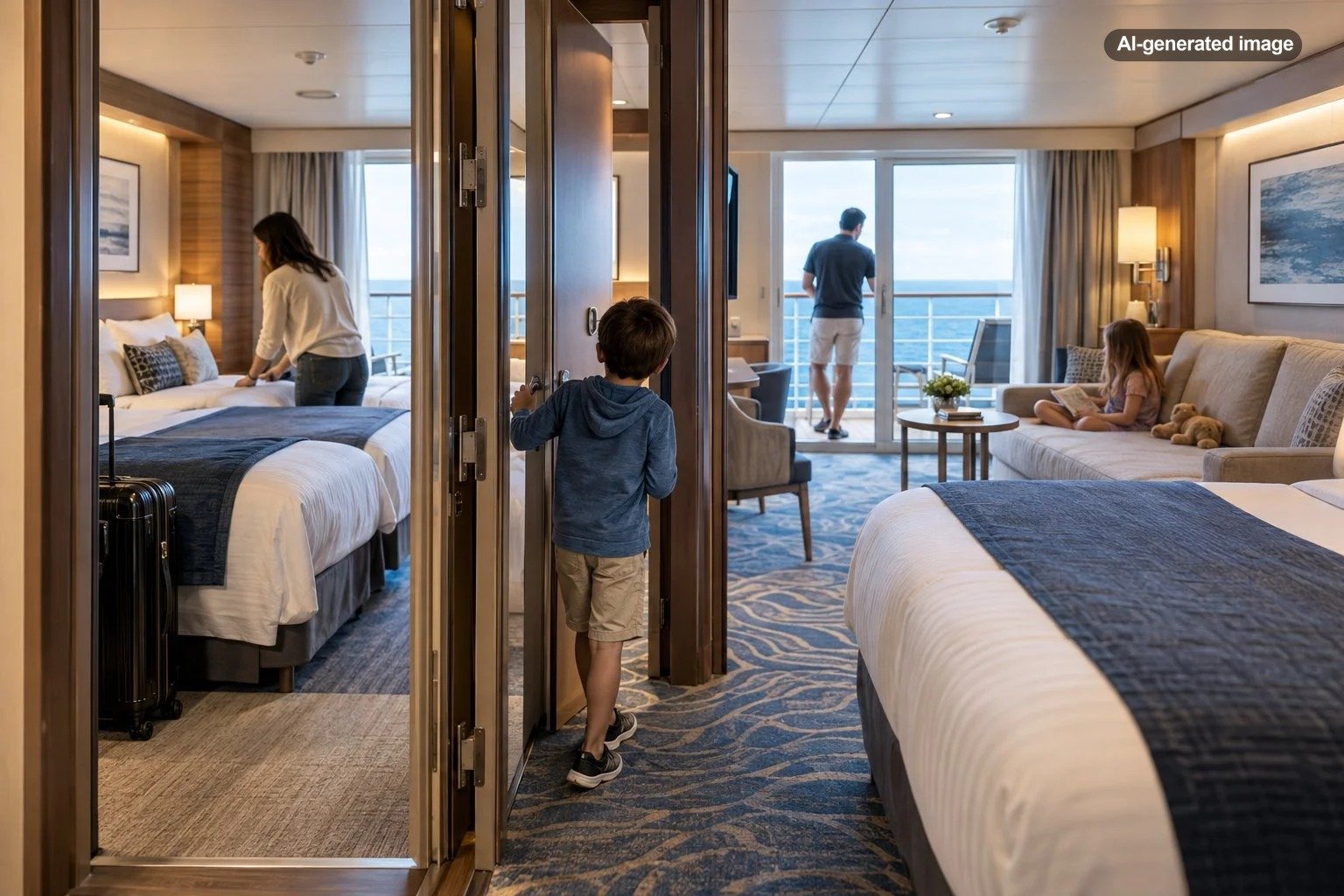
Connecting cabins are two individual staterooms with an interior connecting door. That distinction matters. Two cabins located beside each other are not necessarily connecting cabins, and parents should not assume that adjacent room numbers mean there will be an interior doorway.
For families, the biggest advantage is separation without forcing everyone into completely independent accommodations. Parents can put younger children to bed in one room while continuing to talk, read, or watch television in the other. With older children, the second cabin can provide a degree of independence while keeping the family immediately accessible through the connecting door.
Separate rooms can also reduce friction during longer sailings. One child can nap while someone else gets ready. Early risers do not necessarily have to wake everyone. Parents have an actual door between sleeping areas rather than depending on a curtain or partial divider.
A family suite can provide better shared living space
A family suite generally concentrates the household into one accommodation while providing more space or a more flexible layout than a standard cabin. Depending on the ship and category, that may mean a separate living area, multiple sleeping zones, extra storage, a larger balcony, or other features intended for groups.
This arrangement works particularly well for families that expect to spend meaningful time in their cabin. Parents traveling with babies or toddlers may appreciate having a central living area for snacks, quiet time, and getting ready. Families that enjoy breakfast in the cabin, afternoon downtime, or relaxed evenings may also benefit more from usable shared space than from having two conventional rooms.
The word suite, however, should not substitute for examining the floor plan. Some accommodations provide substantial separation between spaces, while others remain relatively open. A larger room does not necessarily offer the same privacy as two connecting cabins.
Privacy is usually the strongest argument for connecting cabins
Privacy becomes increasingly important as children get older. Families traveling with teenagers may find two connecting cabins especially practical because parents and children each have a distinct sleeping area. Everyone can change clothes, sleep, and get ready with fewer compromises.
This can also benefit parents who want private time after younger children fall asleep. In a single open room, bedtime can effectively become bedtime for everyone. A separate connecting cabin lets parents remain nearby while preserving a more normal evening routine.
For very young children, parents should think differently about separation. The advantage of connecting cabins comes from the interior door. Parents should verify that the rooms are truly connecting rather than simply nearby and choose arrangements appropriate to their family’s supervision needs.
Bathroom access can matter more than cabin size
Bathroom logistics are easy to underestimate when comparing accommodations online. A family can have ample floor space and still spend every morning waiting for one bathroom.
Two connecting standard cabins may provide two independent bathrooms, depending on the categories selected. That can make a significant difference for a family of four, particularly before dinner or an early port day.
A family suite may also offer an especially useful bathroom configuration, but parents should confirm the exact layout rather than assume every suite includes multiple bathrooms. Look at the ship’s published floor plan and room description carefully.
Sleeping arrangements deserve close attention
Maximum occupancy does not tell you how comfortable a cabin will feel at night. A room advertised for four, five, or six guests may achieve that capacity through a combination of permanent beds, sofa beds, pull-down berths, or convertible furniture.
Consider where every family member will actually sleep. Parents with two teenagers may value regular beds and a separate room more than a larger shared suite with multiple convertible sleeping surfaces. Parents with small children may be perfectly comfortable with compact additional berths if the overall layout makes supervision easier.
Also consider what happens when the extra beds are deployed. A sofa used as a bed can reduce usable living space at precisely the time the family is back in the cabin together.
Connecting cabins can make different schedules easier
Family members rarely follow identical schedules throughout a cruise. A toddler may need an afternoon nap. One parent may wake early. Teenagers may sleep later. Someone may return to the cabin before everyone else.
Connecting rooms handle these differences especially well because closing the interior door can create two quieter zones. Families do not have to choose between keeping the entire room dark and silent or disrupting whoever is sleeping.
A well-designed family suite can accomplish something similar if it has genuinely separate spaces. An open-plan suite, despite being larger, may offer less acoustic separation.
Family suites may include benefits beyond additional space
Some suite categories can include services, privileges, or access arrangements that standard cabins do not. These vary substantially among cruise lines, ships, and suite tiers, so they should be treated as part of the specific booking rather than as universal suite benefits.
The practical question is whether your family will use what is included. Paying substantially more for benefits that have little relevance to your routine may provide less value than booking connecting cabins and spending the difference elsewhere on the trip.
Conversely, a suite can be compelling when both the physical layout and the included experience align with how the family intends to cruise.
Compare total cost instead of assuming the suite costs more
It is tempting to assume that two cabins are the economical choice and a suite is the expensive choice. Pricing is not always that straightforward. Cruise fares depend on sailing date, ship, itinerary, occupancy, cabin category, and availability.
Two cabins also mean pricing two separate accommodations rather than simply doubling the advertised per-person amount. A suite has its own occupancy structure. The only reliable comparison is to price both configurations for the same sailing and the same travelers.
Affiliate disclosure: HotelInfo.com may earn a commission when you book or purchase through links on this page. This does not affect the price you pay. Learn more.
When comparing the available configurations for a particular sailing, you can compare available sailings while checking which ships and dates offer room arrangements suitable for your family. Always confirm the specific cabin category and deck plan before completing a reservation.
Which option is better for different family situations?
| Family situation | Often the better starting point | Why |
|---|---|---|
| Parents with teenagers | Connecting cabins | Greater privacy and separate sleeping spaces |
| Parents with younger children | Either | Supervision and the precise layout matter most |
| Family that spends substantial time in the cabin | Family suite | A larger shared living area can be more useful |
| Family with very different sleep schedules | Connecting cabins | Two separate rooms make quiet time easier |
| Family prioritizing an upgraded onboard experience | Family suite | The right suite category may combine space with additional benefits |
| Family focused primarily on practical value | Price both | The less expensive configuration can change by sailing |
What parents often overlook before booking
Adjacent is not the same as connecting
If an interior doorway is important, verify that the cabins are specifically designated as connecting. Nearby cabins can still require everyone to enter through the corridor.
The deck location still matters
A great family configuration in an inconvenient location may not be the best choice for your household. Review the deck plan for nearby elevators, stairs, public areas, entertainment venues, and children’s facilities according to what matters to your family.
Two balconies do not always function as one
If considering two balcony cabins, do not assume the balcony divider can be opened. Policies and physical configurations vary, and the interior connecting door should be the feature on which the family relies.
Storage can become the deciding factor
Families bring more clothing, shoes, toiletries, electronics, and miscellaneous gear into a cabin than couples often do. Compare closets, drawers, floor space, and luggage storage as carefully as the nominal room size.
The children’s ages can change the answer
The ideal arrangement for parents with a preschooler can be very different from the ideal setup with two teenagers. Think about the family’s needs during the actual sailing rather than choosing solely on the prestige or size of the accommodation category.
Questions to check before you reserve
- Are the rooms truly connecting through an interior door?
- How many bathrooms will the family have?
- Where will each person sleep when every bed is in use?
- Does converting the extra beds reduce usable living space?
- Can parents and children maintain different sleep schedules?
- Does the suite provide meaningful separation between sleeping areas?
- Are there suite benefits, and will your family actually use them?
- How does the total cost compare for the same passengers and sailing?
- Where are the cabins located on the deck plan?
- Are there age, occupancy, or booking requirements that affect how family members can be assigned to the rooms?
FAQ
Are connecting cruise cabins better than a family suite?
They can be, particularly for families that prioritize privacy, separate sleep zones, and potentially additional bathroom access. A family suite may be preferable when a larger communal space and suite-specific features are more important.
Are two adjoining cabins the same as connecting cabins?
No. Adjoining or adjacent generally indicates proximity, while connecting cabins specifically have an interior door between them. Confirm the cruise line’s terminology and deck plan before booking.
Are connecting cabins good for teenagers?
They can be especially practical for families with teenagers because parents and children gain distinct spaces while remaining immediately connected. Families should still follow the cruise line’s occupancy and age requirements.
Is a family suite always more spacious than two cabins?
Not necessarily in terms of total combined space or functional separation. Compare actual floor plans rather than relying on category names. Two cabins may provide more separation, while a suite may provide a better single living area.
What is the most important detail to compare?
Compare the real layout. Square footage and maximum occupancy are useful, but the number of bathrooms, type of beds, room separation, storage, and interior connecting door often have a greater effect on how comfortably a family uses the accommodation.
The bottom line
For many parents with school-age children or teenagers, connecting cabins offer an unusually practical combination of proximity and privacy. Two rooms can simplify bedtime, getting ready, bathroom use, and different daily schedules.
A thoughtfully designed family suite can be the better choice for families that want one cohesive accommodation with a comfortable shared living area or suite features they value. Instead of deciding based on the cabin-category name, compare the exact floor plans, sleeping arrangements, bathrooms, deck locations, and complete price for your specific sailing. That comparison usually makes the right choice much clearer.