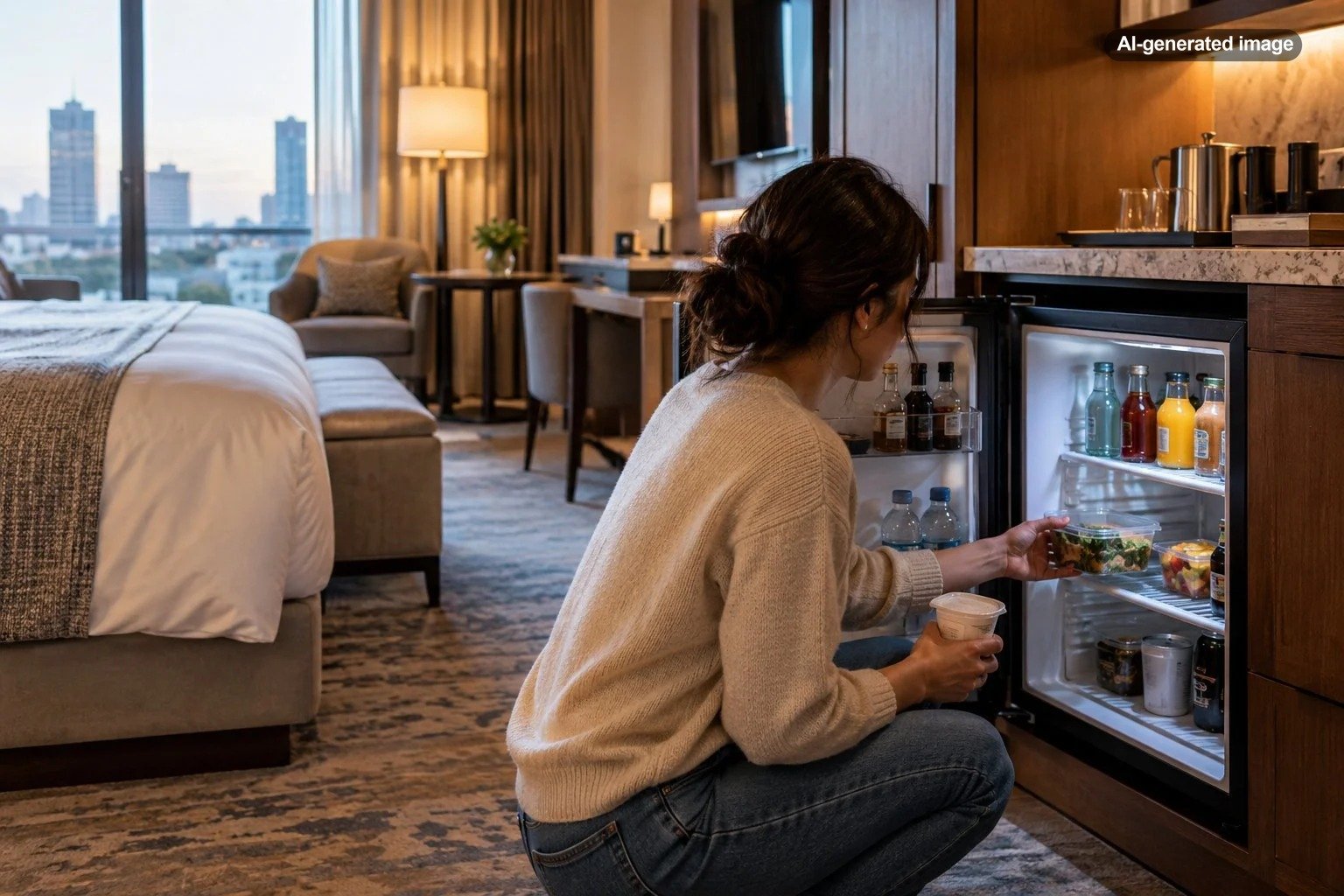
Can You Use the Hotel Minibar Fridge for Your Own Food?
Usually, you can use a hotel minibar fridge for your own food only if the unit has usable space, operates like a normal refrigerator, and the hotel’s setup allows it. The complication is that a minibar is not always the same thing as a guest refrigerator. Some are stocked with hotel products, some may use automated inventory technology, and some are designed mainly for beverages rather than dependable food storage.
If you are planning to keep restaurant leftovers, groceries, baby food, or anything else that genuinely needs refrigeration, check the minibar before relying on it. For important perishables, asking the hotel whether the room has a true refrigerator is a better strategy than assuming the minibar will work.
Quick answer
- Yes, sometimes: An empty or conventional minibar refrigerator may provide enough space for personal food.
- Do not move minibar products automatically: Some minibar systems may track items electronically or have hotel-specific procedures.
- Check how cold it actually gets: A cool minibar is not necessarily suitable for safely storing perishable food.
- Ask before depending on it: The front desk can clarify whether the minibar can be emptied, whether a separate refrigerator is available, or whether another storage option exists.
- Take extra care with temperature-sensitive items: Do not assume a minibar is appropriate for medication or other items requiring controlled refrigeration.
A minibar and a refrigerator are not always the same thing
The most important distinction is the equipment itself. Travelers often use the words minibar and mini-fridge interchangeably, but a hotel may treat them as different amenities. A guest refrigerator is generally intended to give the occupant usable cold-storage space. A minibar is primarily a hospitality service for storing drinks or snacks supplied by the property.
That difference matters because a minibar may already be nearly full. Shelves may be arranged around bottles and cans, leaving little practical room for a takeout container. The hotel may also prefer that stocked items remain where they are so inventory can be managed correctly.
Before rearranging everything, inspect the unit and any information provided in the room. If it looks like a stocked minibar rather than an ordinary empty refrigerator, contacting the front desk can prevent confusion.
Be careful with sensor-equipped minibars
One of the most useful questions to ask is whether removing minibar items can trigger a charge. Hotel minibar technology varies, so there is no universal rule. Some properties handle minibar consumption manually, while others may use automated systems to help track products.
For that reason, removing every bottle so you can fit a carton of leftovers inside is not always a harmless rearrangement. Even when an incorrect charge can eventually be corrected, dealing with it at checkout is inconvenient.
If you need meaningful refrigerator space, ask whether minibar products can be removed without affecting billing. Do not assume that putting everything back later will necessarily produce the same result as leaving it untouched.
Temperature matters more than whether the compartment feels cool
A minibar that feels chilly can be useful for drinks, but perishable food requires more confidence in the temperature. The U.S. Food and Drug Administration recommends keeping refrigerators at 40 F or below for proper refrigerated food storage.
This is especially relevant for items such as dairy products, meat, seafood, eggs, prepared leftovers, and other foods that require refrigeration. If you cannot determine whether the minibar maintains a suitable temperature, it is better not to treat it as dependable long-term storage for perishables.
Travelers bringing a small refrigerator thermometer can verify the temperature when food storage is an important part of the trip. Otherwise, the practical solution is simply to ask the hotel whether the room appliance is intended for food refrigeration.
What about restaurant leftovers?
Leftovers are one of the most common reasons travelers want access to a room refrigerator. Large restaurant containers, however, can be awkward in a compact minibar. Even if there is technically enough interior volume, the shelving or door design may prevent the container from fitting.
Food safety also depends on prompt refrigeration. FDA guidance advises refrigerating perishable foods within two hours, or within one hour when the surrounding temperature is above 90 F. That makes it unwise to carry leftovers around for much of the evening and assume placing them in a minibar later solves the problem.
If keeping leftovers is important, a room with a proper refrigerator is more convenient than repeatedly trying to reorganize a stocked minibar. Travelers staying several nights may find this distinction especially worthwhile when comparing room amenities.
Groceries are easier when you choose them for the available space
If you already know the room has only a compact minibar, choose groceries accordingly. Sealed yogurt cups, small containers, individually packaged foods, and similarly compact items are generally easier to manage than oversized cartons or bulky restaurant packaging.
Avoid packing the compartment so tightly that cold air cannot circulate. FDA refrigerator guidance specifically cautions against overpacking because adequate circulation helps food remain properly chilled.
Also keep your food sealed. Aside from avoiding spills, sealed containers make it much easier to separate your groceries from any minibar products that remain inside.
Do not assume a minibar is suitable for medication
Medication creates a different issue from ordinary snacks or leftovers. Some medicines require storage within a particular temperature range, and a minibar’s performance may not match those requirements. Cooling cycles, unusually cold areas, or insufficient refrigeration can all matter when the acceptable range is narrow.
If you are traveling with temperature-sensitive medication, follow the manufacturer’s or your health professional’s storage instructions rather than relying on general hotel refrigeration assumptions. Contact the property in advance to ask what refrigeration options are available and whether the available equipment can meet your needs.
What should you ask the hotel?
You do not need a complicated conversation with the front desk. A few precise questions usually provide more useful information than simply asking whether the room has a fridge.
- Is the room appliance an empty guest refrigerator or a stocked minibar?
- Can guests place their own food inside?
- Can minibar products be moved without creating charges?
- Is a separate refrigerator available if the minibar is not suitable?
- Is the appliance intended to maintain normal refrigerator temperatures?
These distinctions are particularly useful before a longer stay, when traveling with children, when planning to buy groceries, or when choosing accommodations partly because you expect to store food.
What travelers often overlook
The presence of a minibar icon or refrigerator reference in a room description does not necessarily answer the practical question of how much usable storage you will have. A fully stocked minibar and an empty compact refrigerator can occupy roughly similar space in a room while providing very different experiences for someone carrying groceries.
Capacity is another overlooked detail. A tiny refrigerator may work perfectly well for several drinks and a yogurt but still be nearly useless for a large takeout box. Travelers who expect to prepare simple breakfasts or keep several days of groceries should look for accommodations where usable food storage is a meaningful part of the room setup rather than an incidental minibar feature.
For a short stay, these differences may barely matter. For an extended stay, family trip, or business trip involving repeated takeout meals, they can noticeably affect convenience.
FAQ
Can I remove minibar drinks to make room for my food?
Do not assume you can. Minibar inventory and billing systems vary by hotel. Ask the property before removing stocked products, particularly when the minibar appears to use automated tracking.
Can I keep takeout in a hotel minibar overnight?
Only if you have reasonable confidence that the unit maintains an appropriate refrigerator temperature. FDA guidance recommends refrigerator temperatures of 40 F or below for refrigerated food storage.
Can I ask the hotel to empty the minibar?
You can ask, but whether the hotel will do so is property-specific. Some properties may have another solution, such as a room refrigerator or another approved storage arrangement.
Is an empty minibar automatically safe for food?
No. Empty space does not prove that the appliance maintains the temperature required for perishable food. Check its temperature or ask the hotel what the unit is designed to do.
Should I book a room with a refrigerator instead?
If reliable food storage is important, a clearly described guest refrigerator is generally a more practical choice than depending on a stocked minibar. This matters most for longer stays, groceries, frequent leftovers, or anything that requires dependable refrigeration.