How to Tell If a Hotel Bathroom Has a Door That Actually Closes
Hotel bathroom privacy is one of those room details that can seem trivial until two people are sharing the same space. A listing may say that a room has a private bathroom while revealing almost nothing about the actual door. The bathroom might have a conventional hinged door that closes securely, a pocket door, a sliding barn-style panel, a frosted-glass door, or an open-plan arrangement with only part of the bathroom separated from the sleeping area.
If having a bathroom door that genuinely closes matters to you, the most reliable approach is to inspect room-specific photographs, read recent guest reviews for privacy-related comments, and contact the property when the design remains unclear. Do not assume that the words private bathroom describe the type of door or the level of visual and acoustic privacy.
Quick answer: what to check before booking
- Look at photographs of the exact room category you plan to reserve, not just general hotel gallery images.
- Identify whether the bathroom uses a hinged door, pocket door, barn-style slider, glass panel, or open-plan design.
- Zoom in on the doorway to see whether the panel overlaps the entire opening.
- Search recent guest reviews for words such as bathroom door, barn door, sliding door, privacy, glass door, and no door.
- If privacy is important and the photographs are inconclusive, ask the hotel to describe the bathroom enclosure for your specific room type.
Start with photos of the exact room category
Hotel galleries often combine photographs from several room categories. A bathroom shown beside a standard king room may belong to a suite, accessible room, renovated room, or another category entirely. That makes room-specific photographs much more useful than a property’s general gallery.
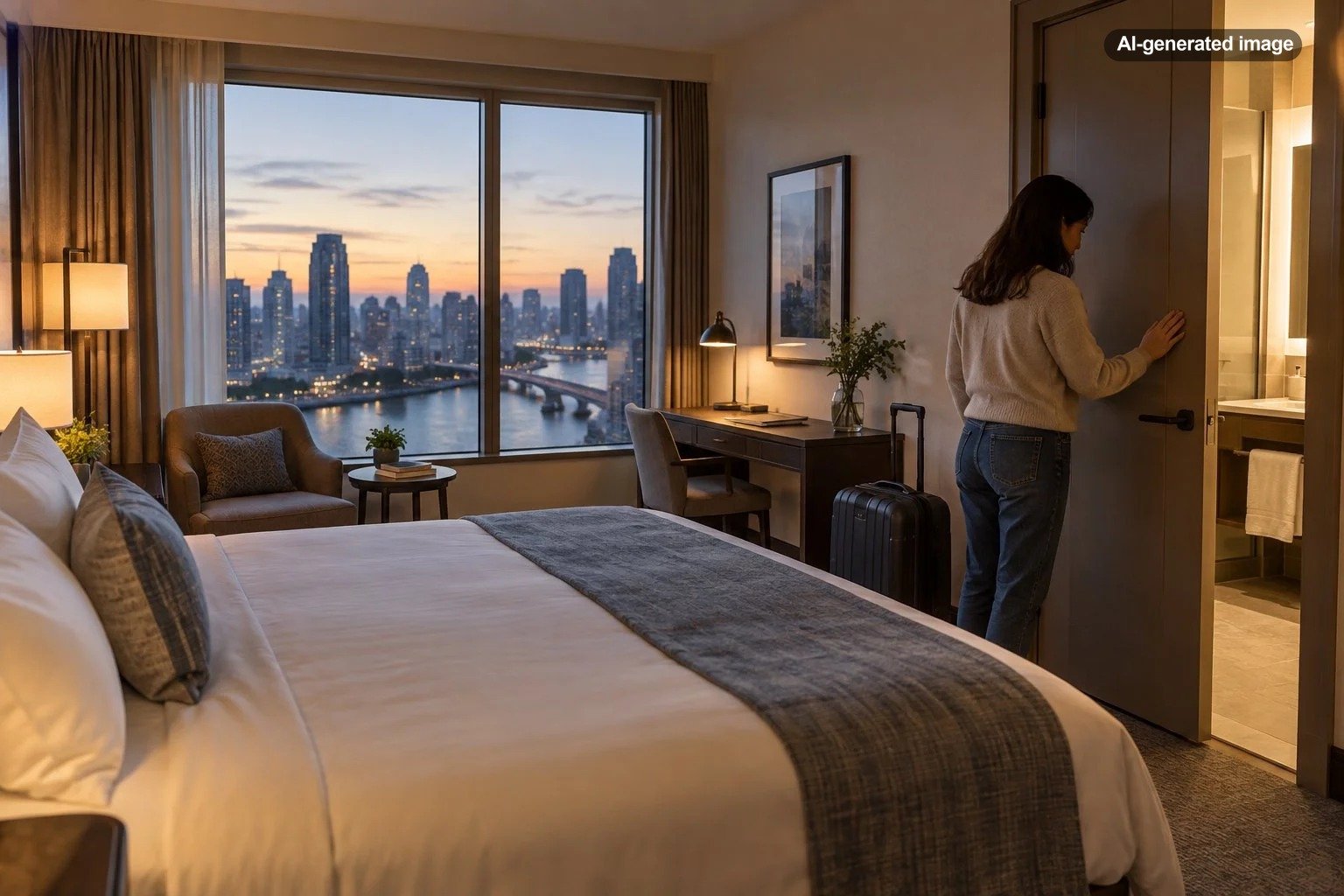
Look for an image taken from the sleeping area toward the bathroom. This angle often reveals more than a close-up photograph of the vanity or shower. You are trying to understand how the bathroom connects to the rest of the room, not simply whether the bathroom looks attractive.
A traditional hinged door is usually easy to identify because you can see a door frame, hinges, handle, and the space through which the door swings. A pocket door disappears into the wall when open. A barn-style door normally hangs from visible hardware and slides across the outside of the wall. Glass doors may be clear, tinted, patterned, or heavily frosted.
Do not assume a sliding door provides the same privacy as a hinged door
A sliding bathroom door can close the doorway while still behaving differently from a conventional door. Some sliding panels overlap the opening substantially and provide reasonable visual separation. Others sit away from the wall or leave gaps around the sides because the panel moves along an exterior track.
The important question is therefore not simply, Does the bathroom have a door? It is whether that particular door covers the opening adequately for your comfort level.
This distinction becomes especially important when roommates, coworkers, friends, parents and adult children, or other travelers who expect more privacy are sharing one room. A design that feels acceptable to a solo traveler may be uncomfortable in a shared room.
Look carefully at translucent and frosted glass
Frosted glass can prevent a clear view through a bathroom door while still allowing substantial light through it. Depending on the design and lighting, silhouettes may also be visible. This can matter at night if one traveler uses the bathroom while another is sleeping only a few feet away.
When examining photographs, notice whether the bathroom entrance faces the bed directly and whether the toilet is positioned close to that entrance. A heavily frosted door across a distant dressing area is a different arrangement from a translucent panel immediately beside the pillow.
If you are highly sensitive to light or privacy, treat phrases such as frosted glass bathroom as a reason to investigate further rather than assuming the glass behaves like a solid door.
Search reviews for the specific problem instead of reading them chronologically
Bathroom-door design often appears only in individual guest reviews, especially when it is not a feature the hotel considers important enough to describe in the official room listing. Instead of scrolling through hundreds of reviews, use any available review-search function.
Useful terms include:
- bathroom door
- barn door
- sliding door
- glass bathroom
- bathroom privacy
- no bathroom door
- door gap
- toilet privacy
Pay attention to whether multiple recent guests describe the same layout. One review may refer to an unusual room or a different category. Several similar comments about the same room type provide stronger evidence that the configuration is common.
Check traveler photos for details the official gallery may not show
Official hotel photography naturally emphasizes the room’s appearance. Traveler photographs can sometimes make the physical layout easier to understand because they are taken from everyday angles rather than carefully selected marketing positions.
A wide photograph from near the bed can reveal whether the bathroom entrance is fully exposed to the sleeping area. Another image may show the door pushed open against the wall, making its sliding mechanism obvious. Even a mirror reflection can help establish where the toilet, shower, vanity, and doorway sit relative to the beds.
Photographs are particularly useful for distinguishing three arrangements that can sound similar in a written description: a bathroom with a solid door, a bathroom with a sliding panel, and an open vanity area with only the toilet and shower enclosed.
Understand what ‘private bathroom’ does and does not tell you
The phrase private bathroom generally distinguishes an in-room bathroom from facilities shared with other rooms or guests. It should not be treated as a promise that the bathroom has a solid hinged door, a lock, full acoustic separation, or a particular degree of visual privacy.
Likewise, a room description mentioning an ensuite bathroom usually tells you where the bathroom is located, not how the entrance is designed. If door construction matters to your trip, photographs or direct confirmation are more useful than broad amenity labels.
Ask the hotel a precise question when the answer is unclear
A specific question is more likely to produce a useful answer than asking whether the room has a private bathroom. Consider asking: Does the bathroom in this exact room category have a solid door that completely covers the doorway when closed?
If you want additional detail, ask whether the door is hinged or sliding, whether it is solid or glass, whether there are visible gaps around it, and whether the toilet is behind that same door. Travelers who specifically need a locking bathroom can ask about that separately, because a door that closes does not necessarily have a lock.
When contacting the property, provide the exact room category you are considering. Different room types within the same hotel can have different bathroom layouts.
Consider who will be sharing the room
Bathroom-door design is largely a compatibility issue. A couple may be comfortable with a sliding door that would make coworkers sharing a room uncomfortable. A solo traveler may barely notice an open vanity area, while a family sharing one room may care greatly about having a solid barrier around the toilet.
Think about visual privacy, sound, light, and nighttime movement separately. A door can solve one problem without solving all four. A solid sliding door may block the view but transmit more sound than expected. Frosted glass may obscure detail while illuminating the room at night. An enclosed toilet compartment can offer excellent privacy even if the sink and shower occupy a more open layout.
What travelers often overlook
The bathroom entrance itself is only part of the room design. Before rejecting or choosing a room, consider the complete layout. A separate toilet compartment may matter more than the outer bathroom door. Conversely, a beautiful bathroom with a large glass wall may offer less privacy than the listing photographs initially suggest.
Also remember that photographs can become outdated after remodeling, and properties may contain multiple layouts within the same category. When bathroom privacy is a firm requirement rather than a preference, direct confirmation from the hotel is the strongest final check.
FAQ
Do hotel bathroom barn doors actually close?
They generally slide into a closed position, but their construction varies. Because the panel moves along a track rather than sealing inside a conventional frame, some designs may leave more space around the edges than a hinged door. Examine room photos or ask the property if that difference matters to you.
Does a private bathroom guarantee a solid door?
No. A private bathroom describes access to the bathroom, not necessarily its door style. The entrance may use a hinged door, sliding panel, glass door, or another configuration.
How can I tell whether a hotel bathroom has a glass door?
Check room-specific bathroom photographs and traveler photos. Look for reflections, visible metal or glass hardware, translucent panels, or photographs showing light passing through the entrance.
Can different rooms in the same hotel have different bathroom doors?
Yes. Room categories, accessible layouts, suites, building sections, and renovation histories can result in different configurations within one property. Verify the room type you intend to reserve.
What should I ask before booking?
Ask whether your exact room category has a solid bathroom door that completely covers the doorway when closed. If necessary, also ask whether the door locks, whether it is glass, and whether the toilet is fully enclosed behind it.
A hotel bathroom door is easy to overlook while comparing beds, views, locations, and amenities, but it can have an outsized effect on comfort in a shared room. A few minutes spent studying room photographs, searching reviews, and asking one precise question can prevent an awkward surprise after check-in.