Where Should I Stay in Los Angeles Without Spending the Whole Trip in Traffic?
The best place to stay in Los Angeles is usually the neighborhood closest to the activities that matter most to you. Los Angeles is not a compact sightseeing city with one universally convenient hotel district. Its beaches, movie studios, museums, restaurants, sports venues, and nightlife areas are spread across a large region, so choosing a hotel by reputation alone can create hours of unnecessary travel.
For a beach-focused trip, consider Santa Monica or Venice. For nightlife, restaurants, and central access to several popular districts, West Hollywood is often practical. Hollywood works well for entertainment landmarks and Metro access, while Downtown Los Angeles is a strong base for museums, sports, conventions, and rail connections. Families planning several days at Universal Studios may be better served by Universal City, Studio City, or nearby parts of the San Fernando Valley.
Quick answer
- Choose Santa Monica or Venice when the beach is the main event and you do not plan to cross the city every day.
- Choose West Hollywood for restaurants, nightlife, design districts, and a relatively central position between Hollywood and the Westside.
- Choose Hollywood for entertainment landmarks, shows, and access to Metro’s B Line.
- Choose Downtown Los Angeles for museums, sports, conventions, and the broadest collection of rail connections.
- Choose Universal City or Studio City when Universal Studios and nearby studio attractions dominate the itinerary.
Start with your itinerary, not a list of famous neighborhoods
The most effective way to reduce traffic is to mark your three or four highest-priority places on a map before booking. Group them by area and count how many mornings or evenings you expect to spend in each cluster. A hotel near the largest cluster will generally save more time than a hotel that looks geographically central but is separated from your plans by congested corridors.
For example, a traveler planning the Getty Center, Beverly Hills, Santa Monica, and restaurants in West Hollywood should usually stay on the Westside or in West Hollywood. Downtown may appear central on a regional map, but it would place most of that itinerary across town. Conversely, a visitor attending a convention, a Lakers game, and museums around Downtown would gain little from staying near the beach.
Also consider when your activities occur. A long transfer to a daytime museum may be manageable, while a long return after dinner, a concert, or a sporting event can feel far more burdensome. Staying near your evening plans often improves the trip even when it does not minimize every mile.
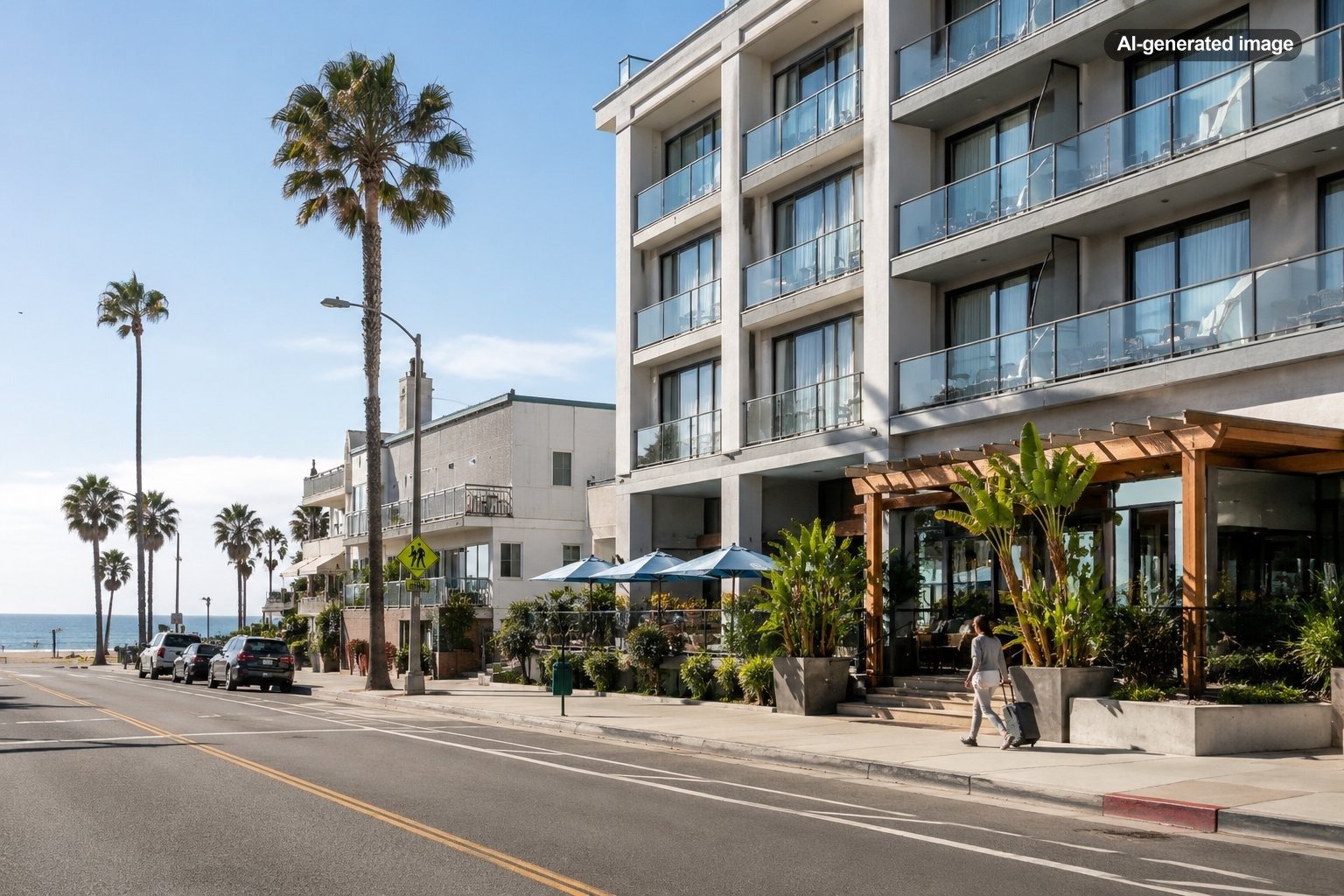
Santa Monica and Venice: best for a beach-first trip
Santa Monica is a practical base for travelers who want mornings near the ocean, a walkable concentration of restaurants and shops, and relatively easy access to neighboring Westside communities. It is particularly suitable for couples, families, and first-time visitors who prefer spending several days around the coast rather than commuting repeatedly to inland attractions.
Venice offers a more eclectic atmosphere and convenient access to the boardwalk, beach, Abbot Kinney Boulevard, and nearby Marina del Rey. It may appeal to travelers who prioritize an energetic neighborhood character over a polished resort-style setting.
The principal tradeoff is distance from Hollywood, Universal Studios, Downtown, and many Eastside neighborhoods. A beach hotel is not a traffic-avoidance solution when the daily itinerary is mostly inland. It works when travelers accept that the coast is their primary zone and treat distant attractions as one or two planned excursions.
Best for
Beach time, oceanfront walks, relaxed evenings, Westside dining, and trips with fewer cross-city sightseeing days.
Consider another area when
Your priorities include Universal Studios, Downtown sports venues, Hollywood nightlife, or frequent appointments across central and eastern Los Angeles.
West Hollywood: best for dining, nightlife, and a central compromise
West Hollywood is often one of the most useful compromises for visitors whose plans span Beverly Hills, Museum Row, Hollywood, and restaurants along the central Westside. It places travelers near a dense collection of dining, nightlife, shopping, and design destinations without committing them to the beach or Downtown.
The neighborhood is especially practical for travelers who expect to use taxis or ride-hailing services for relatively short trips. Depending on the hotel location, several restaurants and nightlife venues may also be walkable. However, West Hollywood is not directly served by Metro rail, so guests who want to rely primarily on trains may prefer Hollywood, Koreatown, or Downtown.
Another distinction is that West Hollywood and Hollywood are separate areas with different travel patterns. A hotel marketed as being near Hollywood may still be inconvenient for Sunset Strip nightlife, while a West Hollywood property may require a drive to major Hollywood Boulevard landmarks. Check the exact address rather than relying on a broad neighborhood label.
Best for
Couples, restaurant-focused trips, nightlife, shopping, Museum Row, Beverly Hills access, and travelers comfortable using ride-hailing services.
Consider another area when
You want direct rail access, daily beach time, or a hotel beside Downtown convention and sports facilities.
Hollywood: best for entertainment landmarks and rail access
Hollywood can be convenient for visitors planning the Walk of Fame, the TCL Chinese Theatre area, live entertainment, and trips to Universal Studios. Stations on Metro’s B Line connect parts of Hollywood with Universal City and Downtown, giving travelers an alternative to driving for several common itineraries.
The main caution is that Hollywood covers more territory than many visitors expect. A property near Hollywood Boulevard may offer a different experience from one near the Hollywood Bowl, Melrose Avenue, or the eastern edge of the district. Review walking routes and station proximity at the individual hotel level.
Hollywood is a useful sightseeing base, but it is not automatically convenient for the beaches. Travelers who envision daily mornings in Santa Monica followed by evenings in Hollywood may spend a substantial portion of the trip crossing the city.
Best for
First-time sightseeing, entertainment history, concerts, Universal Studios visits, and travelers who want access to Metro’s B Line.
Consider another area when
Your trip revolves around the coast, Beverly Hills shopping, or a convention in Downtown Los Angeles.
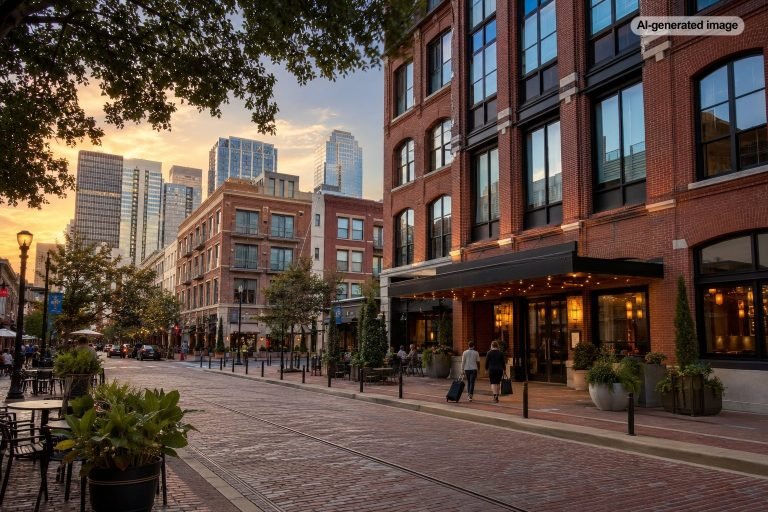
Downtown Los Angeles: best for museums, sports, conventions, and transit
Downtown Los Angeles is a logical choice for events at the Los Angeles Convention Center, games and concerts near the major sports and entertainment venues, and visits to institutions around Bunker Hill, Little Tokyo, the Arts District, and Exposition Park. It also provides access to multiple Metro rail lines and regional connections through Union Station.
This is one of the better bases for visitors who want to reduce driving and build an itinerary around transit-accessible destinations. Metro’s official rider tools provide current maps, trip planning, arrival information, and service alerts, which should be checked shortly before each journey because routes and service conditions can change.
Downtown is less appealing for travelers who imagine stepping outside their hotel and immediately experiencing the beach-oriented version of Los Angeles. It can also feel quiet in some business-oriented blocks outside normal working hours, while entertainment districts may remain active late. Examine the hotel’s immediate surroundings and the walking route to the places you plan to visit rather than judging Downtown as one uniform district.
Best for
Conventions, sporting events, museums, rail-based itineraries, business travel, and visitors attending several Downtown events.
Consider another area when
Most of your reservations are in Santa Monica, West Hollywood, Beverly Hills, or the beach cities.
Universal City and Studio City: best for theme parks and studio attractions
Families planning one or more full days at Universal Studios can reduce early-morning travel by staying in Universal City, Studio City, or a nearby part of the Valley. This is especially helpful when traveling with children, managing strollers, or returning to the hotel for a break.
Universal City has direct B Line access, allowing trips toward Hollywood and Downtown without driving. Studio City provides more of a neighborhood atmosphere, with restaurants and services along major corridors, although convenience varies significantly by exact address.
The tradeoff is that these areas are not ideal for a beach-heavy itinerary. Staying here makes sense when the theme park, studio experiences, or Valley appointments account for a large share of the schedule.
Koreatown and Mid-Wilshire: useful for central positioning
Koreatown and nearby parts of Mid-Wilshire can work well for travelers whose plans are distributed between Downtown, Hollywood, Museum Row, and central Los Angeles. Koreatown has extensive dining options and access to Metro’s D Line, while the wider Wilshire corridor can place visitors closer to museums and business districts.
These areas are better viewed as strategic bases than as substitutes for the beach. They suit travelers who value central positioning, late-night dining, and shorter trips to multiple inland neighborhoods. Parking arrangements deserve careful review because some hotels charge separately, use valet service, or have limited on-site capacity. Verify the current policy directly with the property instead of assuming parking is included.
Should you rent a car or rely on transit and ride-hailing?
A car is useful when the itinerary includes several widely separated neighborhoods, coastal drives, hiking areas, or destinations that are not close to rail. It is less useful when the hotel charges for parking and most activities are concentrated near a Metro line or within one neighborhood.
Travelers can also use a mixed approach. Stay near transit for most of the trip, use ride-hailing services for short evening journeys, and rent a car only for the day that requires it. This can reduce parking logistics without forcing every destination into a transit-only plan.
Metro publishes current rail and bus maps, real-time trip planning tools, and service alerts. The system can be particularly useful for journeys connecting Downtown, Hollywood, Universal City, Santa Monica, and other rail-served areas, but the convenience of any trip depends on the precise origin, destination, transfers, and current service.
What travelers often overlook
- The exact hotel address matters more than the neighborhood name. Two hotels promoted as being in the same area can differ considerably in walkability and transit access.
- Parking can change the real cost and convenience. Confirm whether parking is on-site, valet-only, limited, or charged separately.
- Evening plans should influence the hotel choice. Returning from a late dinner or concert across the city can be more tiring than a daytime sightseeing trip.
- Airport convenience is not the same as sightseeing convenience. An LAX-area hotel may be suitable for a late arrival or early departure but inefficient for a full week of sightseeing elsewhere.
- Moving hotels can occasionally save time. On a longer trip, splitting the stay between the beach and an inland neighborhood may be more practical than making the same cross-city journey repeatedly.
Planning your arrival from LAX
Los Angeles International Airport publishes current ground transportation information covering taxis, ride-app pickups, shuttles, rental cars, public transportation, and airport roadway conditions. Construction and pickup procedures can change, so review the airport’s official instructions shortly before arrival.
Do not choose an LAX-area hotel solely because it appears central on a map. Airport hotels are most practical for overnight connections, early departures, business near the airport, or itineraries concentrated in nearby beach communities. They are generally not the most efficient base for daily trips to Hollywood, Universal City, or Downtown.
Frequently asked questions
What is the most central neighborhood for tourists in Los Angeles?
There is no single central neighborhood for every itinerary. West Hollywood is a useful compromise for many restaurant, museum, Beverly Hills, and Hollywood plans, while Koreatown or Mid-Wilshire may work better for travelers dividing time between Downtown and central Los Angeles.
Is it better to stay in Hollywood or Santa Monica?
Choose Hollywood for entertainment landmarks, Universal Studios access, and Metro connections. Choose Santa Monica for beach time, oceanfront walks, and a trip focused on the Westside. Staying in one while visiting the other every day creates an avoidable commute.
Can I visit Los Angeles without renting a car?
Yes, particularly when the hotel and major activities are near Metro rail or concentrated in one or two neighborhoods. A combination of transit, walking, and ride-hailing is often more practical than expecting transit alone to reach every destination efficiently.
Is Downtown Los Angeles convenient for first-time visitors?
It can be, especially for museums, sports, conventions, and rail-based sightseeing. It is less convenient for travelers whose main interests are the beaches, West Hollywood nightlife, or Beverly Hills.
Should I change hotels during a Los Angeles trip?
For a trip of a week or longer, a split stay can be sensible when the itinerary has two distinct clusters, such as several beach days followed by Hollywood, Universal Studios, or Downtown activities. For a shorter trip, changing hotels may consume more time than it saves.