Can You Change Cruise Cabins After the Ship Has Sailed?
Yes, it can sometimes be possible to change cruise cabins after the ship has sailed, but travelers should treat an onboard move as an exception rather than something they can count on. Ships frequently sail with most or all cabins assigned, and individual cruise lines may restrict or decline onboard changes altogether. If another stateroom is available, Guest Services will normally be the place to ask.
The reason for the request matters. Wanting a better view is different from reporting a maintenance problem, accessibility concern, disruptive noise, or another issue affecting the usability of the cabin. In many cases, the most practical first step is not requesting a move but giving the ship’s staff an opportunity to address the underlying problem.
Quick answer
- You can ask Guest Services about changing cabins after departure.
- A move is never guaranteed because the ship may have little or no unassigned inventory.
- Some cruise lines specifically say onboard upgrades or cabin changes are unlikely or unavailable.
- If your cabin has a genuine problem, report the problem promptly rather than waiting several days.
- If another cabin is offered, ask whether there is an additional charge and whether anything associated with your original cabin changes.
Why changing cabins after departure can be difficult
A cruise ship is not quite like a large hotel where rooms may become vacant throughout a stay. Once a sailing begins, the same passengers typically occupy their assigned accommodations until the voyage ends. That leaves the ship with far less flexibility than travelers sometimes expect.
Official policies illustrate the limitation. Carnival Cruise Line states that it does not accommodate upgrade requests on the day of the cruise or onboard because its ships sail at capacity. Royal Caribbean similarly advises that changing or upgrading a room onboard is very unlikely because almost all rooms are occupied. Policies can vary by cruise line, market, ship, and sailing, so passengers should ask the cruise line about their particular situation rather than assuming a move will be possible.
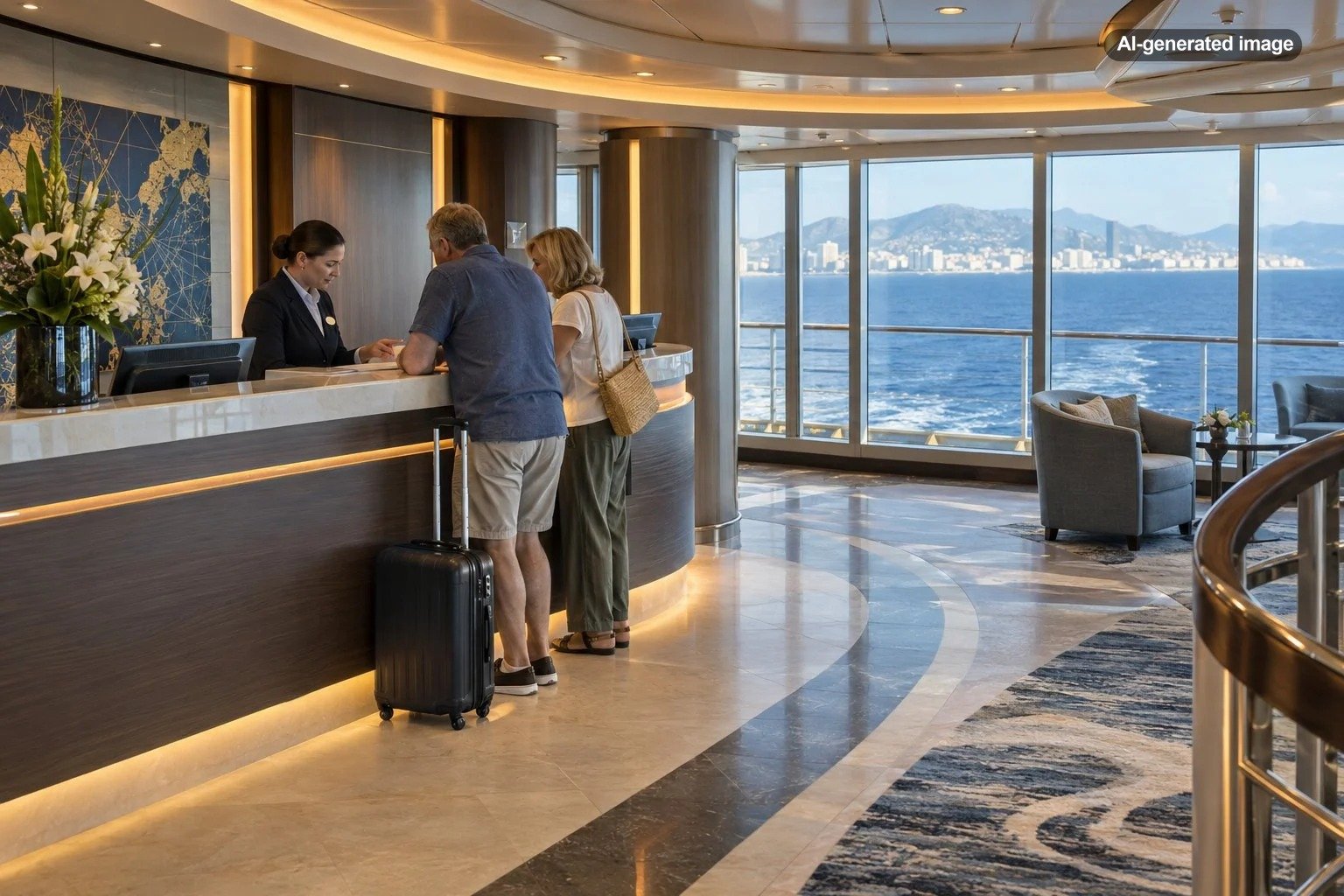
Start with Guest Services as soon as there is a problem
If you want to move because something is wrong with the cabin, contact Guest Services promptly. Waiting until late in the voyage can make the situation harder to evaluate and gives the crew less opportunity to resolve it.
Explain the specific issue rather than simply asking for a different room. For example, describe persistent mechanical noise, a plumbing problem, an unresolved temperature issue, or another condition affecting your stay. The crew may send someone to inspect or repair the problem before discussing relocation.
This distinction is important. A passenger who simply prefers another deck or location is making a discretionary request. A passenger dealing with a cabin that cannot be used as intended is raising an operational concern. Neither situation automatically guarantees a move, but the ship needs to understand what it is being asked to solve.
A cabin change and an upgrade are not necessarily the same thing
Travelers often use the terms interchangeably, but changing cabins does not necessarily mean receiving a better cabin category. A ship might theoretically have another stateroom of the same type available, while having no higher-category accommodations to offer.
If Guest Services proposes an alternative, confirm exactly what is changing. Ask about the cabin number, deck, category, bed configuration, accessibility features if applicable, occupancy limits, and whether the move creates any additional charge. Do not assume that a different cabin is automatically an upgrade.
The reverse can also matter. If solving a problem requires moving to a cabin in a different location or configuration, decide whether the practical improvement outweighs losing something you specifically selected, such as proximity to traveling companions or a preferred section of the ship.
What if the problem is noise?
Noise complaints can be particularly difficult because the source may not be something a cabin change can immediately solve. Sound might come from nearby public areas, ship operations, neighboring guests, hallway activity, or equipment. Some noise is temporary, while other sounds may recur throughout the voyage.
Report recurring noise with enough detail for the crew to investigate it. Note when it happens and where it seems to originate. If staff can identify and correct the source, staying in your original cabin may be less disruptive than repacking and moving.
If the noise cannot reasonably be addressed and another appropriate cabin is available, Guest Services can explain what alternatives, if any, exist. Availability remains the limiting factor.
What if something in the cabin is not working?
A malfunction does not automatically require relocation. Many cabin problems can be handled by housekeeping, maintenance, or another onboard department. That includes issues that appear significant at first but can be repaired relatively quickly.
Report the problem rather than attempting complicated repairs yourself. Give the crew an opportunity to inspect the issue, and follow up with Guest Services if the problem continues. If the cabin cannot be restored to a usable condition, the ship can determine what options are operationally possible.
Changing cabins when traveling with family or friends can be more complicated
Moving one cabin is easier than reorganizing several linked travel arrangements. Families may need specific sleeping capacity, while groups may have deliberately selected neighboring rooms. A replacement cabin elsewhere on the ship could solve one problem while creating another.
If proximity matters, tell Guest Services before accepting a move. Similarly, families should confirm that a proposed replacement can accommodate everyone assigned to the reservation. Cabin occupancy is controlled by the ship’s approved configuration, so an apparently larger room should not be assumed to accommodate additional passengers.
Do not assume an empty-looking cabin is available
Passengers occasionally notice a cabin that appears unoccupied and assume it could be used for a move. That is not a reliable indicator of availability. A stateroom may be assigned, reserved for operational purposes, awaiting passengers, or otherwise unavailable for reassignment.
Only the ship’s staff can determine which accommodations, if any, can actually be offered. For that reason, searching hallways for apparently empty rooms is less useful than asking Guest Services to check its inventory.
Ask about costs before agreeing to move
If an onboard change is possible, clarify whether it is complimentary or requires an additional payment. The answer may depend on why the move is occurring, which cabin becomes available, and the cruise line’s applicable terms.
Do not assume that an unoccupied higher-category stateroom will be offered free simply because the cruise is already underway. Royal Caribbean’s published booking conditions for some markets, for example, state that guests transferring to higher-priced accommodations available after sailing may be required to pay the difference. Exact rules can differ, so the onboard staff should confirm the terms before you agree.
What travelers can do before sailing to reduce the risk
The best time to solve a location preference is generally before embarkation. Review the deck plan when selecting a cabin and consider what is immediately above, below, and beside it. Travelers sensitive to noise may prefer a cabin surrounded by other passenger cabins rather than one directly under a busy public venue.
Also consider walking distance, elevator access, motion sensitivity, accessibility needs, and proximity to companions before confirming a specific stateroom. Guarantee-style bookings can provide less control over the eventual cabin assignment, depending on the cruise line’s terms.
If you discover a concern before departure, contact the cruise line or the travel advisor who manages the reservation. Pre-sailing inventory may provide options that disappear once everyone has boarded.
What travelers often overlook
Moving cabins is not just a matter of receiving another key. You may need to repack, coordinate luggage movement, update traveling companions, and learn a new route around the ship. Depending on the cruise line’s systems, staff may also need to address access credentials or other reservation details.
That makes a move worthwhile when it solves a meaningful problem, but less attractive when the issue is minor and fixable. Before relocating, ask yourself whether the new cabin actually resolves the concern and whether you understand any tradeoffs in location or configuration.
Frequently asked questions
Can I ask for a free cruise cabin upgrade after sailing?
You can ask what options exist, but a complimentary upgrade should not be expected. Some cruise lines explicitly state that onboard upgrades are unlikely or not accommodated because ships may sail at capacity.
Who should I contact if I want to change cabins onboard?
Guest Services or Guest Relations is generally the appropriate starting point. If the request involves a maintenance or housekeeping issue, that team can coordinate with the relevant department.
Should I move cabins because of a minor maintenance problem?
Not necessarily. Report the problem first. Many issues can be corrected without requiring you to pack and relocate.
Can I change cabins in the middle of a cruise?
You can request a change at any point, but whether the ship can accommodate it depends on inventory, the circumstances, and the cruise line’s policies. A request made after departure does not create an entitlement to another cabin.
Is it easier to change cabins before the cruise?
Usually, yes. Before sailing, the cruise line may have more flexibility to review available inventory and modify the reservation. Once the voyage begins, most cabins are already occupied.