How to Document a Bad Hotel Room Before Asking for a Refund
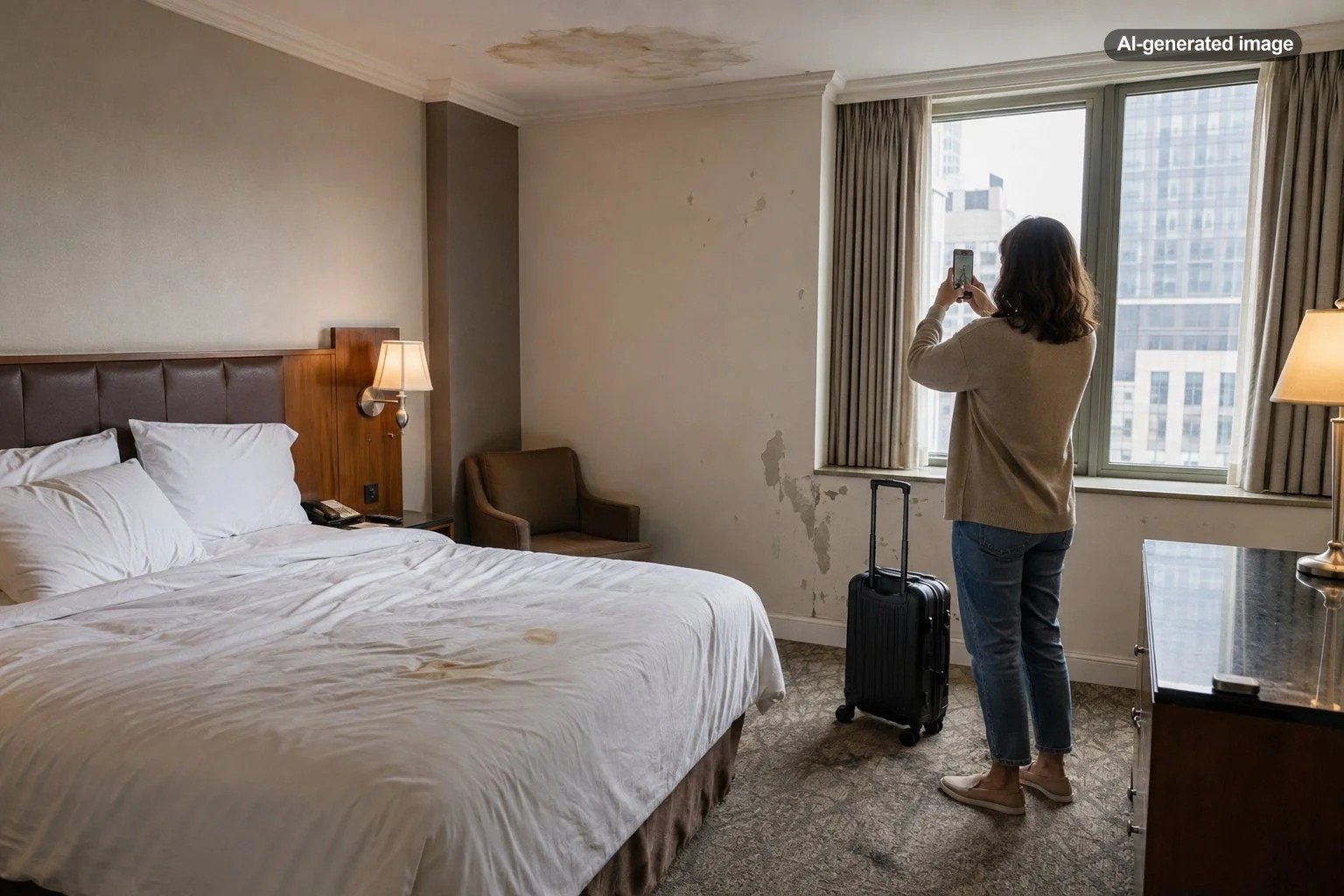
If a hotel room is dirty, damaged, unsafe to occupy, or substantially different from what was booked, document the problem before unpacking, using the room extensively, or checking out. A persuasive refund request normally needs more than a few close-up photographs: it should show what happened, when it happened, how the hotel was notified, and whether staff had a reasonable opportunity to address it.
A disappointing room does not automatically justify a full refund. Minor wear, an undesirable view, or decor that looks less appealing than promotional photography may support a request for assistance but not necessarily reimbursement. The strongest cases involve specific, observable failures that materially affected the stay, particularly when the guest reported them promptly and the proposed remedy did not resolve the problem.
Quick answer: Build a complete record before requesting money back
- Photograph the room number or another location marker, then take wide, medium, and close-up views of each problem.
- Record short videos when movement, sound, leaking water, malfunctioning equipment, or repeated disturbances cannot be shown adequately in a still image.
- Preserve the reservation confirmation, room description, rate terms, receipt, and relevant listing screenshots.
- Report the issue promptly and keep a written timeline of names, times, responses, room-change offers, and repair attempts.
- Request a specific outcome that reflects how seriously the problem affected the stay.
Start by establishing the room and the time
Begin with context. Photograph the room number from the hallway without showing other guests, followed by a wide image of the room from the entrance. If the concern is in the bathroom, take an image showing the bathroom as a whole before moving closer. This sequence connects detailed evidence to the room you were assigned and makes the scale of the problem easier to understand.
Keep the original files. Editing, cropping, adding filters, or sending only screenshots can remove useful context and file information. A phone’s date and time can help organize the record, but do not rely on metadata alone. Write the date and approximate time in a note, email, or message sent while the problem is occurring.
If you discover several issues, document each one separately. A simple file order such as room overview, bathroom overview, bathroom detail, bedding overview, and bedding detail is easier for a manager or claims reviewer to follow than an unorganized collection of nearly identical images.
Capture wide, medium, and close-up evidence
A close-up can show a stain, insect, broken latch, or damaged fixture, but it may not establish where the object was found. A wide photograph provides location; a medium view connects the problem to nearby furniture or fixtures; and a close-up records detail. Use all three when the issue is significant.
For cleanliness concerns
Photograph the affected surface before touching, cleaning, or moving it. Include enough of the bed, counter, shower, or floor to establish location. If debris or staining is difficult to see, take a second image with better lighting rather than altering the first photograph. Do not stage, enlarge, or rearrange the condition.
For maintenance failures
Use video when the problem involves sound or motion, such as a persistent alarm, a rattling unit, water entering the room, or a fixture that will not operate correctly. Begin with a wider view and move toward the source. If a control panel is relevant, show its display and the result of one reasonable attempt to use it. Avoid repeated testing if doing so could worsen damage.
For a room that differs from the reservation
Save the confirmation and the exact description visible when the reservation was made. Then photograph the assigned room’s relevant features. Distinguish a definite booking term, such as the number of beds listed in the confirmation, from a request or preference that was never guaranteed. This distinction makes the complaint more precise and credible.
Preserve what the hotel or booking channel represented
Evidence should show both the room’s condition and the basis for the guest’s expectations. Save the reservation confirmation, cancellation terms, room description, rate details, taxes and fees, and any pre-arrival messages. If a listing or policy page is relevant, capture the full page or save it as a PDF with its URL and access date visible when possible.
If the reservation was made through a third-party service, retain records from both the booking service and the property. Note which business processed the payment because the appropriate complaint path may depend on how the reservation was arranged. Do not assume that a hotel employee can immediately change a charge collected by another company.
Notify the hotel while it can still investigate
Report the problem as soon as practical. State the room number, describe the specific condition, explain its effect, and ask what the hotel can do. A concise report is more useful than a general statement that the room is unacceptable.
For example: At approximately 9:15 p.m., I found water spreading from beneath the bathroom sink into the entry area. I have stopped using the sink and taken photographs. Could someone inspect it, or could I be moved to another room?
Write down the employee’s name or department, the time of the conversation, and the response. If the report is made by phone or in person, send a brief follow-up through email, text, or the hotel’s messaging system. Save chat transcripts and photograph any confirmation screen before closing it. The Federal Trade Commission’s consumer guidance similarly recommends collecting transaction documents, explaining the problem clearly, identifying the requested resolution, and keeping notes about communications.
Document the remedy, not just the original problem
A complete record includes what happened after the complaint. If staff inspect the room, note when they arrived and what they did. If the hotel offers another room, inspect it promptly and document any reason it does or does not solve the problem. If a repair works, record the completion time and how much of the stay was disrupted.
Refusing a reasonable room change without explanation can weaken a later argument that the entire stay was unusable. Conversely, a room change at midnight after hours of waiting may not fully address the disruption. Record the sequence factually and avoid exaggeration.
Match the refund request to the actual impact
Ask for a specific resolution after organizing the evidence. A full refund may be appropriate to request when the room could not reasonably be used and the hotel failed to provide a workable alternative. A partial refund, removal of a particular charge, or adjustment for an affected night may be more proportionate when the problem was limited in duration or scope.
Use a short chronology: what was booked, what was found, when it was reported, what remedy was offered, and how the stay was affected. Attach the strongest images rather than overwhelming the recipient with duplicates, while retaining all original files. Set a reasonable date for a response and keep copies of everything submitted.
What travelers often overlook
- Privacy: Avoid photographing employees or other guests unnecessarily. Do not publish documents that reveal reservation numbers, addresses, payment details, or identification.
- Personal property: Keep luggage and belongings out of evidence photographs when possible so the original room condition remains clear.
- Independent costs: Save receipts for necessary expenses caused by the problem, but do not assume every related purchase will be reimbursed.
- Checkout records: Ask for an itemized folio and save any written promise of an adjustment. A verbal assurance does not show whether the final bill was corrected.
- Public reviews: Keep the refund request focused on facts. Threatening a negative review can distract from the documented problem and the requested remedy.
If the hotel does not resolve the complaint
Escalate through the property’s manager, the hotel company’s guest-relations channel when applicable, or the booking service used for the reservation. Submit the same organized timeline and indicate which earlier contacts did not resolve the matter.
If a credit card charge remains disputed, contact the card issuer promptly and follow its instructions. Deadlines and procedures can matter. In the United States, the Consumer Financial Protection Bureau’s billing-dispute guidance explains federal notice requirements for certain credit card billing errors and recommends keeping copies and records of follow-up calls. Whether a particular hotel complaint qualifies depends on the facts, payment method, and applicable rules, so a charge dispute should not be treated as a guaranteed refund.
Frequently asked questions
Should I take photographs before calling the front desk?
Take enough photographs to preserve a condition that could change quickly, then report it promptly. For an ongoing leak or another situation that could cause further damage, notify the hotel immediately and avoid unnecessary delay for extensive documentation.
Is a time-stamped video enough?
Video can be valuable, but it is stronger when paired with the reservation records, room context, a written timeline, and evidence that the hotel was notified. No single file proves every part of a complaint.
What if the hotel fixes the problem?
Document when the repair was completed and how the issue affected the stay before that point. A successful repair may change the reasonable scope of a refund request, but it does not erase a substantial earlier disruption.
Should I leave the room before speaking with management?
If remaining in the room appears to present an immediate risk, prioritize personal well-being and move to an appropriate location before continuing the complaint. Otherwise, reporting the issue while the hotel can inspect it usually creates a clearer record and gives staff an opportunity to offer a remedy.