Why Some Hotel Bathrooms Have Almost No Counter Space
Some hotel bathrooms look beautifully designed until you try to put down a toothbrush, makeup bag, shaving kit, or contact lens case. The sink occupies nearly every available inch, the mirror stretches across the wall, and there is nowhere dry or stable to arrange everyday toiletries. This frustrating layout is surprisingly common in compact hotel rooms, including some properties that otherwise feel distinctly upscale.
The main reason some hotel bathrooms have almost no counter space is that designers prioritize limited floor space, fixture placement, visual simplicity, and sometimes easier maintenance over the amount of surface available for guests’ belongings. A narrow basin or wall-mounted sink can make a small bathroom feel more open, but it may leave travelers without a practical place to get ready.
Quick Answer: Why Is Hotel Bathroom Counter Space So Limited?
- Small bathroom footprints: The toilet, shower, sink, and doorway must fit into a limited area, often leaving little room for a traditional vanity.
- Minimalist design: A sculptural sink or slim floating basin may be chosen for its clean appearance rather than its storage capacity.
- Circulation and clearance: Reducing vanity depth can leave more room for guests to move around the bathroom.
- Renovation constraints: Existing plumbing locations and bathroom walls can limit the size of a replacement sink or counter.
- Operational considerations: Certain compact fixtures and uncluttered surfaces may simplify parts of the cleaning process, although actual maintenance requirements depend on the design.
These decisions are understandable from a space-planning perspective. The inconvenience becomes apparent when a guest needs room for several products rather than simply a sink for washing hands.
Small Bathrooms Force Designers to Make Tradeoffs
A hotel bathroom must accommodate several fixed elements that cannot be rearranged as easily as bedroom furniture. The toilet needs usable space around it, the shower requires an appropriate enclosure or wet-room arrangement, and guests need sufficient room to enter, turn, and use the fixtures.
In a compact bathroom, a deep vanity cabinet can project too far into the available walking area. Replacing it with a shallow basin may improve the feeling of openness and reduce awkward movement around the sink.
The tradeoff is that the space saved often comes directly from the countertop. A guest may be able to move around the room more comfortably but have nowhere to place a toiletry bag.
This is particularly noticeable when two people share a bathroom. A single narrow shelf might accommodate one toothbrush and a small bottle, but it becomes impractical when both travelers need room for their belongings.
Minimalist Hotel Bathroom Design Can Sacrifice Function
Contemporary hotel bathrooms frequently emphasize uninterrupted surfaces, large mirrors, floating fixtures, and simple materials. These choices can make a compact room appear more spacious and visually organized.
However, a sink that looks striking in a promotional photograph may offer very little practical workspace.
Vessel Sinks Can Consume the Entire Vanity
A vessel sink sits above the surrounding surface rather than being mounted underneath it. This arrangement can create a distinctive architectural focal point, especially when the basin is made from stone, ceramic, or another decorative material.
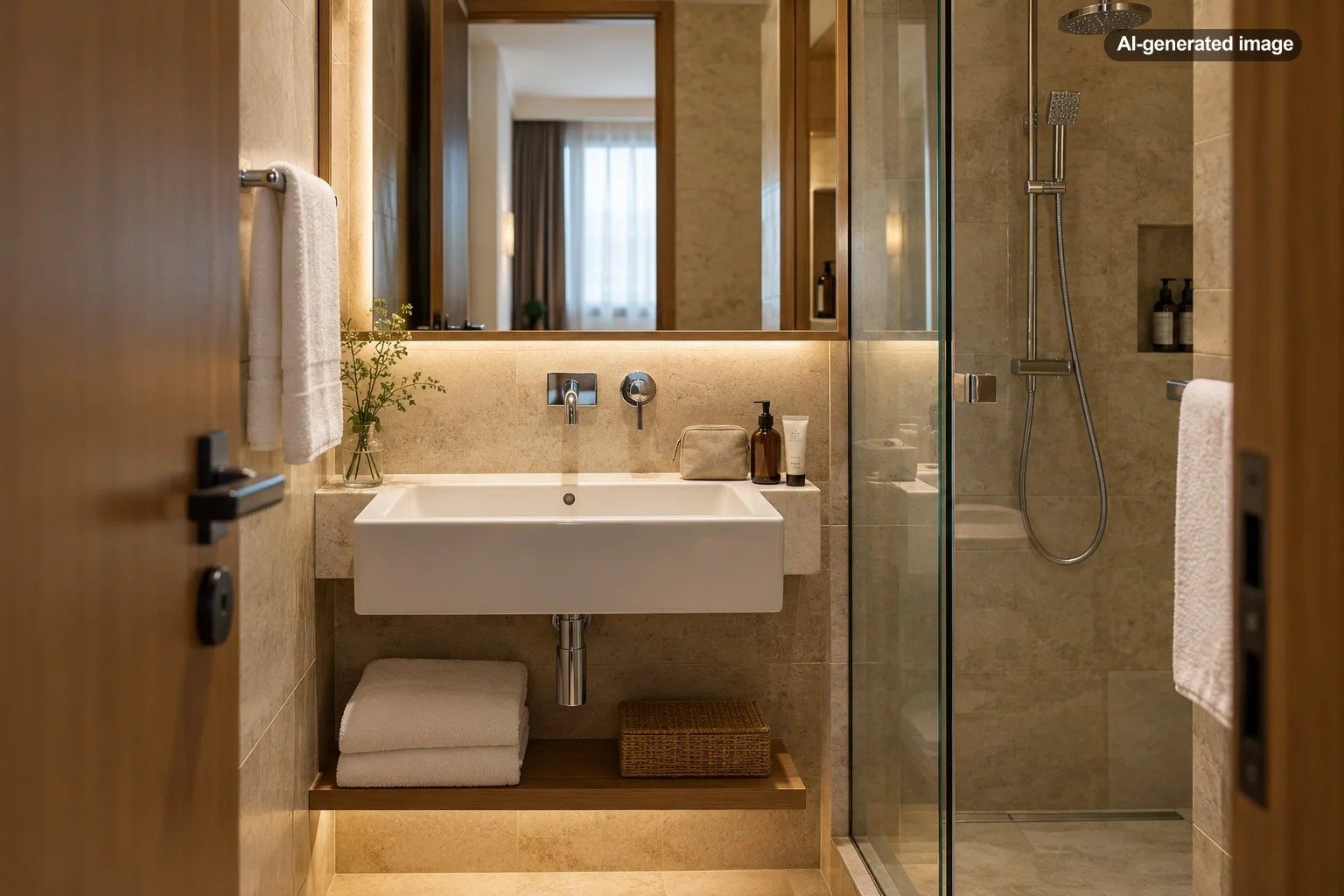
The problem arises when a large basin is installed on a narrow slab. Although the design technically includes a countertop, much of that surface may be occupied by the sink itself.
A wide vessel basin surrounded by only a thin border is substantially less useful for storing toiletries than an undermount basin with a generous landing area beside it.
Wall-Mounted Sinks Leave the Floor Open
Wall-mounted sinks can be useful in bathrooms where a full vanity cabinet would feel bulky. With the floor visible beneath the fixture, the room may appear less crowded.
Some wall-mounted designs provide a small ledge behind or beside the faucet. Others offer almost no usable surface at all.
For a traveler carrying several personal-care products, the distinction matters much more than whether the sink itself looks modern.
Why Renovated Hotels May Still Have Tiny Vanities
A hotel renovation does not necessarily involve moving bathroom walls or relocating major plumbing connections. Doing so can add substantial complexity to a project, especially when similar changes would need to be repeated across many guestrooms.
Instead, a property may replace an older sink with a contemporary fixture that fits the existing plumbing location and available wall space.
This can create a bathroom that looks freshly updated without meaningfully increasing its functional storage.
In some cases, a renovation may even reduce usable countertop space if a conventional vanity is replaced with a smaller architectural basin.
That does not mean every newly renovated bathroom will be less practical. It means that renovation status alone is not a reliable indicator of counter space, storage, or everyday convenience.
Does Less Counter Space Make Hotel Bathrooms Easier to Clean?
Cleaning and maintenance can influence fixture choices, although it would be inaccurate to assume that every small hotel vanity was selected primarily to reduce housekeeping work.
An open sink design may eliminate cabinet doors, drawer fronts, or some additional surfaces that otherwise require attention. Wall-mounted fixtures can also make portions of the floor easier to reach.
However, minimalism does not automatically translate into simpler maintenance. Vessel sinks can have awkward edges, narrow gaps may be difficult to wipe, and exposed plumbing can require careful cleaning.
There is also a practical guest-experience issue: when a bathroom offers almost no storage, travelers may distribute their toiletries across windowsills, towel shelves, or other surfaces that were not designed for that purpose.
A well-designed vanity balances maintenance access with enough room for guests to use the bathroom normally.
Does a Luxury Hotel Guarantee More Bathroom Counter Space?
No. A luxury designation, high room rate, or sophisticated bathroom finish does not guarantee generous countertop space.
Some upscale hotels devote substantial attention to material quality, lighting, fixtures, and architectural presentation while still using compact sink arrangements.
A dramatic freestanding basin might fit the property’s design identity but be less useful than a conventional vanity in a modestly priced hotel.
Similarly, a boutique hotel in an older urban building may have unusual bathroom proportions that limit available surfaces. The property may compensate with attractive finishes and carefully considered lighting, but those features do not replace a countertop.
Travelers who prioritize bathroom functionality should judge the actual layout rather than relying on the property’s overall market position.
How to Spot a Hotel Bathroom With Almost No Counter Space Before Booking
The most effective way to avoid a frustrating bathroom layout is to inspect photographs of the specific room category rather than judging the hotel solely by its general image gallery.
Hotel bathroom photographs often emphasize mirrors, lighting, tile, and attractive fixtures. A wide-angle composition may make a small vanity look more generous than it would feel in daily use.
Look for Space Beside the Sink
Identify the actual horizontal area available around the basin. A broad vanity with an undermount sink may offer space for several items, while a narrow floating shelf with a large bowl may provide almost none.
Do not count the interior of the sink, a sloped basin rim, or a narrow decorative edge as practical storage.
Check for Shelves and Drawers
A bathroom does not necessarily need a large counter if it has suitable alternative storage.
Look for recessed shelves, cabinets, drawers, or dedicated spaces for towels and toiletries. A shelf above the toilet may help with storage, although it is less convenient for items that need to be accessible while using the sink.
Also consider whether the visible storage will already be occupied by the hotel’s towels or amenities.
Find Photos of the Exact Room Type
Bathrooms can differ between room categories within the same hotel. Corner rooms, accessible rooms, suites, and standard guestrooms may have different dimensions and sink layouts.
A beautiful bathroom shown in a suite photograph should not be treated as proof that a standard room has the same vanity.
Where available, compare official room photographs with recent traveler images and reviews. Pay particular attention to comments about toiletries, bathroom storage, sink size, and space for two people.
Ask a Specific Question
Instead of asking whether the bathroom is spacious, ask whether the room category has a vanity counter large enough for a toiletry bag, or whether it includes drawers or bathroom shelves.
A specific question is more likely to produce a useful answer than a general request for a large bathroom. Because layouts can vary, it is worth confirming the exact room arrangement before relying on the response.
What to Do When Your Hotel Bathroom Has No Counter Space
If you arrive to find a sink with almost nowhere to put your belongings, a few adjustments can make the bathroom more manageable without creating clutter or risking damage.
- Unpack only what you need: Keep the bulk of your toiletries in a travel organizer and take out individual items as required.
- Use an existing dry shelf: A stable shelf or cabinet can hold lightweight products if it is intended for storage and does not interfere with hotel amenities.
- Keep electronics away from water: Do not balance hair tools, chargers, or electrical devices on the sink rim or near splashing water.
- Use a waterproof toiletry bag: A bag with a stable base can help keep products contained when there is very little dry surface available.
- Separate shared toiletries: If two people are traveling together, divide personal items into separate pouches to reduce congestion around the sink.
- Ask about alternative rooms: If the layout creates a significant practical problem, reception may be able to explain whether another room category has a different bathroom design.
A hanging toiletry organizer may also help if the bathroom has a suitable existing hook or rail. Avoid overloading towel bars, shower fittings, or other fixtures, and do not attach organizers in ways that might damage walls or finishes.
For longer stays, keeping the bathroom free from loose containers is often more useful than trying to arrange every product around a tiny basin.
When a Vacation Rental May Offer a More Practical Bathroom
Travelers staying for several nights, sharing a room, or carrying substantial skincare and grooming supplies may want to compare conventional hotel rooms with larger accommodations.
Some vacation rentals and multiroom accommodations have residential-style bathrooms with vanity cabinets, drawers, and more space for personal belongings. Others have equally compact bathrooms, so the property type alone is not a guarantee.
When comparing lodging, prioritize photographs of the actual bathroom, the number of people sharing it, and the availability of usable surfaces. A larger overall floor plan does not necessarily mean the bathroom has a better layout.
Affiliate disclosure: HotelInfo.com may earn a commission when you book or purchase through links on this page. This does not affect the price you pay. Learn more.
For travelers considering an alternative to a conventional hotel room, it may be worth taking time to browse Homes & Villas by Marriott Bonvoy and examine the bathroom layouts shown in individual listings. Amenities, bathroom dimensions, prices, fees, and property conditions vary, so review the specific accommodation rather than assuming additional space is included.
What Travelers Often Overlook About Hotel Bathroom Storage
Countertop width is only one part of bathroom functionality. A large-looking vanity can still be inconvenient if the sink is centered in a way that leaves two narrow strips instead of one useful landing area.
Likewise, a relatively small vanity may work well if the sink is offset to one side, creating enough uninterrupted surface for a toiletry bag.
Another overlooked detail is the location of power outlets. A broad counter is less useful for grooming if it is far from the appropriate outlet or if the layout encourages cords to cross wet areas.
Mirror placement, lighting, towel hooks, drawer access, and usable shelf height also affect how comfortably the bathroom works.
Travelers should consider the relationship between these features rather than evaluating each one independently.
For example, a couple preparing for an evening out might prefer a bathroom with one reasonably wide vanity and well-positioned lighting over a visually impressive double-sink arrangement with almost no surface between the basins.
Someone traveling alone for one night may barely notice a compact sink. A traveler staying for two weeks, applying several skincare products daily, or managing contact lenses may find the same layout inconvenient.
Frequently Asked Questions
Why do expensive hotels sometimes have tiny bathroom sinks?
Expensive hotels may prioritize architectural design, finishes, or efficient use of limited space. A property’s price level does not necessarily reflect the size of its bathroom vanity. In compact or unusually shaped buildings, even upscale rooms may have little available counter space.
Are floating hotel sinks better than traditional vanities?
Floating sinks can preserve visible floor space and make a compact bathroom feel more open. Traditional vanities usually offer more storage when they include cabinets, drawers, or usable surrounding counter space. The better option depends on the bathroom dimensions and the guest’s needs.
Can you request a hotel room with more bathroom counter space?
Yes. You can ask the hotel whether another room category has a larger vanity or additional bathroom storage. However, such a request does not guarantee that a different layout is available. It is best to ask before booking when bathroom functionality is particularly important.
Does an accessible hotel bathroom have more counter space?
Not necessarily. Accessible bathroom designs must address applicable access and clearance requirements, which can affect the sink configuration and storage arrangement. Some have generous surrounding surfaces, while others use compact wall-mounted or open-underneath designs. Counter space should be checked separately from accessibility features.
How can you tell whether a hotel bathroom is practical from photographs?
Look for uninterrupted counter space beside the basin, reachable shelves, drawers, hooks, suitable lighting, and a usable area around the sink. Review multiple photographs of the specific room category and check recent guest feedback for references to bathroom storage.
The Most Useful Hotel Bathroom Is Not Always the Largest
Hotel bathrooms with almost no counter space usually reflect a combination of constrained layouts, fixture choices, renovation limitations, and design priorities. A streamlined sink may help a room look larger, but it can create unnecessary inconvenience when there is nowhere to put ordinary personal items.
The most functional bathroom is not necessarily the one with the most expensive materials or the widest mirror. It is the one that provides enough room to move comfortably, use the sink, access essentials, and keep belongings dry and organized.
Before booking, a careful look at the vanity and storage arrangements can reveal more about everyday comfort than the overall bathroom photograph. A few inches of genuinely usable counter space may make a greater difference to a stay than a dramatic basin or an elaborate wall finish.