Why Do Some Hotel Room Thermostats Have a Limited Temperature Range?
Some hotel room thermostats have a limited temperature range because the property’s heating and cooling system is configured to balance guest comfort, energy consumption, equipment performance, and building operations. Rather than allowing unlimited temperature adjustments, the thermostat may accept settings only within a predetermined range. These limits are often intentional, although the precise reasons vary between properties.
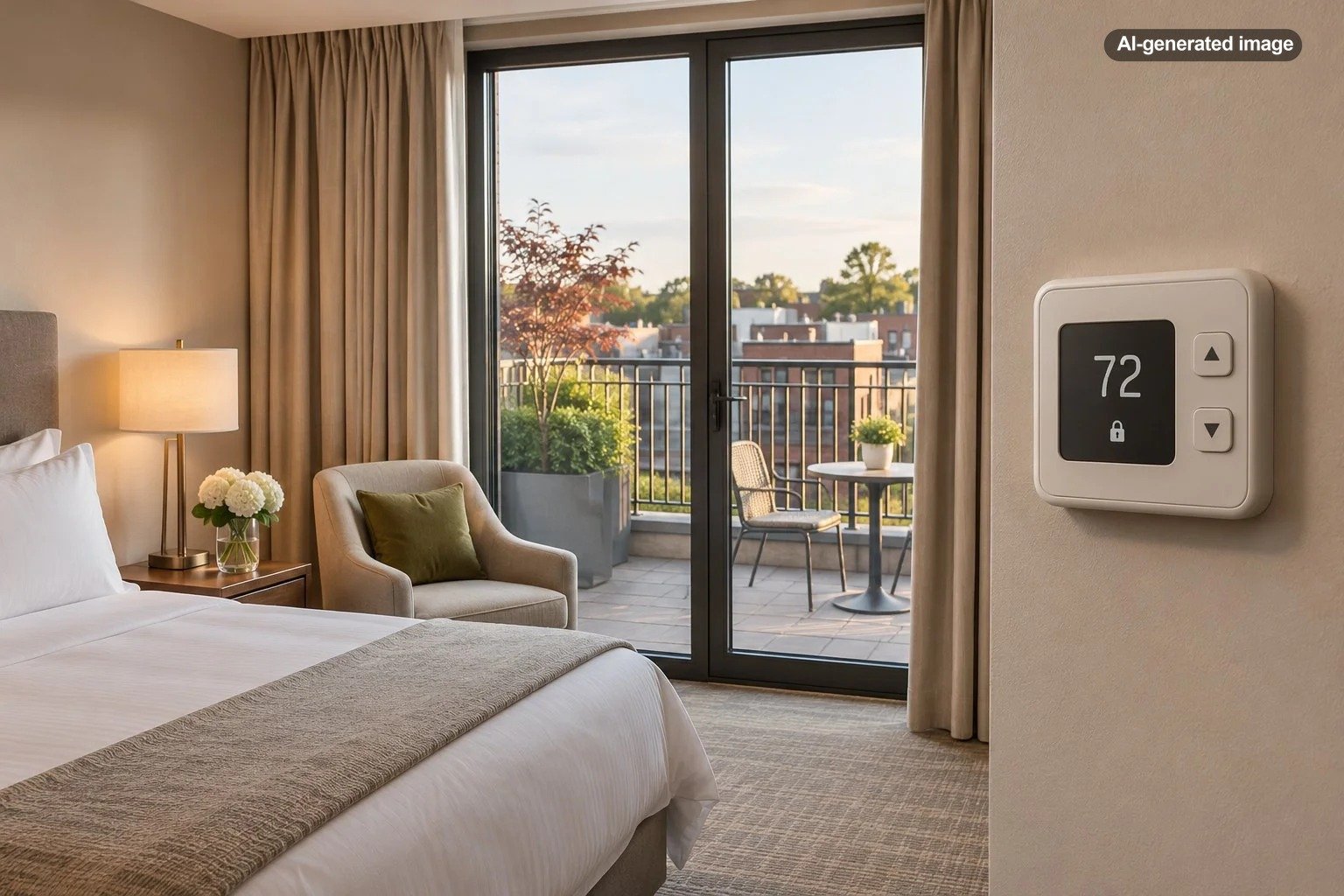
A guest might discover that the thermostat will not go below 68 degrees Fahrenheit, cannot be raised beyond a certain point, or automatically returns to an earlier setting. Those behaviors can have different explanations. Understanding the distinction between a programmed temperature limit, an occupancy-based adjustment, and an actual equipment problem helps travelers determine whether the room is functioning as intended.
Quick Answer: Why Hotel Thermostats Have Temperature Limits
- Energy management: Hotels may restrict extreme heating and cooling settings to reduce unnecessary energy consumption.
- Equipment protection: Operating boundaries can help prevent inefficient or inappropriate demands on certain HVAC systems.
- Centralized controls: Some properties manage guest room temperature settings through a building-wide control system.
- Occupancy detection: Sensors may temporarily adjust heating or cooling when a room appears vacant.
- Humidity and building conditions: Temperature controls sometimes operate alongside moisture-management and ventilation strategies.
A limited thermostat range does not automatically indicate a defective unit or poor hotel maintenance. However, a room that cannot achieve a reasonable level of comfort deserves attention, regardless of how the thermostat has been programmed.
Energy Efficiency Is a Major Reason for Temperature Restrictions
Heating and cooling represent substantial operating considerations for hotels, particularly properties with hundreds of rooms. A small change in the temperature requested in each occupied room can influence the amount of time equipment operates and the demand placed on central systems.
Extreme thermostat settings can also create unnecessary consumption when guests expect faster results from selecting the lowest or highest available number. Setting a thermostat to 60 degrees generally does not make a conventional cooling system chill the room faster than selecting 70 degrees. Instead, it usually instructs the system to continue cooling until the lower target is reached, assuming the equipment can achieve it.
Hotels may establish an adjustable comfort range that accommodates ordinary preferences without permitting unusually aggressive settings. The exact boundaries depend on the property, climate, equipment, and management decisions. There is no single minimum or maximum temperature universally used by hotels.
For travelers, the important distinction is between reducing energy waste and sacrificing reasonable comfort. An efficiently operated hotel should still have a practical way to address rooms that remain uncomfortable within the available settings.
Some Thermostats Are Connected to a Central Building System
A hotel thermostat is not necessarily an independent controller operating like the device in a private home. In many properties, guest room controls interact with a building management system or a dedicated hospitality energy management platform.
These systems may allow hotel personnel to configure temperature boundaries, monitor equipment performance, apply energy-saving schedules, or coordinate heating and cooling according to room occupancy.
A thermostat displaying a selected temperature may therefore operate within additional limits established elsewhere in the system. Certain adjustments might be unavailable to guests even when the equipment itself is technically capable of producing a wider temperature range.
Room-Level Equipment Versus Centralized Heating and Cooling
Different hotel buildings use different HVAC arrangements. Some rooms have individual packaged heating and cooling units, while others use fan coil systems, variable refrigerant flow equipment, or centrally supplied heating and cooling.
In an individually controlled room, the thermostat may directly influence the operation of its dedicated equipment. With centralized systems, room controls may regulate airflow, valves, or local equipment while relying on heating or cooling supplied elsewhere in the building.
This distinction matters when a guest changes a setting but notices little response. The issue could involve a programmed restriction, insufficient heating or cooling capacity, a seasonal operating mode, or equipment that requires maintenance.
Why the Thermostat Sometimes Changes the Temperature Automatically
One of the more confusing hotel experiences occurs when a thermostat appears to accept a temperature setting but later changes it without guest input.
Some hotels use occupancy-based energy management. These systems can combine motion sensors, door contacts, keycard information, and room-status data to determine whether heating or cooling should remain at the guest’s selected setting.
When a room is considered unoccupied, the system may allow the indoor temperature to drift away from the normal comfort target. Cooling might begin again at a warmer threshold, while heating might activate at a cooler threshold. When occupancy is detected, the system can return to its occupied operating mode.
Industry energy standards recognize different operating modes for occupied, rented-but-unoccupied, and unrented guest rooms. The exact requirements and configurations depend on the applicable standard, building, and jurisdiction.
Why Occupancy Sensors Can Be Frustrating at Night
Occupancy detection does not always work perfectly. A guest reading quietly, sitting still for an extended period, or sleeping may generate little movement for a motion-based sensor to detect.
Well-designed systems account for expected guest behavior, but detection methods and configurations differ. An improperly configured or malfunctioning system may treat an occupied room as vacant, causing an unwelcome temperature change.
If the room repeatedly becomes warmer or cooler while someone is sleeping, explain the pattern to the front desk. Staff may be able to inspect the sensor, correct the configuration, or arrange another solution. Guests should not assume that every automatic adjustment is an unavoidable hotel policy.
Temperature Limits Can Also Protect Equipment and Building Conditions
Hotel heating and cooling systems are designed to operate within particular performance conditions. A thermostat setting that demands excessive heating or cooling may keep equipment running for extended periods without producing a meaningful improvement in comfort.
Temperature boundaries can be part of a broader strategy for coordinating equipment capacity, maintaining stable room conditions, and reducing unnecessary mechanical operation.
Humidity is another consideration, especially in warm and humid destinations. Maintaining appropriate indoor moisture conditions may require cooling or dehumidification even when a room is unoccupied. Conversely, turning cooling equipment off for extended periods can create undesirable indoor conditions in certain climates.
These considerations do not justify every restrictive setting. A functioning system should balance energy conservation with appropriate temperature and moisture control, rather than relying exclusively on rigid numerical limits.
Why the Temperature on the Display May Not Match How the Room Feels
A thermostat’s displayed number is not necessarily a reliable representation of the temperature everywhere in the room. In particular, travelers should distinguish between a selected target temperature and a measured room temperature.
A display reading 70 degrees may indicate the requested setting rather than the current conditions. Even when the display measures air temperature, its sensor samples conditions at a particular location.
Several room characteristics can affect perceived comfort:
- Sun exposure: Large windows can increase radiant heat and make areas near the glass feel warmer.
- Airflow: A poorly positioned vent may leave one part of the room noticeably warmer or cooler.
- Humidity: Damp air can make a moderately warm room feel less comfortable.
- Bedding: Heavy comforters can make sleeping conditions feel warmer than the measured room temperature suggests.
- Sensor placement: A thermostat near a heat source, draft, or poorly ventilated wall may not reflect conditions near the bed.
For example, a room set to 72 degrees might still feel uncomfortably warm near a large sun-facing window. Lowering the thermostat may offer limited relief if solar heat or uneven air circulation is the main problem.
What to Do When a Hotel Room Will Not Get Cool or Warm Enough
When the available temperature range does not provide adequate comfort, a few straightforward checks can help distinguish a simple setting issue from a problem requiring hotel assistance.
Check the Operating Mode
Confirm whether the thermostat is set to cooling, heating, or an automatic mode, if those choices are available. A system operating in fan-only mode may circulate air without actively changing its temperature.
Also check whether the display indicates the current room temperature or the desired setting. That difference can explain why the number appears unchanged despite the equipment operating.
Allow Time for a Reasonable Adjustment
Large guest rooms, unusually hot outdoor conditions, and systems recovering from an energy-saving setback may require some time to approach a newly selected temperature.
Repeatedly lowering the target does not necessarily accelerate cooling. Choose a comfortable setting and observe whether the actual room conditions improve.
Check Obvious Airflow Issues
Ensure that luggage, curtains, or furniture are not obstructing accessible supply or return vents. Close exterior windows or balcony doors when appropriate, since some properties use door or window contacts that interrupt cooling when an opening is detected.
Avoid opening equipment covers or attempting electrical or mechanical adjustments. Those tasks belong to qualified hotel personnel.
Contact the Front Desk With a Specific Description
Rather than simply reporting that the thermostat is locked, describe what is happening. For example, explain that the room remains noticeably warm despite being set to the lowest permitted temperature, or that the setting changes during the night.
Ask whether the restriction is intentional and whether engineering or maintenance staff can check the equipment. Depending on the property and circumstances, possible solutions might include a permitted adjustment, a repair, or a room change.
What Travelers Often Overlook Before Booking
Hotel listings commonly mention air conditioning or climate control without explaining the degree of guest control. Those descriptions do not necessarily establish that a traveler can select any temperature or maintain the same setting throughout the night.
For travelers who are particularly sensitive to heat or cold, the distinction may be important. This includes people visiting during unusually hot weather, travelers working remotely from their rooms for long periods, and guests whose sleep is easily disturbed by temperature changes.
Before booking, consider contacting the property directly to ask whether guests can adjust both heating and cooling, whether the controls use occupancy-based setbacks, and whether staff can assist if the available settings do not provide adequate comfort.
Travelers considering vacation rentals or apartment-style accommodations should ask similar questions rather than assuming that a residential-style thermostat provides unrestricted control. Equipment configuration and house rules can differ substantially between properties.
Recent reviews mentioning weak air conditioning, nighttime temperature changes, or unresponsive thermostats may provide useful context. However, a single complaint should not be treated as proof of a permanent property-wide problem. Equipment can be repaired, and experiences can differ between rooms.
Frequently Asked Questions About Hotel Thermostats
Why will my hotel thermostat not go below 68 degrees?
The hotel may have programmed a minimum cooling setpoint, or the thermostat may be operating within a centrally managed range. The specific lower limit is a property configuration, not a universal hotel standard. If the room remains uncomfortable, ask staff to check the system.
Can hotel staff adjust a thermostat’s temperature limits?
Sometimes. Authorized personnel may have access to configuration settings or centralized management controls. Whether adjustments are possible depends on the thermostat, HVAC equipment, property policies, and any applicable operating requirements.
Why does my hotel room become hot while I am sleeping?
Possible causes include an occupancy sensor incorrectly registering vacancy, a programmed setback, inadequate cooling, or ordinary variations in room conditions. Report the timing and symptoms so staff can identify the cause rather than assuming that the thermostat is intentionally restricting nighttime cooling.
Does setting a hotel thermostat to its lowest temperature cool the room faster?
Usually not with conventional thermostat-controlled cooling. The setting generally determines the target temperature rather than increasing the equipment’s cooling capacity. Some systems use more complex control logic, but selecting an extreme target is not a dependable way to achieve faster cooling.
Are limited hotel thermostat ranges required by law?
There is no universal rule requiring every hotel to impose the same guest-adjustable temperature range. Energy codes and standards may require automatic temperature management in certain buildings, while the specific guest-facing limits can also reflect property operating decisions. Applicable requirements vary by location, building type, and adopted code edition.
The Bottom Line on Hotel Temperature Controls
Hotel room thermostats often have limited temperature ranges because they are components of larger systems designed to manage energy use, equipment operation, and indoor comfort. Occupancy sensors and centralized controls can introduce additional behaviors that are not immediately obvious to guests.
The most useful question is not simply how low or high the displayed number can go, but whether the room can maintain comfortable conditions during actual use. When it cannot, guests have a reasonable basis to request an equipment check or another practical accommodation. A programmed limit may be normal; persistent discomfort should not be dismissed as inevitable.
Sources & Further Reading
- ASHRAE Handbook: HVAC Applications, Chapter 7, Hospitality – Technical discussion of hotel guest room heating, cooling, humidity, and comfort considerations.
- ASHRAE Standard 90.1-2022, Addendum cy – Published provisions addressing hotel guest room temperature control modes and HVAC operation.
- Energize Connecticut: Guest Room Energy Management Systems – Technical description of occupancy-based hotel room temperature management and setback strategies.