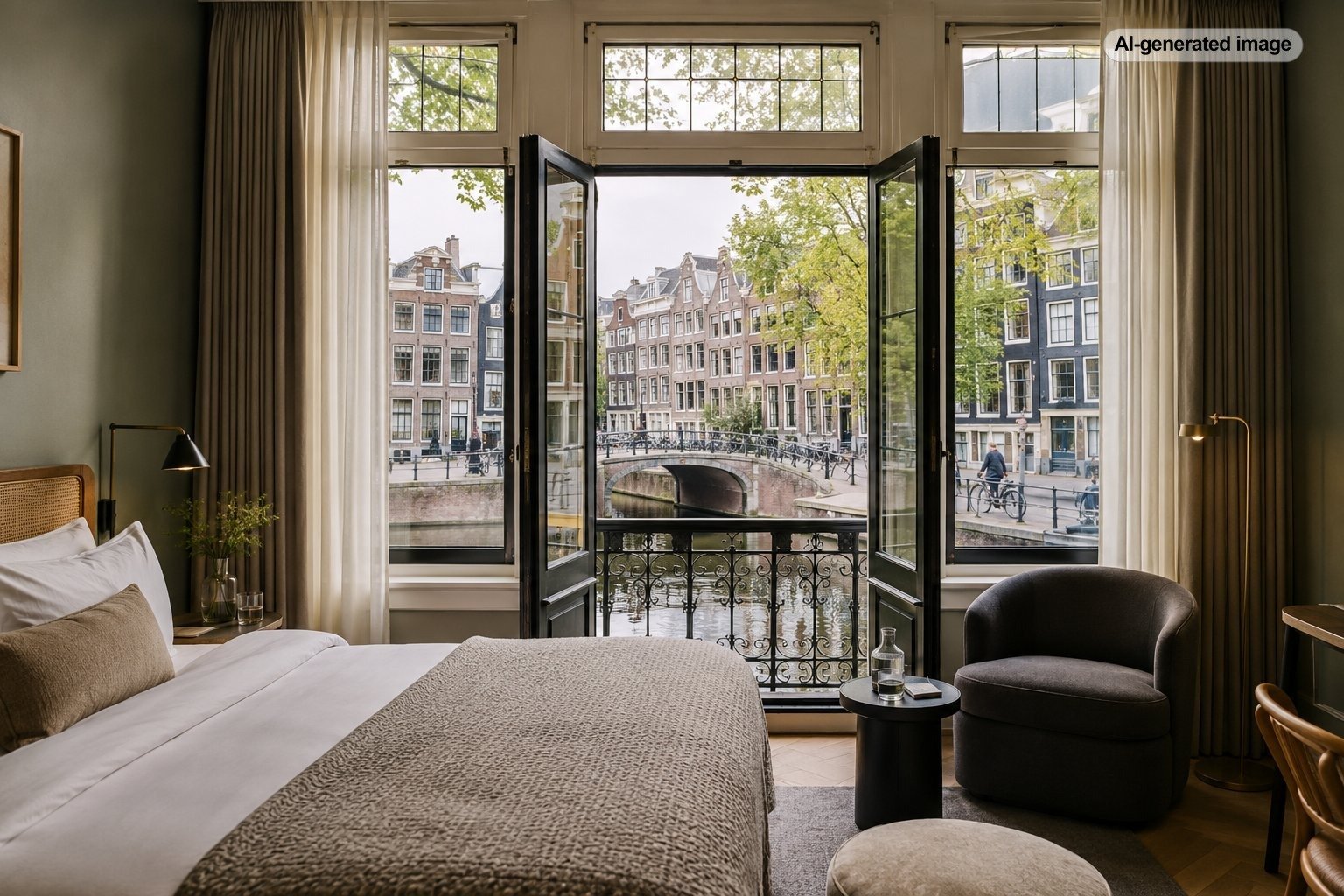
Where Should I Stay in Amsterdam for Canals, Museums, and Walkability?
For the strongest combination of canals, museums, and walkability, stay in the southern or western part of Amsterdam’s Canal Ring, especially around the Nine Streets, Spiegelkwartier, or the canals near Leidseplein. These locations place you between the historic center and the Museum Quarter, making it realistic to reach canal scenery, major museums, restaurants, and central attractions largely on foot.
The Jordaan is the better choice for intimate canal streets and neighborhood atmosphere, while the Museum Quarter is best for travelers who want the Rijksmuseum, Van Gogh Museum, and Stedelijk Museum close to their hotel. De Pijp and Oud-West offer a more residential base with abundant dining, but they require slightly more walking or tram use for some historic-center sights.
Quick answer: The best Amsterdam areas by trip priority
- Best overall balance: The southern and western Canal Ring, including the Nine Streets and Spiegelkwartier.
- Best for picturesque canals: The Jordaan and western Canal Ring.
- Best for museums: The Museum Quarter and nearby Oud-Zuid.
- Best for restaurants and local energy: De Pijp.
- Best for a calmer residential feel near the center: Oud-West.
1. Southern and western Canal Ring: Best overall for a first visit
The Canal Ring is the most practical answer for travelers who want Amsterdam’s defining scenery without sacrificing access to museums. The broad area is not uniform, however. The most balanced locations are generally south and west of the busiest medieval center, around the Nine Streets, Spiegelkwartier, Leidsestraat, and the canals extending toward Leidseplein.
From this part of the city, you can walk through canal-lined streets in the morning, continue toward the Museum Quarter during the day, and return to a wide selection of restaurants in the evening. The Rijksmuseum sits at the northern edge of the Museum Quarter, so accommodations near Spiegelgracht or Vijzelgracht can be particularly useful for combining art museums with the canal district.
Best for: First-time visitors, couples, short stays, and travelers who prefer to minimize transportation planning.
Tradeoffs: Rooms in historic canal buildings may be compact, stairs can be steep, and street noise varies significantly by block. A beautiful canal address is not automatically quiet, so check whether the room faces the street, canal, courtyard, or an interior light well.
Choose the Nine Streets for boutiques and classic canal scenery
The Nine Streets area crosses several of the principal canals west of the central core. It is known for small shops, cafes, narrow streets, and photogenic bridges. Its position is especially convenient for the Jordaan, Dam Square, the Anne Frank House area, and walks through the western canals.
The main compromise is that the Museum Quarter is not immediately outside the door. It remains reachable on foot for many travelers, but the walk may feel long after several hours inside museums. A tram can reduce the effort when needed.
Choose Spiegelkwartier for the easiest canal-to-museum connection
Spiegelkwartier and the nearby canals offer one of the most useful locations for an art-focused trip. The area lies between the central canals and the Museum Quarter, allowing travelers to reach the Rijksmuseum without giving up the atmosphere of the historic canal district.
This is a strong choice for visitors who want early museum reservations, evening canal walks, and convenient access to restaurants around both the center and De Pijp. It can feel less intimate than the Jordaan in places, but its geographic balance is difficult to match.
2. Jordaan: Best for canals and neighborhood character
The Jordaan is a compelling base for travelers who picture Amsterdam as a network of narrow streets, smaller canals, traditional buildings, independent shops, and neighborhood cafes. It sits west of the central Canal Ring and feels more residential than the most heavily visited parts of the historic center, although popular streets and landmarks still draw substantial foot traffic.
Staying here makes the western canals, Nine Streets, and Anne Frank House area especially accessible. It also encourages unstructured walks, which are often more rewarding in the Jordaan than following a rigid attraction-by-attraction route.
Best for: Couples, repeat visitors, photographers, boutique-hotel travelers, and anyone prioritizing atmosphere over immediate museum access.
Tradeoffs: The Museum Quarter is farther away than it is from the southern Canal Ring. Travelers with limited mobility should also examine the exact hotel location because walking distances can accumulate, sidewalks may be narrow, and historic properties may have accessibility limitations.
The Jordaan works particularly well for a stay of four nights or longer, when the pleasure of returning to a distinctive neighborhood may matter more than shaving several minutes from each museum trip. For a very short art-centered visit, the Museum Quarter or Spiegelkwartier may be more efficient.
3. Museum Quarter: Best for major museums and a calmer night
The Museum Quarter is the straightforward choice for travelers building their itinerary around the Rijksmuseum, Van Gogh Museum, Stedelijk Museum, and nearby cultural venues. Staying here can make timed museum entries easier to manage and reduces the need to cross the city before an early reservation.
The area has broader streets and a more spacious appearance than the historic core. Parts of nearby Oud-Zuid feel polished and residential, providing a calmer evening environment than areas close to nightlife hubs or heavily trafficked central squares.
Best for: Museum-focused trips, families, travelers who prefer quieter evenings, and visitors who want to avoid navigating the busiest center every day.
Tradeoffs: The neighborhood does not provide the same immersive canal atmosphere as the Jordaan or central Canal Ring. You can walk north toward the canals, Leidseplein, and the center, but repeated round trips may become tiring. Choosing a hotel near the northern side of the district can improve the balance.
For practical positioning, consider accommodations between Museumplein and the Rijksmuseum rather than much farther south. That keeps the museums close while preserving reasonable access to canal walks, De Pijp, and central neighborhoods.
4. De Pijp: Best for dining, cafes, and a livelier residential base
De Pijp lies south of the Canal Ring and east of the Museum Quarter. It is a dense, energetic neighborhood with restaurants, terraces, cafes, and the Albert Cuyp Market. Its streets generally feel more connected to everyday city life than the central sightseeing zone.
The northern and western edges of De Pijp are the most convenient for visitors who want to walk to museums and canals. A hotel near the Rijksmuseum side of the neighborhood offers a notably different experience from one near its farther southern boundary.
Best for: Food-oriented travelers, younger couples, repeat visitors, solo travelers, and anyone who enjoys returning to a busy neighborhood after sightseeing.
Tradeoffs: Many central landmarks are farther away, and some trips are more comfortable by tram or metro. Evening activity can produce noise, particularly near restaurant clusters and busy roads. De Pijp is walkable within itself, but it is not the most efficient base for travelers trying to see the historic center almost exclusively on foot.
5. Oud-West: Best for a relaxed stay with access to the center
Oud-West sits beyond the western Canal Ring, near Vondelpark and west of Leidseplein. It offers a useful compromise for travelers who want neighborhood restaurants, a less concentrated tourist environment, and practical access to central Amsterdam.
The eastern side of Oud-West is the most convenient for sightseeing. From there, travelers can walk toward Vondelpark, Leidseplein, the Museum Quarter, and the western canals. Trams provide an alternative when weather, luggage, or fatigue makes walking less appealing.
Best for: Longer stays, travelers who appreciate residential neighborhoods, visitors interested in Vondelpark, and those who do not need a canal directly outside the hotel.
Tradeoffs: The canals and museums may each be walkable, but they are not equally close from every address. A property deep in Oud-West can add meaningful travel time, so checking the exact location matters more than relying on the neighborhood name alone.
Areas that may be less suitable for this particular trip
Dam Square and the medieval center
The oldest central streets are convenient for Amsterdam Centraal, Dam Square, nightlife, and several major sights. They can also be crowded and busy, with a greater concentration of late-night activity in certain pockets. This area is practical for a broad sightseeing trip, but it is not the strongest choice when museums and peaceful canal walks are the main priorities.
Amsterdam Noord
Noord offers modern cultural spaces, waterfront settings, and a different perspective on the city. Ferries connect parts of Noord with the central station area, but the neighborhood is less suitable for a trip centered on walking repeatedly between the Canal Ring and Museum Quarter.
Eastern Docklands and farther eastern districts
These areas may appeal to travelers interested in contemporary architecture, waterfront views, or a more residential stay. They generally require greater reliance on public transportation for the classic canals and major museum district.
How to choose the right hotel location within a neighborhood
Amsterdam neighborhood labels can cover a larger area than travelers expect. Two hotels described as being in De Pijp, Oud-West, or the Canal Ring may provide noticeably different walking experiences. Check the property on a map against the places you expect to visit most often.
- For museums: Measure the route to Museumplein or the Rijksmuseum rather than relying on a general claim that the hotel is near the museum district.
- For canals: Confirm whether the hotel is inside the main Canal Ring, beside a smaller neighborhood canal, or several blocks from the water.
- For quiet: Look for information about room orientation, nearby nightlife, street traffic, and whether public spaces operate late.
- For accessibility: Verify elevator access, entrance steps, room location, bathroom layout, and whether the building has steep staircases.
- For transit: Check nearby tram or metro access as a backup even when you plan to walk most of the time.
What travelers often overlook
Historic charm can involve practical compromises
Many canal-area hotels occupy narrow historic buildings. Their character may come with steep stairs, small elevators or no elevator, uneven room layouts, limited storage, and compact bathrooms. Travelers with heavy luggage or mobility concerns should prioritize building details over a picturesque facade.
A short map distance may still feel demanding
Amsterdam’s compact center encourages walking, but museum visits, cobbled surfaces, bridges, bicycles, rain, and repeated detours can increase fatigue. A location that saves 15 or 20 minutes each way may noticeably improve a short trip.
Street-facing and canal-facing rooms are not always quieter
A canal view can also mean boats, bicycles, pedestrians, deliveries, or nightlife outside. Courtyard-facing rooms may be calmer, though they can receive less daylight. Review the room category rather than assuming every room shares the hotel’s advertised view.
Public transportation remains useful in a walkable city
GVB operates Amsterdam’s tram, bus, metro, and ferry network. Even travelers staying centrally may use transit after a long museum day, during poor weather, or when visiting neighborhoods outside the Canal Ring. Routes and service details can change, so consult the official operator when planning a specific journey.
A simple decision guide
- Choose the southern or western Canal Ring when you want the best overall balance and are visiting Amsterdam for the first time.
- Choose the Jordaan when canals, quiet morning walks, boutiques, and neighborhood atmosphere matter most.
- Choose the Museum Quarter when museum access is the central purpose of the trip or you prefer calmer evenings.
- Choose De Pijp when dining and neighborhood energy outweigh the need to walk everywhere in the historic center.
- Choose Oud-West when you want a residential base near Vondelpark with reasonable access to both museums and canals.
Frequently asked questions
What is the best area in Amsterdam for first-time visitors?
The southern or western Canal Ring is usually the most balanced option. It provides classic canal scenery and puts the historic center, Jordaan, shopping streets, and Museum Quarter within manageable reach.
Is it better to stay in the Jordaan or Museum Quarter?
Stay in the Jordaan for intimate canals and neighborhood atmosphere. Stay in the Museum Quarter for the easiest access to major art museums and a generally calmer evening setting. Travelers who want both should consider Spiegelkwartier or the southern Canal Ring between the two.
Can I walk from the Canal Ring to the museums?
Yes, particularly from the southern Canal Ring. The actual effort depends on the hotel’s exact location, your walking pace, weather, and how much time you have already spent sightseeing.
Is De Pijp a good place to stay without a car?
Yes. De Pijp is well suited to travelers without a car because it has extensive dining within the neighborhood and access to Amsterdam’s public transportation network. It is less central for some historic sights, so occasional tram or metro use may be helpful.
Where should I stay for a quiet Amsterdam trip?
Consider the Museum Quarter, Oud-Zuid, or a carefully selected courtyard-facing room in the Jordaan or Canal Ring. Noise varies by individual street and building, so the exact property and room position matter more than the neighborhood name alone.