Why Do Some Hotel Bathrooms Have Glass Walls Facing the Bedroom?
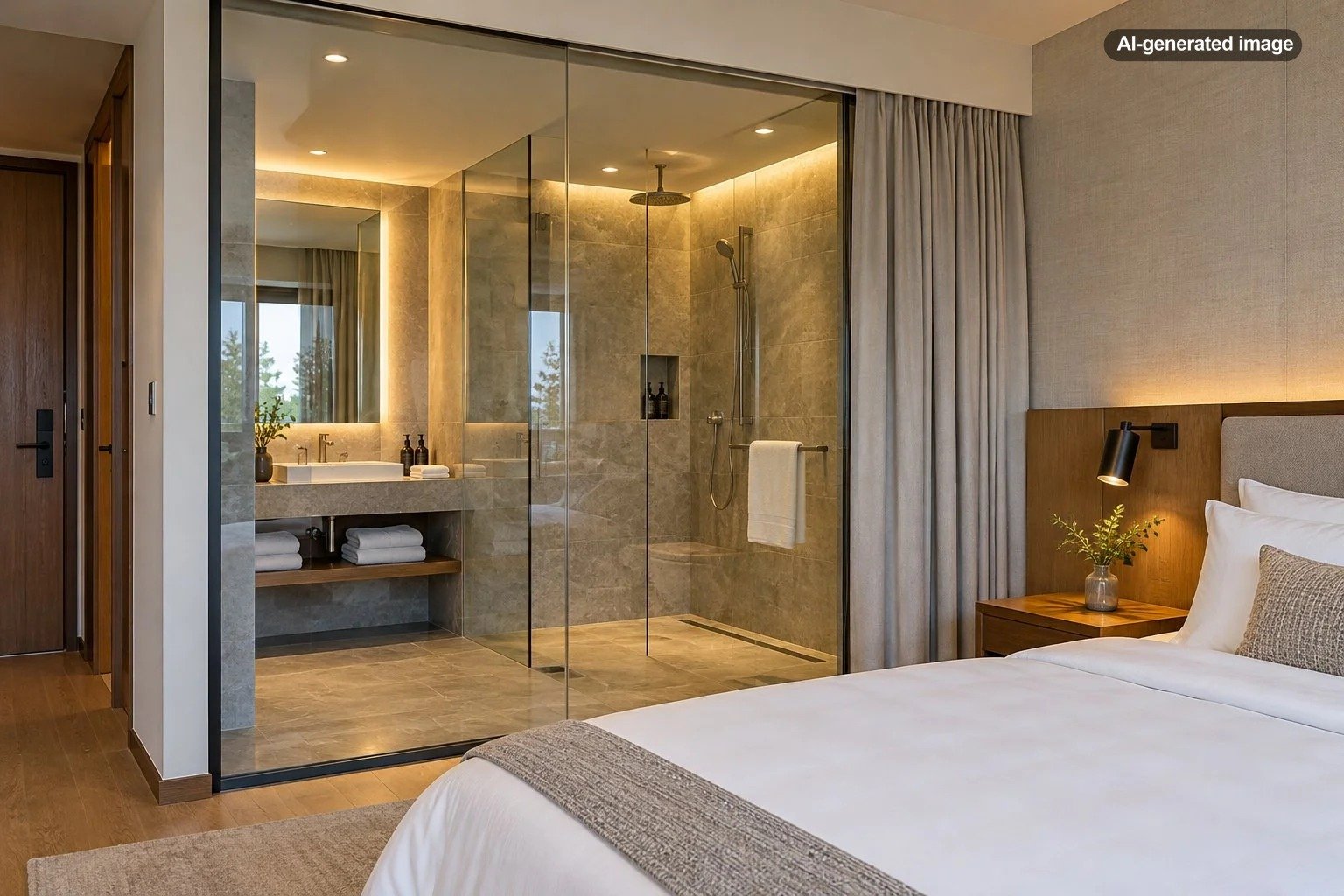
Some hotel bathrooms have glass walls facing the bedroom because designers want to make rooms feel more spacious, distribute natural light, and create a contemporary architectural appearance. Glass can also help a compact hotel room feel less divided into separate enclosed spaces. The approach is particularly associated with design-conscious accommodations, although it can appear across different hotel categories.
For travelers, however, the practical question is often less about architecture and more about privacy. A bathroom that looks elegant in a promotional photograph can feel surprisingly exposed when two people are sharing a room. Understanding the different glass configurations and their limitations can help guests avoid an uncomfortable surprise.
Quick Answer: Why Hotels Use Glass Bathroom Walls
- Visual openness: Transparent partitions allow the bedroom and bathroom to appear connected, making the overall space feel larger.
- Natural light: Glass can allow daylight from bedroom windows to reach an interior bathroom.
- Contemporary design: Glass partitions support a minimalist aesthetic with fewer visually heavy walls.
- Room layout: Glass can make compact or unconventional floor plans feel more cohesive.
- Atmosphere: Some hotels use glass to create a distinctive bathing area intended to feel more integrated with the bedroom.
These design goals do not necessarily mean the bathroom is completely transparent. Some rooms use frosted panels, partial partitions, privacy blinds, or electronically switchable glass. The exact arrangement matters considerably.
Glass Makes a Small Hotel Room Feel Larger
One of the most straightforward explanations is visual space. Traditional bathrooms are enclosed by opaque walls, creating two distinct areas. Even when the bathroom occupies only a modest portion of the floor plan, those walls interrupt sightlines and make the bedroom feel more contained.
A glass partition changes that perception. From the bed or seating area, the eye can continue through the bathroom wall instead of stopping at a solid surface. The room itself has not gained square footage, but its visible boundaries feel less restrictive.
This distinction is especially relevant in compact urban accommodations, where every design decision influences the perception of space. A small bedroom with a conventional enclosed bathroom may feel noticeably different from an identically sized room with a transparent partition.
However, visual openness should not be confused with additional usable space. Glass does not create more room for luggage, improve circulation around furniture, or increase bathroom storage. Travelers prioritizing functionality should evaluate the actual layout rather than relying on the impression created by photographs.
Glass Walls Can Bring Daylight Into Windowless Bathrooms
Hotel bathrooms are frequently positioned away from exterior windows. In some floor plans, the bedroom receives daylight while the bathroom depends entirely on artificial lighting.
Replacing part of an interior wall with glass allows light from the bedroom to travel farther into the room. This can make the bathroom feel brighter and more connected to the rest of the accommodation.
Light transmission varies with the material. Clear glass provides the strongest visual connection, while frosted and textured glass diffuse light and obscure details to varying degrees.
There is a practical compromise. A bathroom illuminated indirectly through glass may still require dedicated task lighting around the mirror. Daylight entering through a bedroom window is not necessarily positioned or distributed well enough for shaving, applying makeup, or other grooming activities.
Additionally, an open glass partition can allow bathroom lighting to spill into the sleeping area at night. That may matter more to guests sharing a room than the daylight benefit does during the afternoon.
The Design Creates a Particular Hotel Atmosphere
Glass bathrooms are also an aesthetic choice. Designers sometimes use them to establish a contemporary, minimalist atmosphere, particularly in rooms where the bathing area is intended to function as a visible design feature.
A freestanding bathtub behind a glass wall, for example, can become part of the bedroom’s architectural composition. In other layouts, a glass-enclosed shower may give the room a more open, spa-influenced appearance.
This approach can work well for travelers who appreciate expressive interior design and are comfortable with reduced separation between spaces.
It is less appealing to guests who regard the bathroom as a strictly private room. A design that feels intimate to one couple may seem inconvenient to friends, relatives, or colleagues sharing accommodation.
Importantly, the presence of glass does not establish that a hotel is more luxurious or provides a superior bathroom. Material quality, ventilation, cleanliness, water pressure, fixture placement, and everyday usability remain separate considerations.
Are Glass Hotel Bathrooms Always See-Through?
No. The phrase glass bathroom can describe several substantially different designs. Understanding these variations is the most useful step when evaluating a room.
Clear Glass Partitions
Clear glass offers an unobstructed view between the bathroom and bedroom. Depending on the layout, someone in the bedroom may be able to see the bathtub, shower, sink, or toilet.
In some properties, only the shower enclosure is transparent while the toilet occupies a separate enclosed compartment. In others, much of the bathroom may be visible. The distinction should never be assumed without examining the floor plan or confirming the arrangement.
Frosted or Textured Glass
Frosted glass transmits light while reducing the clarity of objects and people behind it. It can provide greater visual privacy than clear glass, although the degree of obscurity varies.
Silhouettes may remain visible, especially when a person stands close to the glass or bright lighting is positioned behind them. Frosted glass should therefore not automatically be treated as equivalent to an opaque wall.
Glass With Curtains or Blinds
Some designs incorporate a curtain, sliding screen, or blind that can cover the transparent partition. This arrangement offers flexibility when the privacy feature is properly designed and functional.
It is worth checking whether the covering extends across the entire exposed area. A decorative curtain that shields the bathtub but leaves the toilet visible does not provide the same practical privacy as a fully enclosed bathroom.
Switchable Privacy Glass
Some modern interiors use electrically switchable glass that changes between relatively transparent and opaque-looking states. This can provide a cleaner architectural appearance without requiring a permanent transparent partition.
Even here, the opaque state may diffuse light and reveal silhouettes rather than creating complete visual concealment. The specific technology and installation determine the result.
Why Bathroom Privacy Can Be More Complicated Than Expected
The main drawback of glass bathrooms is that visual privacy, acoustic privacy, and physical separation are three different things.
Visual privacy concerns whether another person can see into the bathroom. Frosted glass, blinds, or screens may help, depending on their coverage.
Acoustic privacy concerns how clearly sound travels between the bathroom and bedroom. A glass partition with gaps around its edges may offer limited sound isolation, even when the glass itself is opaque.
Physical separation concerns whether the bathroom has a proper door, whether the door closes fully, and whether the shower or toilet occupies a distinct enclosed space.
A traveler might discover that a bathroom has an opaque glass wall but no conventional door. Another room might have clear glass around the bathtub but a fully enclosed toilet. These are very different experiences despite appearing under the same general description.
When privacy matters, asking whether the glass is frosted is not enough. The more useful question is whether both the toilet and shower can be used without being visible from the bedroom.
Who Is Most Likely to Appreciate This Design?
Glass bathroom walls can work particularly well for solo travelers who do not need to coordinate privacy with anyone else. The visual openness may make a small room feel more comfortable, and bathroom lighting spilling into the bedroom is less likely to disturb another sleeper.
Couples comfortable with shared space may also appreciate the design, especially when a bathtub or shower is incorporated into the bedroom atmosphere. However, traveling as a couple does not automatically mean either guest wants a transparent bathroom.
Design-oriented travelers may regard the architectural feature as an appealing part of the accommodation experience. For these guests, the room’s distinctive appearance can be a meaningful consideration alongside the location and amenities.
On the other hand, friends sharing a twin room, adult family members traveling together, and colleagues sharing accommodation may find a fully transparent bathroom impractical.
Even travelers who generally prefer an open layout may want greater privacy during a longer stay. What feels interesting for one night can become inconvenient when different sleeping schedules, morning routines, or bathroom habits need to coexist.
How to Check Bathroom Privacy Before Booking
The most reliable approach is to treat bathroom privacy as a room-specific feature rather than a characteristic of the entire hotel.
Start by reviewing photographs of the exact room category. A hotel’s general image gallery may combine several room designs, and a bathroom shown in a premium suite may not resemble the bathroom in a standard room.
Look for photographs taken from the bedroom toward the bathroom. These are often more informative than close-up photographs of the sink or shower.
Next, examine the wording in the room description. Terms such as open-plan bathroom, integrated bathing area, glass-enclosed shower, and partial privacy partition deserve closer attention. None of these descriptions guarantees that the toilet is visible, but they provide reasons to investigate.
If photographs are inconclusive, contact the hotel directly and ask specific questions:
- Is the toilet enclosed behind an opaque wall and a closing door?
- Can someone lying in bed see the shower or toilet?
- Does the glass partition have a curtain, blind, or privacy setting?
- Does the bathroom have a full-height door that closes?
- Are there room categories with completely enclosed bathrooms?
Request confirmation for the room category you intend to reserve. If privacy is essential, it is also sensible to ask whether that design can be guaranteed for your reservation rather than merely requested.
What Travelers Often Overlook About Glass Bathrooms
The first overlooked detail is nighttime lighting. If one guest wakes early or uses the bathroom during the night, the illuminated bathroom may brighten the sleeping area through the partition. A visually striking arrangement can therefore become inconvenient for travelers with different schedules.
The second is the visibility created by reflections. Mirrors and reflective surfaces can reveal parts of a bathroom that seem concealed when viewed directly. A partition’s placement matters as much as its transparency.
The third is ventilation. Glass walls do not establish whether a bathroom has effective moisture extraction. A well-designed enclosed bathroom may handle humidity better than an attractive open-plan arrangement with inadequate ventilation, although the reverse can also be true.
Finally, travelers should distinguish between a glass wall and a glass shower door. A hotel may advertise a glass-enclosed shower while maintaining a conventional opaque wall and closing bathroom door. That is not necessarily the exposed bedroom-facing arrangement that concerns privacy-conscious guests.
Is a Vacation Rental a Better Alternative?
For travelers who place a high priority on separating sleeping and bathing areas, an apartment-style accommodation or vacation rental may offer another option to consider. Some have conventional enclosed bathrooms and additional living space, although layouts vary widely.
A private rental is not automatically more spacious, more private, or better equipped than a hotel. Floor plans, listing photographs, bathroom access, and individual property rules still require careful review.
Affiliate disclosure: HotelInfo.com may earn a commission when you book or purchase through links on this page. This does not affect the price you pay. Learn more.
Travelers comparing alternative layouts can browse Homes & Villas by Marriott Bonvoy as one accommodation search option. Before reserving, confirm the bathroom configuration, total cost, applicable fees, cancellation terms, and amenities of the specific property.
Frequently Asked Questions
Why do hotels put glass walls around the shower?
Glass can make the shower feel less visually separated from the rest of the room, allow more light to pass through, and support a minimalist design. The shower may still sit within a conventional enclosed bathroom, so a glass shower wall does not necessarily imply reduced bedroom privacy.
Can you request a hotel room without a glass bathroom?
You can ask whether the hotel offers a room category with an enclosed bathroom. Some properties have multiple layouts, while others use a consistent design throughout a particular room category. Availability and the ability to guarantee a specific configuration depend on the property.
Does frosted glass provide complete bathroom privacy?
Not necessarily. Frosted glass obscures detail but may still reveal silhouettes, especially under strong lighting or at close range. It also does not automatically block sound or provide the physical separation of a conventional wall and door.
Are transparent bathrooms more common in luxury hotels?
They are associated with some contemporary and design-focused hotel interiors, including upscale properties, but they are not exclusive to luxury accommodations. The choice reflects a particular design approach rather than a reliable indication of a hotel’s quality or service level.
What should you do if your hotel bathroom has less privacy than expected?
Contact the front desk and explain the specific concern. Ask whether another room with a more enclosed bathroom is available and whether changing rooms would affect your reservation or cost. A change may not be possible, so it is preferable to verify essential privacy requirements before arrival.
The Best Bathroom Design Depends on How You Travel
Glass bathroom walls are primarily an architectural solution to questions of light, openness, and visual design. They can make a compact room feel more expansive and create a distinctive atmosphere without changing the actual dimensions of the accommodation.
Whether that is an improvement depends on the traveler. Someone staying alone may welcome the openness, while two people sharing a room may place greater value on an opaque door and dependable privacy.
The practical lesson is simple: do not judge a hotel’s bathroom solely by how attractive it looks in photographs. Check what the glass reveals, what can be covered, whether the toilet is enclosed, and how the arrangement works when one guest is sleeping. Those details often matter more to a comfortable stay than the architectural effect itself.