How to Check Whether a Hotel Has Individual Room Temperature Controls
Having a thermostat in your hotel room does not necessarily mean you can choose any temperature you want. Some properties provide genuinely independent heating and cooling, while others use centrally managed systems that limit the available settings or determine whether rooms receive heating or cooling at a particular time.
To check whether a hotel has individual room temperature controls, look beyond the general air-conditioning description, examine room-specific amenities, and ask the property directly whether guests can independently adjust both the temperature and operating mode. A few precise questions before booking can prevent an uncomfortable surprise after check-in.
Quick Answer: How to Verify Room Temperature Control
- Check the room description: Look for phrases such as ‘individually controlled air conditioning’ or ‘in-room climate control,’ rather than simply ‘air conditioning.’
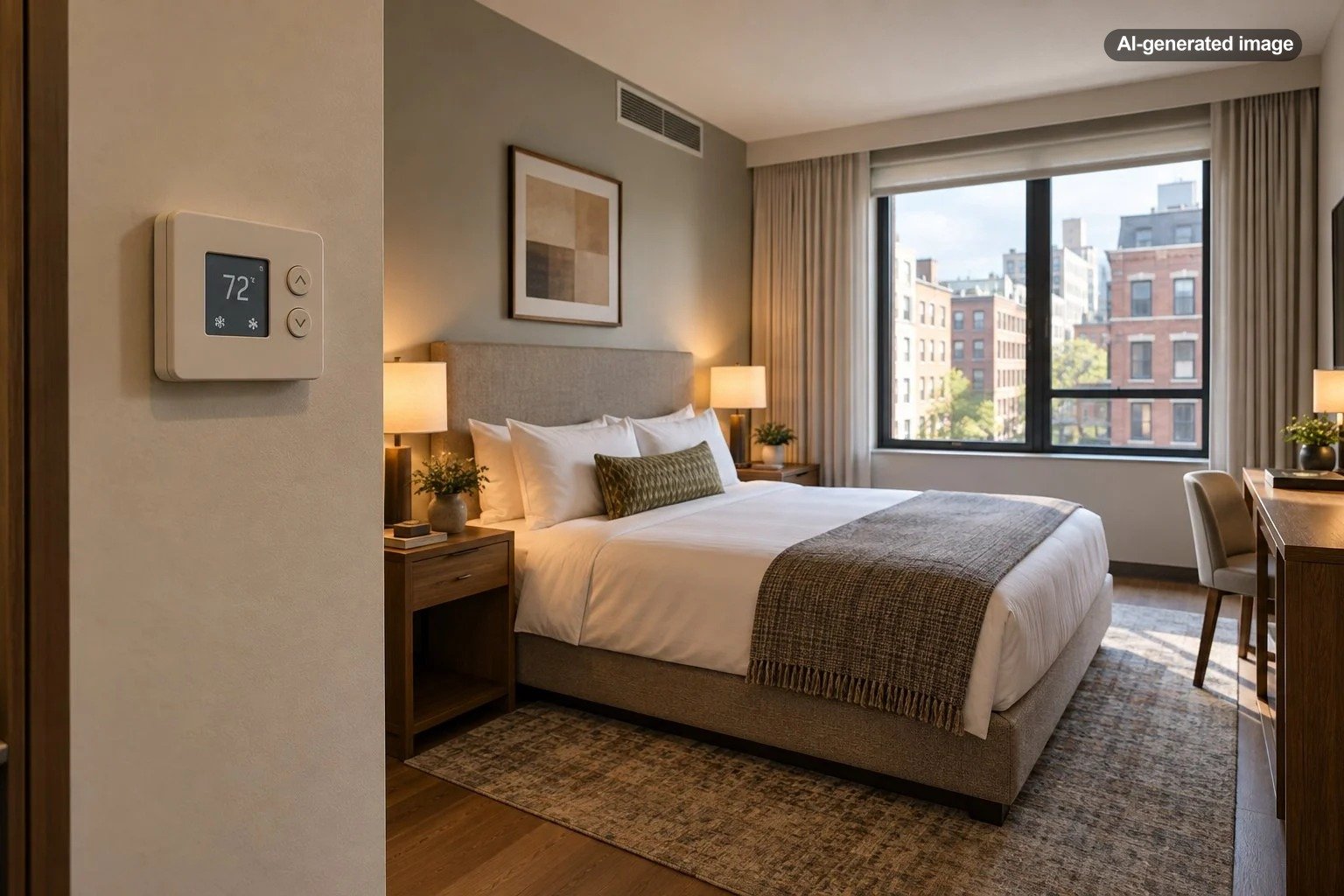
- Review room photographs: A visible thermostat or wall-mounted controller may offer clues, although photographs cannot establish what settings are available.
- Contact the property: Ask whether guests can select their own temperature and switch between heating and cooling independently.
- Ask about restrictions: Confirm whether the system has temperature limits, seasonal operating modes, or centrally controlled schedules.
- Verify your room category: Climate-control equipment can differ between room types, building sections, and accommodations within the same property.
Understand What Individual Temperature Control Actually Means
Hotel climate-control terminology can be confusing because several different systems may be described using similar language. The essential distinction is between a system that responds independently to a guest’s preferences and one where a central system determines some or all of the available heating and cooling.
Independent Heating and Cooling
With a genuinely independent system, guests can typically adjust the room’s temperature setting and request heating or cooling as needed, subject to the equipment’s operating capabilities and any property-imposed limits.
Examples can include certain individually controlled heat pumps, packaged terminal air conditioners, and dedicated room air-conditioning systems. The equipment type alone, however, does not guarantee unrestricted operation. Hotel management settings, building controls, and equipment condition may still affect what guests can select.
Centrally Managed Climate Control
Some hotels use building-wide heating and cooling systems. A room may have a thermostat that adjusts airflow, fan operation, or a local temperature setting while relying on centrally supplied heating or chilled water.
Depending on the system, the property may determine when heating or cooling is available. For example, a guest could lower the thermostat setting on a warm afternoon but discover that the building is operating in heating mode.
Not all central systems work this way. More sophisticated installations may support simultaneous heating and cooling in different rooms. The important question is how the specific property’s equipment operates, not merely whether the hotel uses central HVAC.
Adjustable Temperature With Restricted Settings
A hotel can offer individual controls while restricting the minimum and maximum temperatures. A thermostat might allow guests to change the setpoint only within a predefined range. Some systems also use occupancy sensors, automatic setbacks, or centralized energy-management features.
For most travelers, a reasonable adjustable range may be sufficient. Guests with particularly strong temperature preferences should confirm the actual flexibility rather than relying on the presence of a thermostat.
Read Hotel Amenity Descriptions Carefully
Start with the hotel’s official website and inspect the description of the specific room category you intend to reserve. General property amenities can establish that air conditioning exists without revealing how an individual room is controlled.
Look for wording that explicitly identifies guest control. Phrases such as ‘individual climate control’ and ‘individually adjustable air conditioning’ provide more useful starting points than a generic air-conditioning icon.
Even these descriptions are not definitive. Individual climate control might refer only to an adjustable cooling setting, rather than independent access to both heating and cooling throughout the year.
Similarly, ‘central air conditioning’ does not automatically mean guests have no control. It may describe the equipment infrastructure rather than the actual experience of adjusting the room temperature.
If the website lists several accommodation categories, check each one separately. A recently updated wing, an older building section, and a suite with multiple rooms may use different systems.
Use Room Photographs as Supporting Evidence
Room photographs can help identify the apparent controls, particularly when the hotel publishes detailed images of desks, bedside areas, and walls near the entrance.
A wall-mounted digital thermostat may indicate adjustable settings. A remote control near a wall-mounted air-conditioning unit could suggest a room-specific system. An older fan-coil panel may offer fewer options, although its appearance alone cannot confirm the available functions.
Photographs are less useful when the controls are hidden, the image is outdated, or the hotel has multiple room configurations. Do not assume that every room contains identical equipment simply because one promotional photograph shows a modern thermostat.
If independent temperature control is essential, ask the property to confirm the equipment provided in your booked room category. Photographs should support that conversation rather than replace it.
Ask the Hotel These Specific Questions
Contacting the property directly is often the most reliable way to clarify room-level temperature control before booking. Specific operational questions tend to produce more useful answers than asking whether the rooms have air conditioning.
- Can guests set the temperature independently in each room?
- Can I switch between heating and cooling myself, regardless of the season?
- Is there a minimum or maximum thermostat setting?
- Does the hotel control heating or cooling centrally at certain times of year?
- Does the room’s system continue operating while guests are sleeping, or does it use occupancy-based adjustments?
- Does the room category I am considering have the same climate controls as other room types?
For a concise message, consider: ‘Before booking, could you confirm whether the room has an individual thermostat that lets guests choose both heating and cooling, and whether there are any temperature limits or seasonal restrictions?’
If the reply simply states that every room has air conditioning, politely repeat the distinction between having cooling equipment and being able to control the operating mode independently.
When the answer matters to your reservation decision, consider retaining the written response along with the room-category description. A property representative’s explanation can be useful context, although equipment availability and operating conditions may still change.
Check Reviews for Consistent Temperature Complaints
Guest reviews can provide a second perspective, especially when the official amenity description is vague. Search within recent reviews for terms such as ‘thermostat,’ ‘air conditioning,’ ‘heating,’ ‘too warm,’ ‘too cold,’ and ‘temperature control.’
Pay particular attention to repeated accounts describing the same operating restriction. Several guests reporting that they could not activate cooling during a particular season may reveal a pattern worth investigating.
However, an isolated complaint does not establish that a property lacks individual controls. A malfunctioning unit, an open window that interrupts the system, or a misunderstanding of the controls can produce a similar experience.
Review dates also matter. A complaint written before an equipment replacement or building renovation may not reflect current conditions. Conversely, positive remarks about air conditioning during summer do not necessarily establish that guests can request cooling during winter.
Use reviews to develop questions for the hotel rather than treating anonymous experiences as a definitive technical description.
Recognize the Difference Between Temperature and Fan Control
One commonly overlooked distinction is the difference between adjusting room temperature and adjusting the fan. A control panel with several buttons can appear sophisticated while offering only limited influence over heating or cooling.
For example, a room might allow guests to choose low, medium, or high fan speed while the central system supplies air at a temperature determined elsewhere. Another system may permit a temperature setpoint but automatically regulate fan speed.
Neither arrangement is inherently unacceptable. The concern arises when the available control does not match what the traveler expects.
If you prefer uninterrupted airflow while sleeping, ask whether the fan has a continuous operating mode or whether it switches off automatically when the requested temperature is reached. A thermostat that provides adequate cooling may still operate differently from the constant fan setting you use at home.
Consider Seasonal Heating and Cooling Restrictions
Seasonal system operation deserves particular attention when traveling during spring and fall, when daytime and nighttime temperatures can differ substantially.
Some buildings equipped with changeover-style HVAC systems operate primarily in heating mode during colder periods and cooling mode during warmer periods. A hotel using this arrangement may not be able to provide both functions on demand in every guest room.
Other properties have systems capable of delivering heating and cooling simultaneously to different rooms. It would therefore be inaccurate to assume that all centrally conditioned hotels impose seasonal restrictions.
For travelers who enjoy a particularly cool sleeping environment, the question is especially relevant during cooler months. Outdoor weather alone does not determine how warm a room may feel, particularly with sunlight, interior heat sources, or limited ventilation.
Ask about the system’s current operating mode when your stay approaches, rather than assuming the property’s general year-round description guarantees a particular function on your travel dates.
Choose Accommodations Based on Your Temperature Priorities
Not every traveler needs the same level of environmental control. Someone staying overnight on a business trip may be satisfied with a modest adjustable temperature range. A traveler spending several days working from the room may place greater importance on consistent daytime cooling.
Light sleepers may care about both the achievable temperature and the sound of the equipment. An independently controlled unit can offer flexibility but may produce noticeable fan or compressor noise. A quieter central system may provide a more comfortable overall experience even if the settings are somewhat restricted.
Families sharing a room should consider whether a single thermostat adequately serves different sleeping areas. In a multi-bedroom suite, ask whether each bedroom has its own temperature control or whether one setting applies throughout the accommodation.
Vacation rentals can provide another option for travelers comparing lodging configurations, but independent temperature settings should not be assumed. Guests exploring Homes & Villas by Marriott Bonvoy should confirm the climate-control arrangement of any particular property before reserving.
What Travelers Often Overlook Before Booking
Even after confirming individual controls, several practical details can affect comfort.
Thermostat location: A sensor near direct sunlight or another heat source may measure conditions that differ from the sleeping area. This is a possibility to discuss with the hotel if comfort complaints recur, not something that can ordinarily be established from a listing.
Window restrictions: Some hotels have windows that do not open. Others may use window sensors that affect climate-control operation. Ask about ventilation separately if fresh outdoor air is important to you.
Occupancy settings: Energy-management systems may adjust temperatures automatically when they detect an unoccupied room. Guests who need consistent conditions should ask whether their preferred setting remains active overnight.
Room assignment: A hotel may have different equipment across floors or wings. If staff identify a particular room category or building section with greater flexibility, verify that your reservation corresponds to that accommodation.
Maintenance versus design: A system that cannot reach the selected temperature may be malfunctioning rather than intentionally restricted. At check-in, familiarize yourself with the controls and promptly report any unexpected behavior.
These distinctions help separate a genuine limitation of the hotel’s HVAC design from a temporary service problem.
What to Do When the Room Is Not Comfortable
If the room does not respond as expected, first check the thermostat’s operating mode, temperature setting, and fan configuration. Some systems require a separate heating or cooling selection, while others automatically choose a mode.
If the controls remain unresponsive or the temperature does not change after a reasonable period, contact the front desk. Explain the temperature you are trying to achieve, what the thermostat displays, and whether the equipment appears to be operating.
Ask whether maintenance can inspect the system or whether an alternative room with different climate-control equipment is available. Neither a repair nor a room change should be assumed to be guaranteed.
It is generally better to request assistance than to attempt to override equipment, disconnect sensors, or manipulate controls beyond their intended settings.
Frequently Asked Questions
Does a thermostat in every hotel room mean individual temperature control?
No. A thermostat may provide local adjustment while the central system determines which heating or cooling functions are available. Ask whether the guest can independently select the temperature and operating mode.
Can hotels limit how cold a room gets?
Yes. Some hotels configure minimum and maximum thermostat settings. These restrictions vary by property and system, so travelers with specific preferences should ask about the available range.
Does central air conditioning mean I cannot adjust my room temperature?
Not necessarily. Many centralized systems support individual room settings. The degree of control depends on the equipment design and the property’s configuration.
Can a hotel room have cooling in summer but not winter?
Yes. Certain systems operate in seasonal heating or cooling modes. Other systems can provide either function throughout the year. Confirm the arrangements for your actual travel dates.
Is individual climate control worth prioritizing?
It can be valuable for travelers with strong sleeping-temperature preferences, extended stays, or rooms used for substantial daytime work. Others may prefer a quieter system or a better overall room layout even with some thermostat restrictions.
Make Temperature Control Part of Your Room Comparison
The most useful approach is to treat room temperature control as a specific amenity that requires verification, rather than assuming it comes automatically with air conditioning. Start with the room description, examine supporting photographs and reviews, then ask the hotel exactly what guests can adjust.
A clear answer about heating and cooling modes, thermostat limits, and room-category differences is more valuable than an ambiguous promise of climate control. When those details matter to your comfort, confirming them before booking is a small but worthwhile part of choosing the right accommodation.