Where to Stay in Kanazawa for Kenrokuen Garden and Traditional Neighborhoods
Kanazawa rewards travelers who choose their accommodations according to how they intend to explore the city. Its celebrated Kenrokuen Garden, preserved teahouse streets, samurai residences, and contemporary museums occupy several connected but distinct neighborhoods. Staying near the garden makes early sightseeing easier, while a hotel closer to Omicho Market or Korinbo creates a different balance of historic atmosphere, restaurants, and transportation.
For travelers primarily interested in Kenrokuen Garden and traditional neighborhoods, the strongest starting points are the Kenrokuen and castle area, the central district around Omicho Market and Oyamamachi, and Korinbo near Nagamachi. Higashi Chaya is especially appealing for traditional streetscapes, although staying directly inside its historic core is not essential. Kanazawa Station remains a sensible alternative for short visits or travelers moving between Japanese cities by train.
Kanazawa Accommodation Planning Snapshot
- Best area for Kenrokuen Garden: The Kenrokuen-shita and Kanazawa Castle vicinity.
- Best central compromise: Omicho Market, Oyamamachi, and Kamitsutsumicho.
- Best for samurai heritage and urban dining: Korinbo, near Nagamachi.
- Best for railway convenience: Kanazawa Station, particularly for brief stays.
- Suggested stay: Two nights for a relaxed introduction, or three nights for additional museums, crafts, and neighborhood exploration.
- Transportation: Walking and local buses generally suit a central sightseeing visit; a rental car is usually unnecessary for the principal historic attractions.
How Kanazawa’s Main Neighborhoods Compare
Kanazawa is relatively manageable for pedestrians, but its attractions are not arranged along a single street. The city has several historic centers separated by castle grounds, waterways, commercial blocks, and modern roads. A neighborhood that appears central on a map may still require a substantial walk between particular attractions.
| Area | Main advantage | Consideration |
|---|---|---|
| Kenrokuen and castle | Garden access and historic landmarks | Less immediate railway convenience |
| Omicho and Oyamamachi | Balanced sightseeing location | Busy commercial streets |
| Korinbo and Nagamachi | Samurai district, dining, and shopping | Farther from Higashi Chaya |
| Higashiyama and Higashi Chaya | Traditional teahouse atmosphere | Fewer conventional hotel choices |
| Kanazawa Station | Train access and luggage convenience | Historic attractions require a longer walk or bus ride |
The following eight operating hotels offer different approaches to these locations, from intimate boutique accommodations beside Kenrokuen to practical modern hotels around the city’s commercial center and railway station.
HOTEL AO KANAZAWA: For Kenrokuen Garden and Boutique Luxury
Area: Kenrokuen-shita. Positioning: Luxury boutique. Best for: Couples, garden-focused travelers, and visitors who enjoy intimate accommodations.
HOTEL AO KANAZAWA is among the most geographically compelling choices for travelers whose main priority is Kenrokuen Garden. Located at 1-1 Kenroku-motomachi, the property sits close to the garden and Kanazawa Castle Park. Its position also works for exploring the city’s museums and continuing toward Higashi Chaya.
The hotel occupies a renovated building with just 15 guest rooms, giving it a smaller scale than the city’s conventional hotels. Contemporary interiors, a strong culinary emphasis, and varied room designs make the stay itself part of the experience rather than simply a place to sleep.
Tradeoff: Its luxury positioning and limited room count may make it less suitable for cost-conscious travelers or groups needing several rooms. There is also no hotel parking, so travelers arriving by car should investigate nearby options before booking.
Kanazawa Hakuchoro Hotel Sanraku: For Historic Atmosphere and Relaxation
Area: Marunouchi, near Kanazawa Castle. Positioning: Upscale traditional-style city hotel. Best for: Travelers combining historical sightseeing with restorative hotel time.
Kanazawa Hakuchoro Hotel Sanraku provides an especially appealing balance between Kenrokuen Garden and the eastern historic districts. Its location places Kanazawa Castle, Omicho Market, and Higashi Chaya within the broader walking area.
The interiors reference Japan’s Taisho period, creating a character distinct from contemporary minimalist hotels. A notable feature is the property’s natural hot spring bathing facility, which offers a welcome conclusion to a day exploring stone paths, gardens, and museum galleries.
For travelers who want their hotel environment to reinforce the cultural atmosphere of Kanazawa, this property deserves consideration alongside the more contemporary HOTEL AO KANAZAWA.
Tradeoff: The romantic historical styling may not appeal to visitors who prefer streamlined modern interiors. The station is not immediately adjacent, and travelers carrying heavy luggage may prefer a bus or taxi transfer.
THE HOTEL SANRAKU KANAZAWA: For Refined Comfort Near Omicho Market
Area: Omicho Market and central Kanazawa. Positioning: Upscale to luxury. Best for: Travelers who want traditional design influences without sacrificing the scale of a full-service city hotel.
THE HOTEL SANRAKU KANAZAWA occupies a convenient central position for visitors combining Kenrokuen Garden, Kanazawa Castle, Omicho Market, and the eastern historic neighborhoods. It makes particular sense for guests who expect to divide their days between cultural attractions and the city’s food scene.
The hotel’s interiors incorporate Kanazawa-inspired decorative elements, including guest-room headboards influenced by traditional folding screens. Its larger room inventory gives it a different character from a small boutique hotel, making it a plausible choice for travelers who appreciate a more substantial property.
Staying here also allows visitors to organize sightseeing into manageable sections: the market and central streets on one outing, the castle and garden on another, and the teahouse quarters separately.
Tradeoff: This is an urban hotel rather than accommodation inside a preserved teahouse street. Visitors prioritizing uninterrupted traditional scenery immediately outside their door may prefer a smaller property closer to Higashiyama.
KUMU Kanazawa by THE SHARE HOTELS: For Design and Craft Culture
Area: Kamitsutsumicho, in central Kanazawa. Positioning: Midrange to upscale design-oriented hotel. Best for: Design enthusiasts, younger couples, and travelers interested in contemporary interpretations of Japanese tradition.
KUMU Kanazawa by THE SHARE HOTELS takes a different approach to the city’s heritage. Rather than recreating a historical inn, it incorporates local crafts, artwork, and references to tea culture into a contemporary hotel environment.
Its location at 2-40 Kamitsutsumicho is particularly useful for travelers who want flexibility. Omicho Market and the central shopping streets are accessible, while Kenrokuen, the castle, and Nagamachi can be incorporated into longer sightseeing walks.
KUMU is a logical choice for visitors who regard architecture, art, and design as important parts of their trip. The hotel connects Kanazawa’s traditional craftsmanship with its present-day creative identity.
Tradeoff: It is not directly beside Kenrokuen or inside Higashi Chaya. Guests focused exclusively on garden access may prefer HOTEL AO KANAZAWA, while those seeking a conventional luxury hotel experience may favor a larger full-service property.
UAN Kanazawa: For a Quietly Contemporary Central Stay
Area: Oyamamachi. Positioning: Upscale boutique-style. Best for: Independent travelers and couples who prefer understated comfort near multiple sightseeing areas.
UAN Kanazawa, located at 6-30 Oyamamachi, is another compelling central option. Its concept draws attention to Kanazawa’s rainy climate, treating the experience of spending time indoors and exploring the city in changing weather as part of the destination’s character.
Geographically, the property suits travelers who want to explore beyond a single landmark. Omicho Market, the castle area, and the streets leading toward Korinbo can form separate walking routes without requiring a return to the station between outings.
This location is especially practical for a two-night stay: spend one day around Kenrokuen and nearby museums, then explore the samurai district and the teahouse neighborhoods on another.
Tradeoff: UAN does not deliver the immediate garden proximity of a Kenrokuen-shita hotel. Travelers requiring step-free access throughout their itinerary should also confirm the specific room and route details directly with the property.
Mitsui Garden Hotel Kanazawa: For Central Convenience and City Views
Area: Kamitsutsumicho. Positioning: Upscale city hotel. Best for: Travelers seeking an accessible central base, contemporary rooms, and Japanese design details.
Mitsui Garden Hotel Kanazawa sits at 1-22 Kamitsutsumicho, positioning guests between the station district and Kanazawa’s principal historic attractions. The property’s interiors reference regional crafts such as gold leaf, traditional textiles, and decorative woodwork.
Its upper-floor communal bath with city views is a distinctive attraction for visitors who enjoy unwinding after extended sightseeing walks. The hotel is also a practical base for combining Omicho Market with Kanazawa Castle and Kenrokuen Garden.
Compared with intimate boutique properties, Mitsui Garden offers a more standardized city-hotel format, which may appeal to travelers who value predictable room arrangements and familiar hotel operations.
Tradeoff: It is not situated directly within the historic streets. Importantly, the hotel has announced neighboring construction work scheduled from October 2026 through January 2027, with possible noise during designated working periods. Guests considering those dates should review the latest official notice before reserving.
Tokyu Stay Kanazawa: For Practicality and Longer Visits
Area: Minamicho. Positioning: Moderate to upscale practical city hotel. Best for: Longer stays, business travelers combining work with sightseeing, and visitors who value in-room conveniences.
Tokyu Stay Kanazawa is located at 4-50 Minamicho, placing it near the central sightseeing corridor. Its defining practical distinction is the inclusion of a washer-dryer and microwave in guest rooms, features that can be especially useful during a longer journey through Japan.
For travelers arriving with several days of clothing or continuing onward to another region, laundry facilities within the room can be more valuable than a dramatic lobby or elaborate hotel decor. The central location also means a longer stay does not have to revolve around repeated transportation from Kanazawa Station.
This hotel is worth considering for guests who want to divide sightseeing into shorter outings, return for breaks, and maintain a simple daily routine.
Tradeoff: Its emphasis is practical accommodation rather than an immersive traditional-hotel experience. Travelers seeking distinctive architecture, a hot spring atmosphere, or high-end dining as part of the hotel stay may prefer one of the other options.
Hyatt Centric Kanazawa: For Railway Access and a Modern Upscale Stay
Area: Kanazawa Station West Exit. Positioning: Upscale full-service hotel. Best for: First-time visitors with short stays, travelers carrying substantial luggage, and guests continuing by train.
Hyatt Centric Kanazawa illustrates why the station district should not be dismissed simply because the principal historic attractions are elsewhere. The hotel is located approximately two minutes on foot from the station’s West Exit, making arrivals and departures notably straightforward.
The property combines contemporary interiors with artwork and decorative references to Kanazawa’s cultural heritage. Its restaurants and rooftop bar distinguish it from simpler transportation-focused accommodations.
For a one-night visit, the convenience of leaving luggage near the station and traveling into the historic center by bus can outweigh the appeal of staying closer to Kenrokuen. The same logic applies to travelers making Kanazawa one stop in a wider rail itinerary.
Tradeoff: Kenrokuen Garden, Nagamachi, and Higashi Chaya are not immediately outside the hotel. Guests who prefer to begin sightseeing on foot directly from their accommodation may find a central or garden-area property more satisfying.
Should You Stay Near Higashi Chaya District Instead?
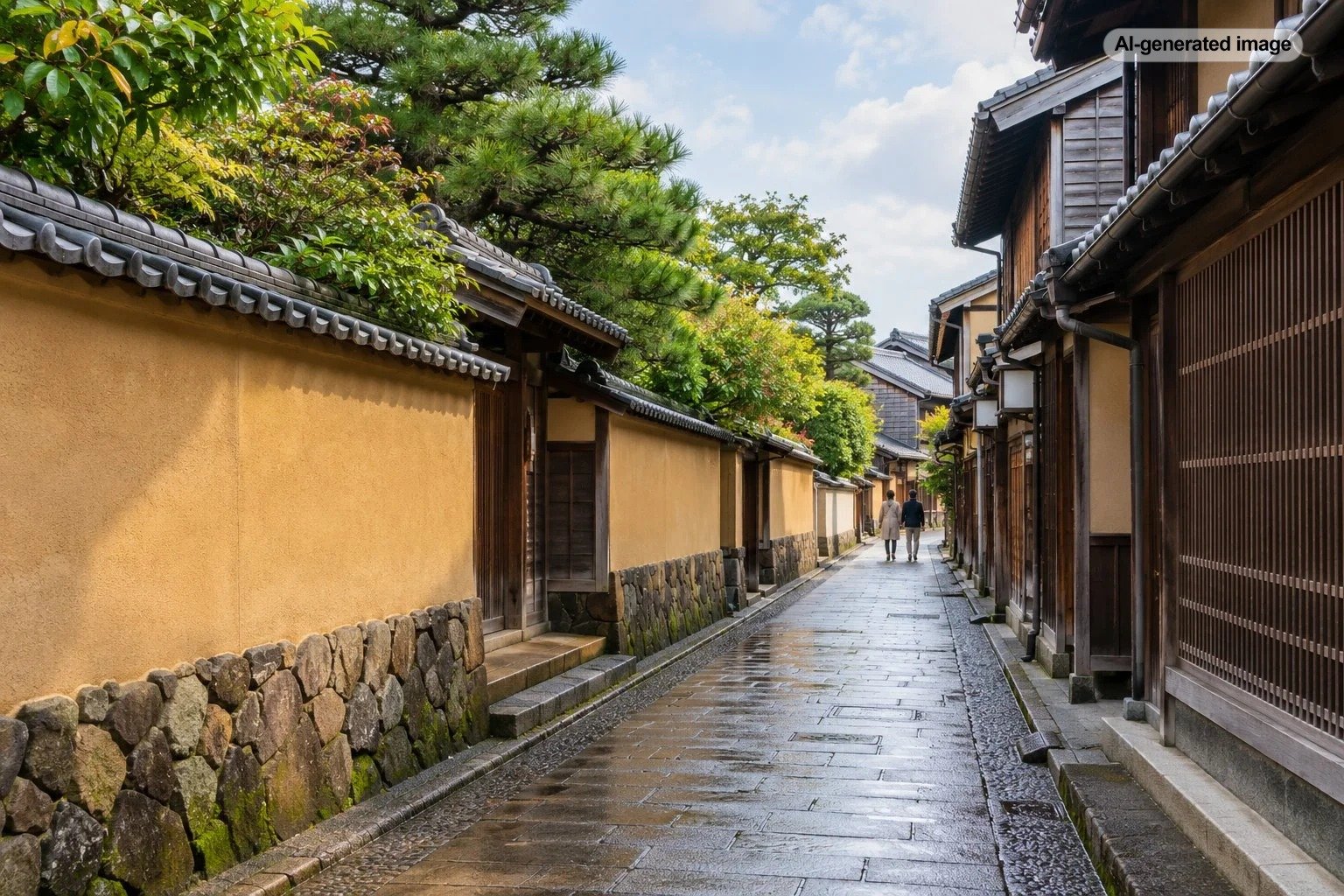
Higashi Chaya, on the eastern side of the Asano River, is one of Kanazawa’s most recognizable historic neighborhoods. Its preserved wooden teahouse buildings, craft shops, and narrow streets create a different atmosphere from the city’s modern commercial areas.
For photography, architectural appreciation, and unhurried neighborhood walks, staying near Higashiyama can be attractive. However, the historic core contains fewer conventional large hotels than Kanazawa Station or the central commercial districts. Travelers interested in accommodations here may encounter smaller inns, traditional houses, and vacation-rental arrangements.
Before selecting a traditional property, examine the precise address and practical access details. Some older buildings may have steep stairs, compact bathrooms, limited luggage services, or different check-in procedures from conventional hotels. Such characteristics depend on the individual accommodation and should never be assumed from a historic exterior.
For many visitors, staying near Kanazawa Castle or Omicho Market and walking to Higashi Chaya offers a more flexible compromise. Japan’s national tourism organization places the walk between the Kenrokuen and castle area and Higashi Chaya at approximately 20 minutes, although the exact route and starting point affect the journey.
What Travelers Often Overlook When Choosing a Kanazawa Hotel
The Closest Hotel Is Not Always the Best Base
Kenrokuen Garden may be the primary attraction, but a visitor who also wants to explore Nagamachi, Higashi Chaya, Omicho Market, and several museums could benefit more from a central location. Review the complete sightseeing plan rather than measuring distance to only one landmark.
Traditional Atmosphere and Traditional Accommodation Are Different
A contemporary hotel featuring regional art is not equivalent to a historic ryokan or a restored machiya townhouse. The former may provide more familiar hotel services; the latter may offer a stronger architectural connection to the city but introduce practical considerations involving stairs, bedding, and building layout.
Weather Changes the Value of a Location
Kanazawa receives substantial precipitation, and the experience of walking between attractions can change considerably during rain or winter conditions. A hotel close to a bus stop, with a manageable luggage route and somewhere comfortable to spend a wet afternoon, may be worth choosing over a marginally shorter sightseeing distance.
Station Proximity Matters Most on Arrival and Departure Days
A station-area hotel simplifies the movement of luggage but adds transportation time to historical sightseeing. For a two- or three-night trip focused on Kanazawa itself, the central neighborhoods often represent a stronger balance. For a single overnight stop, railway convenience may take priority.
Check Room Details Rather Than Assuming a Hotel Category
Japanese hotel room sizes, bed configurations, bathroom arrangements, and luggage space vary by property and room type. Travelers who need extra space should verify the specific room selected. It is also worth confirming cancellation conditions, breakfast inclusion, and local accommodation taxes before booking.
Frequently Asked Questions About Staying in Kanazawa
What is the best area to stay in Kanazawa for first-time visitors?
The central area around Omicho Market, Oyamamachi, and Kamitsutsumicho provides a useful balance for first-time visitors who want to see multiple historic neighborhoods. The Kenrokuen-shita area is a stronger choice when the garden is the main priority.
Can you walk from Kanazawa Station to Kenrokuen Garden?
Yes, but it is a relatively substantial city walk rather than a short walk immediately outside the station. Many travelers prefer using a local bus, particularly with luggage, in uncomfortable weather, or when conserving energy for sightseeing.
Is Higashi Chaya a good place to stay?
It can be an excellent fit for travelers who value traditional architecture and a quieter neighborhood experience. However, accommodation selection and practical facilities may be more limited than in the central hotel districts. Check each property’s exact location and arrangements.
Do you need a rental car to explore Kanazawa?
Usually not for a visit focused on Kenrokuen, Kanazawa Castle, Higashi Chaya, Nagamachi, and the main museums. Walking, buses, and occasional taxis generally provide workable alternatives. A car becomes more relevant when a broader regional itinerary includes destinations outside the central city.
How many nights should you spend in Kanazawa?
Two nights provide a comfortable introduction to the main historic neighborhoods and garden. Three nights allow more time for museums, craft experiences, restaurants, and slower exploration without compressing every attraction into one long day.
Choosing the Right Kanazawa Hotel
For travelers primarily interested in Kenrokuen Garden, HOTEL AO KANAZAWA and Kanazawa Hakuchoro Hotel Sanraku offer especially relevant locations, with different approaches to boutique luxury and historical atmosphere. THE HOTEL SANRAKU KANAZAWA, KUMU, UAN, and Mitsui Garden Hotel Kanazawa create a flexible central base for exploring several neighborhoods. Tokyu Stay Kanazawa emphasizes practical convenience, while Hyatt Centric Kanazawa is well suited to travelers who place railway access first.
The most useful decision is not simply which hotel looks most traditional. It is whether you want to wake up beside the garden, move easily between the city’s historic districts, or make arrival and departure as straightforward as possible. Once that priority is clear, Kanazawa’s accommodation choices become considerably easier to compare.
Sources & Further Reading
- Japan National Tourism Organization: Kanazawa
- Japan National Tourism Organization: Higashi Chaya District
- HOTEL AO KANAZAWA: Official Website
- Kanazawa Hakuchoro Hotel Sanraku: Official Website
- THE HOTEL SANRAKU KANAZAWA: Official Website
- KUMU Kanazawa by THE SHARE HOTELS: Official Website
- UAN Kanazawa: Official Website
- Mitsui Garden Hotel Kanazawa: Official Website and Notices
- Tokyu Stay Kanazawa: Official Website
- Hyatt Centric Kanazawa: Official Website