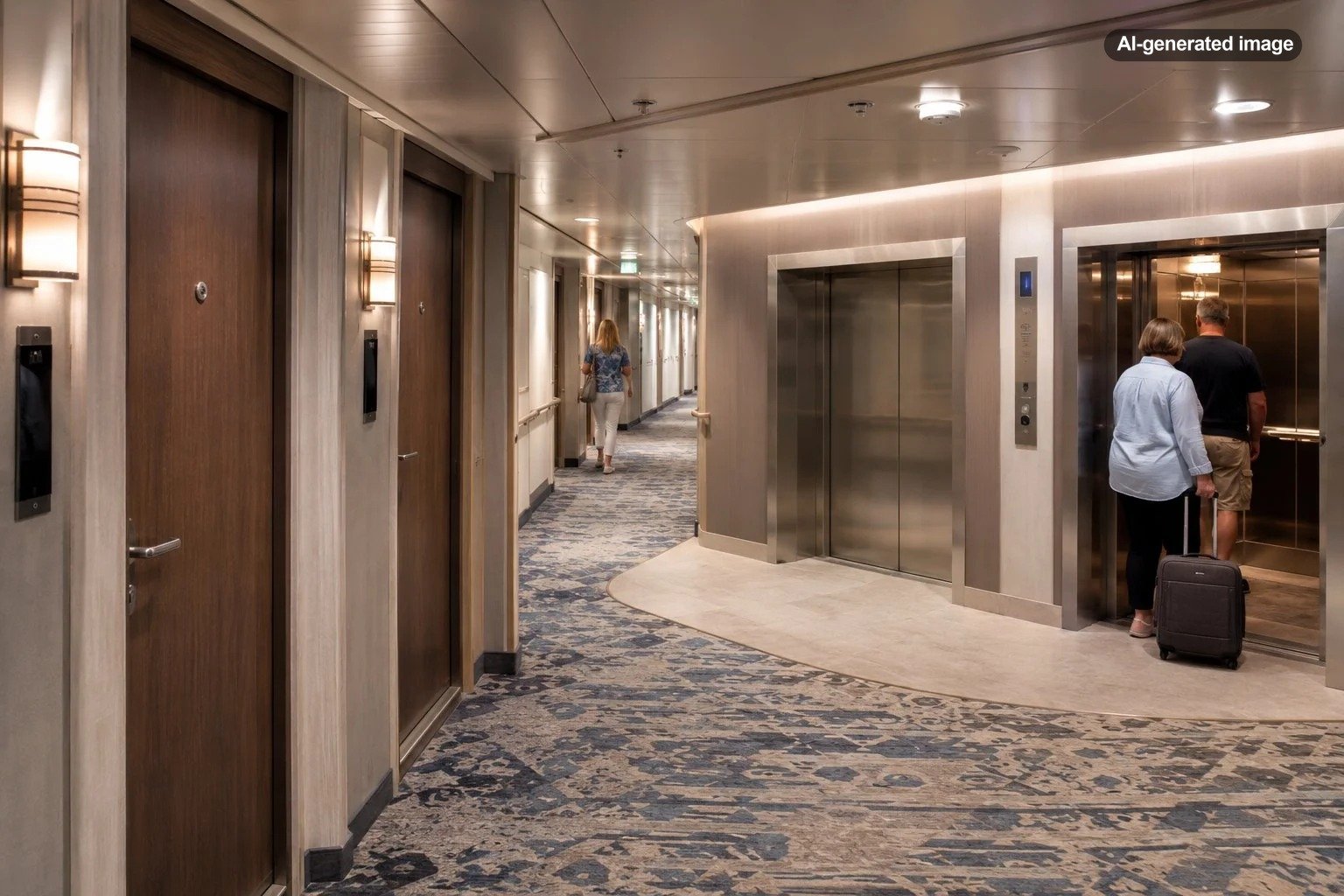
Is a Cruise Cabin Near the Elevators Actually Noisy?
A cruise cabin near the elevators is not automatically noisy. On many ships, a cabin a few doors away from an elevator lobby offers excellent convenience without much additional sound. The greater risk usually comes from passengers gathering, talking, or returning to their cabins late at night, rather than from the elevator machinery itself.
The precise location matters. A cabin near an elevator bank is different from one that shares a wall with an elevator shaft, faces the lobby directly, or sits beside a stairwell used by large numbers of passengers. Ship design, hallway configuration, passenger traffic, and personal sensitivity to noise can all change the experience.
Quick answer
- A few cabins away is often a practical compromise: You retain convenient access without being directly exposed to the busiest part of the lobby.
- Passenger noise is usually the main concern: Conversations, children, footsteps, and groups waiting for elevators may be more noticeable than the elevators themselves.
- A shared wall deserves closer attention: Cabins beside a shaft, service area, or machinery space can carry a different noise risk.
- Traffic changes by time and itinerary: Elevator areas can become busier before dinner, after shows, and during port arrivals or departures.
- Accessibility may outweigh a modest noise risk: Travelers with limited mobility may find proximity to elevators substantially more useful than a cabin farther down a long corridor.
Why elevator proximity does not always mean a noisy cabin
Modern cruise ships commonly place elevator banks in open atriums, cross-corridors, or recessed lobbies. Cabins may be separated from those spaces by a turn in the hallway, a partition, or several doors. That separation can prevent much of the lobby activity from traveling directly into the sleeping area.
Cabin doors and walls do not block every sound, but the hallway layout often matters more than the distance shown on a simplified deck plan. A cabin that appears close to an elevator may sit around a corner and feel relatively sheltered. Another cabin at a similar distance may face an open lobby where voices carry down the corridor.
The elevator cars themselves are not necessarily the loudest element. Chimes, doors, and mechanical movement may be audible in certain locations, but passenger behavior tends to be less predictable. A quiet couple stepping off an elevator creates little disturbance; a group discussing its evening plans outside a cabin can be much more noticeable.
The locations with the greatest noise potential
A cabin facing the elevator lobby
A door that opens directly toward the elevator waiting area has more exposure to voices and foot traffic. This matters most during busy periods, including the time before popular shows, dinner seatings, port excursions, and disembarkation. The disturbance may arrive in short bursts rather than continue throughout the night.
A cabin sharing a wall with the elevator shaft
This is a more important distinction than simply being near the elevators. Depending on the ship and its construction, a wall beside a shaft may transmit humming, movement, or other operational sounds. Deck plans do not always make the shaft boundaries obvious, so an unlabeled space beside a cabin warrants closer examination.
A cabin beside both elevators and stairs
Staircases add another stream of traffic. Passengers who avoid crowded elevators may use the stairs, and groups often pause at the landing to decide where to go. A cabin positioned at the intersection of a main hallway, elevator bank, and stairwell may experience more conversation and footsteps than one along a quieter side corridor.
A cabin near a service door or crew elevator
Passenger elevators are only one consideration. Unmarked or lightly labeled areas on a deck plan can contain crew corridors, service elevators, storage rooms, or housekeeping facilities. These spaces may become active early in the morning. Their presence should not be assumed from the plan alone, but it is reasonable to ask the cruise line or a knowledgeable travel advisor what occupies an unfamiliar space.
When an elevator-adjacent cabin is worth choosing
Convenience can be a meaningful advantage on a large ship. A distant cabin may require a long walk every time a traveler visits the dining rooms, theater, pool deck, or gangway. The difference becomes more significant for passengers with mobility limitations, families managing strollers, adults supervising young children, and anyone who expects to return to the cabin frequently.
An elevator location can also simplify orientation. Large ships may have several elevator banks, and staying near one provides an easy reference point. Midship elevator banks may offer reasonably direct access to a broad range of venues, although the best location depends on the ship’s layout and the places a traveler expects to use most.
For many passengers, the strongest compromise is a cabin in the same general section as the elevators but several doors down the hallway. There is no universal number of doors that guarantees quiet, because corridor shapes and ship construction vary. The goal is simply to avoid opening the cabin door into the waiting area while preserving a short route to vertical transportation.
How to evaluate the cabin before booking
Begin with the deck plan for the exact ship, not another vessel in the same cruise line. Ships within a fleet can have different cabin arrangements, public venues, and elevator configurations. Examine the selected deck as well as the decks immediately above and below it.
- Look for whether the cabin faces the elevator opening or sits around a corner.
- Check whether an elevator shaft or unlabeled interior space shares a cabin wall.
- Identify nearby stairs, connecting doors, public restrooms, laundry rooms, and crew access points.
- Review what is directly above and below the cabin, especially theaters, lounges, restaurants, pools, gyms, and service areas.
- Confirm whether the booking lets you select a specific cabin or assigns one later.
A cabin between passenger decks is often a more predictable choice than one below a busy public area. Being near elevators may matter less than being under a pool deck, buffet, nightclub, or space where furniture is moved early in the morning.
Affiliate disclosure: HotelInfo.com may earn a commission when you book or purchase through links on this page. This does not affect the price you pay. Learn more.
Travelers who are still comparing ships and cabin categories can explore cruise options, then review the official deck plan for each specific vessel before selecting a room. Fares, itineraries, taxes, gratuities, onboard charges, and cancellation terms vary by sailing.
Who should avoid the closest cabins
Light sleepers should be cautious about a cabin directly opposite an elevator bank, even if reviews describe the location as generally quiet. Noise sensitivity is personal, and an otherwise minor burst of conversation can be disruptive when it occurs after midnight.
Travelers taking a celebration cruise, school-break sailing, or short weekend itinerary may also prefer greater separation. These trips can have active evening schedules, which may produce more late-night hallway traffic. This does not mean every such sailing will be noisy, but the potential tradeoff deserves consideration.
Passengers who plan to sleep early, work remotely from the cabin, or keep a young child on a regular nap schedule may value a quieter corridor more than elevator convenience. In those cases, moving farther down the hall can be sensible, provided the additional walking distance is manageable.
What travelers often overlook
Cabin reviews are useful, but they should be read carefully. A guest who reports no elevator noise may sleep deeply or spend little time in the room. Another may describe a location as intolerable after encountering one unusually loud group. Look for repeated comments about the same cabin or surrounding corridor rather than treating a single account as definitive.
Door orientation is another overlooked detail. Two cabins can be equally close to an elevator on a deck plan, yet one may be shielded by a corridor turn while the other receives sound directly from the lobby. Connecting cabin doors can also transmit voices from neighboring rooms, creating a noise issue unrelated to the elevator.
Finally, a guarantee cabin can reduce control over location. It may offer an appealing booking arrangement, but travelers who are highly sensitive to noise should understand that the eventual assignment could be near an elevator, service space, entertainment venue, or another high-traffic area.
Frequently asked questions
Can you hear an elevator moving from a cruise cabin?
It is possible in a cabin that shares a wall with a shaft, but the result depends on the vessel and construction. Cabins merely located near the lobby are more likely to receive intermittent passenger noise than continuous mechanical sound.
How far should a cabin be from the elevators?
There is no distance that works for every ship. A few cabins of separation, preferably with a corridor turn or partition, is often a useful balance. Very sensitive sleepers may prefer a location farther into a residential corridor.
Are forward, midship, or aft elevators quieter?
The answer depends on nearby venues and passenger flow. An elevator bank beside a theater or dining area may become busy at scheduled times, while another serving mostly cabin decks may remain calmer. Midship locations can be convenient but may attract more through traffic.
Is it better to be near stairs instead?
Stairs eliminate reliance on elevators for short trips between decks, but stair landings can also generate footsteps and conversation. A cabin close to both stairs and elevators may be convenient without being the quietest choice.
Should mobility needs take priority over noise concerns?
For many travelers, yes. Long cruise ship corridors can be tiring, and a strategically located cabin may make the entire trip easier. The best choice is often close to an elevator without directly facing the waiting area or sharing a wall with the shaft.
The practical verdict
A cruise cabin near the elevators can be an excellent location, particularly when it sits several doors away or around a corner from the lobby. The word near is not enough to judge the room. The direction the door faces, the presence of stairs or service spaces, and the venues above and below all provide more useful clues.
Travelers who prioritize quiet should avoid the most exposed positions. Those who value accessibility and shorter walks should not reject the entire area. Careful inspection of the exact ship’s deck plan usually reveals a better answer than a simple rule about elevator proximity.