What Does an Extended Balcony Actually Give You on a Cruise?
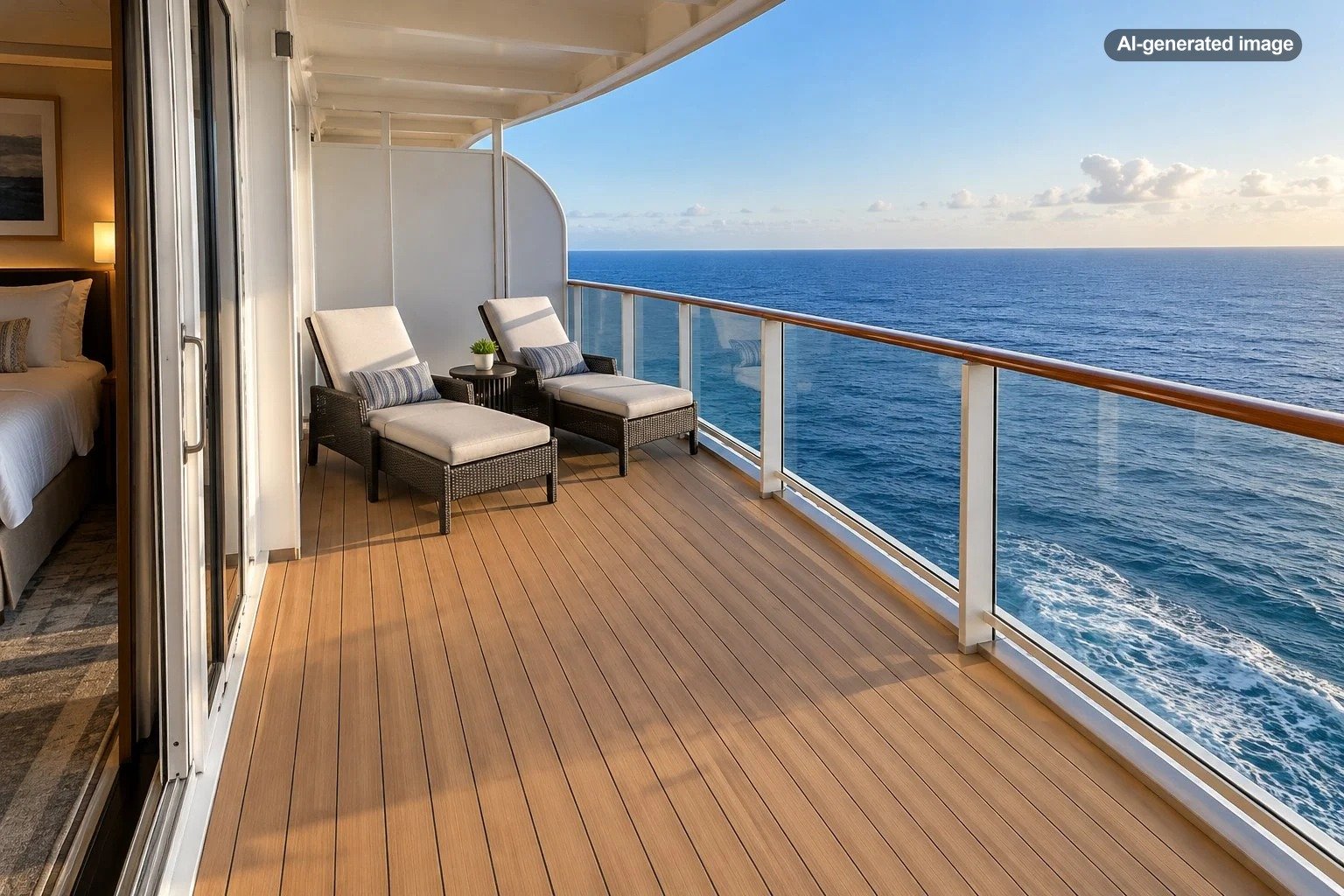
An extended balcony on a cruise gives you more private outdoor space than a standard balcony cabin, usually through additional depth, width, or an unusually shaped deck area. The benefit is not necessarily a larger bedroom or a better view. It is the ability to use your own outdoor space more comfortably, whether that means stretching your legs, moving around furniture, or spending time outside without feeling confined to a narrow strip beside the railing.
That distinction matters because the words extended balcony can sound more substantial than the actual upgrade. On some ships, the difference meaningfully changes how two people can enjoy the space. On others, the extra square footage is modest, awkwardly arranged, or accompanied by compromises in location and privacy. Understanding what you are buying is more useful than relying on the cabin category name alone.
Quick Answer: What Do You Get With an Extended Balcony?
- More outdoor floor space: The balcony generally extends farther outward, stretches wider, or includes an additional section.
- Potentially more comfortable seating: Extra space may make chairs easier to position, although furniture varies by ship and cabin.
- Greater freedom of movement: Two travelers may find it easier to stand, sit, and move around without constantly shifting furniture.
- More opportunities to enjoy the outdoors: A larger balcony can be particularly appealing on scenic itineraries and cruises with substantial time at sea.
- No automatic indoor upgrade: The cabin, bathroom, amenities, and service level may be identical to those of a standard balcony stateroom.
How Is an Extended Balcony Different From a Regular Balcony?
A standard cruise balcony is typically a private outdoor platform accessed through the stateroom. Its dimensions and furniture depend on the ship. Some have enough space for two chairs and a small table, while others provide considerably more usable room.
An extended balcony generally offers additional exterior square footage, but there is no universal cruise-industry measurement that determines when a balcony qualifies as extended. Cruise lines use descriptions such as large balcony, extended balcony, oversized balcony, and extra-large balcony for configurations that vary between ships.
The extra space can take several forms. A deeper balcony projects farther from the cabin, potentially allowing more clearance between the chairs and railing. A wider balcony provides additional side-to-side room. An angled or irregular balcony may have a generous area at one end while remaining narrow elsewhere.
These differences affect usability. A few additional feet of depth can be more valuable to someone who wants to sit comfortably facing the sea than a longer but shallow balcony. Similarly, a spacious-looking corner balcony may offer less practical furniture placement than its total square footage suggests.
Does an Extended Balcony Come With a Bigger Cruise Cabin?
Usually, the defining difference is outside rather than inside. An extended balcony can belong to an otherwise standard stateroom with essentially the same sleeping area, bathroom, storage, and furnishings as neighboring balcony cabins.
However, some cruise lines offer larger balconies as part of distinctly different accommodation categories, including certain suites or premium staterooms. In those cases, the cabin may also have additional interior space or amenities. Those benefits come from the particular category, not simply from the presence of an extended balcony.
Norwegian Cruise Line, for example, identifies large-balcony accommodations separately from various standard balcony and suite configurations on ships such as Norwegian Breakaway and Norwegian Getaway. Its published stateroom categories demonstrate why travelers should examine the actual cabin type rather than assuming that all larger balconies accompany equivalent interiors.
When comparing accommodations, separate three measurements: interior cabin area, balcony area, and combined stateroom area. A listing that advertises total square footage may include the outdoor space, making a cabin appear substantially larger even when its interior is unchanged.
What Can You Actually Do With the Extra Space?
Enjoy outdoor seating more comfortably
For many travelers, the most useful advantage is simply having room to sit without feeling crowded. On a compact balcony, moving a chair away from the railing or opening the balcony door can require adjusting the furniture. A deeper configuration may reduce those inconveniences.
The benefit is especially noticeable when two people want to spend time outside together. One person may be able to stand near the railing while the other remains seated, without either needing to squeeze past furniture.
Spend more time outside during scenic cruising
An extended balcony can become a more appealing place to watch coastlines, harbor approaches, or passing scenery. Travelers who enjoy quiet observation may appreciate having their own outdoor area rather than competing for space on public decks.
It does not, however, guarantee a better viewing angle. A conventional balcony with an unobstructed outward view can be preferable to a much larger balcony affected by structural overhangs or limited side visibility.
Make a private outdoor space feel less restrictive
Even when the furniture remains unchanged, additional floor space can improve the experience. There may be more room to turn around, set down a small personal item temporarily, or use the available seating without constantly navigating around another person.
Families may appreciate the breathing room, but an extended balcony does not increase the cabin’s official occupancy or eliminate the need to supervise children. Balcony railings, doors, and outdoor furnishings still require appropriate caution.
What Does an Extended Balcony Not Guarantee?
It is worth identifying the benefits that are often assumed but are not automatically included.
- Reclining loungers: Some larger balconies may accommodate loungers, but others have the same basic chairs and table as standard balconies. Furniture is not necessarily interchangeable or available on request.
- More privacy: A balcony extending beyond neighboring balconies may be visible from above or from adjacent outdoor spaces.
- Better views: Lifeboats, structural supports, deck overhangs, and the balcony’s position can affect sightlines regardless of size.
- Less noise: Balcony size does not determine whether nearby public decks, venues, or operational areas will be audible.
- Additional services: An extended balcony alone does not establish priority boarding, upgraded dining privileges, or suite benefits.
- More sunlight: The amount of direct sun depends on the ship’s structure, orientation, route, and time of day.
In practical terms, larger does not always mean more luxurious. A well-positioned standard balcony may deliver a more enjoyable experience than a spacious balcony with limited privacy or an inconvenient location.
Balcony Depth, Width, and Shape: Which Matters Most?
For travelers primarily interested in sitting outdoors, usable depth is often particularly valuable. It determines how much clearance exists between the cabin wall, furniture, and railing.
Width becomes important when multiple people want to enjoy the outdoor area together. A wider balcony may support a more comfortable seating arrangement, depending on the supplied furniture.
Irregular shapes require closer inspection. Some balconies are angled because of the ship’s architecture, while others occupy corners or transition areas where the vessel changes width. These configurations can create additional floor area without producing a consistently deep rectangular space.
Consider two hypothetical balconies. One measures approximately six feet across and six feet deep, while another measures ten feet across and only four feet deep. Although their overall areas are similar, the first might offer better front-to-back clearance while the second provides more side-to-side room. Neither is automatically superior.
The best measurement is not just square footage. It is the amount of usable space after accounting for furniture, railings, door clearance, and structural features.
Does the Location of an Extended Balcony Matter?
Yes. Its position on the ship can be at least as important as its dimensions.
Midship balconies
Midship accommodations are often attractive to travelers who value convenient access to different parts of the vessel or prefer a location closer to the ship’s center of motion. A large midship balcony can combine additional outdoor room with a practical position, although the specific decks and neighboring spaces still need inspection.
Aft-facing balconies
Aft-facing balconies look toward the ship’s wake and may feature distinctive shapes or generous dimensions. They appeal to travelers who enjoy watching the ship’s route recede behind it.
Tradeoffs may include greater distance from particular ship facilities, occasional vibration, soot or exhaust-related residue under certain conditions, and differing degrees of visibility from nearby balconies. The experience varies substantially by vessel and deck.
Forward balconies
Forward locations can offer an interesting perspective, but wind exposure may affect comfort when the ship is underway. Some forward-facing outdoor spaces have operational restrictions or design features intended to address those conditions.
Balconies beneath public decks
An extended balcony below a pool deck, outdoor restaurant, or other public area may experience noise from activity or furniture movement. Depending on the ship’s architecture, people above may also be able to look down onto portions of the balcony.
Review the deck immediately above and below the proposed cabin, not only the cabin’s own deck.
Extended Balcony vs. Regular Balcony: Which Is Better?
| Consideration | Regular Balcony | Extended Balcony |
|---|---|---|
| Outdoor space | Generally more compact | Additional area, layout varies |
| Seating comfort | Often adequate for brief use | Potentially more room around furniture |
| Indoor cabin size | Depends on category | Not necessarily larger |
| Privacy | Depends on position | May be more exposed |
| Best fit | Occasional outdoor use | Travelers planning extended balcony time |
| Booking value | Often the simpler choice | Depends on the premium and specific cabin |
The standard balcony is often sufficient for travelers who mainly want fresh air, a private view, and somewhere to sit for a few minutes. An extended balcony becomes more compelling when the outdoor space is an important part of the vacation rather than an occasional amenity.
Is an Extended Balcony Worth Paying Extra For?
The answer depends less on the advertised category and more on your intended use of the space.
An extended balcony may be worthwhile if: you enjoy reading outside, regularly have coffee on the balcony, value a quieter alternative to crowded public decks, or plan to spend meaningful time watching scenery from your cabin.
Couples who want comfortable seating for two may find the difference particularly useful. Travelers booking longer sailings may also appreciate having an outdoor area that feels more functional over several days.
A regular balcony may be better value if: you spend most of your day exploring ports, participate extensively in onboard activities, or primarily use the balcony for brief views and fresh air.
The itinerary matters. A cruise with multiple sea days may create more opportunities to use a generous private balcony than a port-intensive itinerary where most daylight hours are spent ashore. Weather also matters. Wind, rain, strong sun, and temperature can reduce the amount of time an outdoor area is comfortable.
Instead of applying a universal price threshold, compare the actual upgrade premium with the additional use you expect. If the difference is modest and the specific balcony has a practical layout, it may be appealing. If the premium is substantial, you may prefer to spend that amount elsewhere on the trip.
How to Check the Balcony Before Booking
The most important step is to research the exact ship, deck, and cabin number. A general promotional photograph may represent the accommodation category rather than the individual balcony you will receive.
- Identify the balcony’s separate square footage. Confirm whether published measurements describe the outdoor area or the total accommodation.
- Examine the deck plan. Look for unusual balcony shapes, nearby public spaces, overhangs, lifeboats, and structural features.
- Check the furniture arrangement. Determine whether the balcony actually includes the seating you expect.
- Look for cabin-specific photographs. Images of the exact cabin or a genuinely identical configuration can reveal practical details missing from category illustrations.
- Assess visibility from neighboring decks. An outward extension can sometimes reduce privacy.
- Confirm any view restrictions. A larger balcony can still have a partially obstructed outlook.
- Compare cabin selection rules. If choosing a guaranteed category without a specific assigned cabin, do not assume you will receive a preferred balcony shape or location.
It also helps to compare several sailings on the same ship and, when appropriate, equivalent accommodations on different vessels. Cabin designs can vary dramatically even within one cruise line.
Affiliate disclosure: HotelInfo.com may earn a commission when you book or purchase through links on this page. This does not affect the price you pay. Learn more.
When comparing ships and departure dates, you can browse cruises with Expedia as part of your research. Use the cruise line’s official deck plans and cabin descriptions to confirm balcony dimensions, furnishings, and location before selecting a particular accommodation.
What Travelers Often Overlook About Larger Cruise Balconies
One easily missed consideration is that the balcony may be larger without being more sheltered. An exposed extension can receive more direct sunlight, wind, or precipitation than a recessed standard balcony. Travelers who prefer shade should examine overhead coverage rather than assuming extra space improves comfort.
Another is that outdoor furniture occupies a meaningful portion of the available area. A balcony with generous measurements can still feel cramped if chairs are bulky or cannot be repositioned conveniently.
Travelers should also distinguish between visual spaciousness and actual privacy. A projecting balcony may provide wonderful outward views while making the occupant more visible to passengers above. Conversely, a recessed balcony can feel sheltered but may have more restricted sightlines.
Finally, a premium balcony cannot change the fundamental conditions of an itinerary. During unfavorable weather, rough seas, or periods when outdoor access is restricted, its additional square footage may provide little benefit. The value of the upgrade is therefore tied to how you travel, not merely what appears on the deck plan.
Frequently Asked Questions
Is an extended balcony the same as an oversized balcony?
Often the terms describe similar ideas, but they are not standardized across cruise lines. Extended may refer to additional depth, while oversized may simply mean a balcony with more area than the category norm. Always verify the actual dimensions and configuration.
Can you fit a lounge chair on an extended cruise balcony?
Possibly, but not necessarily. The answer depends on available floor space, balcony shape, existing furnishings, and cruise line policies. Do not assume loungers are supplied or that additional furniture can be requested.
Are extended balconies more private?
Not automatically. Some balconies extend beyond the structure above them and may be visible from higher decks. Others have sheltered configurations with relatively good privacy. The precise cabin location is decisive.
Does an extended balcony have a better ocean view?
Extra outdoor area may provide more freedom to position yourself, but it does not guarantee a clearer view. Ship structures, balcony partitions, and the cabin’s orientation can all affect what you see.
Should you choose an extended balcony or a higher deck?
Neither choice is universally better. A higher deck may offer a different viewing perspective, while an extended balcony provides additional outdoor area. Compare the actual sightlines, proximity to public spaces, overhead coverage, and likely noise before deciding.
The Bottom Line: Buy the Space You Will Actually Use
An extended balcony is most valuable when its extra dimensions improve how you spend time outside. It can turn a compact seating area into a more comfortable private retreat, especially for travelers who enjoy scenic cruising, quiet mornings, and relaxing outdoors together.
But the upgrade does not automatically provide a larger room, better furniture, superior privacy, or a more desirable location. A carefully selected standard balcony can be the stronger choice when its view, shelter, and position better match your priorities.
Before paying a premium, compare the specific balcony’s measurements, shape, furnishings, and surroundings. The real advantage is not simply having more square footage. It is having outdoor space that makes your particular cruise more enjoyable.