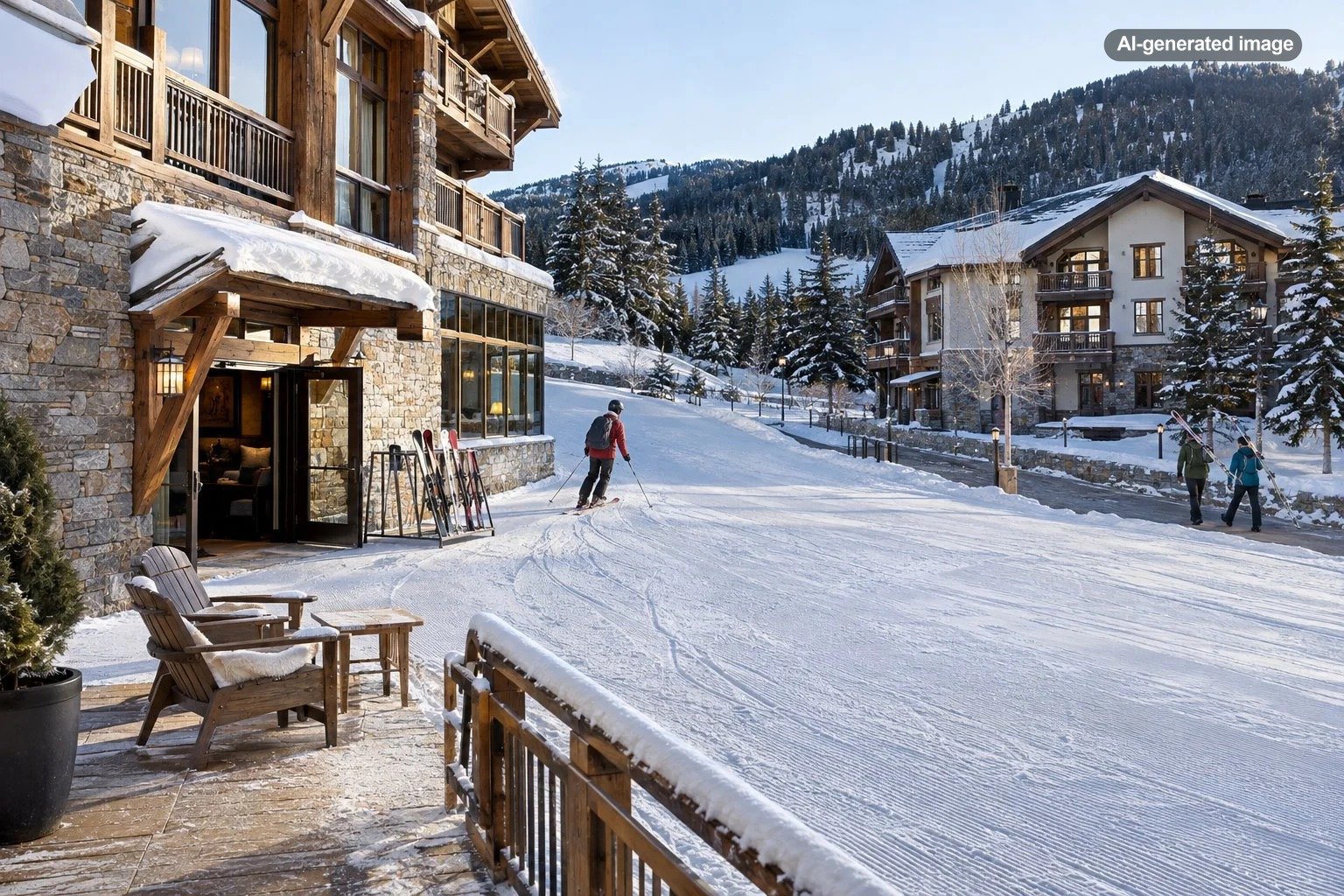
What Is the Difference Between Ski-In/Ski-Out and Ski-Adjacent Hotels?
The difference between a ski-in/ski-out hotel and a ski-adjacent hotel comes down to how directly you can reach the slopes. A genuine ski-in/ski-out property allows guests to begin skiing from the property or an immediately connected access point and return on skis under suitable conditions. A ski-adjacent hotel sits near the ski area but may require walking, crossing a road, taking a shuttle, or using another connection before reaching the lifts or a skiable trail.
Both arrangements can make a mountain vacation convenient, but they are not interchangeable. The distinction affects how you organize mornings, manage equipment, take breaks, supervise children, and return after the lifts close. It can also influence what you are willing to pay for accommodations.
Quick Answer: Ski-In/Ski-Out vs. Ski-Adjacent
- Ski-in/ski-out: Offers direct or nearly immediate skiable access between the lodging and the mountain, assuming the connecting terrain is open and usable.
- Ski-adjacent: Located beside or close to the ski area, but does not necessarily provide a skiable connection.
- Slopeside: Describes proximity to ski terrain, although the term does not consistently guarantee ski-in/ski-out access.
- Most convenient for frequent breaks: A property with reliable ski-in/ski-out access to terrain suitable for your group.
- Potentially better value: A ski-adjacent hotel with a short, straightforward route to the lifts.
The important question is not simply how close the building appears to a ski run. It is whether the actual route between your room, the mountain, and your return point works for your skiing ability and daily schedule.
What Does Ski-In/Ski-Out Actually Mean?
Ski-in/ski-out describes accommodations with skiable access in both directions. Ideally, you can put on your skis or snowboard near the property, connect to maintained ski terrain, and return without relying on a vehicle or a substantial walk.
However, the phrase is a lodging description rather than a universally standardized guarantee. Properties may use it for very different arrangements. One hotel might have a groomed trail directly outside its ski room. Another might require guests to walk across a courtyard, climb a short incline, or follow a connecting path before putting on their equipment.
Ski-In and Ski-Out Are Two Separate Features
A property can offer convenient access in one direction without offering the same experience in reverse.
For example, a hotel might sit above a lift and allow guests to ski downhill to the base area each morning. Returning could require riding a particular lift before it closes, taking a shuttle, or walking uphill from the nearest accessible trail.
Conversely, a hotel below a ski run might be easy to reach at the end of the afternoon but require an uphill walk or shuttle ride to begin skiing.
Before booking, confirm both directions independently. Ask where guests put on their equipment in the morning and how they return at the end of the day. A single photograph showing a snowy slope beside the building does not answer either question.
Direct Access Does Not Always Mean Easy Access
Even genuinely ski-in/ski-out hotels can present challenges. Their connections may involve narrow traverses, short but steep sections, surface lifts, or trails unsuitable for beginners.
A confident intermediate skier might consider a narrow connecting trail effortless. A first-time skier, a young child, or someone returning from an injury may find the same route inconvenient.
The ideal ski-in/ski-out property therefore offers more than proximity. Its access should connect to terrain appropriate for the guests using it.
What Is a Ski-Adjacent Hotel?
A ski-adjacent hotel is located close to the ski resort’s slopes, lifts, base village, or related facilities without necessarily having a direct skiable connection. The description emphasizes location rather than the ability to ski to and from the building.
Depending on the property, guests might walk a few minutes to a lift, cross a pedestrian plaza, use an on-demand shuttle, or travel a short distance to the resort’s main base area.
Some ski-adjacent properties are exceptionally convenient. A hotel directly opposite a gondola entrance, for instance, might involve a brief walk on a cleared sidewalk. For many guests, that is easier than navigating a difficult ski-in/ski-out connector.
Others may be farther away than promotional photographs suggest. Mountain terrain, parking lots, road layouts, and differences in elevation can make a seemingly short distance more demanding when carrying equipment.
How Do the Two Hotel Types Compare?
| Consideration | Ski-in/ski-out | Ski-adjacent |
|---|---|---|
| Slope access | Skiable connection when conditions permit | May require walking or transportation |
| Morning routine | Potentially fewer transfers | Usually requires reaching a lift or base area |
| Midday breaks | Often easier to return to the room | Depends on walking distance and shuttle access |
| Typical price positioning | Direct access may command a premium | May offer more choices across price ranges |
| Main limitation | Access depends on terrain, lifts, and snow | Actual transfer may be less convenient than advertised |
Neither category automatically determines room quality, service, dining, equipment storage, or other hotel amenities. Those features should be evaluated separately.
When Is Ski-In/Ski-Out Worth Paying More For?
Direct slope access can be particularly valuable when the convenience will be used repeatedly rather than appreciated only once or twice.
Families With Children
Families often have more equipment to manage and may need frequent breaks. Easy access to the hotel can simplify clothing changes, snacks, rest periods, and the logistics of helping younger skiers.
Nevertheless, a beginner-friendly route matters more than the label. If returning to the hotel requires navigating an intermediate trail, a short walk from a ski-adjacent property to the beginner area may be preferable.
Groups With Different Skiing Schedules
Some travelers prefer opening lifts and skiing continuously. Others want a relaxed morning or an afternoon away from the mountain.
When guests can return independently, reliable ski-in/ski-out access allows the group to maintain different schedules without repeatedly coordinating transportation.
Travelers Planning Multiple Consecutive Ski Days
For an extended mountain vacation, saving a transfer each morning and afternoon can become meaningful. A convenient return route is especially appealing after a physically demanding day.
Still, consider the entire trip. A hotel with direct trail access but inconvenient dining, limited equipment storage, or restricted connections to the terrain you intend to ski may not be the most practical choice.
When Can a Ski-Adjacent Hotel Be the Better Choice?
A ski-adjacent hotel may offer a better overall arrangement when the journey to the mountain is short and predictable.
Beginners: A property near the ski school meeting point, learning area, or main gondola can be more useful than one connected to an unsuitable trail.
Travelers prioritizing restaurants and village activities: A centrally located hotel might provide easier access to dining, shops, and evening activities, particularly when the main ski-in/ski-out accommodations sit farther from the village center.
Budget-conscious travelers: Forgoing direct trail access may free up money for lessons, equipment rentals, dining, or a longer stay. The price difference varies by destination, property, and dates.
Mixed-activity groups: When some travelers do not ski, access to pedestrian areas, public transportation, and non-ski activities can matter more than a trail outside the hotel.
A short, level, well-maintained walk can be entirely reasonable. The concern is an unexpectedly long or difficult transfer while carrying boots, skis, poles, or snowboards.
What Can Interrupt Ski-In/Ski-Out Access?
The most overlooked limitation is that ski-in/ski-out access is conditional, even when the hotel itself remains open.
Early- and Late-Season Conditions
A resort may have enough snow or snowmaking coverage to operate its main mountain while lower-elevation connecting trails remain closed. Properties relying on those connectors may temporarily lose their advertised skiable access.
Early-season and spring travelers should pay special attention to this distinction. A hotel may be near operating ski terrain without having a usable trail all the way to its entrance.
Lift Closures and Operating Hours
Some return routes depend on a particular lift or connection. Weather, operational decisions, and daily closing times can affect whether guests can reach the hotel on skis.
If the property requires a lift to return, find out what alternative transportation is available when that lift is closed. Do not assume every trail remains available after normal operating hours.
Terrain and Equipment Restrictions
A connecting route might be too challenging for some guests or unsuitable for certain activities. Snowboarders may also find long, flat traverses particularly inconvenient.
Confirm whether access works for your equipment and ability rather than assuming the experience is identical for every visitor.
How to Verify a Hotel’s Actual Slope Access Before Booking
Hotel descriptions are useful starting points, but the most dependable approach is to examine the route itself.
- Locate the building on the resort trail map. Identify the nearest lift, connecting run, and appropriate return route.
- Check walking distances. Ask for the actual route between the ski storage area and the nearest usable lift or trail, not merely the straight-line distance.
- Identify the trail difficulty. Confirm whether beginners can safely use the connecting terrain under normal operating conditions.
- Ask about seasonal limitations. Determine whether skiable access depends on specific trails opening.
- Verify the return route. Ask whether reaching the hotel requires a particular lift or involves uphill walking.
- Clarify shuttle arrangements. For ski-adjacent accommodations, confirm pickup locations, operating schedules, equipment policies, and whether transportation is included.
- Check equipment storage. Determine where skis, snowboards, and boots are stored and whether any storage charges apply.
One particularly useful question to ask the hotel is: Can a beginner leave the ski storage area, reach the appropriate lifts, and return to the property without carrying equipment or taking transportation?
The answer can reveal more than the hotel’s category label.
How to Evaluate the Total Value of Each Option
Rather than comparing room rates alone, consider the cost and convenience of the complete skiing routine.
A ski-adjacent hotel with complimentary equipment storage next to the gondola may eliminate the need to carry skis from the hotel every morning. Another might require a paid locker or regular shuttle transportation.
Similarly, a ski-in/ski-out hotel may reduce daily transfers but involve a higher room rate or other charges. Resort fees, parking, equipment storage, and transportation arrangements vary by property and should be verified before booking.
Compare how much skiing you expect to do, whether you plan to return to your room during the day, and how comfortably everyone in your group can manage the access route.
For a short vacation focused on skiing from morning until the lifts close, a convenient ski-adjacent location may be perfectly sufficient. For a longer trip involving children or frequent breaks, direct access may justify a higher lodging budget.
Frequently Asked Questions
Is slopeside the same as ski-in/ski-out?
Not necessarily. Slopeside generally describes a property beside or near ski terrain, but it does not consistently guarantee a skiable route in both directions. Verify the actual connection before assuming the terms are equivalent.
Can a ski-in/ski-out hotel lose its direct access?
Yes. Insufficient snow, closed connecting trails, lift interruptions, and other operational conditions can prevent guests from skiing directly to or from the property. The alternative arrangement depends on the hotel and resort.
Are ski-adjacent hotels always cheaper?
No. Direct slope access often carries a premium, but pricing also reflects location, property quality, room category, season, amenities, and demand. An upscale ski-adjacent hotel may cost more than a simpler ski-in/ski-out property.
Is ski-in/ski-out better for beginners?
Only when the connecting terrain suits beginners. A ski-adjacent hotel beside the learning area may be more convenient than a ski-in/ski-out property reached by a challenging run.
Does ski-in/ski-out mean the lifts are right outside the hotel?
Not always. Some hotels connect to trails that lead to a lift farther down the mountain. Others provide access close to a lift terminal. Ask about the precise route rather than assuming immediate lift access.
Choosing the Right Ski Hotel for Your Trip
The fundamental distinction is straightforward: ski-in/ski-out refers to skiable access, while ski-adjacent refers to proximity. What matters in practice is how that difference affects your daily experience.
Choose ski-in/ski-out when dependable direct access, independent schedules, and convenient midday breaks are priorities. Consider ski-adjacent accommodations when the lift connection is simple, the location better serves your group, or the overall lodging arrangement provides better value.
In either case, examine the actual terrain, confirm the route in both directions, and ask how access changes when conditions are less than ideal. The most convenient ski hotel is not necessarily the one closest to the mountain on a map. It is the one whose access works best for the people staying there.