How to Tell If a Safari Lodge Is Too Large for a Quiet Experience
A safari lodge can be beautifully designed, remote, and surrounded by wilderness yet still feel busier than a traveler seeking a quiet experience expects. The most useful number to investigate is not simply the property’s acreage or how secluded it appears in photographs. It is the combination of guest capacity, lodge layout, shared facilities, vehicle operations, and the number of people moving through the property at the same time.
There is no universal room count at which a safari lodge becomes too large. A thoughtfully dispersed lodge with a dozen rooms may feel remarkably peaceful, while a smaller camp with closely spaced tents and one communal dining area can feel quite social. For travelers prioritizing stillness, privacy, and an intimate atmosphere, the goal is to understand how the property actually functions rather than relying on labels such as boutique, exclusive, or intimate.
Quick answer: look beyond the number of rooms
- Check maximum guest capacity. Room count can be misleading when family suites, villas, and multi-bedroom units accommodate several people.
- Ask how many safari vehicles operate at full occupancy. A quiet lodge can feel considerably busier when multiple vehicles depart and return together.
- Study the layout. Widely separated accommodations and several small common areas can make a larger property feel calmer.
- Understand the dining format. One central dining room produces a different atmosphere from flexible private tables or several dining locations.
- Consider who the lodge is designed for. Family-oriented, group-friendly, and event-capable properties may naturally have more activity than small adult-focused camps.
Guest capacity matters more than the marketing description
Start by finding the total number of rooms, tents, suites, or villas, then estimate how many guests the lodge can accommodate when full. A property with eight accommodations may sound tiny, but the experience can change if several are large family units. Conversely, a lodge with more rooms can remain relatively peaceful if the accommodations are spread across a large footprint and guests rarely gather in one place.
For a traveler who strongly values quiet, very small camps often have an inherent advantage. Fewer guests generally mean fewer simultaneous arrivals, conversations, vehicle departures, dining groups, and movements through common spaces. Some operators explicitly distinguish their smaller camps from larger sister properties by describing them as more intimate or better suited to guests seeking a quieter atmosphere.
That does not make a larger lodge a poor choice. Greater capacity can support more facilities, additional staff, broader dining arrangements, family accommodations, pools, shops, wellness spaces, or different places to relax. The tradeoff is that there are simply more opportunities for other guests to enter your experience.
Ask how many vehicles leave on each game drive
Safari lodge size is especially noticeable at departure time. If a full property requires several game-drive vehicles, guests may gather simultaneously for refreshments, guide assignments, and boarding. The same pattern repeats when vehicles return for meals.
Ask the lodge or safari planner how many guests typically share a vehicle and approximately how many vehicles operate when the lodge is full. Also ask whether private vehicles can be arranged. Availability, conditions, and additional charges vary by property, so this should be confirmed directly rather than assumed.
The broader wildlife area matters as well. A small camp does not automatically guarantee uncrowded sightings if many other lodges share the same roads or traversing area. Conversely, a moderately sized lodge operating within a spacious private reserve or concession may produce a quieter game-viewing experience than its room count suggests. Travelers seeking seclusion should therefore investigate both lodge capacity and vehicle density in the wildlife area.
Look closely at the design of the common areas
A lodge’s floor plan can reveal more about its atmosphere than its promotional adjectives. Imagine where guests will naturally converge. Is there one lounge, one deck, one pool, and one dining room? Or are there several terraces, small seating areas, private decks, and separate places where guests can spend downtime?
A central design can be appealing for travelers who enjoy meeting other guests and discussing sightings over drinks or dinner. Someone hoping to read quietly, watch wildlife alone, or spend long periods without social interaction may prefer a property where accommodation units have substantial private outdoor space.
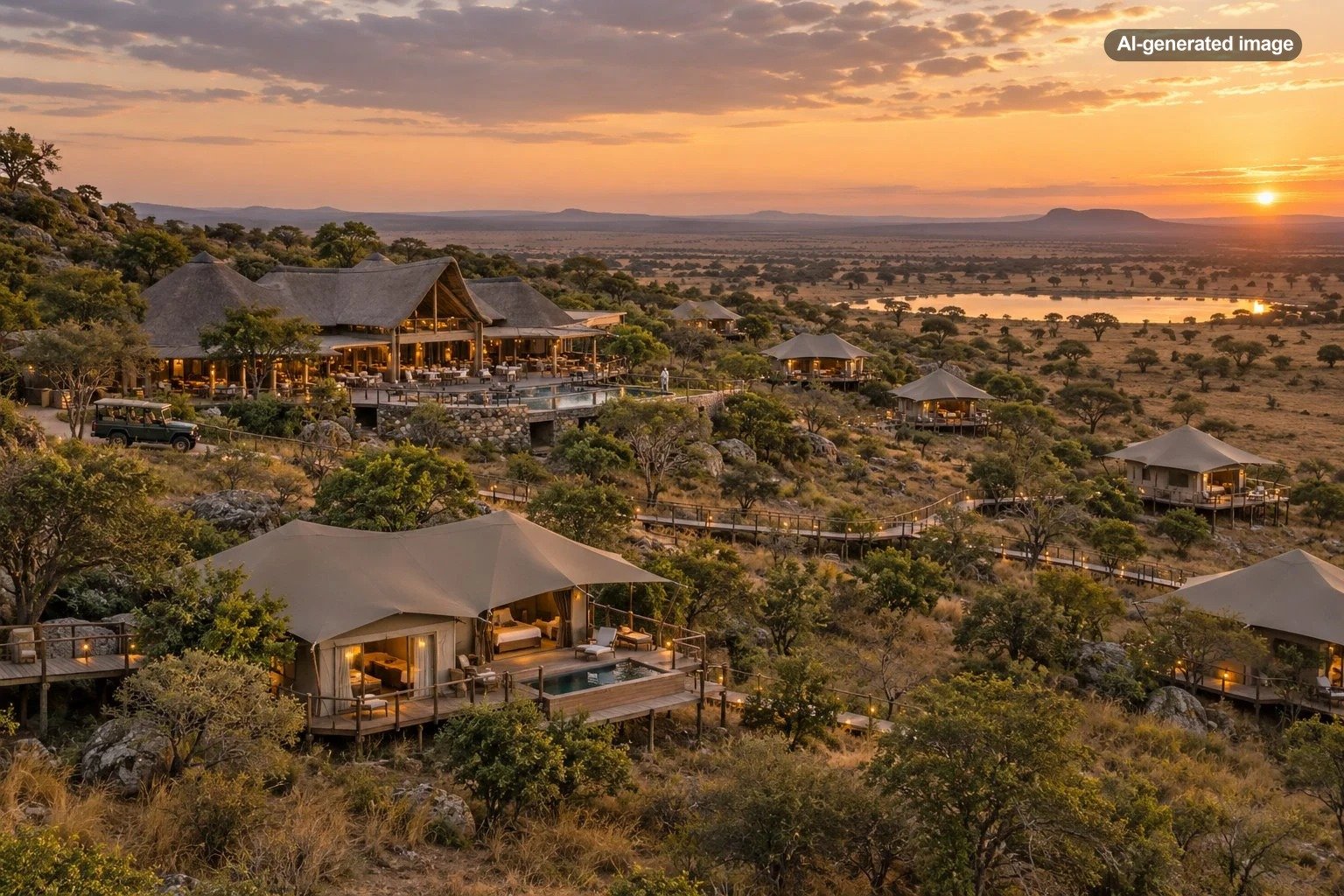
Also examine the distance between rooms. Photographs frequently emphasize the landscape rather than neighboring accommodations, so use a property map when available. If privacy is important, ask whether rooms directly overlook paths, the pool, the main deck, or other suites.
Dining style can determine whether the lodge feels social or serene
Safari dining varies considerably. Some camps embrace communal meals as part of the experience, with guests, hosts, and sometimes guides sharing one table. For sociable travelers, this can be a highlight. For someone intentionally choosing a quiet vacation, it can create more interaction than expected even at a very small camp.
Ask whether meals are normally communal, served at separate tables, or offered in multiple locations. If private dining is important, confirm whether it can be requested and whether there are restrictions or additional costs. Do not assume that an expensive or low-capacity lodge automatically provides private tables.
Meal timing matters too. A larger lodge with flexible dining arrangements may actually feel less crowded than a tiny camp where every guest follows the same schedule and gathers around the same table.
Family-friendly and group-friendly properties have a different rhythm
Travelers seeking near-silence should pay attention to the property’s intended audience. A lodge designed for families may have family suites, children’s activities, larger communal areas, and schedules that accommodate different ages. None of these characteristics is negative, but they can create a livelier atmosphere.
Likewise, a property that readily accommodates extended families, incentive groups, celebrations, or small events may occasionally feel much busier than its usual photographs suggest. Couples and solo travelers who want a consistently low-key environment may prefer an adult-focused camp, a very small satellite camp, or an exclusive-use villa when those formats suit the trip.
Separate room privacy from safari privacy
These are two different questions. A large lodge can provide excellent privacy inside and around individual suites while operating a comparatively busy safari program. A tiny camp can provide an intimate game-drive experience while placing tents close enough that neighboring conversations are noticeable.
Consider the experience in three layers: your accommodation, the shared lodge, and the wildlife activities. If quiet is a priority, all three should fit your expectations. A spectacular private deck cannot completely compensate for crowded common areas if you spend substantial time there, and an intimate dining room does not guarantee solitude during game drives.
Questions to ask before booking
A short email to the property or safari specialist can clarify what photographs cannot. Useful questions include:
- How many guests can the lodge accommodate when completely full?
- How many safari vehicles typically operate at full occupancy?
- How many guests are normally assigned to each vehicle?
- Are meals communal or served at individual tables?
- Are there several lounges or quiet outdoor areas away from the main lodge?
- How closely spaced are the rooms or tents?
- Does the property frequently accommodate families or larger groups?
- Can a private vehicle or private dining arrangement be requested?
The quality of the answers can be more useful than a simple claim that the lodge is peaceful. Specific operational details allow you to judge whether the property matches your own definition of quiet.
What travelers often overlook
Occupancy can change the character of the same lodge from one stay to another. A property operating well below capacity may feel extremely calm, while the same property at full occupancy can have a different rhythm. Because future occupancy cannot always be predicted or guaranteed, travelers who consider quiet essential should choose a lodge whose design works for them even when every room is occupied.
Location within the property matters too. A room near reception, the bar, pool, dining deck, kitchen, or main path may experience more passing activity than one toward the edge of the lodge. When room allocation requests are accepted, asking for a quieter location can sometimes matter as much as choosing a smaller property.
Finally, do not assume that bigger automatically means noisy or smaller automatically means peaceful. A well-designed larger lodge can disperse guests effectively, while a six-room camp built around a single compact communal hub can be intentionally sociable. The more reliable approach is to examine capacity, layout, operating style, and the structure of the safari program together.
FAQ
How many rooms should a quiet safari lodge have?
There is no universal cutoff. Lower-capacity camps often provide a more intimate environment, but spacing, shared facilities, guest profile, and vehicle operations can matter just as much as room count.
Is a tented camp always quieter than a safari lodge?
No. The terms describe accommodation styles imperfectly and do not reliably indicate capacity or atmosphere. Check the actual number of units, maximum guests, layout, and communal arrangements.
Can a larger lodge still be a good choice for couples?
Yes. Larger properties may have secluded suites, private decks, several dining spaces, and enough room to disperse guests. Couples should evaluate the specific layout and operating style rather than rejecting a property based on room count alone.
Does a private reserve guarantee fewer safari vehicles?
No. Access arrangements differ among reserves and concessions. Ask how many lodges or vehicles use the relevant wildlife area and whether there are rules governing vehicles at sightings.
What is the strongest sign that a lodge will feel quiet?
No single feature guarantees it. A convincing combination is modest guest capacity, widely spaced rooms, substantial private outdoor space, multiple places to relax, flexible dining, and a safari operation that does not concentrate many guests and vehicles in the same place at the same time.