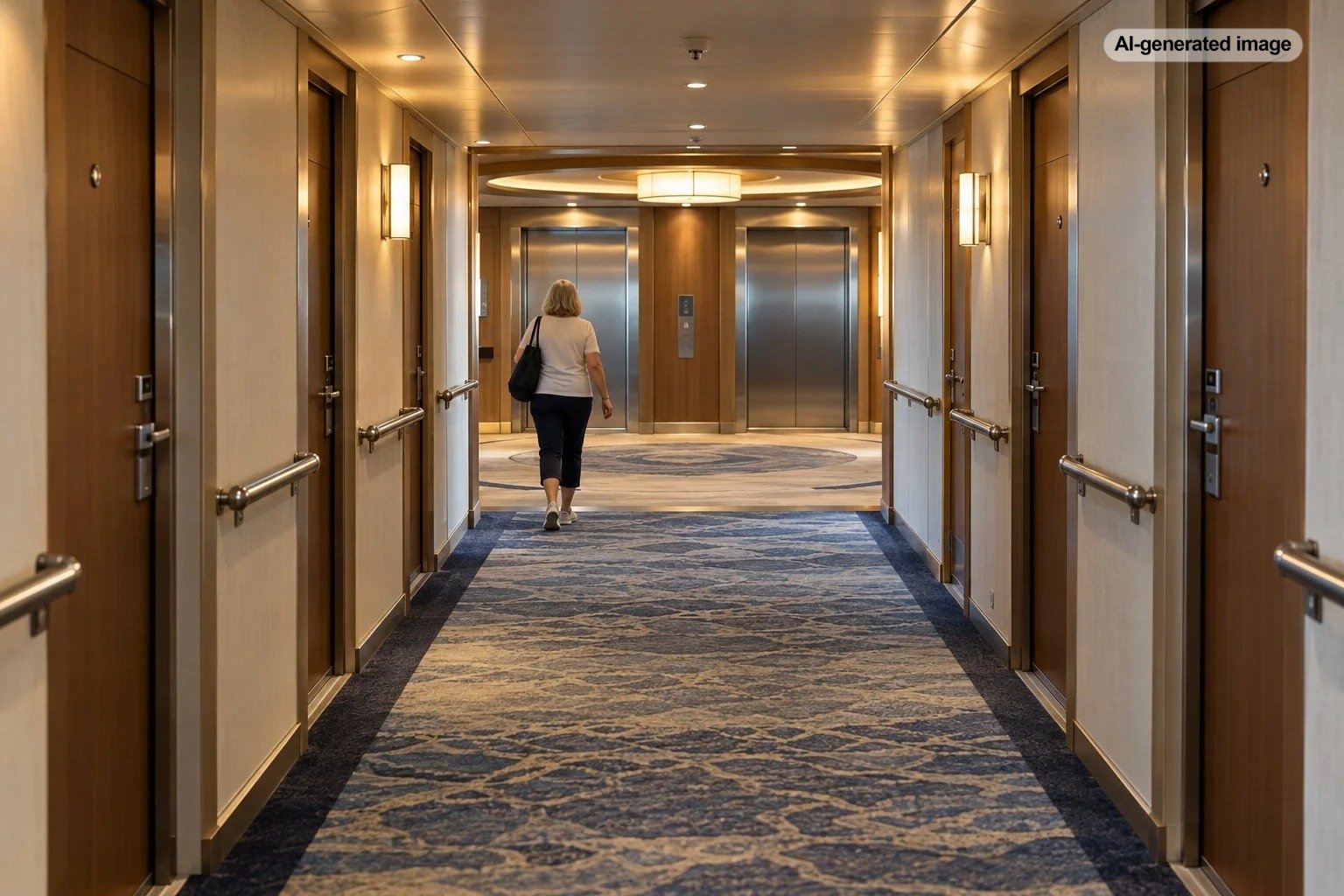
How Far Is Too Far From the Elevators on a Large Cruise Ship?
On a large cruise ship, a cabin at the end of a long hallway can look appealing on the deck plan. It may seem quieter, more private, and comfortably removed from busy public areas. However, that distance feels different when you are returning from dinner, carrying beach bags, or making several trips between your room and the ship’s attractions.
For most travelers, a cabin roughly 5 to 15 doors from an elevator lobby is a practical starting point. Beyond approximately 20 to 30 cabin doors, the walk deserves closer consideration, particularly on a very large ship. These are planning guidelines rather than standardized distances. Cabin spacing, corridor layout, and the location of the actual elevator entrance vary considerably between vessels.
Quick Answer: How Far Is Too Far?
- Within approximately 5 cabin doors: Extremely convenient, especially for passengers who want to minimize walking, although traffic near the elevator lobby may be noticeable.
- Approximately 5 to 15 doors: A useful compromise between accessibility and separation from busy elevator areas.
- Approximately 15 to 25 doors: Often reasonable for active travelers, but potentially inconvenient for frequent trips to the cabin.
- More than 25 to 30 doors: Worth evaluating carefully, particularly for passengers with limited stamina, young children, or mobility concerns.
Door counts are only rough visual estimates. The better question is how long the actual walking route will feel after several trips throughout the day.
Why Elevator Distance Matters More on Large Ships
Modern large cruise ships can have extensive passenger corridors, multiple elevator banks, and public facilities distributed across different parts of the vessel. A cabin that appears relatively central on a deck plan may still be a considerable walk from its nearest elevator entrance.
Passengers rarely make the journey just once. A typical sea day might involve leaving for breakfast, returning to collect sunglasses, visiting the pool, changing for lunch, relaxing in the cabin, and dressing for dinner. Every additional hallway becomes part of that routine.
Consider two hypothetical cabins. The first is a short walk from a midship elevator lobby. The second is at the far end of the same accommodation corridor. Both may offer similar room sizes and amenities, yet the second requires additional walking every time its occupants leave or return.
For an energetic couple who spend most of the day outside their cabin, the difference might be insignificant. For someone managing fatigue or accompanying a child who needs frequent breaks, it can become an important consideration.
How to Judge Distance on a Cruise Deck Plan
A cruise ship’s official deck plan is the most useful starting point. Instead of relying exclusively on cabin numbers or broad descriptions such as forward, midship, and aft, trace the route from the actual cabin door to the nearest passenger elevator lobby.
Count the Doors, Then Examine the Route
Counting cabin doors provides a rough comparison between available rooms on the same ship. However, cabin doors are not evenly spaced, and interior and balcony accommodations may have different layouts. Suites and service spaces can also interrupt the sequence.
Look for corridor turns, cross-passages, and changes in hallway alignment. A cabin that is only a short distance from an elevator shaft on the printed plan might require walking around a block of interior rooms to reach its entrance.
Find the Correct Elevator Bank
Some ships have separate forward, midship, and aft elevator groups. Others have fewer principal banks or unusually positioned public areas.
Do not assume the geographically nearest elevator serves the places you plan to visit most often. Check how the elevator banks connect to restaurants, entertainment spaces, the pool deck, and embarkation areas.
For example, a cabin near the aft elevators may be particularly convenient for an aft dining venue but less useful for a forward theater. The layout matters more than the label attached to the cabin’s location.
Look at Adjacent Decks
The deck immediately above or below your room can be as important as hallway distance. A cabin close to elevators but beneath a busy public venue may not offer the peaceful environment you expected.
Where possible, look for accommodations with passenger cabins above and below. Check nearby stairways, service areas, and public entrances, recognizing that deck plans do not reveal every operational noise source.
Near the Elevators Versus Far Away: The Tradeoffs
Neither location is inherently superior. The right choice depends on your priorities and the configuration of the particular vessel.
| Consideration | Near an Elevator Lobby | Farther Down the Corridor |
|---|---|---|
| Daily walking | Usually less | Potentially substantial |
| Passing foot traffic | May be greater | Often lighter |
| Convenience | Good for frequent returns | Better for travelers who leave for long periods |
| Privacy | Depends on lobby layout | May feel more secluded |
| Mobility considerations | Often preferable | Requires careful evaluation |
One important distinction is that elevator machinery and elevator-area activity are not necessarily the same noise issue. On many ships, nearby conversations, passing passengers, and stairwell traffic are more relevant than mechanical elevator sounds. Actual noise exposure depends on the ship’s construction and corridor design.
Who Should Prioritize a Short Elevator Walk?
Passengers With Limited Mobility or Stamina
Travelers who use mobility aids, experience fatigue, or have difficulty walking long distances should consider elevator proximity an important booking criterion.
However, proximity alone is insufficient. A passenger using a wheelchair or scooter also needs to consider accessible cabin features, corridor clearances, turning space, and accessible routes. These requirements should be confirmed directly with the cruise line before booking.
Families With Young Children
Families often make more frequent cabin visits than they originally anticipate. Forgotten items, naps, clothing changes, and tired children can turn a distant cabin into a recurring inconvenience.
A location within a manageable walk of elevators can simplify the day, although parents may prefer a cabin slightly removed from the busiest lobby.
Travelers Who Return to Their Cabins Frequently
Some passengers treat their cabin as a convenient retreat. They may return several times for reading, medication, changing clothes, or simply enjoying a private balcony.
For these travelers, the additional walking imposed by a remote cabin may matter more than it would for someone who leaves after breakfast and stays out until evening.
When a Cabin Far From the Elevators Makes Sense
A distant cabin is not automatically a poor choice. In some situations, its advantages outweigh the inconvenience.
Travelers who value a quieter hallway may appreciate accommodation farther from major passenger circulation points. Less through-traffic can contribute to a more secluded atmosphere, although nearby service doors, crew areas, and public facilities still deserve attention.
Similarly, a particular balcony position, suite layout, or preferred view may justify extra walking. Some passengers deliberately choose forward or aft accommodations for their location or outlook.
The strongest reason to accept a longer walk is a specific feature you value, not simply the assumption that the end of a corridor must be better.
Remember That Midship and Near the Elevators Are Different Things
Midship cabins are frequently recommended because their position near the vessel’s center can reduce the sensation of certain ship movements compared with locations toward the bow or stern. Lower decks can also appeal to passengers concerned about motion.
However, being midship does not necessarily mean being close to an elevator. On some ships, the elevator banks are positioned away from the precise center of the vessel.
A midship cabin between two elevator groups may involve more walking than a slightly forward or aft cabin immediately beside a passenger elevator lobby.
For motion-sensitive travelers, this creates a genuine tradeoff: a more central cabin position may take priority over the shortest elevator walk. For travelers concerned primarily with physical accessibility, the opposite may be true.
What Travelers Often Overlook
Elevator Waiting Time Is Separate From Walking Distance
A cabin close to elevators does not eliminate waiting, especially when passengers are moving between decks for dining, entertainment, or port activities. An elevator bank may be convenient geographically yet busy at certain times.
Guests comfortable using stairs occasionally may gain additional flexibility, but stairs should never be assumed to be a suitable alternative for everyone.
Cabin Categories Can Limit Location Choices
Not every cabin category is distributed evenly across a ship. A preferred balcony type, connecting room, accessible cabin, or suite may be available in only certain areas.
Rather than choosing a location first and discovering that the desired accommodation is unavailable, compare both cabin characteristics and placement together.
Guarantee Cabins Reduce Location Control
Some booking arrangements allow the cruise line to assign the specific cabin later. Such arrangements may offer a different pricing proposition, but they can limit your ability to choose elevator proximity.
If location is essential for comfort or mobility, review the assignment conditions carefully before selecting this type of booking.
Distance Matters More Over a Longer Cruise
An additional walk that feels trivial on embarkation day may become more noticeable across a longer sailing. Consider your likely daily routine, the number of sea days, and whether your itinerary involves physically demanding shore excursions.
After a full day exploring a port, a remote cabin can seem much farther away than it did during the initial ship tour.
A Practical Way to Choose Your Cabin Before Booking
Start by identifying two or three acceptable staterooms in your preferred category. Use the ship’s official deck plan to compare their distances from passenger elevators, the placement of adjacent public spaces, and nearby corridor intersections.
Then consider how you expect to use the ship. Will you spend most of your time near the pool? Do you plan frequent cabin breaks? Are you sensitive to motion? Is hallway quiet more important than minimizing walking?
For a traveler who expects to make numerous cabin visits, the closer room may provide meaningful everyday convenience. Someone prioritizing privacy or a particular view may be happier accepting a longer walk.
If you are still choosing your ship or sailing, you can compare available sailings and then evaluate the official deck plan for each vessel before selecting a stateroom.
When deciding between otherwise similar rooms, consider asking the cruise line or a knowledgeable travel advisor about the actual walking route rather than relying on an approximate deck-plan measurement.
Frequently Asked Questions
Is It Noisy to Stay Right by a Cruise Ship Elevator?
Not necessarily. Elevator lobby design, cabin-door placement, and passenger traffic all influence noise. A cabin directly beside a busy lobby may experience more conversations and passing footsteps, but some elevator-adjacent rooms can be reasonably quiet.
How Many Cabins Away From the Elevator Is Ideal?
Approximately 5 to 15 cabin doors is a practical starting point for many travelers, but there is no universal ideal. The actual walking route and your individual mobility needs matter more than the door count.
Are Cabins at the Very End of a Cruise Ship Hallway Bad?
No. They may appeal to travelers seeking less passing traffic or a specific cabin location. Their principal disadvantage is potentially longer walking distances, and they are not guaranteed to be quieter.
Should Older Travelers Always Book Near an Elevator?
Age alone does not determine the best location. Walking ability, stamina, personal preference, and any accessibility requirements are more useful considerations. Travelers who want to limit daily walking will generally benefit from a convenient elevator location.
Is It Better to Be Midship or Near an Elevator?
For passengers particularly sensitive to ship motion, a more central location on a lower deck may be preferable. For passengers who need shorter walking routes, elevator proximity may be the higher priority. When possible, choose a cabin that offers a reasonable balance of both.
The Best Distance Is the One That Fits Your Routine
There is no universally correct number of feet or cabin doors separating a cruise stateroom from the elevators. A distance that feels effortless to one passenger may become frustrating to another, especially over a week of frequent trips.
For most travelers, choosing a cabin a modest distance from the nearest elevator lobby offers a sensible balance of convenience and privacy. Those with limited mobility or frequent cabin needs should lean closer, while guests prioritizing seclusion or a special cabin position may accept a longer walk.
The most useful booking habit is simple: inspect the actual ship’s deck plan, trace the walking route, and evaluate how that location will work during an ordinary day onboard. A comfortable cruise cabin is not just about what is inside the room. It is also about how easily you can reach it.