Hotel Suite vs. Two Adjoining Rooms for a Family: Which Is Better?
For most families, a hotel suite is the simpler choice when the children are young, the stay is short, or parents want everyone behind one entry door. Two adjoining or connecting rooms are often better for families with older children, longer stays, competing sleep schedules, or a strong need for privacy and an additional bathroom.
The best option is not determined by square footage alone. Door configuration, bedding, bathroom access, supervision, hotel terminology, and the property’s occupancy rules can matter more than the room category printed on the booking page.
Quick answer
- Choose a suite for younger children, easier supervision, shared family time, and fewer concerns about room separation.
- Choose two connecting rooms for older children, two bathrooms, greater privacy, and separate sleep schedules.
- Do not assume adjoining means connecting. Adjoining rooms may simply be near each other, while connecting rooms generally have an interior door between them.
- Compare the actual layouts. Some suites are large open rooms with a sofa bed, while others include a genuinely separate bedroom.
- Confirm arrangements directly with the hotel. Room placement and connecting-door requests may not be guaranteed solely because they appear in a reservation note.
Hotel suite vs. two rooms at a glance
| Consideration | Hotel suite | Two connecting rooms |
|---|---|---|
| Supervision | Usually easier, especially with younger children | Better suited to children old enough for more independence |
| Privacy | Varies considerably by layout | Generally stronger, with separate bedrooms and entrances |
| Bathrooms | Often one, but layouts vary | Typically one per room |
| Sleep schedules | Good only when the sleeping area is truly separate | Usually better for different bedtimes and early risers |
| Booking certainty | One room category can be easier to reserve | Connecting placement may require additional confirmation |
| Family gathering space | Often includes a sitting area | May lack a shared living space |
When a hotel suite is the better choice
A suite is usually the more comfortable arrangement for parents traveling with babies, toddlers, or elementary-age children who need close supervision. Everyone remains within one primary accommodation, and parents do not need to manage two hallway doors, two sets of keys, or children moving between rooms through a public corridor.
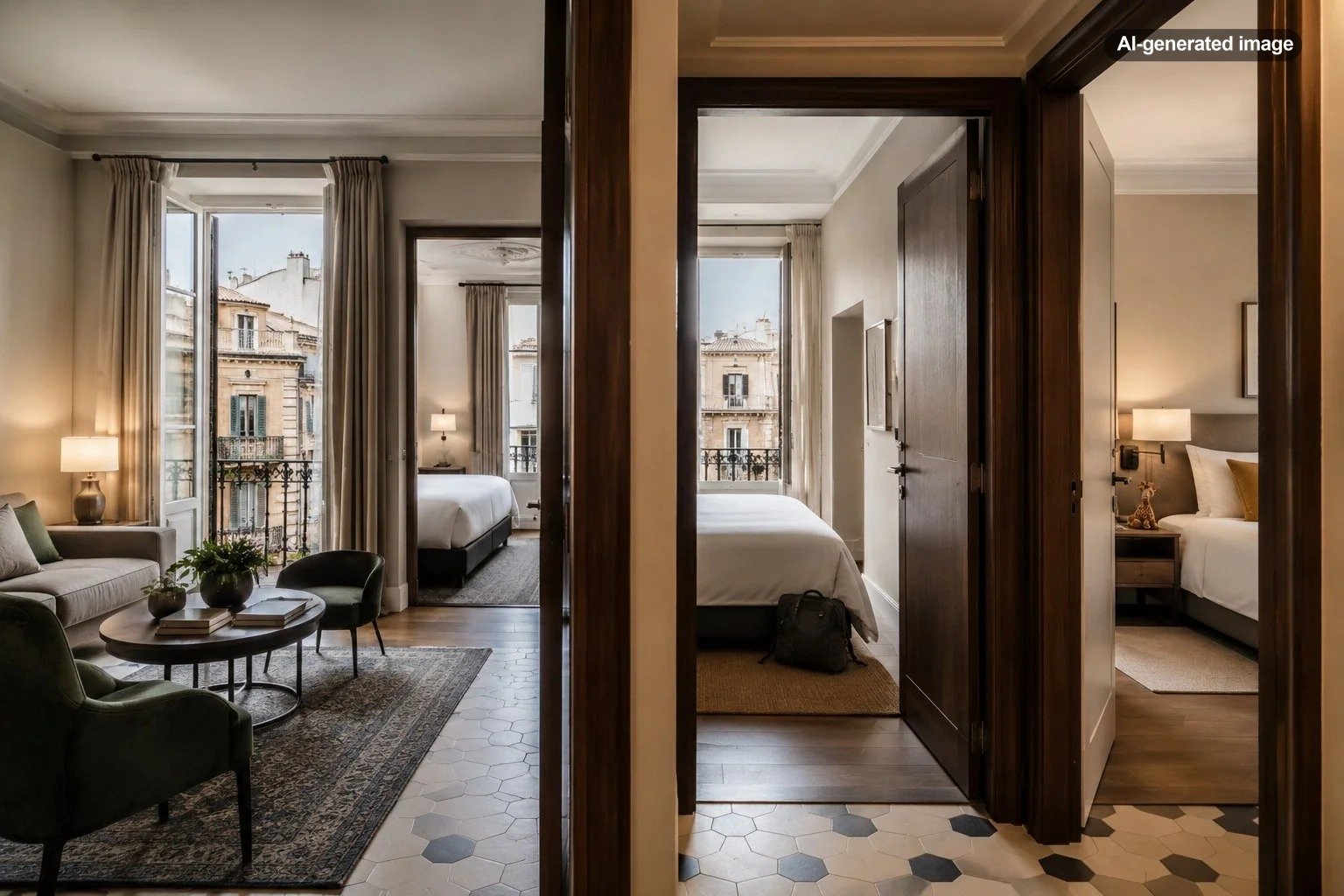
The strongest suite layout has a bedroom separated from the living area by a full door. That distinction matters after bedtime. Parents may be able to talk, watch television quietly, prepare for the next day, or order food without sitting silently in a darkened room.
However, the word suite does not always mean multiple rooms. A studio-style suite may be one large space containing beds and a seating area. It can provide more floor space without providing meaningful sound separation. Families should examine the floor plan, room description, and bedding configuration rather than relying on the category name.
Suites are particularly useful for:
- Parents who want children close throughout the night
- Families staying for only a few nights
- Trips involving naps or early bedtimes
- Families that value a shared sitting or dining area
- Travelers who prefer managing one reservation and one room entrance
When two connecting rooms are the better choice
Two connecting rooms can make a family trip substantially easier when children are teenagers, relatives are traveling together, or adults and children keep different schedules. Closing the interior door creates privacy while preserving convenient access between the rooms.
The second bathroom is often the decisive advantage. Morning showers, bedtime routines, and preparation for an event can move much faster when the family is not waiting for one sink and one shower. Two rooms may also provide more conventional beds, more storage, and a second television.
This arrangement can be especially valuable on a longer trip. After several days, the ability to separate quiet time, work calls, entertainment, and sleep may be more useful than a suite’s common sitting area.
The main drawback is uncertainty. A hotel may treat connecting rooms as a request rather than a guaranteed room configuration, particularly when reservations are made under separate confirmation numbers. Families should ask whether the connecting arrangement is guaranteed, request that both rooms be linked under the same reservation profile, and confirm the request again before arrival.
Connecting rooms are particularly useful for:
- Families with teenagers or responsible older children
- Parents who want a separate bedroom
- Travelers who place a high value on two bathrooms
- Longer stays where personal space becomes more important
- Families with different wake-up, nap, or bedtime schedules
Adjoining and connecting are not always the same
This terminology is one of the most important details to clarify. In common hotel usage, connecting rooms have an interior door that allows guests to move between rooms without entering the hallway. Adjoining rooms may be next to each other, across the hall, or simply located nearby.
Usage can vary by property and booking platform, so the safest approach is to ask a precise question: Do the rooms have a private interior connecting door? A vague request for rooms together may not produce the arrangement a family expects.
Parents should also consider whether they would be comfortable with the children occupying a room that can only be reached through the corridor. If not, connecting rooms or a properly divided suite should be treated as essential rather than optional.
Compare sleeping arrangements, not just capacity
A room may technically accommodate a family without offering comfortable beds for everyone. A suite that sleeps six could rely on a sofa bed, bunk beds, or rollaway arrangements. Two standard rooms may provide more permanent beds, but the exact configuration can vary.
Before booking, identify who will sleep in each bed and whether the proposed arrangement works for the entire stay. A sofa bed that seems manageable for one night may be less appealing during a weeklong trip. Families should also verify maximum occupancy and any property-specific rules regarding children, cribs, rollaways, or additional guests.
Which option is likely to cost less?
Neither setup is consistently less expensive. A suite can carry a premium because of its size, separate living area, location, or additional features. Two rooms can cost more because the family is purchasing two complete accommodations, but they may also offer better value when they include more beds and two bathrooms.
Compare the full stay rather than the headline room rate. Taxes, mandatory property charges, parking, breakfast arrangements, and cancellation terms can affect the practical difference. Also consider whether the suite reduces the need for two rooms but requires paid breakfast for additional guests, or whether two rooms include separate benefits under the booked rate.
Affiliate disclosure: HotelInfo.com may earn a commission when you book or purchase through links on this page. This does not affect the price you pay. Learn more.
Travelers who are still comparing layouts can browse family-friendly hotels on Hotels.com, then verify the specific room configuration and connecting-room policy directly with the selected property.
What families often overlook
The location of the suite bedroom
A separate bedroom is less useful when everyone must walk through it to reach the bathroom or exit. Review the layout carefully when privacy is a priority.
Interior-door security
In connecting rooms, determine how the interior doors lock and whether younger children can operate them. Families may prefer to keep both sides open while everyone is awake and secure the arrangement according to the hotel’s instructions at night.
Noise between rooms
A connecting door can transmit more sound than a solid wall. This may matter when one room is intended for sleeping children and the other for adults who plan to stay awake.
One reservation versus two
Two rooms booked through different channels or under different names may be harder for the hotel to coordinate. Keeping the reservations linked and documenting the connecting-room request can reduce confusion, although it does not create a guarantee unless the property explicitly provides one.
Emergency planning
Families should decide which adult is responsible for each child and make sure older children know the room numbers, meeting plan, and appropriate way to contact a parent. This is useful even when the rooms have an interior door.
A practical decision rule
Choose a one-bedroom suite when close supervision and a shared living area matter most. Choose two guaranteed connecting rooms when privacy, real beds, and two bathrooms matter more. If the rooms are only adjoining, decide whether hallway separation is acceptable before treating them as a substitute for a suite.
For many families, the children’s ages provide the clearest answer. Younger children generally make a suite more practical. Older children and teenagers often make connecting rooms more comfortable. The final choice should be based on the actual floor plan, not the room label.
Frequently asked questions
Is a suite always one bedroom plus a living room?
No. Some suites have a separate bedroom, while others are open-plan rooms with additional seating or a sofa bed. Check whether a full door separates the sleeping and living areas.
Can a hotel guarantee connecting rooms?
Policies vary. Some properties sell a confirmed connecting-room category, while others record the arrangement only as a request. Ask the hotel how the booking is classified and whether the connection is guaranteed.
Are adjoining rooms safe for children?
The answer depends on the children’s ages, maturity, room placement, and the family’s comfort level. Adjoining rooms without an interior door require guests to enter a shared corridor to move between rooms.
Do two rooms usually provide more space than a suite?
Not necessarily, but two rooms often provide more separate sleeping space and an additional bathroom. A large suite may offer more shared living space. Compare listed dimensions and floor plans when available.
What should families confirm before arrival?
Confirm the bedding, maximum occupancy, number of bathrooms, presence of a fully closing bedroom door, and whether connecting rooms are guaranteed. It is also sensible to verify that both reservations are linked when booking two rooms.