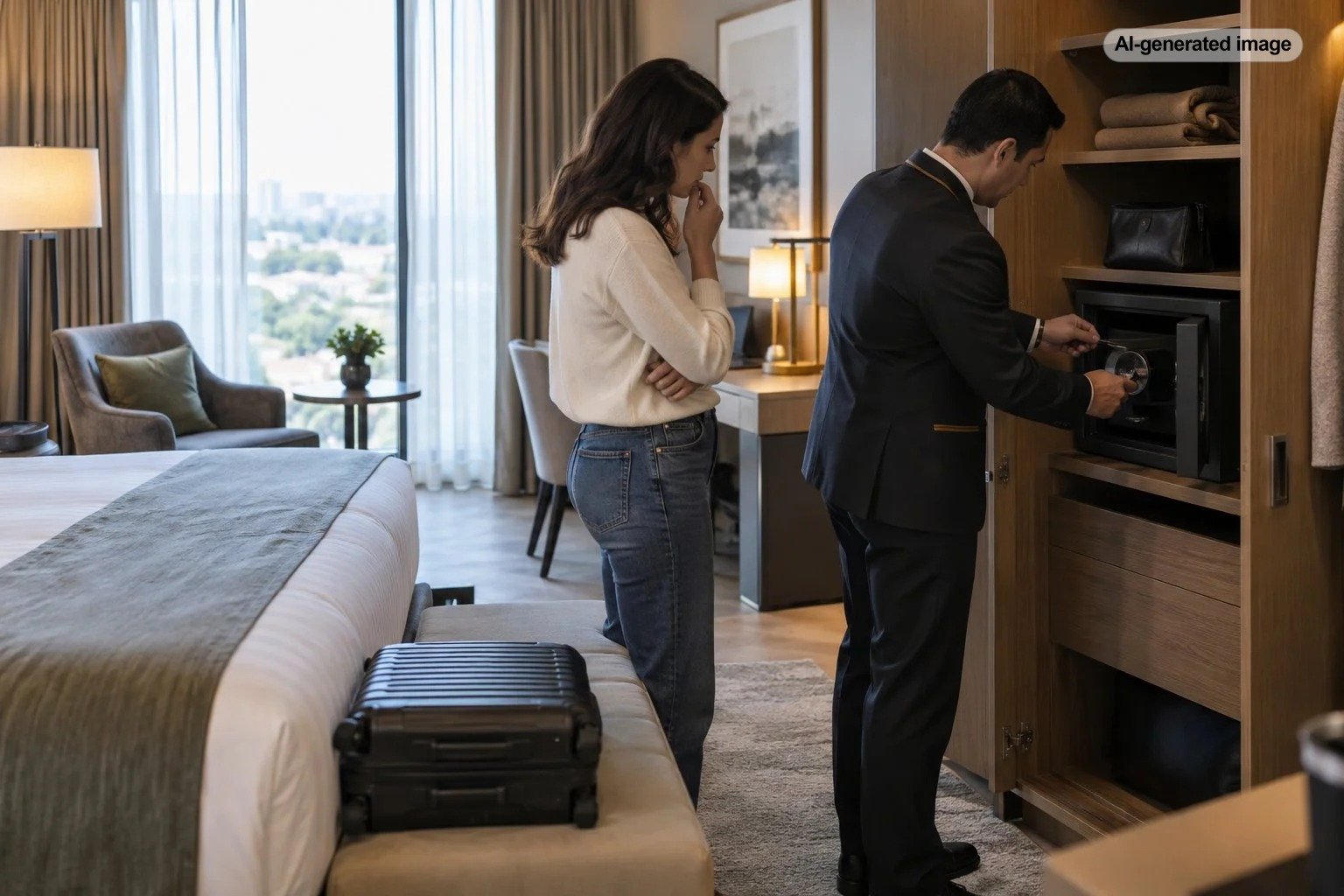
Can Hotel Staff Open Your Room Safe If You Forget the Code?
Yes, hotel staff can often help open an in-room safe when a guest forgets the code, although the exact process depends on the safe and the property’s procedures. Hotel safes are commonly designed with controlled emergency-access methods so an authorized employee can assist when a guest is locked out, the batteries fail, or the electronics malfunction.
That does not necessarily mean every front-desk employee can simply enter a universal code. Modern hotel-safe systems can use management devices, temporary or master codes, mechanical override keys, or combinations of those methods. Access may also be limited to designated managers, security personnel, or engineering staff.
Quick answer
- Many electronic hotel safes include an emergency-opening method available to authorized hotel personnel.
- The hotel may need to confirm that you are the registered guest before opening the safe.
- Depending on the equipment, staff may use a management device, controlled override code, or mechanical override key.
- Some systems create an audit record showing when an override was used and, in certain systems, which authorized employee performed it.
- Procedures vary by property, so contacting the front desk is usually the appropriate first step.
How hotel staff can open a locked room safe
Electronic safes intended for hotels are generally built differently from a simple consumer lockbox. Because guests can forget codes, batteries can become depleted, and electronic components can fail, manufacturers may provide hotels with one or more emergency-access options.
Safemark, a manufacturer of hotel safes, describes an Emergency Handheld Override used by authorized personnel on several of its safe models. Its systems can maintain an audit trail that records events such as safe openings, override openings, and the identity of authorized staff members involved. Safemark also offers high-security mechanical override options on certain models.
Other hotel-safe systems use different approaches. Omnitec, for example, lists emergency-opening methods that can include master codes, mechanical keys, management controls, or single-use codes generated specifically for emergency access. This illustrates why the process you encounter at one hotel may be quite different from the process at another.
Why there is an override in the first place
An emergency override is not merely a convenience for forgetful travelers. Hotels need a controlled way to deal with several predictable problems.
You forgot the code
This is the most straightforward situation. You entered a personal code when locking the safe but cannot remember it later. Repeatedly guessing may not help and, depending on the model, could trigger a delay or other security behavior. Calling the front desk is usually more practical than continuing to experiment with the keypad.
The batteries are depleted
Many room safes operate on batteries. Some hotel-safe systems provide a way for authorized staff to supply temporary external power or otherwise access the unit when its normal battery power is unavailable.
The electronics malfunction
A keypad, motor, display, or other component can occasionally fail even when the guest knows the correct code. Mechanical overrides and dedicated management tools provide another route into the safe without relying entirely on the guest keypad.
Will any hotel employee be able to open it?
Not necessarily. A hotel can restrict safe-opening tools or credentials to particular employees. Safemark states that access to its password-protected override system is limited to personnel designated by management. That type of control helps distinguish legitimate guest assistance from ordinary room access.
In practice, this means the employee at the front desk may arrange the assistance rather than personally open the safe. A manager, security employee, maintenance technician, or another authorized staff member may need to come to the room. The precise job title and verification procedure are property-specific.
What to expect when you ask for help
Start by calling or visiting the front desk and explaining that your in-room safe is locked and you cannot open it with your code. Be prepared for the hotel to verify your connection to the room before providing access. The exact verification steps are determined by the property.
An authorized employee may then need to meet you at the room. Depending on the installed safe, that person might connect a management device, enter a controlled emergency credential, use a high-security mechanical key, or follow another manufacturer-approved procedure.
You should not assume that the hotel can tell you what your forgotten guest code was. Emergency access is generally about opening the safe through a separate authorized method, not recovering your personal code from the keypad.
Does an override make a hotel safe insecure?
The existence of an override does not, by itself, indicate that a safe is poorly designed. A hotel needs some form of contingency for forgotten codes and equipment failures. The more useful question is how that emergency access is controlled.
Security-oriented hotel-safe systems may use password-protected management tools, property-specific keys, limited-duration or single-use emergency codes, and electronic audit trails. For example, Omnitec describes models capable of generating a random single-use emergency code, while Safemark describes systems that record override events and the authorized staff member involved.
Those features do not make every hotel safe equivalent, nor do they guarantee how a particular property manages access. Hotels use many safe models and operating procedures. Travelers should therefore treat an in-room safe as one layer of protection rather than assuming that every unit offers the same security characteristics.
What travelers often overlook about room safes
It is worth checking the safe before placing something urgently needed inside. Confirm that the keypad responds normally, the door closes smoothly, and you understand the locking procedure shown on the safe or in the room instructions. After setting your code, verify that you can reopen the safe before storing passports, medication, keys, electronics, or other items you may need on a schedule.
If the display indicates a low battery, the buttons are unreliable, or the locking mechanism behaves unexpectedly, contact the hotel before relying on the safe. Do not attempt to pry open the door, dismantle the keypad, or force the mechanism. Apart from potentially damaging hotel property, doing so can make a simple lockout considerably harder to resolve.
If you are checking out soon, allow some extra time for assistance. The employee authorized to open safes may not be standing at the front desk, and resolving the issue can require a visit to your room.
Frequently asked questions
Can the front desk give me a universal hotel safe code?
You should not assume that a universal guest-access code exists or that front-desk employees have one. Hotel-safe designs vary, and emergency access may require a management device, controlled credential, mechanical key, or another restricted procedure.
Can staff open the safe if the batteries are dead?
Many hotel-safe systems are designed with contingency methods for power problems. Depending on the model, these may include an external power source, management control, mechanical key, or another emergency-access method.
Will opening the safe erase my belongings or damage the safe?
A normal authorized override is intended to provide access without forcing the safe. The exact behavior depends on the model, so hotel staff should follow the procedure intended for the installed equipment.
Can the hotel see when the safe was opened?
Some hotel-safe systems maintain audit histories. Safemark describes models that record locking, opening, and override events, while Omnitec offers models with electronic audit capabilities. Whether those records are available at a particular hotel depends on the safe model and how the property manages it.
What should I do first if I forget the code?
Stop guessing if the safe is not responding as expected and contact the front desk. Explain that you are the guest assigned to the room and need assistance opening the safe. The hotel can then follow its own identification and emergency-access procedure.